Latest Comments

Guest - Aislinn Dyestuff Citizen Science.
09. Oktober 2026
This is a great project. I look forward to the results. Thanks for letting us know.
Guest - Aislinn Time for...
09. Oktober 2026
Looks delicious!
Guest - Katrin Sprang Discussion
18. September 2026
Hi Rachel, I have looked for more photos of you, but that was not very successful. I found a link on...
Guest - Beatrix Sprang Discussion
15. September 2026
That lozenge pattern element is not a photograph, but a scan. So it should be to scale. But I pinned...
Guest - Katrin Sprang Discussion
15. September 2026
I was not referring to Rachel's reconstruction (is the reconstruction you refer to the one photograp...
NOV.
29
0

I made things red!

When people asked me if I did dyeing, too, my usual answer is something along the lines of "no, I don't - there's no reason why I should do everything, and I have wonderful colleagues I can hire for that".

However... I have peeked in a lot of pots when my colleagues were dyeing. I have been enjoying their lovely colours for ages. I learned a lot about what to use, and in what concentration, and in what sequence, when we were discussing colour choices for museum reconstruction projects.

And starting with the dyeing experiment in 2012, I also got to stir some pots with dye myself... all on my own. Now, for the dyeing experiment, you don't need to know how to dye. You just need to follow the recipe to the last letter - so all the creativity that is part of "real" dyeing work is gone. It's not even a big deal if there are spots on the yarn, because it is not about spotless dyeing, it is about finding out about the influence of metals.

Playing around, creatively, with colours, though - that does also appeal to me. Enter opportunity for that: after the last Forum, there was some madder left over, and some alum. That madder was already soaked (and had started to slightly ferment), so it was about time to be used.

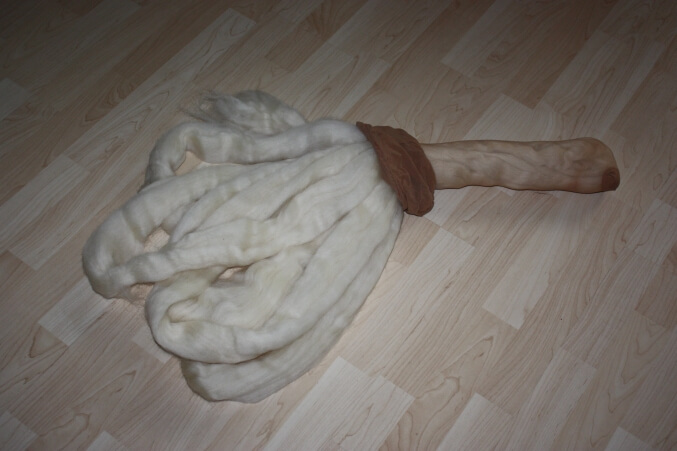
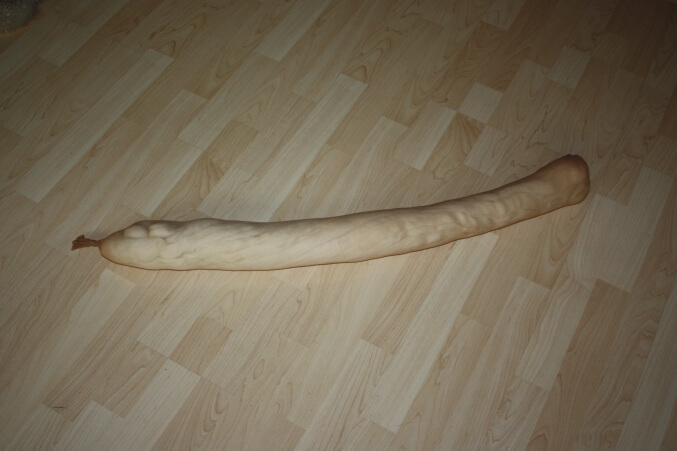
And since I had decided to play around, I did exactly that. I stuffed Romney top into a stocking leg (to cut down on madder particles in the fibre, and on felting), and off it went into the mordant.
IMG_1526IMG_1528
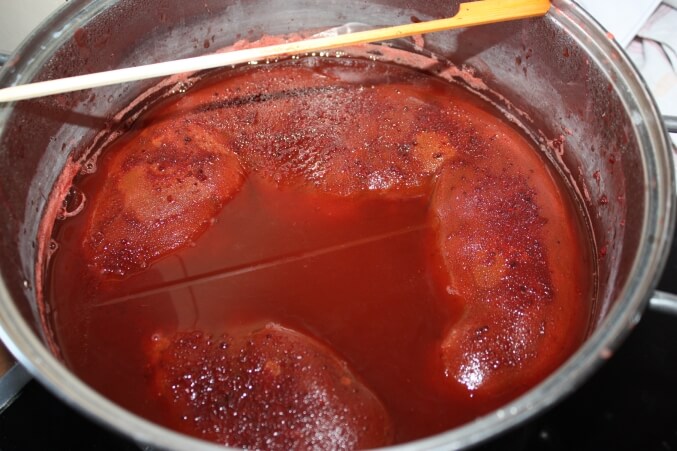
After mordanting, it took a nice bath in the madder liquid...
IMG_1529
... but came out rather splotchier than hoped for, due to the middle of the stocking leg filling being rather compressed. Now I don't mind splotchy (in modern stuff, not the historical, mind you) - but the light spots seemed almost undyed, and that was too much (or too little) for my taste.

So I stuck it in again, sans the stocking leg this time (which was, instead, used to hold the madder sludge).
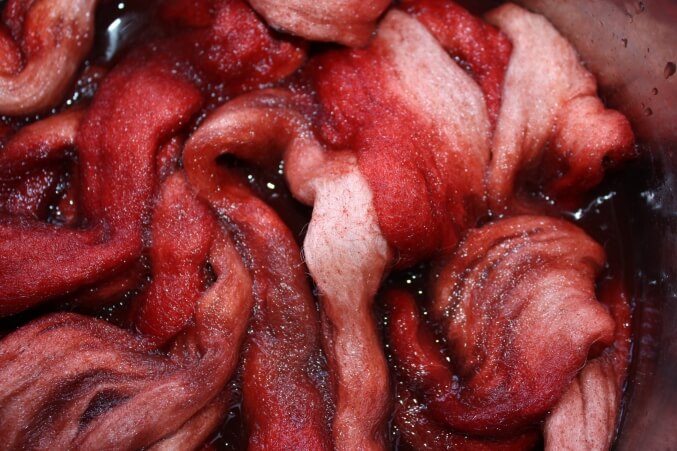
IMG_1538
The end result is rather nice, I think:
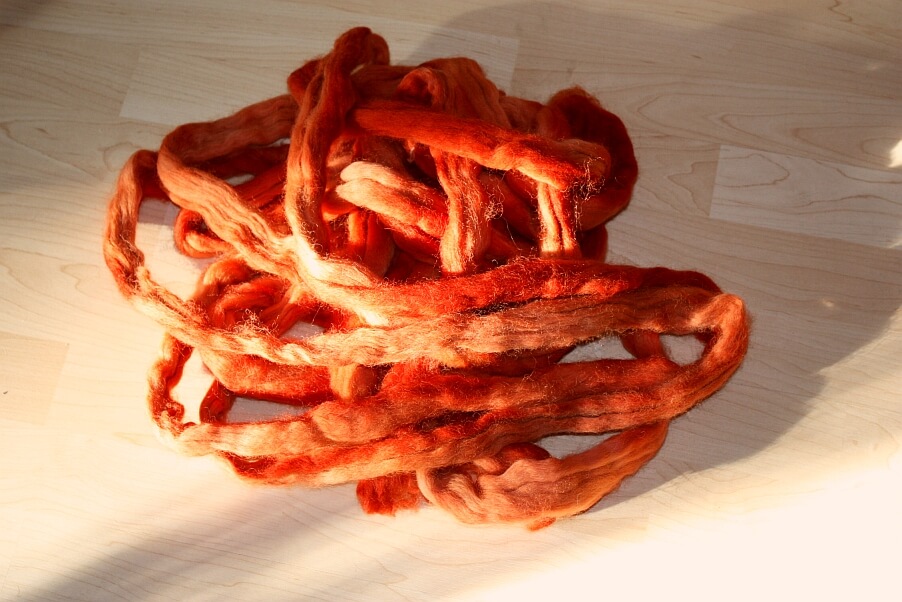
red_romney
It is a warm, bright red that is hard to photograph. And of course it is full of madder dust, but that just can't be avoided when dyeing with that stuff.

So at some point in the medium future, there might be some madder spinning in store for me...
0
NOV.
28
0

Need some editing done?

Today's blog post is different - but in case you need some editing done, it is hopefully also helpful:

My friend and co-author Gillian Polack, known for a list of books both fiction and non-fiction, has an unexpected opening in her schedule... and she is thus taking on editing work (which she normally doesn't). This will be possible until February 2017, so it's sort of a special offer.

I've had the pleasure of working together with Gillian with her editor's hat on, so I know that she does a very good (and very thorough) job.

In a similar vein, if you would like her to give you private consultation for your writing, or research, that would be possible per chat (or, I guess, if you're in Australia or willing to travel there, it might even be possible in person).

If you are interested, you can reach Gillian via this contact form on her website - she'll give you her rates for the job you are asking for, and you can discuss details with her, too.
0
NOV.
24
1

And still more links.

I'm almost through the incredible link backlog - so here's the last drop for now:

If you are looking for a new way to practice your early Mesopotamian writing skills, you might want to bake some cuneiform cookies.

Here's an article about the sequence of adjectives in English - a "crazy grammar rule".

A list of sheep breeds (though there's not much information about many of them, especially not much information about the wool).

Speaking of wool, Hakai Magazine has a nice article about the importance of wool for the vikings.

Jonathan Jarrett has posted a book review about "Debunking History" by Ed Rayner and Ron Stapley.

And that finally clears my list. I hope there was something enjoyable among the links for you!
0
NOV.
23
0

And even more links!

Continuing from yesterday, for your amusement wants and procrastination needs - more links! To things!

The Atlantic has a piece about how the current incentives and structures make science worse, not better - The Inevitable Evolution of Bad Science.

Textilis has a post about Appliqué embroideries on medieval textiles.

If you're looking for a bit more to read, Isabella von Holstein's thesis "A light stable isotope (C, N, H, O) approach to identifying movement of medieval textiles in North West Europe" is available online here.

A Scottish lacemaking company is using modern computer technology to keep their looms running - CAD instead of punch cards.

If all that makes you want a sonic screwdriver, here's a knitting pattern for one. Functionality not guaranteed - unfortunately!
0
NOV.
22
0

Link drop.

Can you guess what has accumulated during the last two weeks? Right. Links. Lots and lots of links about various topics... which means my browser has so many tabs open right now that it even scares me (and I'm nigh-undauntable by lots of open tabs).

So, here you go, in no particular order whatsoever:

A (short) history of pockets in women's clothing.

What archaeologists say about Trump's election. (Text of the post on Archaeologik is in German, but the links point to English pages.)

A 3D-Model of the medieval mikvah in London.

Aarhus Uni Press has Danish Medieval Castles as their free e-book of the month.

The Importance of Being Scared: An article about fairy tales and fear.

And that's it for today - more linky things tomorrow!
0
NOV.
21
0

Settling in, winding down.

I'm settling in again, and starting to take care of all the things that should be dealt with before the year ends - getting the last of the madder roots out of the soil is on the list for right after this blogpost, as the weather is okay at the moment. There's also some sorting and de-cluttering going on, mostly on the computer (it's amazing how backup files can add up and multiply, with several duplicates in some cases).

The cat is happy again, as her bad paw has healed and she is allowed to roam outside again. The Most Patient Husband of Them All and I have celebrated our wedding anniversary this Sunday, with a nice little hike in the sunshine and lovely cake and coffee afterwards. The bills are paid, my sleep deficit is about gone, and it feels really, really good to be home again, and get on top of things again.

Time to take care of all that stuff that has been postponed, and get the stock sorted out and stuff re-ordered. There's some editing work waiting, the Forum results to sift through and get ready to write them up, so it doesn't look like it will be boring anytime soon. It is also the time of the year to start planning for the next one. And, of course, it is the season to start baking Christmas cookies - something I'm really looking forward to!
0
NOV.
01
0

Spinning Demonstration on the Great Wheel.

First of all, sorry for the blog silence yesterday - I was away from the computer most of the day, and during the time I did spend physically close to it, we had internet connection issues. These do happen here occasionally, and they are normally no big deal when they do, as they will be over after two or three hours at most... but yesterday, it did mean no access during the time window I had for blogging.

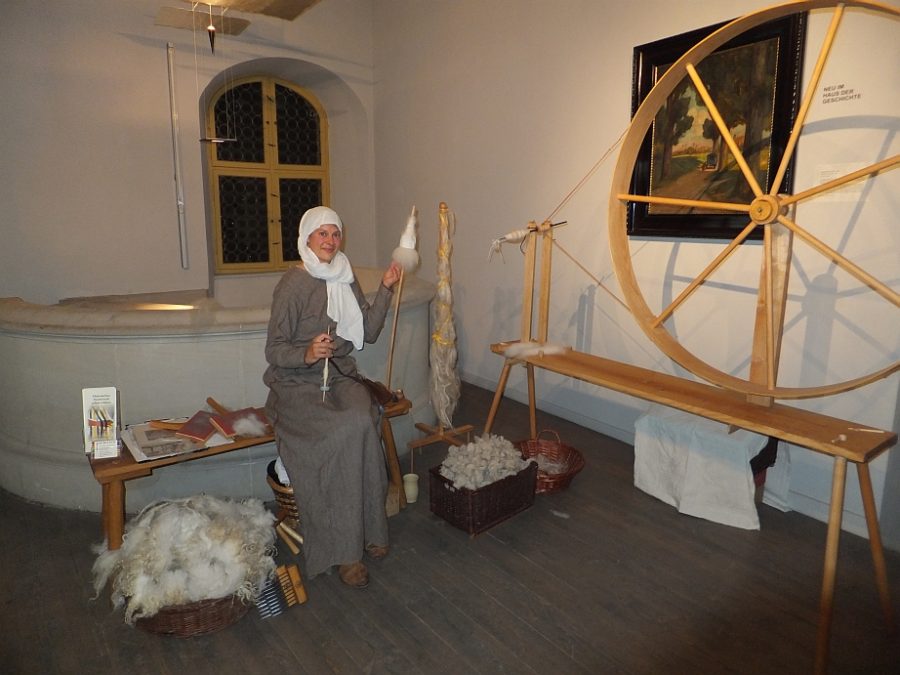
Today is a holiday in Germany, so I had planned to blog yesterday and tell you there'd be no blog post today. Well, plans and how they work out... anyway, this means you are getting this picture today instead of yesterday:

dinkelsbuehl
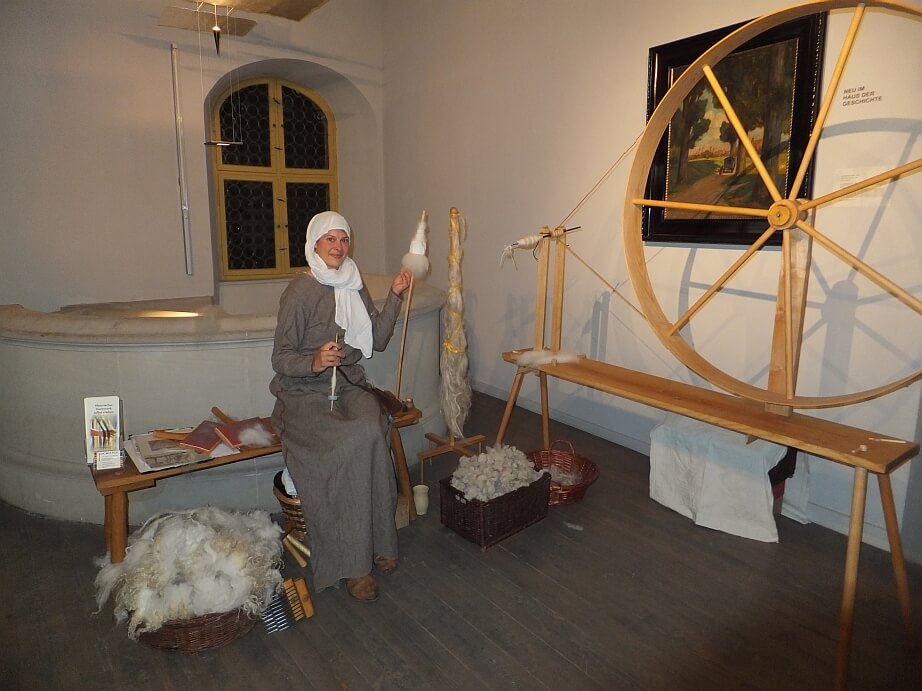
That was my setup on the Long Night for spinning in Dinkelsbühl. It was a wonderful evening with many, many people stopping by for watching the spinning and asking questions. The picture was taken during one of the rare and short moments when there were no visitors there, right at the end of my presentation.

Time really flew by, and the evening was over before I knew it! I loved all of it, and it gave me the opportunity to demonstrate how much of a difference the fibre and the fibre preparation made when spinning on the Great Wheel. I had rolags made from Eider wool (industrially combed, smooth medium-staple wool that I just rolled together with the cards), from Bergschaf wool (industrially carded, crimpier wool with a shorter staple that I rolled together with the cards similarly to the Eider stuff) and from Rouge de Roussillon wool that I carded up from the washed fleece myself. The differences were astounding, with the smoothest, most even thread coming out of the Eider wool and the clumpiest, least even one out of the Rouge. That was partly due to my bad sorting and carding of the Rouge fleece I brought with me, though, and I am sure that with a bit more getting used to that specific fibre, the thread would also have improved a lot.

Demonstrations like these always yield some thread, but they rarely result in wheel spinning output that I'd find acceptable or even good quality. Talking to people to explain the spinning takes away some concentration from the spinning itself, and while I can happily chat along when making my standard yarn on the spindle and distaff, the wheel does take more concentration for me to get a good thread. Another factor is the quality of the rolags that I work with during those demos.

Even though I explain to people during these demonstrations that textile work takes time, and patience is oh so important, I usually skimp on the preparation of the rolags to speed things up a bit. I also make a rolag or two, then spin them up, then explain something else, then make rolags again - and that results in differences each time, which also has an impact. Finally, the combination of explaining and trying to show off the spinning speeds possible with the wheel means I'm not making the best possible thread out of the fibre I have, and switching frequently between spindle and wheel plus carding and combing means it is hard to find the rhythm and workflow for any of these tasks - because obviously, explaining and demonstrating the individual steps and how they work together is much, much more important on these events than making the best yarn possible.

So in case you are at a crafts demonstration one day and have somebody demo-ing with a lot of explanation, you might get to see slightly sloppier work than they normally do, because the priorities have shifted - from working towards the best result possible with the tools and materials available to giving the best explanation and demonstration for you. And that, I'd say, is one of the best reasons that somebody can have for not working up to the usual standards!
0

By accepting you will be accessing a service provided by a third-party external to https://www.pallia.net/

Kontakt