Beatrix' comment to yesterday's blog post merits an answer. I was originally planning to do that in the comment section, but it is a little too long for that, and I ended up wanting images, so here's my reply.
In one of the articles published about the piece, a 57 cm head circumference is mentioned as the reconstructed head size for the cap to fit, which corresponds to an not overly large modern woman's head (I think the article is the one in the Collingwood memorial volume, "Crafting Textiles"). If one looks at the re-drawings of caps worn by women in the article "Enigmatic Beauty", the ones showing the back are all going down into the nape of the neck and are fully covered by the ties, with the sprang panel sometimes jutting out a bit (presumably to accommodate a hairbun). A very nice example is online in the collection of the GNM. In no case I have been able to find, either on the images referred to in "Enigmatic Beauty" nor on other images, the lower end of the sprang panel being visible; the ties always sit low, always cut across the sprang at its full width, and with the sprang panel pattern visible right above the ties.
Both the reconstruction and the original on the images in the "Crafting Textiles" book sit fairly high up on the dummy head, and the reconstruction is also shown from the back. There, it is possible to see the double-thread sprang passage just on top of the crossed ties, which is about mid-way up the back of the head. That is not what I would consider a "good fit" compared to the contemporary images. Coincidentally, if wearing the hair in a bun, this is the typical place where most of the hair mass would sit. Placing the ties just there makes the whole arrangement either quite uncomfortable or insecure, in my personal test results.
This is the cap done, as best as possible, to the measurements given in the articles about the piece. The sprang section is 27 cm long allover. As you can see on the left, the cap sits right at my hairline, not especially deep in the forehead. On the right, you can see how it looked after careful arranging of the ties so that they more or less covered the lower edge of the panel. It took some fiddling, and you can still see a little gap. The ties are definitely not crossing low on the nape of the neck here.
For the sake of full disclosure on my head size: My head measures 57 cm around on ear level if I measure over all my hair put up in a bun. It is 52.5 cm measured at the same place without hair. The circumference going from below the hairline in front of the forehead to the nape of my neck and back is exactly 52 cm. Measurement from front of hairline in the middle of the forehead to the nape of the neck, across the middle of my head and down to the nape, going over the bun lets me come out at about 37 cm.
(And now you know more about my head measurements than you ever wanted to know.)
Now, this specific cap might have been worn differently, or on a much smaller head, resulting in a different fit, which might well have been the case, and so a 27 cm sprang panel might have been the correct full length. It might have been worn by a small child, for all we know.
But then the maths still does not add up. We have a full length of 27 cm of the complete sprang panel stated, measured from top to bottom. I assume this does include the double-thread passage at the end, as there is nothing mentioned anywhere to hint at this being only the patterned section.
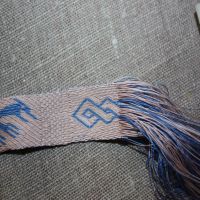
On one of the images published in the article "Linen sprang from Lengberg Castle", it is possible to measure the length of one of the lozenges in the pattern. I get about 1.8 to 2 cm, so let's stick with 1.8 as the smaller measure.
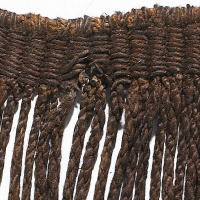
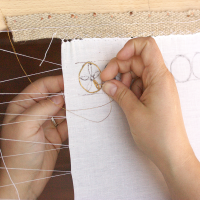
That pattern element consists of 10 rows, which gives each row an approximate height of 1.8 mm. The complete pattern has 186 numbered rows, as published after Carol Jones' reconstruction in the article "Enigmatic Beauty". There is one un-numbered row above row 1, which is a plain 1-1 row. (There are some numbering hiccups in the pattern, looking at the numbers on the side, but they even out.) In addition to these main pattern rows, there is the slightly wider row formed around the starting thread, and because the pattern holes in the image mentioned above only start at a little distance from that starting thread, there have to be two more plain rows before the pattern start (of which one would be the un-numbered 1-1 row in the pattern). Then there's an additional seven rows done with double threads at the very end, narrowing down the panel.
So we have 188 sprang rows, plus the slightly thicker starting row around the anchor thread, plus the seven double-thread rows. Even if we say all of these are no larger than the 1.8 mm found above, a total of 196 rows times 1.8 mm results in 352.8 mm - so 35 cm and a bit. Consequently, one thing must be incorrect: either the 27 cm total panel length, or the pattern description as given, with the 1.5 repetitions of the motif.
Which means either the sprang pattern length would need to be revisited, or one of the measurements somewhere has a typo or was erroneous (which we all know can happen, or, as the German physicists taught me, "Wer mißt, mißt Mist" because something can always go more or less wrong), or there is something else somewhere that would explain the discrepancies. I cannot say which is the case - only what I have found from trying to work the reconstruction as described in the articles.
Literature referred to:
Nutz, Beatrix, Case, Rachel and James, Carol 2021. A unique survival: A woman's fifteenth-century headdress from Lengberg Castle, East Tyrol. In: PRITCHARD, F. (ed.) Crafting Textiles: Tablet Weaving, Sprang, Lace and Other Techniques from the Bronze Age to the Early 17th Century. Oxford: Oxbow Books.
Case, Rachel, Nutz, Beatrix and James, Carol. 2019. Enigmatic Beauty. The Decorative Headwear of Lengberg Castle.