Latest Comments

Guest - Aislinn Dyestuff Citizen Science.
09 October 2026
This is a great project. I look forward to the results. Thanks for letting us know.
Guest - Aislinn Time for...
09 October 2026
Looks delicious!
Guest - Katrin Sprang Discussion
18 September 2026
Hi Rachel, I have looked for more photos of you, but that was not very successful. I found a link on...
Guest - Beatrix Sprang Discussion
15 September 2026
That lozenge pattern element is not a photograph, but a scan. So it should be to scale. But I pinned...
Guest - Katrin Sprang Discussion
15 September 2026
I was not referring to Rachel's reconstruction (is the reconstruction you refer to the one photograp...
OCT
16
0

Lacing question.

I got a little sidetracked today while looking for images of 14th century clothing - because, well, of the question of lacing.

There is one image from a South Tyrolean mural, dated 1360, where in two cases, the tight-fitting woman's dress is clearly showing lacing in the front. This, in turn, is tied to the garment having a cut in quarters (with a divided front into two panels, or else the front lacing does not make any sense at all). Most of the other images of women I can find from the later half of the 14th century do show tight-fitting dresses, sometimes with a strongly accentuated bust, but there's no lacing or other closure shown. 

The fit of the dresses (especially the accentuated bust, and these dresses often have a very wide neck-opening) does point towards there being some kind of fitting that requires an opening; or it was a wool dress that could be stretched over the rather squishy bust. In that case, the breasts would either need to be naturally shapely and firm, or an underdress would have to do any shaping required, as a wool dress will stretch nicely, but not necessarily so with a linen lining. 

Which brings us to the many, many questions. A tight-fitting dress does need to have some substance on the tight-fitting areas, which points toward there being a lining; in that case, it can also do some shaping. This means an opening is required. So... when do the first images with a front lacing on a woman's dress turn up?

I'm happy for any hints towards this! I can offer, as linked to above, 1360 as the starting point, located to South Tyrol; I have a nice side lacing from the 1320s, and another front lacing from England, 1370-75. 

The hunt is on ; ) 

0
OCT
15
0

The Schnalstal...

Today, I have for you: A video including sheep, and some weaving (those after about the 24 minute mark). Enjoy! 

0
OCT
14
0

Status Report

Status of my cookery/Forum equipment collection: Progressing (cooking stuff is almost all collected now, except for the very tricky bit - the baking sheets, where I'm quite sure there are not several available).

Status of the little car: Freshly checked up and equipped with winter tyres. Though I have learned that the next time an oil change is due, we will most probably need a new oil pan... because the thread for the screw that stoppers everything up is worn out by now, and the area around it is too thin and fragile to just cut a new thread a size larger and use a larger screw. Sigh. Well, we'll see in a year or two when we'll have to go for the next oil change.

Status of a small article I was writing (for a really nice magazine on the other end of the globe): Handed in for evaluation and feedback (not sure if it's enough images, or the right ones, so we'll see).

Status of random other things: In the post, in the pondering stage, or shoved back a little to wait for being gotten on with because of other stuff.

There you go. Also, is it Friday already? 

0
OCT
12
0

Slowly...

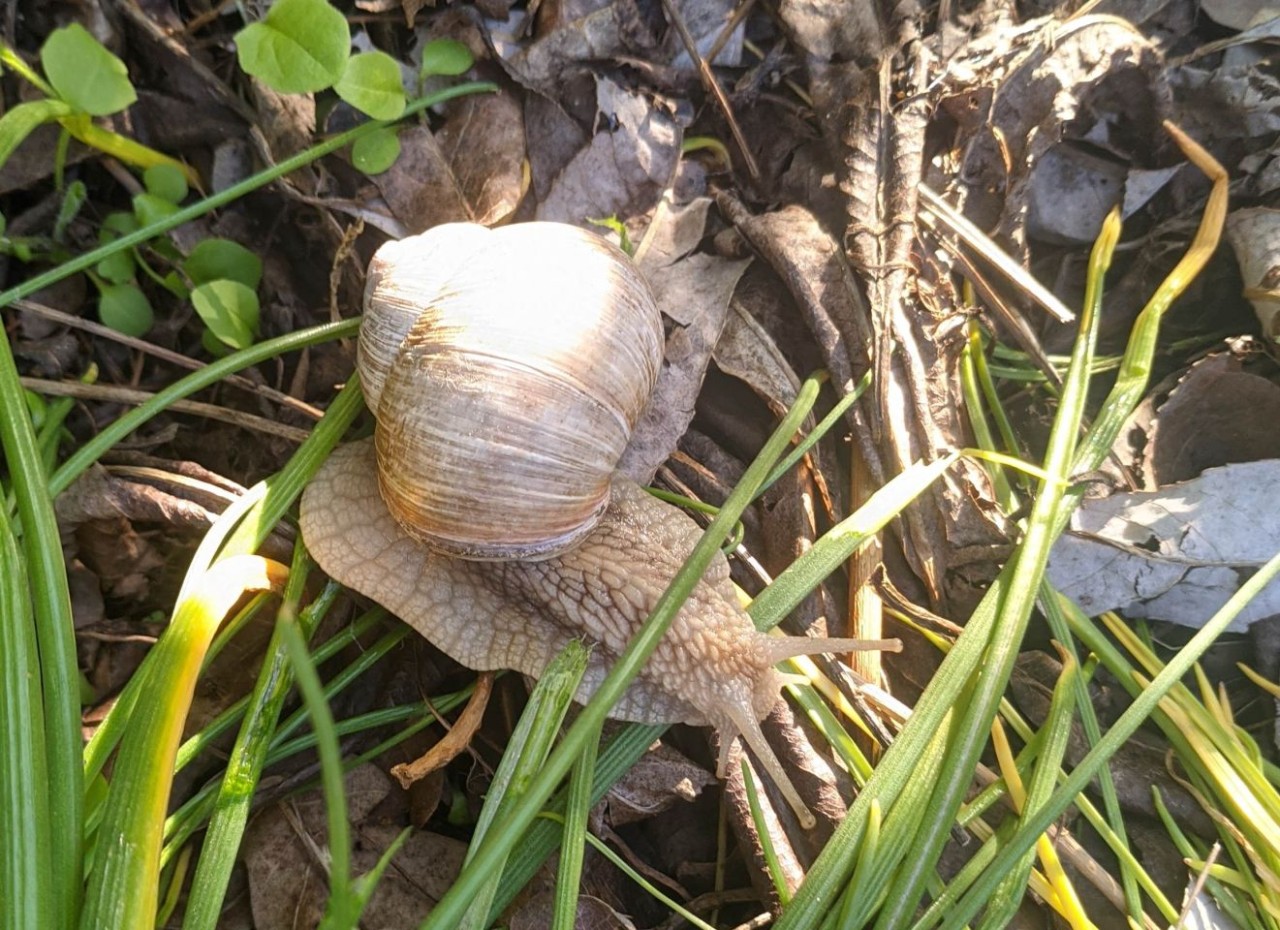
...I'm still sorting photos, bit by bit, and feel about as speedy as this snail (whose picture was one of the batch today).  

Some day, though. Some day! 

0
OCT
09
0

The Hunt for the Understanding.

As soon as the cat will decide she has snuggled enough and will get up from my left forearm (which is apparently a very nice place to hang out on), I will turn on the printer to print out drawings of the surviving 14th century doublets that I have found. The goal? Try and reconstruct a way to, well, construct them.

It's fairly clear that there are some key body measurements that will go into the doublet measurements (such as, well, the waist, rather obviously), but one of the authors writing about the Chartres pourpoint has an interesting theory about how the pattern fits into a rectangle, and I would like to take that idea and try to run with it.

It would be nice if that would be the key - and otherwise, if the running should not work, I'll just fall on my face and try to figure out something else.

Speaking of something else - I have been introduced to the idea of making the holes in sprang by un-crossing a crossing of the previous row, and have looked a little more to find it seems to be the common version in both the Norwegian tradition and the Eastern European tradition. The Dutch book that I have, on the other hand, does the holes not by un-crossing something from the previous row, but by actively making a hole in what is usually called the plait row (the one starting with a double thread). This is very, very interesting - and now I wonder how it was done in today's Germany, back when it was a little more en vogue. Were we leaning to the Dutch way? Or the North-Eastern way? Or was there a mix? Would it be possible, if looking at enough early modern instruction books, to find out where the border was?

Questions. We'll never run out of them, right?

0
OCT
08
0

No photo today...

...but there was writing being done, and the workshop prep is progressing nicely, and I have discussed details about the upcoming batch of netting needles for the shop, so I am quite happy.

And looking forward to the weekend, even though it's only Friday tomorrow! 

0
OCT
07
1

Time for...

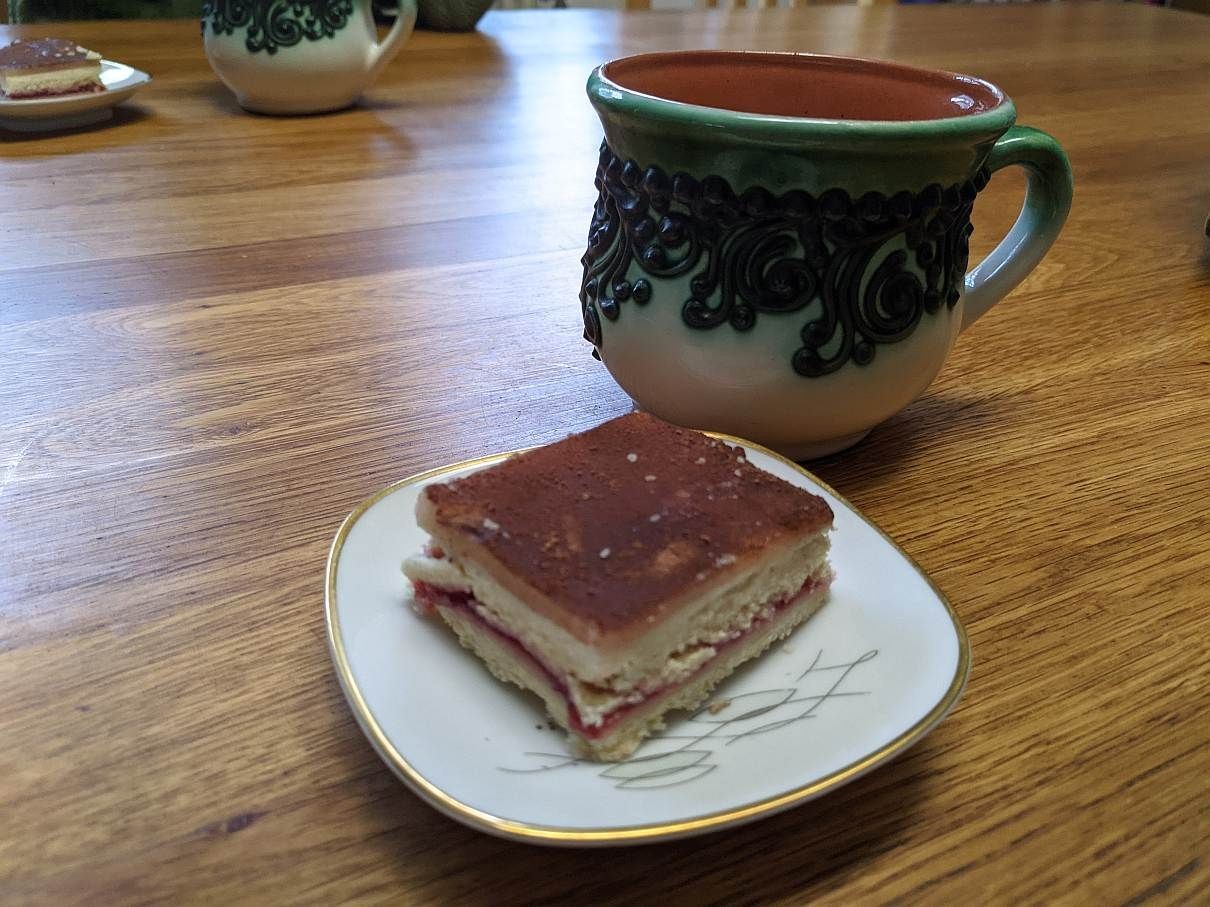
...coffee and cake, and not just in form of a digital image, which I provide to you here from my very large stack of digital images: 

This is exactly what I would like to have now, and what I am looking forward to, as soon as I have sent out the last emails for the session planning for the Forum. Phew.

The cake in the image, by the way, is a Nürnberger Snitte, or at least my version of it. Basically it's the Danish Hindbaersnitte (raspberry thingie) on steroids- it's not just pastry dough, raspberry jam, pastry dough and a layer of sugar-raspberry icing, it replaces the icing with vanilla buttercream and a layer of marzipan.

They are... delicious. Can very much recommend.

0

By accepting you will be accessing a service provided by a third-party external to https://www.pallia.net/

Contact