







Latest Comments

Guest - Aislinn Dyestuff Citizen Science.
09 October 2026
This is a great project. I look forward to the results. Thanks for letting us know.
Guest - Aislinn Time for...
09 October 2026
Looks delicious!
Guest - Katrin Sprang Discussion
18 September 2026
Hi Rachel, I have looked for more photos of you, but that was not very successful. I found a link on...
Guest - Beatrix Sprang Discussion
15 September 2026
That lozenge pattern element is not a photograph, but a scan. So it should be to scale. But I pinned...
Guest - Katrin Sprang Discussion
15 September 2026
I was not referring to Rachel's reconstruction (is the reconstruction you refer to the one photograp...
FEB
13
1

More Translation Fun.

Translation fun not as in "transporting a saint's bones from here to somewhere else", but translation as in "making a text from one language magically appear as a very, very similar text in another language". 

Sometimes it's really easy and straightforward. Sometimes, the other language would express it in a different way, so making a literal translation is understandable and clear, but a little odd. And sometimes... the word doesn't exist.

Case in point (other than the Erhebung): Umbettung. (Looks like it's a theme here with the dead...) In German, there's a word for taking a corpse out of the burial place and re-burying it at some other place, and that is Umbettung. (The literal translation would be transfer-bedding? Something "betten" means to carefully lay it down into a dedicated bed, and the "um" indicates that it is changing position either inside the same bed or into a new one; in case of bones, it's generally a new one.)

So, like anyone tasked with translating a text from German to English, I use the words that I have in my head, and if I am unsure or if I don't have them in my head already, I go chase for them. Usually my first point of call is dict.leo.org and sometimes I go look the thing up in German in Wikipedia and then switch to the English page on that thing. (Wiktionary.org, while a wonderful resource and one of my favourite for language learning or etymology checking, is usually not one of my go-to places.) 

Leo told me straight away... nothing. Oh, wait, the forum with questions and discussion section has something. Something as in "someone looked for this translation before and was told that this is a total no-go in England and thus they have no word for it". Just to make sure (and because I find these things fascinating), I looked it up on Wikipedia and there is Umbettung and, apparently, a Japanese version of the article. There is also an article about one very specific regional tradition involving the regular Umbettung in Madagascar, called Famadihana, and for this, an English entry does exist. However, while the German version says it's a ritualistic Umbettung right in the first sentence (and in the image caption), there is no such text in the English version (and no caption at all). Being curious, I then checked the French entry for that, and there's a descriptive image caption and also no term that looks to be the direct equivalent of the German one to me. 

Related to this, and also fun to look at: There's quite a difference between the article "Beinhaus" in German and its English equivalent term "ossuary", both in length and in specific sub-topics covered. So yes, there seems to be a lack of terms regarding the handling of corpses once they are buried in the English language.

(Also, in case you wondered what kinds of rabbit holes I will fall into when not taking care? This kind.)

0
FEB
12
1

Glittery!

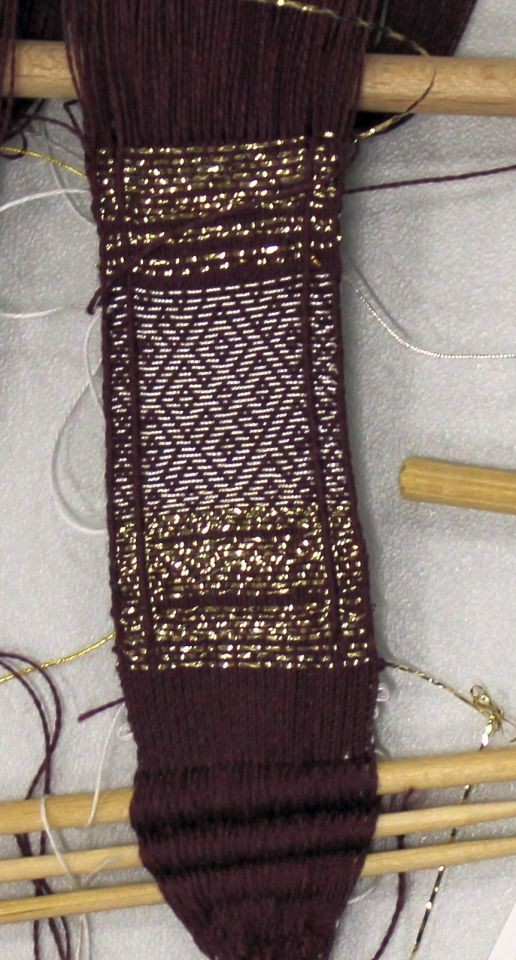
I was sorting some photos and came across this lovely example of how important the right brocading thread is: 

As you can see, there's a nice difference between shiny (in the middle) where the thread was nice and smooth, and glittery (before and after), where the thread had some kink to itself - and the pattern is much, much less legible. So, again, the thing is to choose wisely...

(You can also see some quite big differences on how tight the threads sit, and how neatly the weaving was. Fortunately the image does not tell whose hands it was... ; ) 

0
FEB
11
0

Argh.

Now and again it happens that I press "publish now" here on the blog, and then either I don't press the "yes, indeed, I did just tell you to publish now so go ahead already and do it" confirmation thingie firmly enough, or maybe I just forget (though yes, I should have learned it by now), and consequently... the thing doesn't get published.

Which is exactly what happened to yesterday's post. Now, usually, I just go ahead and publish it a day later instead, maybe with an "aaargh" and an explanation tacked on, but yesterday's post was mostly a vague hint at something fun that would happen today, and it did. I made another recording with the two guys from Kaptorga, with the intention to talk about tablet weaving.

The meet-up happened, the talking happened, but I think I'm not giving away too much if I say that the topics ranged from here to there and, yes, they did include tablet-weaving, but it was not really the podcast about tablet weaving that we had intended to do. Which means... we might do a third try, if people are not running away with bleeding ears after hearing me chat with Adam and Jonathan for, um, a little more than two hours.

(Two hours! I have to drag a more comfy chair into my recording nook next time. That little stool that I'm usually taking there leaves a stool-top-shaped impression in my butt after about one and a half hour. Not the best choice, in retrospective.)

So. That was fun, and my morning, and now I still have a list of stuff that I wanted to have done and dusted several days ago already, as I used most of yesterday's attempted blog post to whine about - but I have started to make inroads on some of the tasks, and that's good. I cannot tell you yet when the podcast will go online, and if you don't have German it will not help you in any way anyways... but I'll let you know when it is live.

And now I will go and feed the little cat, before she complains too much!

0
FEB
09
0

Summer Workshop Medieval Manuscripts

Sometimes, I get info for something that sounds like an absolute blast and really useful at the same time, but, alas, I am about a decade too late for it, sometimes more.

The most recent example is an info pdf about a medieval manuscript summer school, held in Leipzig. In case you are interested, or know somebody who might be, the website is at https://www.ub.uni-leipzig.de/forschungsbibliothek/sommerkurs-handschriftenkultur, and this is the pdf flyer in question:

0
FEB
06
0

Friday! Hooray!

I have, for a change, actually managed to clear some papers off the stack on my desk. The little cat approves, as she now has a bit more space to place her furry hindquarters (though mostly she places herself all in front of me, between the laptop and the edge of the table). Outside it's still fairly cold and grey, some snow is left on the streets (especially here right in front of our house) and some on the grassy areas, but there's much less now than a week ago. And I've already received the first emails telling me that I should think of buying seeds for the next season.

Also, it looks like there will be some stuff going to be made for an exhibition next year, which really delights me. Not just because that will mean nice photos of the process, once it's running! 

With the discussions about the exhibition, in regard to what is possible and what is not, I have realised that it would be really, really nice and cool (and also helpful) to have a sort of a nationwide register (even better would be a register and warehouse) for all those things made for temporary exhibitions and then without proper use afterwards. There's so many amazing things getting researched and made, and many of those will later on just disappear into some storage room. Or worse.

So... if anyone has an idea on how to make this a project, preferably with some funding for its long-term establishment... please let me know. I'd love to see this.

0
FEB
05
2

So... what would you call it?

First of all, the breeches are finished, have been tried on and tested, and they fit well (much improved, actually, by the set-in gores between leg and middle part) but were hard-ish to put on because the belt is too short to keep it together while pulling them up. That resulted in some fishing for the belt ends afterwards.

No pictures yet, as I want to do their first showing at the conference in the presentation, but I am very happy with the piece, and they do look quite similar to what can be seen on images.

Other stuff that is going on: Paying bills (sigh), doing some bureaucracy stuff (which will ensure some payment later, so yay) and, of course, the neverending ongoing work on... the translation of the thesis. There's been progress translation-wise, and I have now gotten to the start of the catalogue, and there I stumbled across a specific German term that I don't really know how to translate.

In German, there's the term "erheben" (like in uplifting, or in getting up if you do it yourself, but that is not the case here) used in the context of making a saint. Erhebung is when the body is exhumed with the intention of venerating it and placing the bones in some reliquiary, or in some other position where they can be venerated. (It includes the good old time-honoured Catholic practise of splitting off some tiny fragments and selling them off to other places so they can use it for stuff including naming a church and dedicating the main altar to the original owner of the splinter.) So if you are writing about some saintly guy or gal and the text says that their Erhebung was at this or that point in time, it's very clear what is meant.

This, it turns out, is one of the things that are hard to google. Erheben, after all, means a range of other things as well. German Wikipedia has an article on just this (yay!) but there is no version in any other language, especially not in English (grrr, plan thwarted). A quick use of the search engines revealed that the Duck (I say I would google it, but I use duckduckgo) is very willing to tell me everything about the cardiac thingy called ST elevation, which it will helpfully convert my "saint elevatio english" into, but not about English church-y terminology. So.

Does anyone here happen to know how that would translate, precisely, into English?

0
FEB
04
0

All sewn up!

There was some more stitching, and now the breeches are all finished, and waiting to be tried on and tested. I am looking forward to that! It was already very interesting to see their transformation from a weird, very large piece of fabric to something definitely trouser-like once the belt was added to the picture.

I'm also still very much delighted by the stitches used - with some more pondering (which there is time for, with the stitching, as you might know) I finally realised that the variation of the seam means that everything on the piece can be done with a variation of whip-stitching. Which is... nice. Especially if you love this kind of seam. 

(In case you wondered: I'm fine with it, but am not totally and utterly enamoured with it. There you go.)

0

By accepting you will be accessing a service provided by a third-party external to https://www.pallia.net/

Contact