







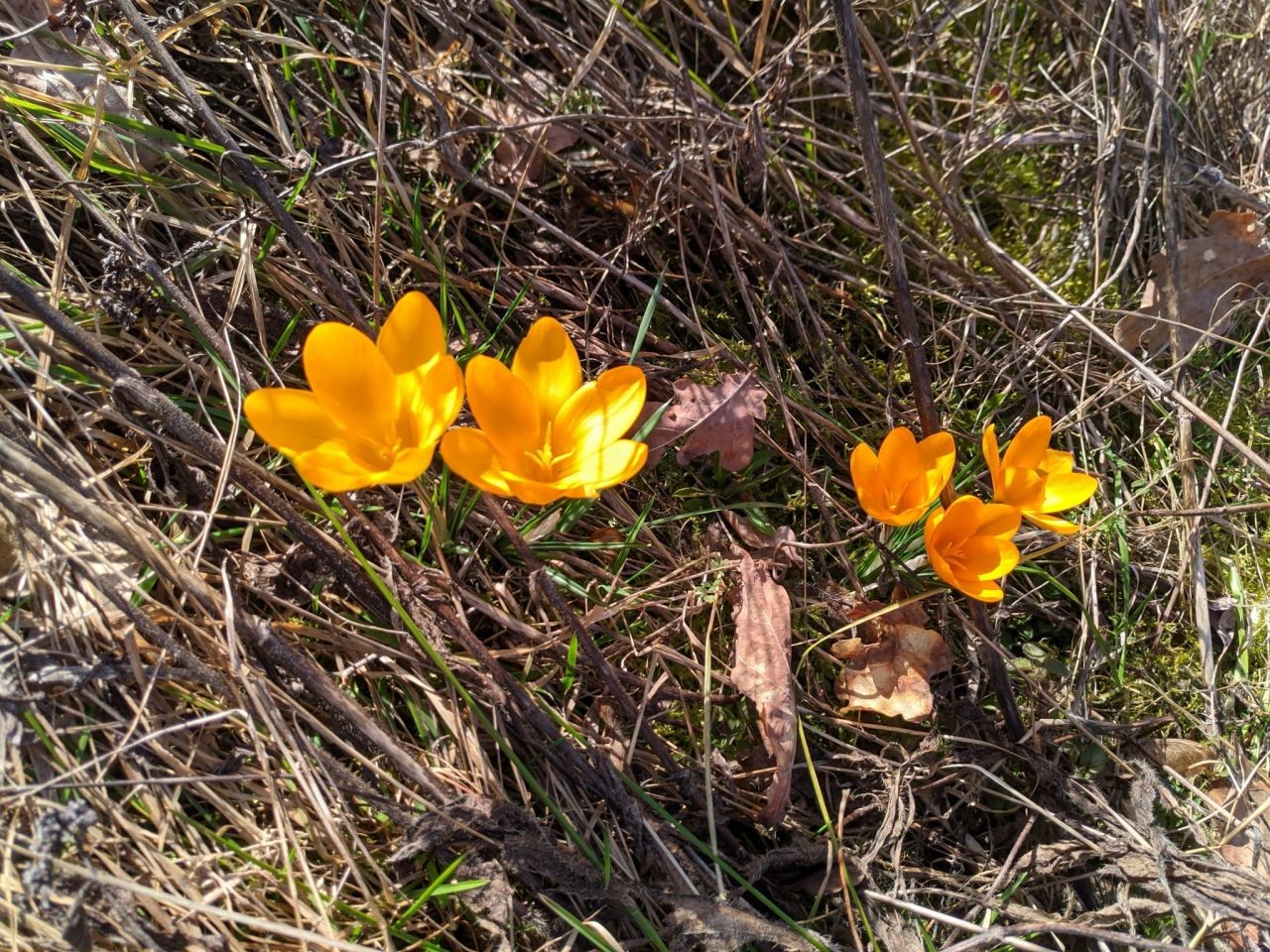
I am off to do things - which means that I will be off the blog until March 16. Until then, I will leave you with these harbingers of spring:

...and hope that you will have a good time and enjoy some lovely weather!


I am off to do things - which means that I will be off the blog until March 16. Until then, I will leave you with these harbingers of spring:
...and hope that you will have a good time and enjoy some lovely weather!
I've gotten the information that there's a new open access book out, about - natural dyes! The book is the result of an EU project to help revive natural dyeing, but is mainly geared towards educational and artistic users.
You can download the pdf for free from this website. I hope you enjoy it (and thank you Mari for the information!)
I spent today in an online conference, which was fabulous, but a little short on break time - so my brain feels rather mushy now. Nothing a little bit of fresh air and some food won't fix, hopefully, as there's the weekend packing to be done...
Tomorrow is another conference day, with the same rather enthusiastic schedule, and tired or not right now, I am already looking forward to it a lot!
I've stumbled across links to two alternative search engines recently. One of them is Marginalia Search, which, sadly, does not refer to marginalia in medieval manuscripts, but rather to the margins of the Internet.
The other is called WiBy and dubs itself "the search engine for the classic internet". You know, the Internet as it used to be when it was geocities and lots of personal websites, or at least that's the vibe I got from it.
It does indeed seem to me like searching the 'Net gets harder these days, with more and more AI-generated stuff flooding everything. Only a few days ago, I got to see a "crochet pattern" showing cat's faces. It looked lovely, and quite life-like, but more like needle-lace than crochet, and though the "pattern" looked hand-written, the whole thing was, you guessed it, AI. All this added to the fact that some terms are harder to find things anyway than others, and unfortunately textiles have a lot of these terms... well.
So I've taken a look at the two alternatives, and I think they're not my solution. They are both giving out links to sites that might not be up on top of the Duck's list (I usually use duckduckgo as search engine), but nothing that looked really interesting to me and that I hadn't seen before. There might be more amusing or enlightening outcomes for other searches than "hand spinning" and "medieval textiles", but those are the two that I tested.
No glorious alternative for me, thus. Which means I will stick to the duck for now, with the addition of searching via academic portals and the Google Scholar page - which is, actually, quite good, much as I try to limit my use of Google stuff.
Sometimes, when you're researching something, it seems like there are funny gaps in what we know, or what we have, or both. For instance, there seems to be a funny gap for textiles from around the year 1000. There's also a funny gap regarding spindle whorls that date to the High Middle Ages. (Granted, there's a funny gap regarding spindle whorls, period, at least if you are looking for publications with a focus on them... but that is an entirely different story. Just like the fact that it might just be perception, as you never have enough information about the current focus topic, no matter what it is.)
I have Slavic whorls that are decently published, Early Medieval ones, Viking period ones (Birka, we are grateful for you), and there's collections of Late Medieval and Early Modern ones, but the High Middle Ages? Meh.
Or at least I haven't found much. There's the occasional mention of one being found somewhere, but they are rarely published properly, with the weight, measurements, and a drawing.
So in case you have good examples, or know of good publications with them... I'm all ear.
One of my to-prep-things is done and dusted (and we even managed to do the presentation test run in 18 of our allotted 20 minutes), so I have only three left - a short thing about spinning, a longer one for a museum presentation in South Tyrol, and the band-weaving workshop in Unterschleißheim on February 28. Whew!
Fortunately, the bandweaving is mostly packing up my stuff and re-visiting the workshop plan, which already exists, and the long and more work-intensive one is almost done, with a few new things to be added after our last preparatory chat today. For the third one I will also be able to re-use some of the slides I already have, so it should be more a question of getting an idea of what I want to say in what sequence, and digging out stuff, adjusting slides, and ordering them into an appropriate sequence.
But that's a task for tomorrow. For now, Madame the cat is calling and wants some attention. (Well, probably some food, actually...)
So much for my plan to watch a presentation that was available online after the fact - in contrast to the announcement, it was not recorded after all, and is thus not available. It would have been something on backstrap weaving, but due to time differences, the real thing would have been at three o'clock in the night hereabouts. My love for textiles runs deep, but my love for sleep is at least as profound, so I would have passed even if I had known that it will not be recorded.
Still, funnily, it makes a difference somehow to be disappointed because it's in the middle of the night and one will not join in, or to be disappointed because it was announced to be recorded and then be told it was not, after all. Not that the outcome is any different.
I am not complaining, by the way - something may have happened, technical or otherwise, to have things turn out like that. What I'd rather complain about (well, among many other things that are of a more political or social nature, but I am planning to do other things this evening as well and will thus not even get started) is how much AI has made searching for stuff on the 'Net harder than before. Back a few years ago, when I was looking for something, there was the occasional thing that was repeated on a few websites. Mostly it was easier to identify and thus fairly quick to sort out - but now, searching is much more cumbersome just due to the sheer amount of copy-and-paste stuff, and repetitions of things quite clearly written by AI. Add that to the fact that some things are hard to search for anyways ("spindle" can mean way too many things, for instance, and some other terms are, well, not advisable due to NSFW reasons) and it gets unpleasant.
Unfortunately, that does not look like a problem that will go away any time soon. This AI stuff is here for a while, and will most probably continue to spew shitty hallucinated texts all over the 'Net, and then gobble them up again to feed itself with the basis for even more, even wilder hallucinations.
You can clearly tell that I'm no fan of the AI boom. Yes, I know that there are some use cases where it's a real help, and I am using AI assistance for those as well. Such as translation help, so you don't have to look up every second word in the dictionary, and yes, I am old enough and old-fashioned enough that there were texts in my life that I had to tackle like this if I wanted to read them. Or programming assistance when it's a common software and a problem that you can very clearly describe, and very clearly describe how you want to solve it. My guideline these days is that if I could find the solution written out by someone (someone real, human, breathing and thinking) on the 'Net somewhere, it's something that may be solveable by AI. If not... nope. With a little nope cherry on top. It's basically a very, very large cross-language dictionary, and that is, in my opinion, all that it's good for, and all that it will be good for. It also has the desire to please you, so chances are high you won't get any solid or sensible advice. Which means... it's a large dictionary with a bias.
In addition, all that "free" use of AI comes at quite a cost - because these servers don't run themselves, and there is a considerable amount of energy and logistics going into them these days. Especially the image generation eats up quite a lot of resources, and with a lot of that being, more or less, utter crap, and also a lot of it being just for fun... well. Meh.
So. Rant over. For now. I'll now go and have a nice, analogue, non-AI (maybe even non-intelligent) evening.
By accepting you will be accessing a service provided by a third-party external to https://www.pallia.net/