Latest Comments

Guest - Aislinn Dyestuff Citizen Science.
09. Oktober 2026
This is a great project. I look forward to the results. Thanks for letting us know.
Guest - Aislinn Time for...
09. Oktober 2026
Looks delicious!
Guest - Katrin Sprang Discussion
18. September 2026
Hi Rachel, I have looked for more photos of you, but that was not very successful. I found a link on...
Guest - Beatrix Sprang Discussion
15. September 2026
That lozenge pattern element is not a photograph, but a scan. So it should be to scale. But I pinned...
Guest - Katrin Sprang Discussion
15. September 2026
I was not referring to Rachel's reconstruction (is the reconstruction you refer to the one photograp...
NOV.
23
2

Colours, colours.

When you're working with colours, definitions or descriptions of them are always an issue. Green as grass, blue as the sky, dark as the night - even these descriptions, time-honoured and always nice, include a large variety of shades.

It would be nice to have a good, solid way of describing colours, wouldn't it? Well. There's electronic colour checkers, there's colour space charts, and then... there's human beings.

One of the little side shenanigans we did at the Forum was test how well a colour checker fan works. These are printed colours with a defined number according to a system - you might be familiar with the RGB system, or have heard of CMYK. There's a number of other systems as well, but in this case, that's only relevant insofar as the number you'll write down as your colour name will change.

We asked people to sit down and try to describe the colours of some of our madder sample dyeings with help of the fan. (Thank you to everyone who did!) Everyone who I asked about how it went agreed on it being difficult, as the printed colour patches were not really matching the actual textile colours.

Well. Having had quite the experience with how dissimilar measurements done on the spinning angle were if taken by different persons, I was a bit suspicious from the start on how well the colour fan might work (or not). It would be really, really nice if it did, making the description of colours easier, and more reliable, and hope springs eternal. 

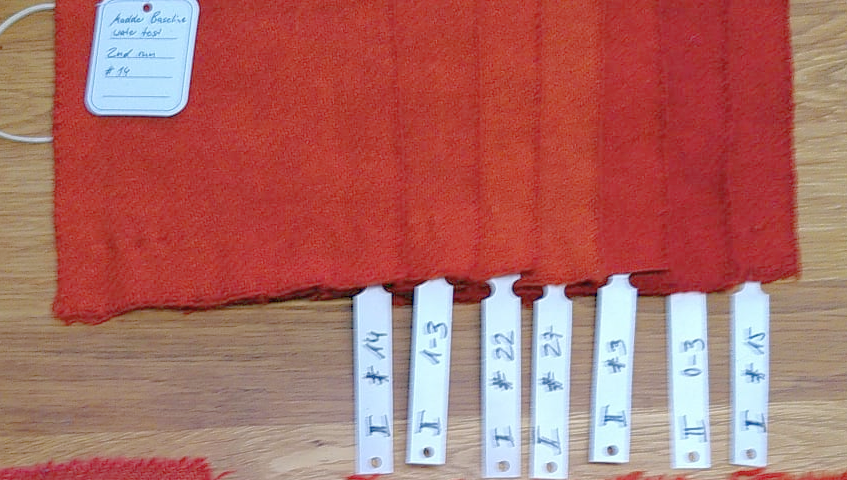
This is what we had as one set of samples:

It's a rather bad picture, but hopefully you can see that there's a little difference between some of the samples. Make up your own mind on how many groups you'd see regarding darkness/colour depth - myself, I see three in the originals and four in this (bad) picture, with the one to four pieces in the group having no discernable difference.

Here's the clincher: The cloth patches were not sorted by darkness when participants were doing the colour checking and matching. And... as a result, we had the same colour number assigned to the darkest shade and the lightest shade by different people.

Which, to me, means that this simple method is, unfortunately, out - and that you should not trust the colour numbers given by "comparison-by-eye" using a colour fan tool. 

Sigh. It would have been so nice, wouldn't it?
0
NOV.
22
1

Back home, but with a lot of homework...

I'm back from the Forum and my recuperation afterwards - much needed, and much appreciated, and now it's tackling all the emails that have accumulated, and sending out all the orders that came in, and then... back to normal work plus the Forum homework.

And oh, there's homework. We ran a total of four experiments and one dyeing test during the week (yes, madness indeed). One was the continuation of Micky Schoelzke's exploration of fake purple that she started last year (you can read about that on the Forum homepage). Then I had the splendid idea of trying out mordanting with horsetail (equisetum arvense), which was an experiment on its own. Then there were the dyeing tests - a first trial at reconstructing some early modern recipes for dyeing knitted caps, with the three great providers of red: madder, cochenille, and kermes. Micky had an experiment with madder as well, a spin-off from the fake purple research, using madder root that had been pre-treated in different ways.

And then, of course, there was the Madder Baselines experiment. We had the staggering number of 35 different water samples for testing the dyeing outcome and the influence of the water on the dye result... so that was huge, and ate up all the time available, and then some. Especially since the experiment went not just as planned.

It was rather clear when we were getting ready that the amount of goods was very large for our small beakers - but there's the decision to make between having very small samples (where any fluctuations in amounts of madder, or the quality of the teaspoonful you are using compared to the quality of the second teaspoonful for the next sample will make more of a difference the smaller your samples are) or having larger samples and larger amounts of dyestuff but running the risk of uneven dyeing. 

We decided to go for larger samples and the risk of spotting... which, in retrospective, was not a good decision, as spotting was very, very prominent. So we went for the afterbath - which was another mordanting run, and another dye run. That did not satisfy us with the results, so we decided to use the waters that we had more of to do a second run, with more liquid and thus less of a risk of uneven dyeing. Another batch of samples to make, another mordanting run, another dye run.

And then we had to test the different madders that we got - mordanting and dyeing in de-ionised water, to make things all even and comparable. 

Long (very long!) story short: We did get to see some differences depending on the waters used, but they were not as pronounced as we would have expected them to be. There's also a difference between the different madders. Now the last factor that would need to be checked is... the Human Factor. Because the speed with which you heat your dyebath, the temperature, they also might make a difference. 

Fortunately, most of the Forum participants volunteered in taking part of this experiment, and dyeing a sample at home. Which is why this happened today:

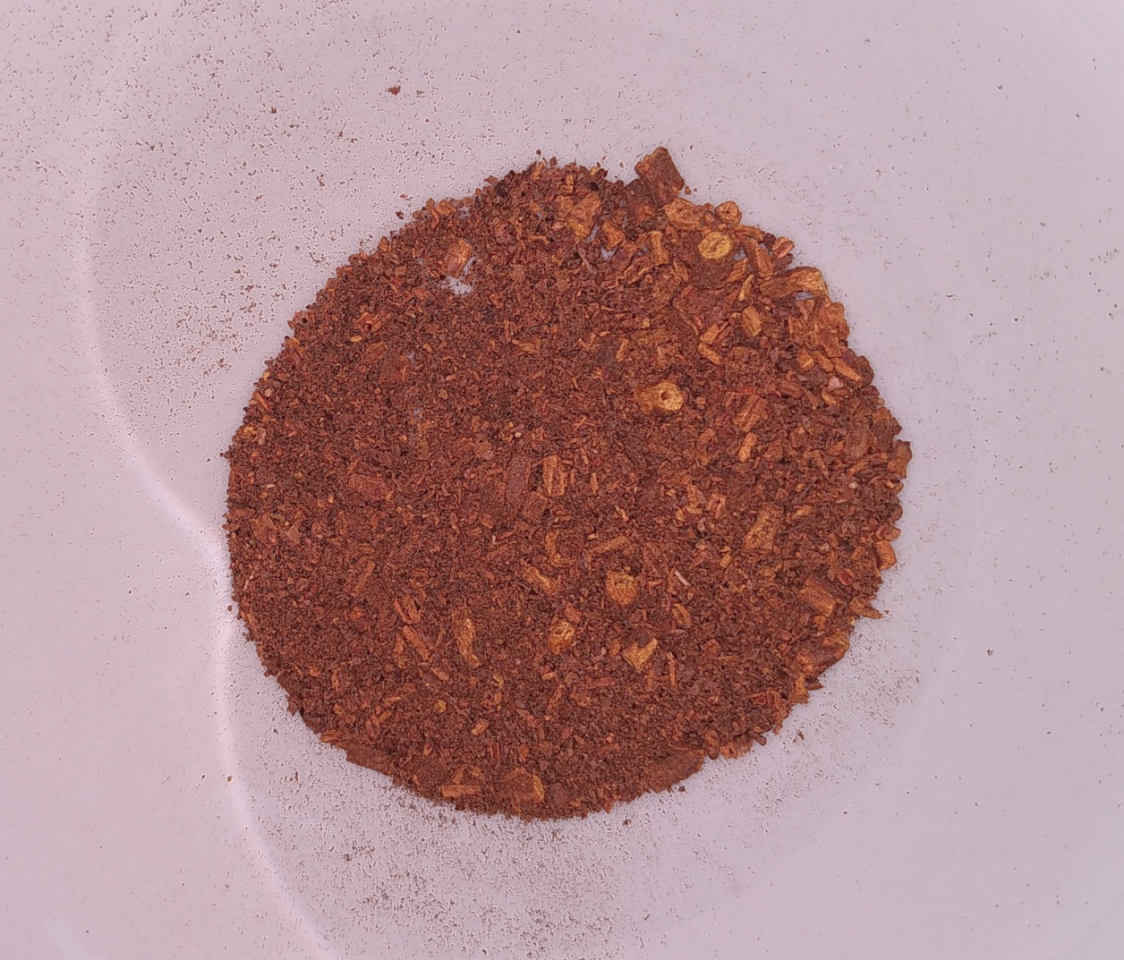
I harvested some more madder from the garden yesterday, and today it was dried enough (I sped the process up a bit) to be ground, and now it can finish dyeing... and then there'll be a test run of my instructions for the volunteers, and then these can be sent out. 

And then we'll see. I am very, very curious if there will be differences visible - after all, it's the same madder, the same samples, the same mordant, the same instructions, and the same water (de-ionised water for the win!). 

What's your guess? Will we have differences? Or will it all look the same? 

0
OKT.
31
3

Getting There.

Heaps of things to take to the Forum, some larger, some smaller, are turning up at different spots hereabouts - sometimes three in a room, sometimes one. There's a stack of books, there are tools, there's a few canisters now to take the liquids along without them exploring the car illegally... there's materials and extra stuff and the whole documentation logistics like the camera and tripod and so on and so on.

I've started a second batch of bran water, using the starter from the last go, which will be fermenting for a few days now. I am also, since this morning, the proud owner of a lot of 250 ml lab glasses - of which a lot can fit into a single canning pot, and thus we can run a good number of sample dyeings at once.

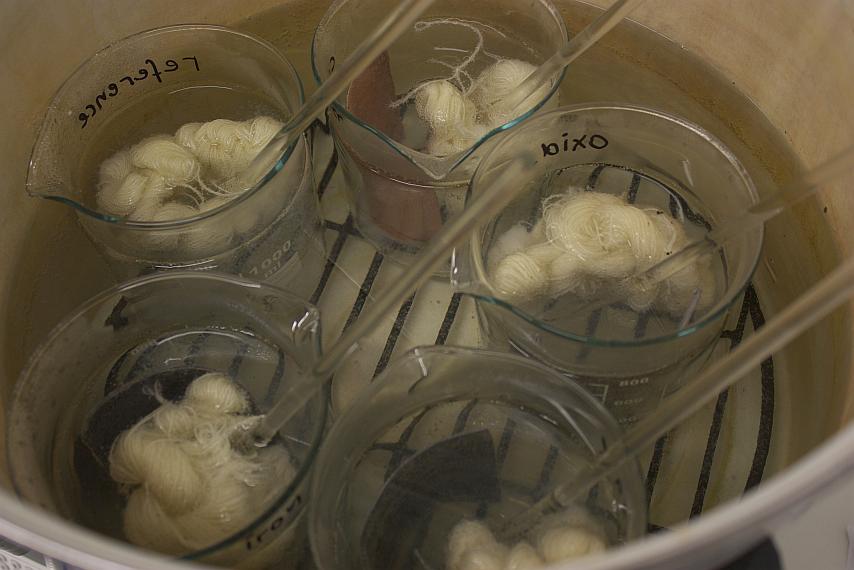
 A waterbath is the tried-and-trusted method to have the same temperature curve for all the samples, and to do them at the same time. We've used that method before when doing dyeing experiments, but with the 1 l beakers, and only 5 or, at the most, 6 will fit into the pot.

If my math and rudimentary drawing skills are correct, we'll be able to fit 20 of the 250 ml beakers into the same pot easily. And though using the small pots means that we'll only be able to do very small samples, and run the risk of them being dyed not completely evenly, having the large number for a run seems, to me, to be an acceptable trade-off.

This, by the way, is one of the bits that I find both exhausting and fascinating when planning and doing archaeological experiments: The myriad decisions that you have to make. Smaller jars or larger ones? Sometimes things and processes don't scale well, and there's a point at which it becomes difficult to measure the very small amounts, plus the inevitable tiny differences will have a much larger impact. Natural substances (like raw, fresh tartar) or processed? The natural stuff or raw stuff may have components that change the outcome, but the processed pure form means it will be possible to repeat the experiment better. What to document, and how often? Sometimes taking measurements will disturb the process, but not taking them means you'll stand there lacking data. How many variables to test, and which ones are the important ones?

So, so many questions. There's a decision to make at every single step, and an experiment has a lot of steps, even if it's a simple one. So you make the decisions, and then you stick with them, and you hope they were the right ones!

(No blog post tomorrow, by the way - it's a holiday here.)

0
OKT.
30
0

Even More Experiment Prep...

Well, the plan for the Madder Baselines is about done - the rest of the planning will have to be done as soon as we know how many samples there will be to handle, and then go for a last check through the long list of steps - before following them through to, hopefully, a nicely colourful end.

Meanwhile I have a second template to turn into a plan and protocol: the template for a mordanting experiment. Common Horsetail is said to contain quite a bit of alum, so it is in theory a replacement for mineral alum which may not have been available everywhere. However, it's not really clear if the horsetail is really suitable for this, mostly because there's no recipe that tells us about amounts necessary, or if there was any other preparation done before using it. Or at least I have not been able to find any...

So the idea was to try out if the plant will work as a mordant, and if yes, how much of it is needed. Because even if it's available, if you need ten times the amount of wool weight to have enough alum, well... that would mean 10 kg of the dried plant for a single kilo of wool, and if you've ever woven fabric, you know that a kilo is a puny amount.

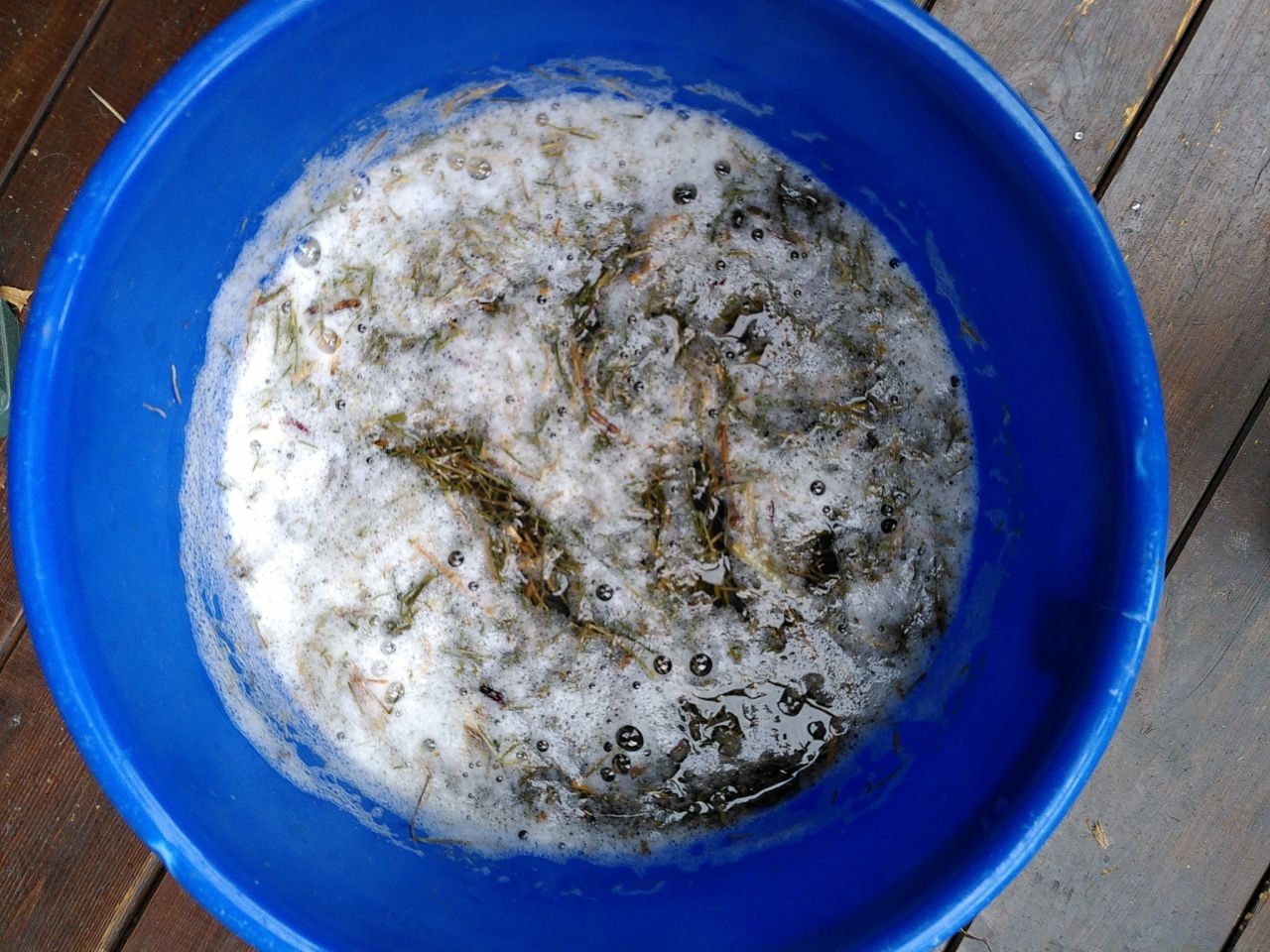
I can think of three different methods of using the plant straight away: as it is (just dried, then soaked, and maybe boiled a bit previously to better get out the contents), fermented, or (which would also reduce the bulk of it) burnt to ashes (which should still contain the metal, though maybe in a different form). 

Obviously, the burning and the using as is do not need extra prep time, but the fermenting does. I'm happy to report that the 100 g of plant that I put into 7 litres of rain water are doing what they are supposed to be doing: Making bubbles and working on changing their smell.

It's not an unpleasant smell (at least not yet), but it is definitely much different from the smell it had at the start (like dried horsetail, but thank you, Captain Obvious). I'm very, very curious already to find out how (or if!) all this will work!

0
OKT.
24
2

Freshly Dug Out.

These are madder roots from our garden, freshly dug out. They'll make part of the second part of our experiment on madder dyeing - using different batches of madder with the same water, and see how different they will come out.

Madder is said to get better the longer it matures - first in the ground, then once harvested, resting time of a few years is also said to make it better. But I figure that too-fresh madder may be better than no madder at all...

It will be dried now and then ground up, and I hope for a yield of at least 30 g afterwards (though in a pinch, 10 g would be enough). It would definitely be nice to have some more samples to test. So - do you happen to have a bit of dried madder to spare? Would you be willing to donate 10 to 30 g of it for our experiment?

0
OKT.
20
0

Dyer's Strong Water!

Dyeing recipes are, well, let's say they often are interesting. And usually they will raise a lot of questions. And then some more.

First of all, just like old recipes for cooking, medieval and early modern dyeing recipes go easy on the measurements. Which makes a lot of sense because measuring stuff easily and precisely, like it's possible with modern scales, was not a thing back then. Also, just like with cooking food, variabilities can be quite large, which means that you'd have to gauge by experience if this is too much, too little, or just right.

And then there's the question of what is meant by a specific term. Such as... bran. That, it seems, can either be bran (as in wheat bran) just added to the dyebath, or it's fermented bran - if you let the stuff sit in a bit of water, it starts to ferment, turning slightly acidic.

Some of the recipes that we plan to look at during the Textile Forum also mention that as an ingredient - it also goes by the moniker "dyer's strong water" in some cases.

So guess what happened here in the kitchen?

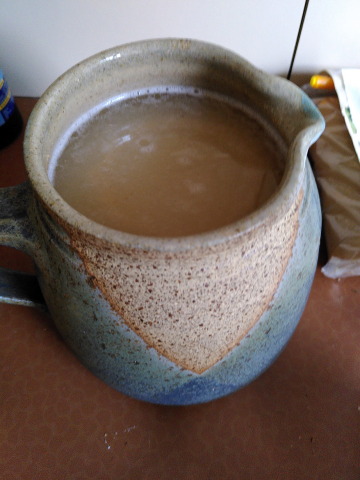
It's fermented bran - I got a taste of it when I was in Romania, where it's called "borș", and it does have a quite pleasant taste. If you're curious now, you can read more about it in Wikipedia, and if you google for recipes, you will get some instructions about it. I tried with added (dry, actual Romanian) bread in the mix first, as many of the instructions tell you to, but I left it for a bit too long and the bread went mouldy. So in the second attempt, I used only bran and water - it took a bit longer for it to turn sour, but it was a success that time.

So now I'm looking forward to trying this in the dyeing! 

0
OKT.
18
1

Mmh... maybe a little less wool.

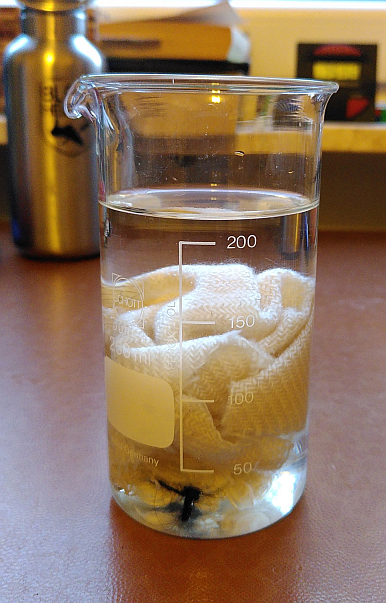
Just in case you were curious on how much wool one can fit into a 250 ml lab glass beaker, it's about 12 g of dry goods in this example, consisting of a small skein of yarn and a piece of fabric about 17 cm square:

tIt fits, but there's not much floating possibility... so it might be a good idea to put in a little less wool. Probably a smaller piece of fabric, and maybe a little more yarn to stay at sort-of-sensible amounts (but yarn will be a bit less, um, stiff?).

It's always fascinating to watch things unfold and questions come up when planning an experiment. There's usually a lot of aspects, and one has to decide on how to handle each one, while knowing that in many cases there's no really good solution that will cover all the possibilities..

0

By accepting you will be accessing a service provided by a third-party external to https://www.pallia.net/

Kontakt