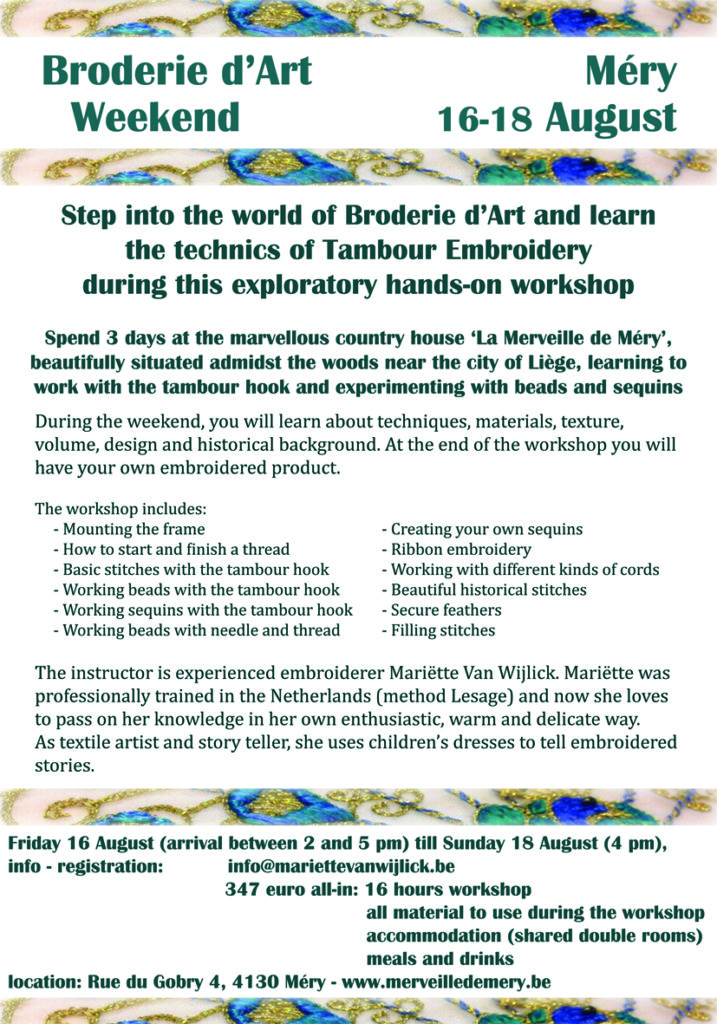
You might remember that I went to Belgium in January, to teach tablet weaving at the beautiful Merveille de Méry? This summer, there will be another workshop there. It's a relatively modern form of embroidery, but since Tambour embroidery has tickled my interest for a few years now, I'm a little sad that it's on a date where I will not be able to join in. (Since the reason for that is that I'll be in Dublin on the WorldCon on that weekend, behind my table in the dealer's hall, my sadness is not too bad, though.)
However, that should not keep you from considering a weekend's worth of lessons in Tambour embroidery (unless, of course, you consider coming to Dublin as well). So here's the info about the workshop, together with the contact information for booking:
Whatever you do on that weekend in August - I hope you will have fun!
A while ago, I marked out two weekends for giving workshops... and then it took me a while to decide on what topics to offer. In the end, I had decided on making one of the weekends a two-day tablet-weaving workshop. And that's where it got complicated.
For table-weaving, you need to tension your warp. Obvious, right? Well, for several people to have a nice setup where they can work with a nicely tensioned warp in appropriate length at an appropriate height, this very quickly means you need a system for the setup. Especially as every warp should be accessible without crawling on the floor to pass under other people's warps, or hopping over them (which would be an admirable feat, by the way). After all, the weavers might want to get up and stretch once in a while, or have something to drink, or go to the toilet, or whatever.
(Fun fact: I might actually do a bit of crawling underneath things in such a workshop, even though it would not be necessary - but it would mean a longer way to walk. So.)
In consequence, this means I need a room that is large enough to accommodate my setup of several tables and chairs, which will then accommodate up to a dozen weavers. And finding a room that is close enough to my home base, affordable, and available on the weekend in question - well, that has turned out to be a challenge greater than expected.
But finally, I have found a room for the tablet-weaving course. So there will be a weaving weekend in Erlangen on August 31 and September 1, teaching a deep understanding of tablet-weaving and a system that will allow you to freestyle patterns. No pattern draft necessary. (If you're interested, there is an Early Bird discount of 25 € with the code DerFrueheVogel - valid until May 31.)
With that course and weekend all settled, the two others were easier: I will be offering a filet netting workshop on June 22, and a "freestyle workshop" on June 23. The freestyle workshop is 3 to 4 people, we will chat beforehand on what you are interested in, and then everyone gets to work on their own project or issues - and can sneak peeks into the other participants' projects as well.
So if you're interested... check out the workshop links, and maybe I'll see you in a month or three!
It has taken a good while, but it's finally all settled - the European Textile Forum 2019 has a venue, and it will take place November 4-10 as planned.
Our venue for this year is the Lauresham Laboratory for Experimental Archaeology, connected to the UNESCO World Heritage Site of Lorsch Abbey and a spectacular place to be. I have a lot of personal fond memories of Lorsch, having been on archaeological digs there several times, working together with lovely colleagues, and having some memorable moments. Like the one where one of the students found some coins right after the assistant prof promised a money prize for finding a coin. Like the one where I was staring so hard at the greenish-pinkish bands in the sand there, to find the line between an old trench and natural undisturbed soil, that I stopped seeing in colour and had to stare at a white wall for a while. Like assisting the technician in taking site measurements; he was a very, very special character, so working with him was sometimes quite exhausting (but I got treated to an ice cream sundae in the evening, which did make up for that). Best of all is that I was part of the student group that excavated in the so-called "Südosttor" area... and what had been thought to maybe have been the south-east gate turned out to have been the loo.
So I'm very happy to return to Lorsch, especially since I have not been there for years, and the whole Lauresham Laboratory is also new to me.
For the Forum, we are graciously given use of the Visitor Information Centre with several rooms, plus use of the facilities in the open-air laboratory itself. This includes houses and workspaces modelled after archaeological finds and ideal-typical monastery plans and descriptions from Carolingian times. Most important for our purposes, there is a dye house on the grounds, as well as a weaving house with three warp-weighted looms installed there plus one mobile warp-weighted loom. I cannot tell you how thrilled I am at how this all worked out, and I am so much looking forward to our conference!
I have also been promised that our group will get a tour of both the Abbey grounds and the Laboratory, which will surely include a visit to the 8th/9th century Gate Hall, the most famous building in Lorsch, and truly, truly spectacular.
So now, finally, it's time to send out the Call for Papers. As every year, we will have a focus topic, and this time it's "Shared Warps, Shared Wefts". You can find the CfP on our website, or you can download the pdf version here.
Last details regarding the conference still need to be figured out, so registration is not open immediately, but will be possible from May 27 onward.
For now, please save the date if you're planning to come, and spread the word about this conference if you know people who might be interested!
I'm on the hunt - on the hunt for suitable rooms for giving workshops, for all those lovely topics where my home is not large enough - such as tablet-weaving with more than two people.
Since tablet-weaving workshops have been requested again and again, and I'm also really psyched about giving them (as teaching tablet-weaving is utter fun, for me), I need a room for that... with enough good light and enough space to place tables and chairs for a convenient setup, and preferably not too far away from home.
By chance I discovered that Erlangen's urban administration actually offers a "room search", where you can search for rooms for all kinds of events and all kinds of group sizes. That actually helped me a lot to discover the possibilities - and now I'm waiting for answers.
If I can find a room, there will be a tablet-weaving workshop on the weekend August 31/September 1, similar to the one I gave in Belgium in January: Understanding how tablet-weaving works, so you can weave patterns without needing a pattern draft. Which, if you ask me, is the coolest and most exciting (and fun!) way to do tablet-weaving!
The annual meeting of EXAR, or, with its full name, the European Association for the Advancement of Archaeology by Experiment, will be taking place in Vienna/Austria this year, from September 26 to 29. Presentations will be held on September 27 and 28, with the rest of the conference days reserved for get-together and excursions.
An EXAR conference in Vienna was the first EXAR conference I've attended, and it was utterly wonderful - so I deeply regret that I won't be able to go there this year, as I've already booked my booth spot for the Nadelkunst in Weikersheim, and that is on the very same weekend.
If you have no such date clash, however, this year's conference will be focusing on “Experimental Archaeology in Science and Teaching”, and it will be presented in cooperation with the Natural History Museum Vienna. (Which is, all by itself, a gorgeous place to visit.) The Call for Papers for the conference is now open, and they are looking for presentations or posters, addressing the following topics:
methods of analysing finds and features which provide the basis for
experiments
experiments and their results/reconstructions based on or used for
experiments
science-based demonstrations and related museological teaching methods
Presentations are possible in either German or English, with the request to do the slides in the other language to make your presentation as widely accessible as possible to the audience (so German slides if you are talking in English, and vice versa). Presentation length should not be more than 20 minutes.
The Call for Papers will be open until June 15, 2019, and is possible via the website www.exar.org. Conference registration will be open until August 31, and conference fees for non-speakers are between 12,50 € and 40 €.
I'm back from the fair, which was - as usual - both fun and exhausting. We had a slightly different setup in our booth this year, which made things a bit more interesting as well. New layouts always mean spending a little more time on setup and decoration, as things need to be figured out anew. We both arrived early enough on setup day, though, to do this in a fairly relaxed way. No car calamities this time - and not even a traffic jam or similar thing that would have held me up!
As always after a fair, I took it easy for a day to relax and unwind a little, and also as always, I now have homework to do: Update stuff on the shop page, write emails, look up things, and so on.
There's also some other stuff here waiting for me to have some time... exciting little bits of stuff. Now where's that extra day between Saturday and Sunday, reserved only for fun things? Can somebody invent that, please?
I'm prepping for the Nadelwelt fair - checking all the things that need to be checked, charging all the batteries, topping up the stock stuff that needs to be topped up.
Also, of course, packing the overnight things - which always include the Three Magic Wellness Things: the travel yoga mat, my current knitting project, and something to read (which usually means the e-book reader). It also always includes, of course, the washbag... which this time around put me in front of a slight problem.
As this is also what goes with me on cycling and paddling holidays, and has to fit into rather small bags for that, my washbag is supposed to stay as small as possible. Unfortunately, over the years, it has grown a bit, due to my wanting to take some additional stuff. Such as a pair of glasses for when the lenses are out. Or more skincare products. Age, here, is definitely leaving some traces!
So in the quest of keeping it small and manageable, most of the things are packed into small containers. Which means my soapbox is an old small box for peppermint candies, and it will only fit a very slim piece of soap. Which, in turn, means I occasionally transfer a piece that has shrunk enough into my travel washbag, and replace the shrunken piece with a new big one.
This time, the small piece came from the soapbox that I take with me to the bouldering gym... but the new piece of soap, bought from a soapmaking manufacture, was so large that it didn't fit that box either. A quick internet search later, and now I know how to divide a piece of soap.
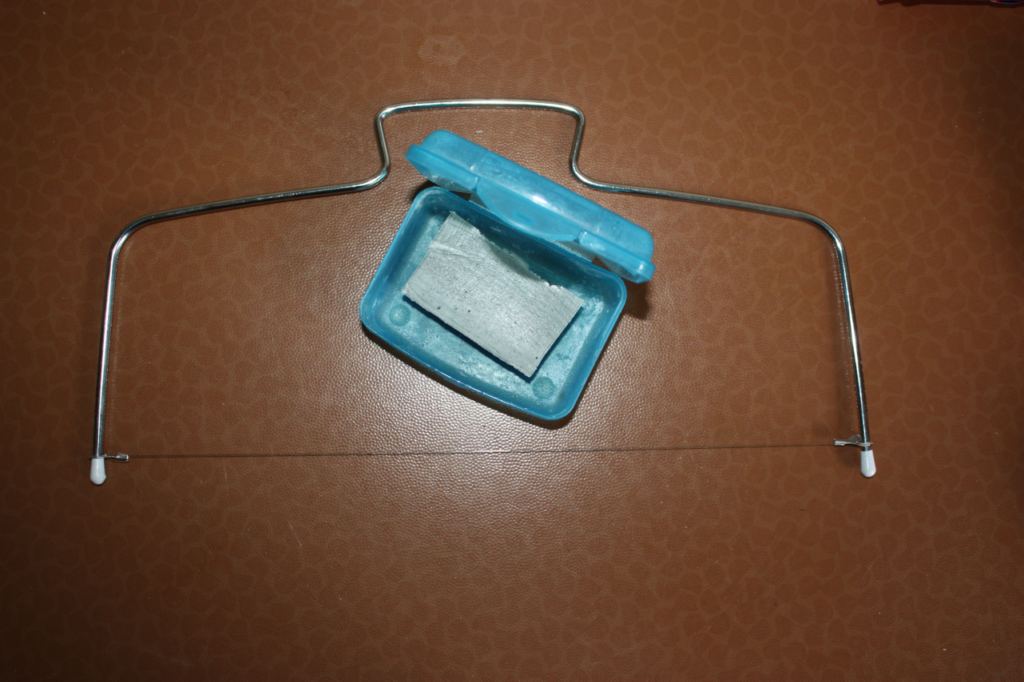
The easiest way to do this without the soap splintering is to heat it up in the oven, at about 100° C for at least half an hour; this softens the piece. Then you can either cut it by pressing through it with a very sharp knife, or try using a piece of thin, strong string, or - probably the best method - cut it with a thin wire. I used the wire from a cake cutting device that hangs out in our kitchen, and it worked very well indeed.
One quarter of the huge piece that I had to cut apart, and the cake-cutting wire device thingie. Which, by the way, also works fantastically on cake.
So now my soap round-robin is done (and I have three more pieces that will fit the box, too) - on to the rest of the packing!