Latest Comments

Guest - Aislinn Dyestuff Citizen Science.
09. Oktober 2026
This is a great project. I look forward to the results. Thanks for letting us know.
Guest - Aislinn Time for...
09. Oktober 2026
Looks delicious!
Guest - Katrin Sprang Discussion
18. September 2026
Hi Rachel, I have looked for more photos of you, but that was not very successful. I found a link on...
Guest - Beatrix Sprang Discussion
15. September 2026
That lozenge pattern element is not a photograph, but a scan. So it should be to scale. But I pinned...
Guest - Katrin Sprang Discussion
15. September 2026
I was not referring to Rachel's reconstruction (is the reconstruction you refer to the one photograp...
APR.
22
0

Off to start the season!

I've been busy as a bee these last few days with preparations...

biene
and now the car is packed with goods, there's a cold box with food in there (I'm already looking forward to the barbecue evening for all the traders on Saturday), plus tables and tablecloths and all the odds and ends that are needed for a sales table - I'm off to the first event of the season!

If you go and visit the IRM, make sure to drop by and say hello; I'll be in Room 8 (which is one of the bathrooms, very nice and cosy).
0
APR.
19
0

Random bits and bobs.

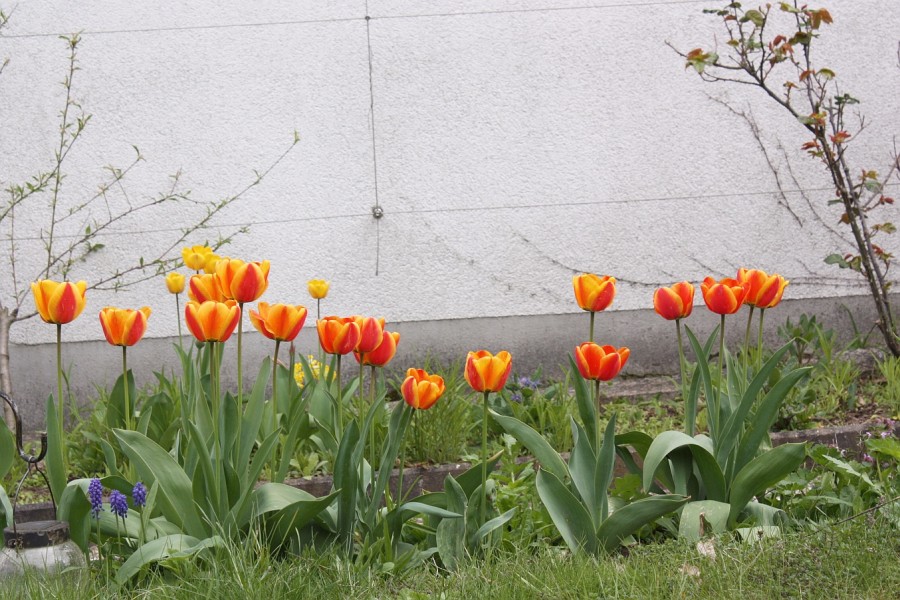
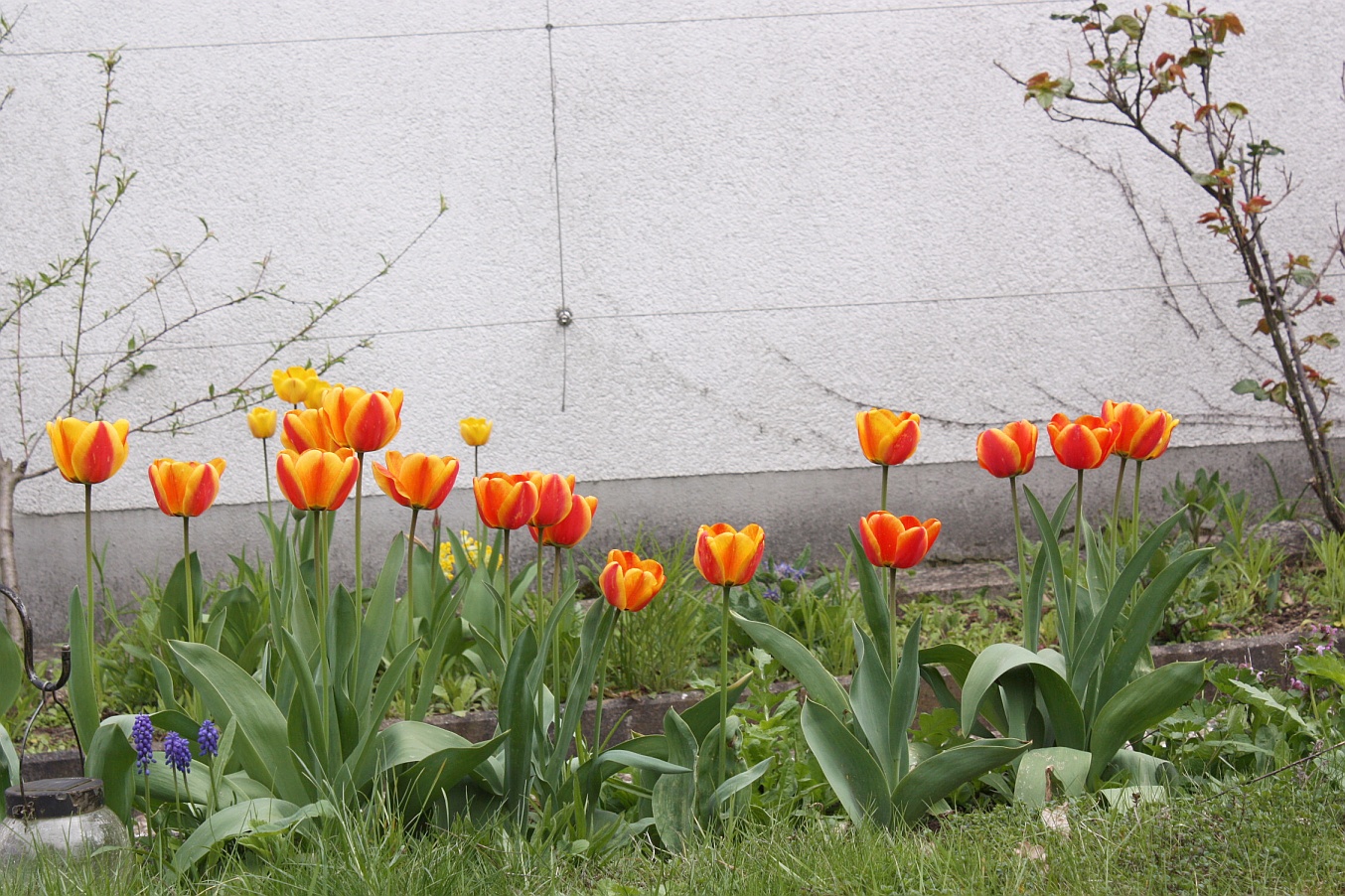
First of all, here's how the red-and-yellow tulips look today:

redtulips
They are lovely, and they seem to be really robust - several years ago, a friend brought us ten red-yellow bulbs, ten black ones and ten white ones. There's one small white tulip left from that planting, the black ones have all disappeared by now, but the red-and-yellow ones are going so strong that I even had enough bulbs for a second cluster somewhere else in the garden last year. (I'm a little sad about the white and black ones. I really liked them!)

In other news, I've been busy working on one project which I cannot disclose yet, plus preparing for both the IRM (drawing closer and closer) and the Internationaler Museumstag, taking place on the third Sunday in May (so this year it's May 22). I'll be in Darmstadt on that day, demonstrating really early textile techniques - think neolithic times. This is a bit earlier than my normal focus time, so I'm extra excited and happy to do something different this time around, and have been doing some preparation work for it. (That will include taking a few photographs for the programme and PR, which is on my to-do-list for tomorrow.) Some more prep work is also planned - I'll have to harvest a few samples of plants that were used for these proto-textiles, but this is a task better done nearer to the actual event. Speaking of which - the programme for the day in the Landesmuseum Darmstadt is not online yet, but I've had a sneak peek, and I can tell you that it is chock full of interesting things!
0
MäRZ
23
0

Have some Wednesday Links.

It's the middle of a week! And a shorter one at that - time for some links!

Jane Austen's novel "Emma" has its 200 year anniversary this year, and there's an exhibition about it at Chawton House Library, Hampshire, UK. The exhibition will run until September 25, 2016, so if you want to see it, there's still plenty of time left to plan a trip. If you like textiles (which you probably do, since you are reading this blog), it gets even better: part of the exhibition features contemporary embroideries, inspired by patterns from Austen's time. This part is called Stitch-Off, and you can read more about it here. If you're curious about the patterns used, you can find them here, and if your fingers are itching, it's still possible to join in on the project.

Totally unrelated, but rather funny: the UK is building a new polar research ship and they have invited the public to suggest names for their vessel - with interesting results. The leading suggestion is Boaty McBoatface. (The Council responsible was smart, though, as they are only inviting suggestions - they'll be free to pick whatever name they like best in the end.)

 
0
MäRZ
03
0

Calls for Papers! Date for NESAT!

There are two Calls for Papers open currently that have come to my attention (which usually happens through an email in my inbox). The first one is for Assemblage, Sheffield's peer-reviewed graduate journal of archaeology. Assemblage is currently seeking submissions for its 15th issue. Since 1996, assemblage has been run by postgraduate students at the University of Sheffield, and publishes articles and features on a wide array of topics related to the field of archaeology.

The publishers invite postgraduates and early career researchers to email articles between 3,000 and 5,000 words to Diese E-Mail-Adresse ist vor Spambots geschützt! Zur Anzeige muss JavaScript eingeschaltet sein. by 1 April, 2016.

You can access previous issues and view submission guidelines at http://www.assemblage.group.shef.ac.uk/.

The second CfP is really exciting, at least to me - as it's for NESAT! The next conference now has not only a place (Liberec in the Czech Republic), but also a date (May 22-26). The CfP is also open and will remain so until May 31. The organisers encourage papers that present lesser-known or recently excavated textiles, techniques and iconography that will generate discussion and exchange of information among conference attendees. In addition, this conference will include a poster session. Posters can be focused on any topic related to
archaeological textiles, but should be primarily visual.

You can find the schedule for the conference preparation here on the NESAT website, and the first entry also links to the full call as a pdf file.
0
FEB.
29
0

Recent Textile Stuff.

Here's some textile-related stuff (finally, as promised) that has popped up during the last few days. Enjoy!

Tracy Hudson has an article up in the EXARC digital journal, looking at spinning experiments and how much they can tell us.

Another exciting thing, right at my doorstep: The Kaisermäntel ("emperor's cloaks) in Bamberg are getting some quality research time, and it already looks like the researchers will find exciting things, such as remains of pre-drawings on the fabric (link goes to a German article). There are six pieces counted as Kaisergewänder, and they are the oldest extant textiles of European rulers, dating back mostly to the 11th century. Only mostly, as the fine gold embroidery was cut out from the original ground cloth and transferred to new silk ground fabrics.

It was assumed until now that the original placement of the embroideries was preserved during that transfer, but current research will look into that. Art historian Dr. Tanja Kohwagner-Nikolai, who is working on these wonderful textiles, is doubting that the original arrangement has been preserved especially regarding the Sternenmantel, which is a cloak with embroideries of constellations. She suspects that the embroideries were purposefully arranged differently, with the intention of supporting a cult around the rulers Heinrich and Kunigunde.

The project will run for the next four years, looking into different questions around the pieces and their history from the 11th to the 15th century, up to their last conservation and restauration in mid-20th century. Research will be interdisciplinary, with material and technological analyses, historical and art historical methods combined.

This is a very exciting project - I do hope they will get a lot of good results from the analyses! If you'd like more information, here is the (German) page of Uni Bamberg about the project. If you are in the area, you can visit the Diözesanmuseum and see the garments for yourself (the museum is open Tue-Sun 10-17 o'clock).

Sarah Bendall has posted the next chapter on her effigy bodies reconstruction: Boning and Binding.

Finally, rather unrelated, but really interesting: Barbie dolls dressed up with hijabs.
0
DEZ.
21
0

CfPs, and a job offer thingie.

Somehow I have accumulated a whole stack of things that wait to be shared, and since the holidays are very close now, I'd better start sharing them right away...

First of all, there are two calls for papers, both for sessions at the EAA, or more precisely the 22nd Annual Meeting of the EAA in Vilnius 2016 (31st August – 4th September).
All relevant information about the EAA conference, conditions, fees, accommodation etc., can be found on the conference web page, http://eaavilnius2016.lt/:1. Conference and membership fees and conditions: http://eaavilnius2016.lt/registration-fees-and-conditions/2. Accommodation: http://eaavilnius2016.lt/registration-fees-and-conditions/ and http://www.vilnius-tourism.lt/en/information/accommodation/3. Guidelines for speakers and poster presentations: http://eaavilnius2016.lt/general-info/guidelines/4. Deadlines: http://eaavilnius2016.lt/general-info/deadlines/
Untold Stories: Technology, Linearity and Complexity in Archaeological Thought.

The material record naturally lends itself to long-term perspectives. In few areas is this as apparent as the study of technology, which has historically been closely intertwined with the disciplines of archaeology and anthropology. But has our focus on the long-term caused us to unwittingly shape a unilinear, technologically deterministic picture of the past? And is there something to be learnt from the parts of the story which have been pruned from this evolutionist model?

The papers presented in this session will explore examples of how our pattern-seeking approaches have excluded interesting aspects of the story of the relationship between humanity and technology, and the methods by which we can reinstate these. We argue in favour of complexity (but not as a rule); of the little details which can enrich or subvert archaeological grand narratives, while acknowledging that the latter are also an integral part of our discipline.

This session is intended to stimulate discussion of our current approaches to the archaeology of technology, and to consider ways in which they can be developed in order to inform broader theoretical and methodological developments.

The deadline for submissions is February 15. More info and abstract submission:  http://eaavilnius2016.lt/
And another session at the same conference:

TH1-13: ‘Tradition and innovation in textile technology in Bronze Age Europe and the Mediterranean’ has been provisionally accepted in the theme "Interpreting the Archaeological Record", and the call for proposals of papers and posters has now been opened.

Textile craft with its complex technology and socio-cultural significance has been a key craft in the societies of Bronze Age Europe and the Mediterranean. However complex and socially and economically important, textile technology has often been considered as being rather traditional and non-innovative throughout many centuries of the Bronze Age.
The present session aims to examine textile technology in search for its traditional and innovative elements, through investigating the evidence of archaeological textiles, textile tools and their diachronic changes, botanical and faunal environment, textual sources and imagery of textiles and cloths. The session will focus on the Bronze Age in Europe and the Mediterranean, although papers referring to transitional periods from the Neolithic to the Early Bronze Age, and from the Late Bronze Age to the Early Iron Age will also be welcomed.
We particularly welcome all papers discussing various aspects of traditions and innovations traced in textile technology, especially these regarding raw materials and their processing, textile techniques, textile tools and equipment, organisation of textile production and dynamics of its specialisations, cross-cultural and cross-craft interactions, and changes of textile craft in relation to socio-cultural transformations of the past societies.

All paper and poster proposals should be submitted electronically at: https://www.eventure-online.com/eventure/welcome.form?type=abstract&congress=152_EAA&c=bd4350a3-56f9-46d1-8d66-514d76e0eb3c by 15 February 2016.
EXARC invites to a meeting called Goals and perspectives for experimental archaeology and archaeological open-air museums, Leiden (NL), taking place March 10 to 13, 2016. More about the meeting can be found here.

In addition, there's a PhD project in Glasgow, with a spot for a student. The research project will develop nanoparticles for the treatment of textiles found in the Mary Rose. More about this and contact for application can be found at the Glasgow Textile Conservation blog.
And that's all conference and job links I have for now...
0
DEZ.
03
0

Finally a new website for the Forum.

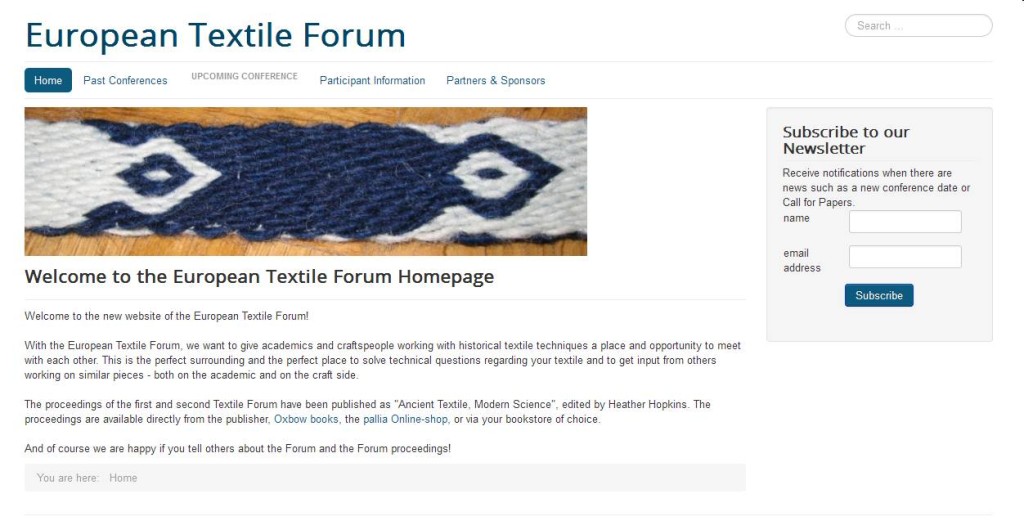
Yes, I'm sure the last thing you want to hear about (again!) is the website stuff I've been dealing with... but bear with me one last time, as it's not my own website. Instead, it's the site of the European Textile Forum - which also had to transfer to a new server when I was changing my provider.

I took the opportunity to do some long-overdue overhauling of the site as well. It's not completely done yet (there's more stuff lined up to be made available again, in the new structure and hopefully in a more accessible way), but it's online, it's serviceable, it now also runs on Joomla! and there are a lot of small, behind-the-scenes changes that should make organising work for the next Forum a good bit easier for me. (Easier is always nice.)

[caption id="attachment_2048" align="alignnone" width="640"]etf-screenshot This is how the page looks now - much nicer than before, I think. I hope you like it, and like always, if you have feedback - it's more than welcome!


I asked my new Internet guy to make the connection to the new place yesterday, and it went through delightfully fast, so you can now join me in enjoying the new site. And if you're interested in the Forum, or know somebody who might be, there's a newsletter you can subscribe to and we'll send you the occasional news and Call for Papers.

(My new Internet guy, by the way, has the wonderful company name Schwarzkünstler. That translates, literally, as "black artist", and that would have been someone in the printing business way back when printing was still new and it was still considered an art. Which means, as the internet is sort of the new form of print in a way, I get to have a little private squee for that name every time I see it. Which is very, very often at the moment, with all the logging in and transferring files...)
0

By accepting you will be accessing a service provided by a third-party external to https://www.pallia.net/

Kontakt