







Latest Comments

Guest - Aislinn Dyestuff Citizen Science.
09. Oktober 2026
This is a great project. I look forward to the results. Thanks for letting us know.
Guest - Aislinn Time for...
09. Oktober 2026
Looks delicious!
Guest - Katrin Sprang Discussion
18. September 2026
Hi Rachel, I have looked for more photos of you, but that was not very successful. I found a link on...
Guest - Beatrix Sprang Discussion
15. September 2026
That lozenge pattern element is not a photograph, but a scan. So it should be to scale. But I pinned...
Guest - Katrin Sprang Discussion
15. September 2026
I was not referring to Rachel's reconstruction (is the reconstruction you refer to the one photograp...
MäRZ
22
0

Multi-Lingual Textile Terminology Resource!

Textile terminology, as many of you will probably know, can be a never-ending headache. Especially when you are looking at texts in a foreign language. Consequently, there have been a few attempts at making glossaries or catalogues; sometimes, there is a small multi-language glossary or dictionary in the appendix to a book or article. Burnham's "Warp and Weft" also states the terms for different weaves in several languages.

However, there's a whole book with textile terminology that I had never heard about before: “Nordisk textilteknisk terminologi- Förindustriell vävnadsproduktion”, written by  Elisabeth Strömberg, Agnes Geijer, Margrethe Hald and Martha Hoffman and published in 1967. The title of the book translates to “Nordic textile technical terminology - pre-industrial fabric  production”. The book consists of Swedish term definitions, with synonyms in Danish, Icelandic, Norwegian, Finnish, English, French and German. The edition was revised by Geijer and Hoffmann in 1979. The Icelandic and Finnish terms were compiled by Elsa E. Guðjónsson.

So there's a whole book out there - and it gets even better. Amica and Maria from historicaltextiles.org have brought together KulturNav, a website where museums and other organisations can have shared lists of things hosted; the Textile Museum in Borås, who agreed to manage the dataset from the book, and friendly help from fellow nerds to convert the whole book into a database.

And now it's done - the Terminology is online and available, for free, via KulturNav. You can find the whole back story, and some instructions on how to use the database, on the Historical Textiles blog, including instructions on how to contribute should you find something is missing, or would like to suggest a change.

This is a wonderful thing - and my thanks to everybody involved who made this possible!
0
FEB.
04
0

Internet Resources.

The Internet is full of helpful things, and I have a few more resources for you today. Hooray free helpful things!

First of all, the Book of Kells is online, in all its digitised splendour and glory, free for you to look at! Here's the official announcement from the Trinity College Dublin, and here's the direct link to the digital book.

Aarhus Uni Press' free e-book of the month is Re-Mapping Exile (edited by Michael Böss, Irene Gilsenan Nordin and Britta Olinder); it's a collection of essays about aspects of exile in Irish writing.

And finally my discovery of yesterday: The Reallexikon zur Deutschen Kunstgeschichte is available online, for free, under the title of RDK Labor. It works like a wiki in that you can also submit articles, and it's a huge resource of information on German art history.

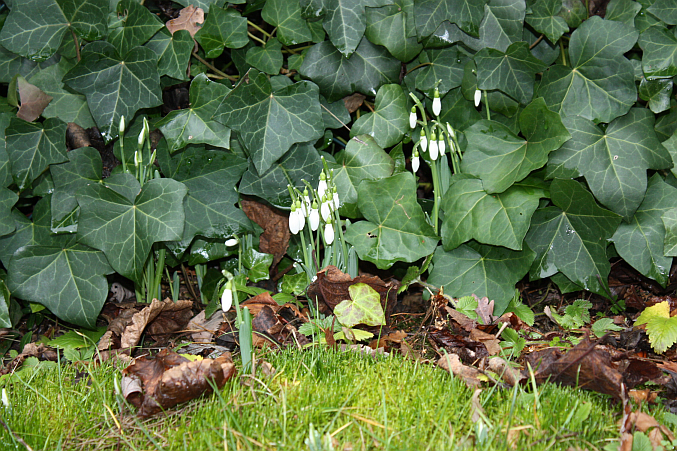
On a completely different note, it's snowing outside, and - very fittingly - the snowdrops are blooming:

snowdrops
0
DEZ.
18
0

I'm back home, and I have stuff for you.

You're getting a late blogpost today because I had slow internet today, and it even ate a half-written post... but you are getting one, and it is one with free stuff! (Very fitting for the season...)

First of all, as a reminder - free ebook in Aarhus Uni Press this month is Woven into the Earth. Go download it if you haven't done so yet, and tell your friends who are interested in archaeological textiles. This is a wonderful book, and it is definitely good to have.

You already downloaded it? You would like more books? Here you go.

On a completely different, and very much non-archaeological note - there is a free e-book about working with MS Word, "Microsoft Word for Publishing Professionals" by Jack M. Lyon. A few years ago, the author's newsletter "Editorium" helped me a lot when prodding my thesis text into shape, as well as later when I had typesetting to do. If you're working with Word (as so many people in the social/historical/archaeological sciences do), you might want to give it a look.

And now on to the juicy bits.

I had the opportunity to visit Estonia for a few days, and I didn't only meet lovely fellow textile people and fellow archaeologists and got to see exciting finds in several museums and a good number of the Estonian textile finds, I also brought home some books (about, who would have guessed it, Estonian textile finds). Two of them are about the finds from Siksälä, which is a burial site used continuously from the 11th to the 15th century - the Estonian Iron Age and Middle Ages. Siksälä has yielded exceptionally rich finds, including textiles wonderfully decorated with bronze spirals. There's a publication in two parts, a text part and a catalogue part; both are in Estonian*, but anyone can look at the pictures and construction drawings. And if I say anyone, I do mean it - both the first volume and the second volume are available online, free of charge, thanks to the University of Tartu.

Another absolutely amazing Estonian find is the craft box from Lohavere (which should be written with a little ~ sitting on top of the o), which comes from the hillfort of the same name, dated to the 12th and early 13th century. If you know the Mästermyr find and have always dreamt of something similar, but related to textiles? Here it is. The craft box, made from birch bark, contained textile remains, prefabricated and half-finished products, bronze ornaments and tools, some of them neatly stored in smaller boxes or little pouches. It is an absolutely fascinating find and gives so much information about how the spiral decorations were worked... and it, too, is published in a little book, and that, too, is available online free of charge.

These finds absolutely deserve to be better-known - so feel free to spread the word, and of course enjoy the publications of these gorgeous finds!

*Estonian is a language belonging to the Finno-Ugric group, and more or less related to Finnish. A few fun facts: Estonian has fourteen cases. Yes, fourteen - because there are no words to signal direction (like "into" or "from"), and a case is used instead. More fun facts? Estonian has no genders, so there's no problem with being politically correct. Because there were a lot of Germans in Estonia in the Middle Ages (Hanseatic League was a reason for that, for instance) there are quite a few German words still around, which makes not understanding most of the rest even more peculiar. Final fun fact for today: as I'm easily amused, it diverted me no end that the greeting "Tere" sounds much like the southern German colloquial "Dere" (which is very short for "Habe die Ehre", I have the honour). If you're intrigued now, here are a few useful Estonian phrases, and here is a very interesting pdf with facts about Estonian.
0
DEZ.
16
0

How to prevent Win10 from taking over your computer.

A friend recently told me she now has Windows 10 - which she didn't want. It did not care for her wants or wishes, however; it just went ahead and installed itself.

If you're running Windows and would like to avoid the same thing happening, you can use the GWX stopper tool - explanations and download link can be found here.

If you're guessing now that I am using this thing, you're completely right - I would like to decide myself when to change operating system, thankyouverymuch!
0
DEZ.
02
0

Aarhus Uni gives you an early present!

Aarhus University Press has a long list of books in their catalogue, and they include Else Oestergaard's "Woven into the Earth", the wonderful book about the garment finds from Greenland. They also have a monthly campaign of one e-book that they post on their site, downloadable for free.

Guess what this month's ebook is? Right - Woven into the Earth. Go here to download it, and feel free to spread the word. The book is absolutely wonderful and a must-have if you are interested in medieval garments. (h/t to Christa, who found this first.)

Other delightful news - the open-air museum village in Düppel, where I went to give a presentation this summer, has won a cultural award given out by Berlin. Congratulations!
0
NOV.
30
0

Catching up on Link Stuff.

There's a stack of lovely links to share with you, so you're not getting an "Old Knitting" post today (wait for tomorrow, though...)

Instead, here is other stuff I hope you'll enjoy:

Uppsala University has a new database called "Gender and Work", where you can search and find different sources regarding, well, gender and work. While the title sounds very international, it looks like the database interface and the base itself are Swedish only. Still, if you are looking for sources and can read Swedish, this might be a lovely tool for you.

The next one is definitely in English. I know this, because I have helped making it myself... as you might know, I am a fan of the wonderful Escape Pod, so when I met with Alasdair at LonCon, I volunteered, spur-of-the-moment, to be one of their narrators. Well, though my first story is not for Escape Pod, but for Cast of Wonders (which is a YA podcast, soon to be part of the Escape Artists flock), I'm very excited that it is live now. You can listen to me narrate "Fairy Bones" by Guy Stewart here. (My voice is a little nicer usually, those were the last dregs of the Cold of Doom that had me in its claws for a while.)

If you read German and are interested in material culture of the Middle Ages Roman Age, there's an interesting (and textile-/clothing-related) article at Archaeologik, titled "Von Menschen und Kapuzenmänteln oder Wie kommuniziert eine Gesellschaft mit Alltagsgegenständen?".

You prefer more English? Here you go. There's a long poem listing an incredible amount of weird pronounciation rules (or exceptions) in English, called, fittingly, "Chaos". Sometimes, people attempt to read it, and here's one of the many youtube videos of it:


In final news, I'm hard at work getting the new European Textile Forum pages finished and online. I've kept records of how the old pages did look (which included the programmes, well, at least mostly!) but there was no real, proper archive. This will change now for the better, and it will also make administration and preparation of the Forum easier for me in the future (at least I hope so).
0
OKT.
16
0

Our Blog Tour has started!

I'm happy to announce the first post of our blog tour, over at the Travelling History blog. Gillian and I went through our photo archives for this one, and we hope you'll enjoy the pictures.

Our book was also mentioned in an article in the Western Telegraph, along with several other books about the Middle Ages.

Let's stay book-related - there's an open access ebook about words and language called Medieval Hackers. If you're interested in language and history of words and wording, give it a look.

And still staying with books, though from a slightly different angle, I found this article about the Kubler-Ross Model of Grief Associated with Editing and Rewriting utterly hilarious. And oh so true! I remember that time my phd thesis draft got completely pulled apart, resulting in a huge re-write and some re-ordering. I was devastated, and annoyed, and then even more annoyed (but differently) when I realised that all the criticism was, indeed, valid points and the book could be so much better if I did those edits. Similar things happened in other areas - I've done layouting and thought that my choice of fonts was fine, until someone came along and told me "I'd rather recommend that". Well, what shall I say? He was utterly right.

The good thing about getting edits, and getting over it - after the first few times of running through the phases, it gets easier and easier to take that deep breath and think "well, I'll just try the recommended edit on for size, I can always change it back if it's not better than it is now". (Not surprisingly, it usually was better after the change my editors suggested. I'm a lucky one to have had these editors!)
0

By accepting you will be accessing a service provided by a third-party external to https://www.pallia.net/

Kontakt