Latest Comments

Guest - Aislinn Dyestuff Citizen Science.
09. Oktober 2026
This is a great project. I look forward to the results. Thanks for letting us know.
Guest - Aislinn Time for...
09. Oktober 2026
Looks delicious!
Guest - Katrin Sprang Discussion
18. September 2026
Hi Rachel, I have looked for more photos of you, but that was not very successful. I found a link on...
Guest - Beatrix Sprang Discussion
15. September 2026
That lozenge pattern element is not a photograph, but a scan. So it should be to scale. But I pinned...
Guest - Katrin Sprang Discussion
15. September 2026
I was not referring to Rachel's reconstruction (is the reconstruction you refer to the one photograp...
JULI
17
0

Maney Journal of the Month, and other stuff.

Time for a few links for your reading delectation!

Maney's  Journal of the Month is Costume, the journal of the Costume Society. Which means they are offering 50 articles for free access until the end of this month. Most (if not all of them) are post-medieval and modern in focus.

Not enough reading? Not early enough? How about some Egyptian stuff? A 2010 conference at the Egypt centre had quite a few textile-related topics. The conference papers have now been published in book form, and there's also a streaming archive on this website so you can download the individual presentations in podcast form.

Not medieval enough? Go over to historyextra, where Gillian and I co-wrote an article about 7 weird and wonderful medieval facts in celebration of the Beast's publication.
0
JUNI
12
0

Friday Linkfest.

There's a huge stack of links I want to share with you!


A German archaeologist, specialising on excavation and research of gallows squares and other places of execution, is trying out crowdfunding for her upcoming excavation project. You can take a look at the (German) page here - it definitely is an interesting excavation, and I hope she'll succeed with her funding!

Ferguson Municipal Public Library has received the award for the "Library of the Year". The article shows what a library can be and do for the public - that award was really deserved!

You might have stumbled across an article telling you that chocolate can help weight loss during the last months - it was all over the internet, and apparently all over print media, too. That study was actually a half-hoax - it was intended to show how unreliable pseudo-studies will have an impact on diet fads and public opinion, revealed by the author about two weeks ago. Let's hope this helps, because what John Bohannon writes about the many studies that tell you anything you wish is unfortunately true... fat is good for you, fat is bad for you, carbohydrates are good for you, bad for you, ... there's studies to prove all this. More or less, that is.

The Sad Puppies Hugo thing is still making waves.
Related to that, Kameron Hurley has a rant on her blog that I found well worth reading.

The Middle Ages' love for colour extended to the subtle colouring of gold alloys - as evident on the Shrine of Our Lady of Huy, c 1260. A group of researchers has studied recipes and the actual colouring of the shrine. (Linked article contains link to the actual study paper behind the Maney paywall.)

Genevra Kornbluth has a photo archive about "luxury arts" online, including many museum objects dating back to the Middle Ages.

And if that was not enough of a Linkfest for you, go over to Phiala's blog - she has linkage, too.
0
MAI
28
2

The Handling of Mistakes.

We all make mistakes, small ones, big ones, some that are easily fixed and some that haunt us for ages. (Sometimes small, easily fixed ones can still be of the haunting sort, though.) Mistakes are not nice to make, but they are a part of life, and every one of them is an opportunity to learn, and do better next time.

Mistakes are also an opportunity to think things over, and maybe alter them to the better. There's no such thing as a perfect script, as any writer knows... finding mistakes and editing them is a process that makes the final manuscript a much better piece, since there will inevitably be stuff that is not a real proper mistake, but can do with some change for the better anyways.
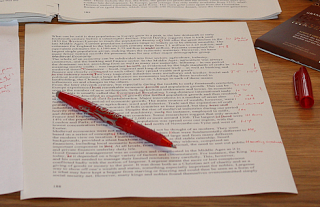
You don't want to know how many typos we found in the Beast in the final big edit.
Trust me. You don't.


But does that mean every mistake should remain visible? That is the suggestion of Guy Claxton, who says erasers are an instrument of the devil and should be banned from classrooms (all quotes in the following are from this article). Because, and now comes the point that makes me groan,
...schools should encourage students to acknowledge their mistakes because that’s the way the “big wide world” works...
Erm, excuse me? Mister Claxton, what planet are you living on, and how can I get there? The last time I looked around in the "big wide world" that I am currently living in, mistakes are not acknowledged, oh no. They are brushed over, or hushed up, or even rewarded with a hefty chunk of severance pay. When was the last time you heard a politician declare openly and publicly that he or she had fucked up, made a serious mistake, is very sorry and then actually did something to remedy the error? Or when did they obviously learn from a mistake?

There's massive protest against TTIP and CETA (go sign the protest if you have not yet done so, please); but do the politicians admit that it might have been a mistake? Nope - they are still trying to push it through. There's bees dying everywhere because of new pesticides, but does that lead to a ban on these chemicals? Ah no.

Don't even get me started on the EU VAT stuff. 2015 is half gone, the Digital VAT has proven to be a huge problem for small traders, many of which have closed their doors, but what is happening? Very very little, and very very slowly - and the plans to extend the new rules to all goods in 2016 still persist. (Please sign the petition if you have not yet done so, and spread the word so that others sign it, too. It's not looking good for small businesses at the moment, and that does include my own business.)

Do I need to go on? I don't think so. If we have a culture of standing up and admitting your own mistakes, and then openly correcting them and trying not to make a similar mistake in the future, I think it is hiding very, very well in this "big wide world" of ours. At least it's not the culture that our captains of industry, politicians and magnates are steeped in.
Speaking to the Daily Telegraph, professor Claxton said: “The eraser is an instrument of the devil because it perpetuates a culture of shame about error. It’s a way of lying to the world, which says ‘I didn’t make a mistake. I got it right first time.’ That’s what happens when you can rub it out and replace it.
Being able to fix your mistakes and make things better is not something, in my experience, that perpetuates shame about the error. On the contrary - I'd be much more ashamed about something that has to stand visibly for everybody to see. I do know that many of my colleagues feel the same about visible errors in their craftwork. If it can be fixed without trace, it should be okay to fix without trace; often enough, that is not the case anyway, because there will remain a reminder of the error that is at least visible to the person who made the thing. Life is hard enough without having to live with all your little mistakes visible to the world, too.

If you are not tired of reading about this topic yet, hop over to Another Damned Medievalist's blog, whose post in reply to the piece about erasers was the reason for this whole post. (I really just wanted to write a few words before linking to her, but then I got off on a tangent.) ADM's looking at the eraser-is-the-devil thing from a different angle and takes it apart with a little historical knowledge. (To whoever groused her at Leeds to blog more again: thank you!)
0
MAI
27
0

Looking for manuscripts?

If you are researching sources, be it written or image sources, on the internet or in real physical publications, you will have run into the how-to-find-stuff problem: There is a bunch of things very easy to find, as they are quite prominent. So everybody finds them, and everybody knows them.

Then, of course, these things get cited, and linked to, and re-published, which makes them even easier to find. The books less looked at, the sites less often linked to? Not so visible. Or, as digitizedmedievalmanuscripts.org puts it:

Finding digitized medieval manuscripts is not an easy task: the most prominent libraries are easily found and pinpointed on the maps. Problems arise for all the other digitized libraries that are not discoverable through search engines for many reasons (the website is not optimized or not accessible by crawlers and doesn't appear on web searches, the library is in a language different from English only, or, more in general, the website is difficult to access due to poor web design).
That, of course, is not only true for manuscripts, but DMMapp collects digitised medieval manuscript libraries. There's a long list of libraries that have manuscripts digitised and online, for free - so if you are looking for some things less often looked at... look no further. (Or do, and make sure to tell them about the library if it's not yet in the list.)
0
MAI
14
1

Lovely Linkfest.

There is a stack of links to things you might find interesting again - time to clear out those browser tabs and send you careening through the internet!

First of all, Cathy writes about Greek sprang hairnets.

Erik Kwakkel writes about rare medieval name tags - from foundlings.

Neil Gaiman was interviewed about reading by Reading Rainbow, and talks about comfort reading (among other things).

An Anglo-Saxon recipe for an antibiotic has tested succesfully against a modern resistant bacterial strain - the Independent has an article about this (though I wouldn't call the recipe revolting, as they do).
0
MAI
08
1

Friday Links.

Friday, linktime...

Amica and Maria, two textile nerds (according to their own description) have started a new blog called Historical Textiles.

Gillian Polack is collecting recipes from SF fandom, and she wants yours too. The recipes will end up in a book - fandom deliciousness!

apc has a monograph about an excavation from York online, and it includes textile-related finds (among them a needle): Blue Bridge Lane & Fishergate House.

More research literature? Uni of Groningen has a publications database that might make you happy.

If you prefer something with more pictures, here's a collection of bizarre images from medieval manuscripts.

Sad things are happening too, unfortunately: The Tsock Tsarina has returned to her blog, but for the worst of all reasons - to announce that she has terminal cancer. I learned how to knit while following her instructions on how to make socks in "Tsocks 101", and her sock designs are something that always make me smile. Fuck cancer.


0
MäRZ
25
0

Machines, Translations, Chess Pieces.

More links for you!

There's a database of medieval and early modern machine drawings available online, for free; the earliest drawings are by Villard de Honnecourt, from the thirteenth century.

If that is not madness enough for you, why not try this blog? It gives you a new chapter of Amadis of Gaul (1508) every Tuesday, translated into English. (This book drove Don Quixote mad, or so the blog says.)

Also: chess pieces, found in Northampton.
0

By accepting you will be accessing a service provided by a third-party external to https://www.pallia.net/

Kontakt







