Latest Comments

Guest - Aislinn Dyestuff Citizen Science.
09. Oktober 2026
This is a great project. I look forward to the results. Thanks for letting us know.
Guest - Aislinn Time for...
09. Oktober 2026
Looks delicious!
Guest - Katrin Sprang Discussion
18. September 2026
Hi Rachel, I have looked for more photos of you, but that was not very successful. I found a link on...
Guest - Beatrix Sprang Discussion
15. September 2026
That lozenge pattern element is not a photograph, but a scan. So it should be to scale. But I pinned...
Guest - Katrin Sprang Discussion
15. September 2026
I was not referring to Rachel's reconstruction (is the reconstruction you refer to the one photograp...
FEB.
10
2

Gummy Silk - The Adventure Goes On.

Well, I definitely got your attention with the gummy silk thing yesterday!

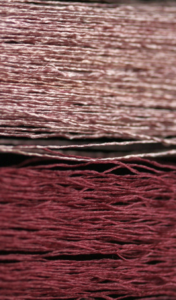
First of all, here's a better picture of the two silks side by side:


Now to the answers to all the comments yesterday...

Jessica's comment was:

That's really interesting! And it probably explains the deep colours we see in medieval embroidery. And how they were able to do couching over padding with a relatively thin thread and still being able to force the gold threads into place and keep them there. How does this partly gummed silk compare to modern Chinese flat silk? That's my go-to silk for medieval projects as it produces embroidery with a slight wavey texture as seen in medieval embroidery.
The gummy silk is quite a bit stiffer than the de-gummed one. The flat silk that I know is much more prone to snagging on anything that looks like it might be rough, but I haven't been able to do a proper comparison with similar silks yet. The gummy sample was a bit of the Texel stocking silk, which is a four-ply silk with slightly twisted singles, the de-gummed was flat silk (my embroidery silk). I have flat gummy silk here, but it's much thinner than the embroidery silk. On my list is trying to make a thicker thread from it, similar in size to the embroidery silk, and see how that compares. That will involve some winding first, though, and fortunately-unfortunately I'm a bit too swamped with other things right now to sit down and do that.
My guess would be that the textures the gummy silk will result in will be a bit different from the degummed one, but how much? That would need some investigation...
Beatrix wrote:

I wrote an article a while ago where I came upon twisted medieval silk. This is from my article:
Lisa Monnas and Roberta Orsi Landini wrote on S-twisted silk threads: ´fourteenth-century velvets usually have Z-spun main ends…but from the late 1420s their [i.e. Italian velvets] main warp threads were generally S-twisted. In contrast Ottoman velvets of the late 15th and 16th centuries generally have Z-twisted main warp threads´ (Monnas 2012, 15); ‘the finest silk thread was used for the warp: strong shiny silk organzine, generally made up of 2 S-twisted ends’ (Orsi Landini 2017, 15-16).
Monnas, L. (2012) Renaissance velvets. London: V&A Publishing.
Orsi Landini, R. (2017) The velvets in the collection of the Costume Gallery in Florence / I velluti nella collezione della Galleria del costume di Firenze. Riggisberg and Florence: Edizioni Polistampa.
So even reeled silk seems to have been twisted - at least a bit.
There's definitely silk with twist - sorry if my post sounded like there was only the untwisted version. Organzine, which is a 2-ply from more or less twisted singles, is also still used today as fine silk for weaving. It's much less prone to snagging than untwisted single, and still has a very nice shine to it.
The silk with very little or almost no twist is an exception, usually there's at least a bit of twist in there. Some is already added (or can be added) when reeling it off the cocoons. Usually, that small amount of twist makes no difference whatsoever - unless you're doing something like the Albecunde belt, where there will be an optical difference between the two tablet turn directions. That belt only works as wonderfully well as it does. Embroideries also usually seem to use really flat silk with no appreciable twist, though a little bit of twist there will not have too much of an impact, at least according to my experiences - plus you can always twist the needle to add or remove twist if it does.

Finally, Florence asked:
How does one de-gum silk?
There's several different ways to do it; you can read more about how the process works here (where different methods used in the industry are given).

The classical method is to boil it off with soap, typically Marseille soap, which is based on olive oil. Which is also what I used for the de-gumming test I did today with a bit of the Texel silk.

[caption id="attachment_6739" align="alignnone" width="300"] During the de-gumming process - it's starting to lose some of the colour to the soap soup.
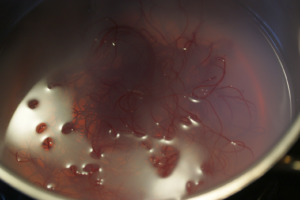

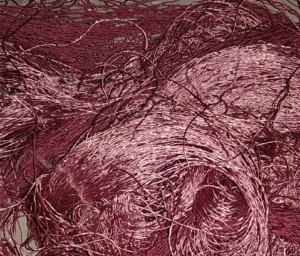
It's hanging out to dry right now, so proper colour comparison may only come later. I'm just as curious as you are!
0
FEB.
09
11

Gummy or Not Gummy...

Sometimes, some detail in research pops up, and then it keeps haunting you, and occupying you, just a tiny bit. It's not growing into a big project, but it is always there, and occasionally, things touch it and then you try and fit the new thoughts into the current theories.

Well, that was probably a bit cryptic. So. Let me explain. About... silk.

As you probably know, most silk used in the Middle Ages was reeled, not spun - the long filaments from several cocoons wound off said cocoons together to get you a thread of silk. The more cocoons, the thicker your thread.

When the silkworm makes the cocoons, they're for its protection - so they are pretty hard. That's caused by sericin, or silk gum, which is more or less a protein-based glue sticking the filaments together and hardening them into a nice, protective shell. Hot water softens the sericin so the cocoons can be reeled off (it also kills the silkworm). The glue stays on, though, getting you... gummy silk, or raw silk.

This raw silk is stiff and can feel like a stiff nylon thread, very un-like the soft silk that we know today... because modern silk is usually completely de-gummed.

The thing about de-gummed silk? If you don't twist it, it is very fragile and prone to snagging. It's hard to handle altogether (though yes, very soft and shiny). Since talking to a conservator friend years ago who told me that usually, medieval silks have a much firmer structure than modern ones, I've been wondering about the use of gummy or partially gummy silk in history. The more recent research about the Albecund band is making me more and more convinced that gummy silk would be the solution to a few of the issues with weaving such a band.

One of the questions in that regard was - how does dyeing gummy silk work? Will it dye well? And will the dye be fast? (Side question - what happens if you de-gum it after dyeing?)

Well, I've gotten back two skeins that were test- dyed together, as in both mordanted and dyed together.


The gummy silk took on the colour much, much better... isn't that fascinating?

 
0
FEB.
08
0

Nalbinders Wanted!

Do you do nalbinding? If yes, you could help a fellow crafter and researcher with her thesis project - Nele Nuutinen is writing about nalbinding instruction books, and is running a survey about nalbinding instructions used to learn the technique.

You can find the survey here - it is open until March 2. Please feel free to share the link with other nalbinders, too!

 
0
FEB.
03
1

Shiny, shiny, shiny!

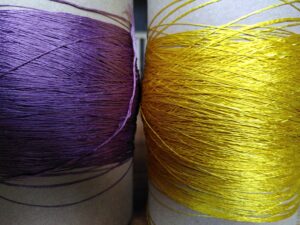
I'm all excited - the first batch of my embroidery silk in new colours arrived today, dyed lovingly and carefully by my friend and colleague Margit from Alte Künste. And she has managed to dye the most gorgeous yellow I've ever seen.


It's like liquid sunshine. It's like textile gold. It's warm and soft and it's yellow, yellow, yellow.

There's a lovely purple as well - and I have not yet wound off the red and the pink from their skeins into something better storeable and handle-able. Winding silk that fine, I have learned, can be a real challenge if you don't know what you are doing. The skeins, even if handled like raw eggs, tend to tangle a bit during the dyeing process. As this thread is flat silk that has been totally de-gummed, it snatches and tangles easily. My first tries at winding off silk from the skein, years ago, were the total catastrophe. I tried to do that with one of the common four-armed skein holders or swifts. Well. I very quickly found out that there's a reason why Japanese silk swifts have more than four arms... so I did upgrade to a swift with more arms, and that does make a huge difference. It's still a fiddly task. (Weirdly, it's also one that I find very hard to stop. Just past this one snag. Just until the next hitch. Just this one more. Just past this knotty tangle. Oh, is it half past three already? Oops. Well, I can do a few minutes more...)

Once  all the new skeins are wound, I can portion the silk off on the 10 m rolls for the shop, and take photos, and then you'll be able to buy it.

For today, though, I'll sit next to it for a bit longer and go "my preciousssssss"...
0
JAN.
28
0

New Sticks.

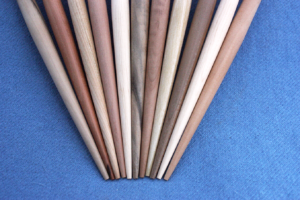
I have finally gotten around to taking photographs of the newly (well, sort-of-newly by now) arrived spindle sticks. I've restocked all kinds, and since they are handmade, they are always a little different in each batch.

This time, however, the pearwood sticks are really different - as in very, very colourful. Apparently pearwood has a quite large spectrum of possible appearances: while it's usually a kind of warm, soft reddish tone, it can range from very light (looking almost like cherry wood) to very dark (looking almost like walnut tree wood). And this time, well, my wood wizard seems to have gotten their hands on an especially colourful batch of wood.


So many different colours!  (You can get the sticks in my shop.)
0
JAN.
25
0

Spinning Done.

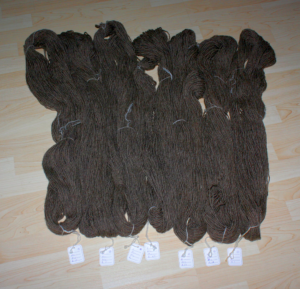
What you see here...


is the rest of the weft yarns spun for the Trindhøj man's garments. They've taken their bath and they have dried and they are en route to being woven... and I am very, very curious on how the finished fabric will turn out!

Each time I spin for a weaving project, I'm amazed at how much yarn is eaten up by a puny bit of fabric. Well, in this case, it's not so puny, with about 170 cm on 275 cm. That makes it a fairly good thing that the thread count per cm is not as high as in a medieval medium-fine fabric, but at only about 3-4 threads per centimetre.

Altogether, I've spun about 6400 m of yarn for this piece of fabric. The loom eats a generous portion as loom waste, which accounts for some of the extra yarn needed; then there's of course a bit of shrinkage after weaving, when the raw weave is wet finished. Finally, there's always need for some leeway just in case, it's not nice to run out of yarn right before the end. I've also added on a bit more of the weft yarn as one of the batches turned out to be rather thinner than intended.

Spinning consistently to the same thickness and the same amount of twist over a longer time - I still find that challenging. Though admittedly my comfort zone regarding yarn thicknesses has grown quite a bit in the past years compared to when I started spinning, and my tendency to gravitate towards a certain thickness of yarn has diminished with all the practice that I've been getting spinning yarns to specification for weaving projects. I think in that regard it did help a lot that some of these projects - like this one - required yarns that were a lot thicker than my default thin yarns.

Have you done spinning outside your comfort zone thickness? And/or spinning in bulk for a larger project?
0
JAN.
24
0

The Eternal Ink...

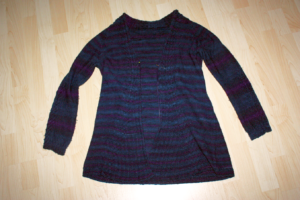
My eternal ink is finished, finally! I blame a number of things for it taking so long - among them, yes, the pandemic, as that seriously cut down on our opportunities to sit in a café and knit while enjoying some coffee. Travel times also were reduced greatly, though that was not as much of an influence, since the cardi is knit in one piece, and I have this rule about not taking along any projects that will not fit into my project bag. Which is rather small, because, you know, travel.

(I tend to lug along a plethora of things anyways, and usually way more than I will use or need, so it does make a lot of sense for me to limit myself.)

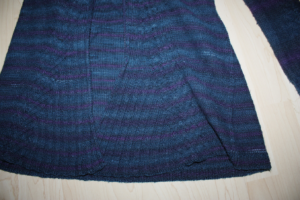
So here is some picture proof of the finished thing:


I'm very happy with it - the only thing left to do now is to sew in the zip so I can close it. The original pattern intends for it to stay open, and I've worn it a few times already now without a closure... but I like to have the option of wearing it closed, too. In case I end up not liking it with the zip, well, I can always take it out again.

The wool is very, very soft and nice to wear, and I also really like the colours. The stripes are not too blatant, but I think they add some interest, and the cables are also rather subtle but nice.


Also - I managed to tweak the pattern a bit while I was knitting so it fits me really, really well. Which is also a nice thing!
0

By accepting you will be accessing a service provided by a third-party external to https://www.pallia.net/

Kontakt