Latest Comments

Guest - Aislinn Dyestuff Citizen Science.
09. Oktober 2026
This is a great project. I look forward to the results. Thanks for letting us know.
Guest - Aislinn Time for...
09. Oktober 2026
Looks delicious!
Guest - Katrin Sprang Discussion
18. September 2026
Hi Rachel, I have looked for more photos of you, but that was not very successful. I found a link on...
Guest - Beatrix Sprang Discussion
15. September 2026
That lozenge pattern element is not a photograph, but a scan. So it should be to scale. But I pinned...
Guest - Katrin Sprang Discussion
15. September 2026
I was not referring to Rachel's reconstruction (is the reconstruction you refer to the one photograp...
AUG.
27
0

The Wheel is Turning.

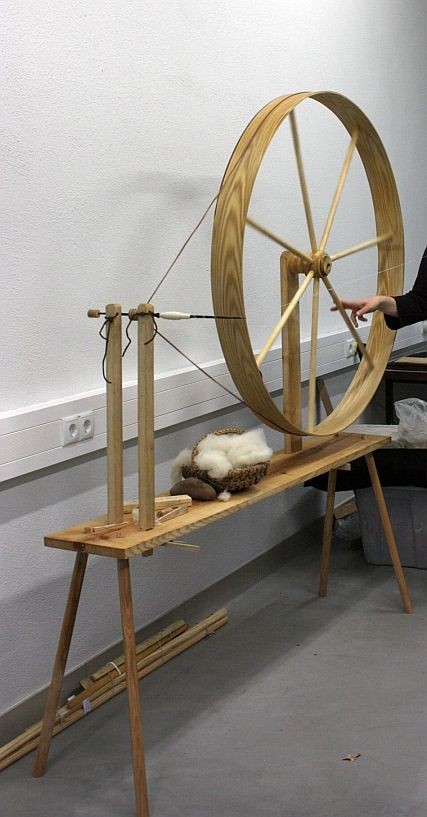
The wheel is set up, and it's been far too long since I've last taken it for a spin - it took me a bit to get it all running smoothly again. Though that is also due to trying the other spindle, which (still) does not work as nicely as the one I usually have.

Why? Well, it would be nice to know... The wheel is always a little wobbly, and depending on how the individual bits are aligned (and they have a tendency to shift a bit during use), the drive band stays on... or not. The "other" spindle has more of a tendency to shift, and there's only one good groove on it, so as soon as the drive band manages to hop out of that groove, it's gone and off completely. 

As there's no grooves or higher sides on the rim of the wheel, the drive band will also tend to slip off if the wheel is not well enough aligned. That can happen if the fixing wedge of the wheel support works itself loose, or if the whole thing is leaning a bit to one side and the wheel wanders on its axle, or if it's put on the wrong way around (though it is theoretically symmetrical, it isn't quite).

So. All those are reasons enough to take it out and give it a little test drive before it appears at a demonstration, but the main reason is actually for me to get some practice in... or I will have a very, very tired right arm very quickly otherwise! 
0
AUG.
23
0

...and once in a while...

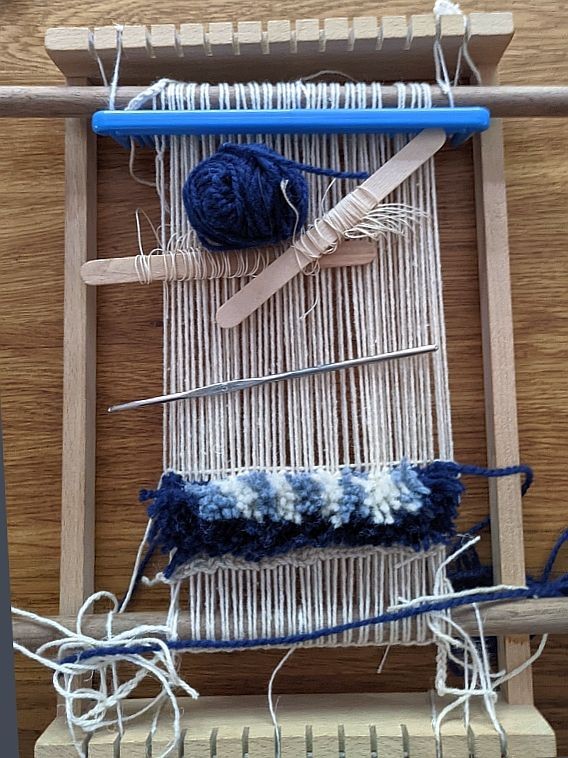
... I get to try something new. Thanks to an online workshop about traditional Turkish carpet weaving, I now know a lot more than before (though of course it was only covering the basics), and I managed to do a few rows of knots on my tiny practice piece:

It's definitely a fascinating technique, and as with so many textile techniques, the single steps and moves are simple and may look easy, but getting it all just so, and having a good, consistent result will take a lot of experience and practice. I hope I will be able to find some time to weave at least a little bit more, so I can take it off at some time and have a mini-carpet. Probably just large enough for the cat to sit on (though by far not large enough for her to curl up on...)

0
JUNI
17
2

Finally.

Sometimes, things take a lot longer than one thinks possible.

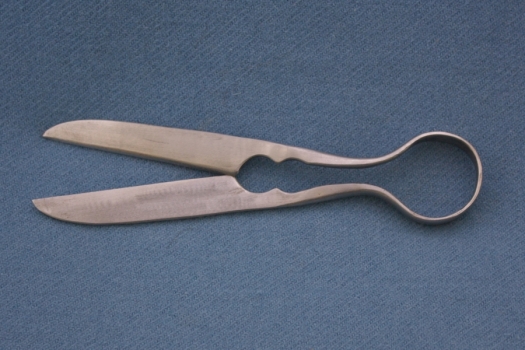
Case in point? Well... I've been looking for a blacksmith willing to make shears for me for ages. Probably best if I don't try and find out exactly how long! It's been more than a decade for sure though. 

A lot of people were interested at first, but then it never worked out - most of the time, I was just ghosted. However, I have finally found somebody to make them for me, which means that they are now available in the shop.

They are small, like many of the originals were, with about 13.5 cm length - and they will cut fabrics very well. I've tried all of them on different kinds (linen, wool, and silk), and they did manage all of them fine. 

And now we will see if other people are as over the moon about these as I am... I find it hard to believe still that they are now really here!

0
JUNI
14
0

The Madder-Ness.

One of the main things on my desk at the moment is work on the Madder Baselines experiment - at least a bit of a preliminary write-up has to be done, and, well, I am more and more convinced the stuff is called madder because it makes me... the same.

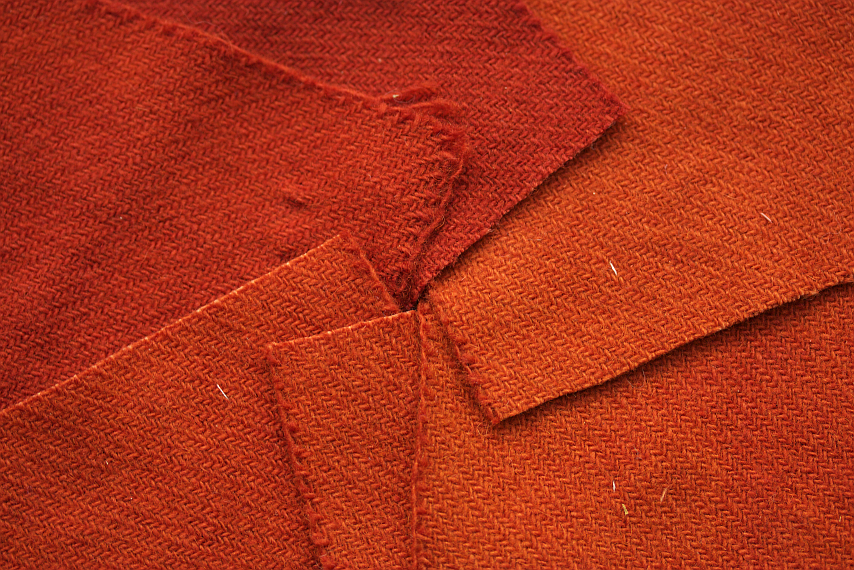
Also, there's such a huge difference between looking at colours on the fabrics in real life and in daylight, and in looking at them on a photograph on the screen. Print will probably be different again, too, but for now, I'm frustrated enough by not getting nearly as much of a difference on the pictures than they show when yo look at the objects.

On that image, four should be very similar to each other, and the other two quite different from the group, with some difference between them as well. That's one of the better images actually, where it's relatively easy to distinguish at least on my screen. The others... ah well.

There's also quite a stack of results (dye-wise) that I'm not sure how to make sense of. Samples that should be exactly the same colour are sometimes (almost) the same, sometimes not. The samples from the pots running in parallel are quite well-matched to each other, the samples from a second run with the same ingredients don't match those of the first run.

As I said - quite surely, madder comes from crazy!

At least it's a pretty red. Or some of them. Mostly.

0
JUNI
06
0

Colour Measurements...

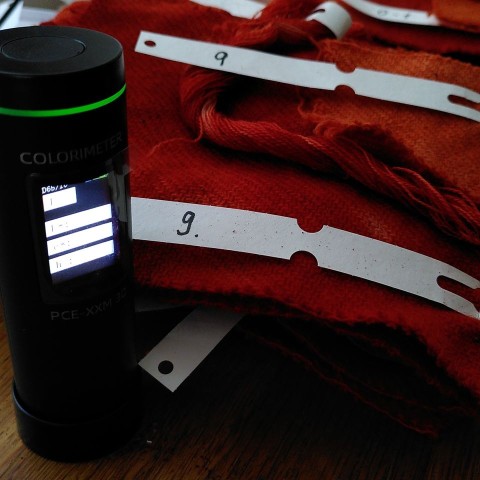
So after finding out about how difficult it is to judge, compare, and describe (or colour-list-match) colours by eye, I'm now trying to see if a colour checking tool is helpful in this regard. Which means... hearing a lot of beeps.

Because every time this thing here takes a measurement: 

...there's a little beep.

I'm going for averages, since the samples are not all completely evenly dyed, some more than others. So I've been taking 20+ measurements of each sample so far, and now I have enough to go and see if the data looks useful, or not.

For today I've definitely heard enough beeps!  

0
JUNI
04
0

Refashioning the Renaissance.

There's new exciting projects popping up... and sometimes it takes me a few years to find out about them. Like the "Refashioning the Renaissance" project, a large research venture about everyday clothing and fashion in the Renaissance. It's based in Finland, but the website is in English.

The project encompasses quite a lot of different research bits and pieces, such as the re-making of a silk stocking, dyeing tests, and more - you can read about those on the project blog. The project will still continue for a while, and I hope they will get to do a lot more fascinating things!

0
APR.
26
2

Sizing.

Because I have to wet and stretch the skeins anyways, the plan for the warp yarns this time was that I add some sizing in that process, saving Silvia (who will do the weaving) from that extra prep step.

As it's here and available already, we settled on animal glue for the sizing. The idea behind sizing is to strengthen the threads against friction and abrasion on the loom, making it easier to weave and giving a better end result. So I dissolved some animal glue in warm water, bathed the skeins in their hot bath to set the twist, pressed out as much excess water as possible and gave them a good long soak (about half an hour) in the gluey liquid. 

All this was followed by the usual draining of the skeins, then stretching them and hanging them with a weight to dry. In this case, I made sure to move them frequently, especially at first, to prevent them from sticking to the drying rods.
All five skeins are almost dry by now, so they will get packed and sent off soon, and then we'll see how things go...
0

By accepting you will be accessing a service provided by a third-party external to https://www.pallia.net/

Kontakt