Latest Comments

Guest - Aislinn Dyestuff Citizen Science.
09. Oktober 2026
This is a great project. I look forward to the results. Thanks for letting us know.
Guest - Aislinn Time for...
09. Oktober 2026
Looks delicious!
Guest - Katrin Sprang Discussion
18. September 2026
Hi Rachel, I have looked for more photos of you, but that was not very successful. I found a link on...
Guest - Beatrix Sprang Discussion
15. September 2026
That lozenge pattern element is not a photograph, but a scan. So it should be to scale. But I pinned...
Guest - Katrin Sprang Discussion
15. September 2026
I was not referring to Rachel's reconstruction (is the reconstruction you refer to the one photograp...
SEP.
01
16

Do you know of any... headwear?

After writing my PhD thesis (which will come out one day in English, I have not forgotten you - I am doing things towards it) I was quite happy to get going on some other writing/research topic. Unfortunately, though, that project fizzled out very soon in its career.

Then all those other things that will assault a freelancer and beg for time took over. Organising or re-organising things, getting smart about how to do invoices, keeping track of finances, sourcing goods that I could sell on markets, preparing workshops, flyers, business cards and so on. The decision to do a blog, and the time that went into it. Projects usually came (and still come) in clumps as well, tearing huge rifts into plans and schedules. And Textile Forum came into my life and took over for a few weeks each year (and will do so next year). In short, I did not get around to do much writing and research for the other book project that was still in my figurative desk drawer. And I sort of fell into a research hole.

Then came the opportunity to work again on that project. Let's call it... Dusty Old Bookproject, or DOB for short. I started, did some stuff, and ran against a wall because what I had thought would be a slight restructure and extension... was not. It needed a full re-thinking, re-working and re-structuring, and I could not see that yet. So I did some things on and off, but it really didn't come along very well. And there was still all the other freelancing stuff to be taken care of, which takes a huge chunk of time, continuously.

Then along came Exciting New (to me) Bookproject, and I suddenly rediscovered that research is such a huge heap of fun. Pure unadulterated fun in sitting in the library, going through books, taking up snippets of information and learning new things, new angles, new concepts. So now I am working on both of them, DOB and ENB, and instead of having a bad conscience... I feel good, because I am actually doing more work on DOB now than I did before ENB came along.

And I'm at a stage for DOB where I am looking for more material. More specifically, I am searching for links or books or hints on where some more extant headwear might be found. Date range is from about 500 to 1500, though I might narrow that down for the final book. Geographic range is Europe. And I'd be delighted if you could tell me of some, because just like the proverb says: Four (hundred) eyes see (much) better than two.
0
AUG.
30
0

Oh Yersinia. You really did it.

If you've been more than marginally interested in the epidemic called "Black Death" that wrought havoc on the population in the Middle Ages, you may have caught that there was a (sometimes quite heated, I gather) dispute about whether it was the Plague as we know it today, or something entirely else, or a mutation of the Plague, or a combination, or whatever. And I confess I was leaning towards "something else", too, just like a lot of other scholars.

But now they did it. You know, those archaeologists and other scientists? These guys that poke around in old stuff, messing around with our nice familiar concepts of history, dragging home old bones and potsherds and lumps of clay and textile and rusty metals? They did it. They found the DNA of the Bringer of Black Death.

And it's Yersinia Pestis.

Their research is published in an open-access peer reviewed journal (oh, we so need more of those), and you can read the whole article for yourself. Good old Yersinia. Wreaking documented havoc on mankind since 541.
0
AUG.
29
2

Wool, wet. And dry.

Since I seemingly promised you wool pictures and Heather reminded me of that, here they are. All were taking during the test runs for a washing wool procedure (and the test run was, by the way, quite successful).

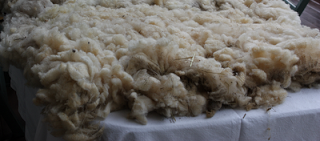
This is Rhönschaf-wool before washing, laid out on a cloth.


All the wool was pretty clean, as wool worn by sheep hanging out outside goes. And I discovered during washing that a lot of the darker colour is due to dust and fine earth particles hanging in the fleece.


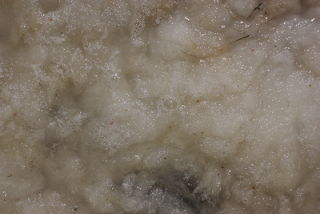
And this is wooly magic happening right there. This is the wool soaking in rainwater, and it's basically cleaning itself. You see the little bubbles about in the middle of the picture? That is the result of a reaction between sheep urine, lanolin, sheep sweat and soft water. It's... soap bubbles. Which will remove a bit of the lanolin and all the urine and sweat, leaving the wool...


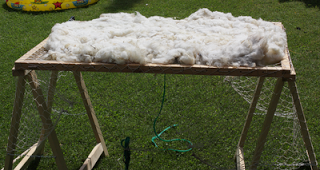
... nice and clean after rinsing. It's spread out for drying on my beating frame here. And yes, I have managed to wash a whole fleece's worth of wool at once, thanks to well-timed rainfall hereabouts.
0
AUG.
25
0

Not much to tell.

Though I'm furiously working on stuff, I don't have much to tell about it yet - I don't want to jinx the project and that means I will be keeping mum for now.

There are a few very nice and exciting things afoot, though, and I will soon be able to tell you more. For now, I enjoy that one project so much that I'm getting sidetracked into almost forgetting to blog, and the other has stolen me a bit of sleep the day before yesterday because I had to think about it.
And this second one is linked to a trip to England, which I am wildly looking forward to.

Finally, I have spent part of yesterday evening with legalese - turns out the German law regarding the right of withdrawal has changed again, and I thus had to change the legalese texts in the shop. Speaking of which, I have also made a good bit of progress translating the legalese for the English version - though those of you waiting will have to hold out for a bit longer still. Sorry for that! (I really need a duplicator so I can turn into three of me during the work hours... anyone know where I could get one?)
0
AUG.
23
2

Updated the Shop!

The new spindle whorls are now in the shop, and it's possible to order both the discs and the new, hand-thrown ones. For the latter you can just tell me the weight you'd like - they are in a span of c. 10 to c. 47 g - and I will pick out one. (Or, while I still have most of them, you can tell me which one from the photo in yesterday's blog you would like.)

Plus there's something else in the shop. I will be giving a workshop in Erlangen on how to do medieval embroidery on October 29, where we will cover counted work, and October 30, where we will do uncounted embroidery (including a little gold embroidery). Both days can be booked separately via my Onlineshop - there's a category called "Kursangebot" - so you can come to one or the other or, of course, to both. Please be aware that there is only a limited number of places available. If you are coming from further away and need a place to stay, I can supply you with some info to help you find a place to stay as well.

I'd love to see you in October!
0
AUG.
22
0

Good things have happened.

I had a wonderful weekend, spent with friends doing nice and weekendy things like playing boardgames (among them a few hilariously bad ones), chatting, eating cake and planning future craft projects (theirs, not mine).

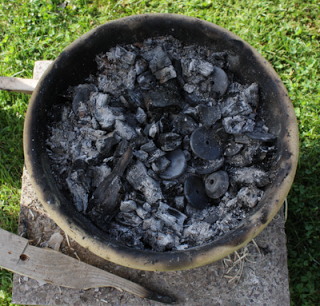
But before that, on Friday evening, I finished off the workweek with some... work. Hot, interesting, adrenaline-flush-making work. I dragged our firebowl and wood and stuff out in the garden, and I started layering in wood and the now bone-dry clay whorls I made. Which makes that procedure some weird cross-over between kilnless firing and pitfiring.


As expected (because you always have them in a kilnless firing procedure), there were losses.


Most of what you see in that box, though, are not whorls, but the remainder of two of the three medieval type piggy banks that I put in as well, even though I knew there was a very, very high probability they would not survive it. (Because their time for drying... let's just say it was not generous. At all. And my mum taught me better.) But I still wanted to know, and I don't know when I'll be doing this again, so...

Losses on the pieces that had dried out properly were not so high. And most of the whorls came out whole and nice and black:


I have a thing for reducing-athmosphere fired pottery. I mean I like pottery colours, especially white and off-white, but I just dig the black stuff. I now have one (non-functional) very very crudely made piggy-bank that has no piggy shape and 57 spindlewhorls to re-stock the online store with. Not all of the thicker whorls are perfectly round, so I might have to test a few and maybe take them out, but overall they do look good. And my fancily decorated disc whorl even survived as well:


That, my friends, was a really nice Friday evening.
0
AUG.
19
0

Looking happy while getting wet.


As all the long-term readers of this blog know (because I’ve written it repeatedly), I am naturally lazy. I am also aware of efficient working procedures and non-efficient working procedures, even if it is not always in my power to change from the latter to the first.

Washing wool is a high-consumption activity: It needs obscene amounts of water, some work time and a huge lot of waiting time, especially for the wool to completely dry again so it can be put back into storage. It also needs some equipment to make wool washing sustainably efficient. Plus, the wool that still has its natural oils is a joy to work with, and wool that has been scoured heavily or washed with too much agitation is prone to felt, making the following processes harder and maybe even severely damaging overall fibre quality.

So my first impulse (and more or less my wish) is to leave the wool as it comes from the sheep, washing-wise, and start with the process of beating, combing and carding straight away. However, there’s dirty wool and there’s clean wool, and dirty wool is harder to work with in some circumstances. Much harder to work with. So much so that the investment of water, work time, wait time, and equipment seems to be an efficient investment again.

Currently, I’m testing the waters for wool-washing – checking how much time I need for a batch, how much water, what works better or not in my scale of material amounts, which might be roughly equivalent to the processing amounts of a very small medieval industry or a large household. And that, in turn, means I’m very happy that it is raining right now, and that I have just gladly ran out into the rain, getting wet while bucketing rain water from the container being refilled to an extra storage container. And will do so again in case it rains enough to fill the first container completely again.

And now I’ll dry off with a cup of coffee and some nice work.
0

By accepting you will be accessing a service provided by a third-party external to https://www.pallia.net/

Kontakt