



Search the Blog
Latest Comments
More Alpirsbach.
About everybody who has done reconstruction work on late medieval legwear and used the Alpirsbach pattern as one of the sources has mentioned (if they have written about it, obviously) that the crotch as drawn on the pattern will not work.
I can confirm. It's too pointy, so that you will have the full length for the crotch drawn in on the pattern, but it is not usable in its full length - the little pointy point will be pointless, you could say. So why did I go for the pattern style anyways? Well, because a) I wanted to see how it did not work, and b) I didn't want to make something up before having an idea of what to make up.
I have now changed it to a sort of narrow U-shape for the second leg, and it looks much better.
I have also mapped all the long and short seam allowances so I can do the felled seam in the right direction. And I have cursed (frequently) my choice of test fabric, which is rather heavy and stiff and needs some wrangling to work with the relatively narrow seam allowances.

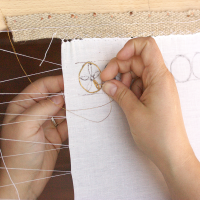
One leg is sewn (though not hemmed) all the way down, the other halfway, and the butt seam is in (that's the one being done in the picture). They have a tendency to twist around the wearer's legs, which is a little weird and may be a) normal and totally okay or b) something that will turn out to be not so good, and will need an adapted pattern making process in future iterations. But it might also be one of the reason why these hose were footed: So that the seam stays where it's supposed to stay.
Now the only step left (apart from the feet, and finishing the long seams) is to figure out the final version of the codpiece, and cut, sew, and install that. It will also be very interesting to see if the thing really stands nicely on its own or whether it needs to be filled with something.
All very interesting : )
Comments
By accepting you will be accessing a service provided by a third-party external to https://www.pallia.net/