



Search the Blog




Latest Comments
Guest - Katrin
Sprang Discussion
18. September 2026
Hi Rachel, I have looked for more photos of you, but that was not very successful. I found a link on...
Guest - Beatrix
Sprang Discussion
15. September 2026
That lozenge pattern element is not a photograph, but a scan. So it should be to scale. But I pinned...
Guest - Katrin
Sprang Discussion
15. September 2026
I was not referring to Rachel's reconstruction (is the reconstruction you refer to the one photograp...
Guest - Beatrix
Sprang Discussion
14. September 2026
There is something Rachel did not mention. She told me: "Well, I worked with the measurements we too...
Guest - Katrin
Sprang Discussion
14. September 2026
Well, this is certainly developing into an interesting discussion.
Firstly, going from that lovely l...
Things That Happened During Summer Break (part 6)
(continued from part 5)
There was, of course, even more stuff about looms and weaving. Together with Florian, who works at Lauresham, I'd been pondering and planning a loom made from hardware store parts - things you'd easily get at a typical German Baumarkt. The aim was to have an affordable loom from parts you can get without having special stores, and it should of course also be easy to build.
[caption id="attachment_6419" align="alignnone" width="300"]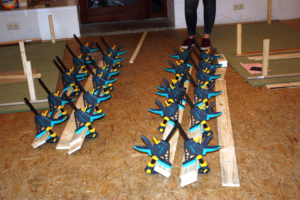 Putting together the two uprights - since we had the luxury of a lot of clamps, we used them. The boards are glued together, and then secured additionally with a few screws.
Most of the cutting-to-length of the parts can be done in the hardware store, where there's usually a cutting service point. That greatly reduces the amount of work and time necessary for making the loom - most of the tasks that are left is assembling the bits by glueing and screwing.
There's still some details to fine-tune, but overall, our little side project was a definite success. The hardest part about this loom is squaring off the ends of the round beam - it would be possible to use another solution, but the square ends will sit very securely in the upper part of the loom, and getting the sawing done was successfully undertaken by someone who does not have a lot of practice with this.
[caption id="attachment_6418" align="alignnone" width="300"]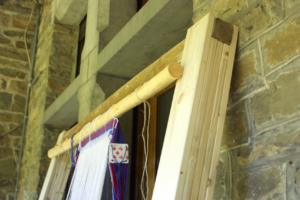 The upper part of the loom, with the square end of the round beam sitting nice and snug in the uprights. For the first test, another beam with a weave already attached was used - for "proper" weaving, you'd attach your weave to the beam directly or via a narrow slat or rod that the starting border has been stitched to.
The loom comes in at about 80-90 € for the materials, plus the cost for the loomweights. I did manage to find something hardware-store-y for that as well, though it might need pre-ordering, as it's not an utterly common item. Curious?
It's a certain kind of pipe connector that weighs about 120 g each, is about 3 cm wide, and can be strung up easily. So for someone who prefers to buy weights instead of getting hold of some clay and forming, then drying them, this is a viable alternative. They come in at about 3-4 € per piece, which means that if you want to do a very wide weave, it will cost you quite a bit of money. On the other hand, it also means you can get them from a suitable supplier and will have no work at all with them.
The finished loom is a full-size thing, with 140 cm between the uprights, and a bit more than 2 m in height. It's heavy enough to stand securely in our first tests, and it should be possible to adjust loom position to keep the shed size large enough for easy weaving even for beginners. The prototype is still being tested.
There was, of course, even more stuff about looms and weaving. Together with Florian, who works at Lauresham, I'd been pondering and planning a loom made from hardware store parts - things you'd easily get at a typical German Baumarkt. The aim was to have an affordable loom from parts you can get without having special stores, and it should of course also be easy to build.
[caption id="attachment_6419" align="alignnone" width="300"]
Putting together the two uprights - since we had the luxury of a lot of clamps, we used them. The boards are glued together, and then secured additionally with a few screws.Most of the cutting-to-length of the parts can be done in the hardware store, where there's usually a cutting service point. That greatly reduces the amount of work and time necessary for making the loom - most of the tasks that are left is assembling the bits by glueing and screwing.
There's still some details to fine-tune, but overall, our little side project was a definite success. The hardest part about this loom is squaring off the ends of the round beam - it would be possible to use another solution, but the square ends will sit very securely in the upper part of the loom, and getting the sawing done was successfully undertaken by someone who does not have a lot of practice with this.
[caption id="attachment_6418" align="alignnone" width="300"]
The upper part of the loom, with the square end of the round beam sitting nice and snug in the uprights. For the first test, another beam with a weave already attached was used - for "proper" weaving, you'd attach your weave to the beam directly or via a narrow slat or rod that the starting border has been stitched to.The loom comes in at about 80-90 € for the materials, plus the cost for the loomweights. I did manage to find something hardware-store-y for that as well, though it might need pre-ordering, as it's not an utterly common item. Curious?
It's a certain kind of pipe connector that weighs about 120 g each, is about 3 cm wide, and can be strung up easily. So for someone who prefers to buy weights instead of getting hold of some clay and forming, then drying them, this is a viable alternative. They come in at about 3-4 € per piece, which means that if you want to do a very wide weave, it will cost you quite a bit of money. On the other hand, it also means you can get them from a suitable supplier and will have no work at all with them.
The finished loom is a full-size thing, with 140 cm between the uprights, and a bit more than 2 m in height. It's heavy enough to stand securely in our first tests, and it should be possible to adjust loom position to keep the shed size large enough for easy weaving even for beginners. The prototype is still being tested.
Comments 2

Miriam Griffiths
on Montag, 04. Oktober 2021 21:51
How interesting. I wonder if using a system like this, rather than the more typical loom-weight set-up, might enable easier acquisition of suitable loom weights from such shops. https://exarc.net/issue-2020-4/ea/experiment-warp-weighted-loom-and-heavy-loom-weights
Katrin
on Dienstag, 05. Oktober 2021 15:24
By accepting you will be accessing a service provided by a third-party external to https://www.pallia.net/