Latest Comments

Guest - Aislinn Dyestuff Citizen Science.
09. Oktober 2026
This is a great project. I look forward to the results. Thanks for letting us know.
Guest - Aislinn Time for...
09. Oktober 2026
Looks delicious!
Guest - Katrin Sprang Discussion
18. September 2026
Hi Rachel, I have looked for more photos of you, but that was not very successful. I found a link on...
Guest - Beatrix Sprang Discussion
15. September 2026
That lozenge pattern element is not a photograph, but a scan. So it should be to scale. But I pinned...
Guest - Katrin Sprang Discussion
15. September 2026
I was not referring to Rachel's reconstruction (is the reconstruction you refer to the one photograp...
FEB.
20
2

More Sprang Stuff.

I have been dabbling a bit more with the Lengberg cap sprang - on and off, though mostly off in the last months, and now it's more on again. (I am on row 48 or so of almost 200, and I realised that I will need the frame for the Sprang workshop in June, which gave me a nice bit of extra motivation to finish before then.)

While I did make the pattern for the hands-on piece for an exhibition about women's networks by marriage, due to start in May, the piece was done with slightly thicker threads and ran much longer than the original for the same amount of rows. Our solution was for me to make fewer rows - it's enough so you can still get a nice impression of the pattern, but it also was a good compromise for the museum budget. In this case, being a bit "off" from the original was thus not really bad.

It still irked me a little, especially after taking more looks at images of the original and realising how incredibly dense it was. So I made another set-up (with probably way too long threads, but I wanted to have room to manipulate at the end still), with slightly thinner threads, and made it my main task to get the fabric really, really, really, really dense.

By now I am far enough to see how well it worked - and I am actually not too far off the original this time!

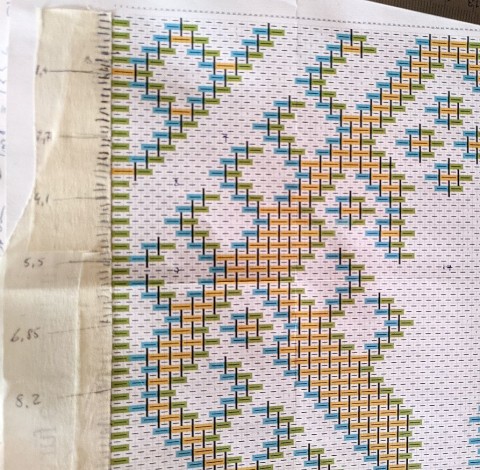
This image shows you part of the pattern chart written by Carol James, with my marks of "done" rows and, more importantly, small numbers giving the length in centimeters at that place on the original, calculated from the amount of overall rows and the full length of the original piece. It's a guideline, thus, nothing more - but I find it very helpful.

As you can see (more or less well), I should be at about 6.85 cm of length now. I am at... 
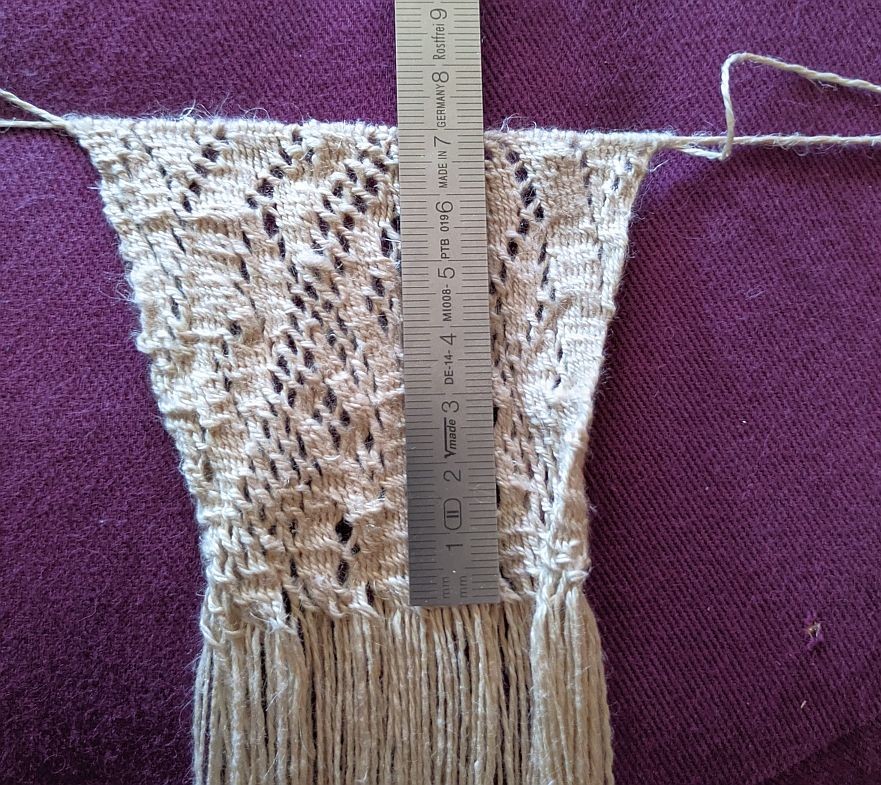
...about 7 cm. That is not too bad! The bottom piece is a little more irregular, and I measure something between 7 and 7.3 cm there, but I still have hope that it might even out again some more.  

The trick to getting there was, apart from having the right thickness of threads, working with very little tension and pressing the new row in very, very, very hard. That includes pulling the threads against the weaving sword in small bunches, and repeating it across the width several times. It doesn't take quite as long as the braiding row itself, but it feels almost like it!

So this is how the frame looks, and yes, that is my working "tension".
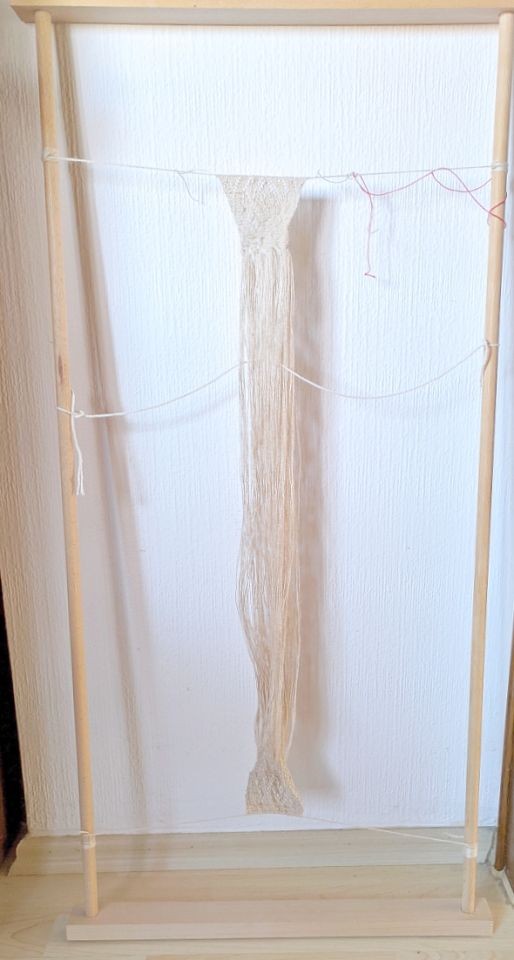
It does work, though! And I can have a little more working tension when doing the manipulation, too, as I am working close to the top fell. Now only about 150 rows to go, and I will be done! 

0
FEB.
19
0

New Book Available!

There's a book out, published at Brepols, with essays in honour of Eva Andersson-Strand - and the very good news is: It's not only available to buy in printed form, but also as a free e-book!

The book has 24 chapters, and you can find it (including the open access link) here.

0
FEB.
18
0

One done, three to go.

One of my to-prep-things is done and dusted (and we even managed to do the presentation test run in 18 of our allotted 20 minutes), so I have only three left - a short thing about spinning, a longer one for a museum presentation in South Tyrol, and the band-weaving workshop in Unterschleißheim on February 28. Whew!

Fortunately, the bandweaving is mostly packing up my stuff and re-visiting the workshop plan, which already exists, and the long and more work-intensive one is almost done, with a few new things to be added after our last preparatory chat today. For the third one I will also be able to re-use some of the slides I already have, so it should be more a question of getting an idea of what I want to say in what sequence, and digging out stuff, adjusting slides, and ordering them into an appropriate sequence.

But that's a task for tomorrow. For now, Madame the cat is calling and wants some attention. (Well, probably some food, actually...)

0
FEB.
17
0

CfP PunTex International Seminar

Due to some reason that I still haven't found, my facebook access was suddenly blocked, and the only way to free it up again was to take a video selfie, or a photo selfie, and upload that.

Apparently this is a safety feature now, if there is a doubt that your login or account is legitimate. Or so.

I did consider just closing down my facebook, but then I sent in a random selfie, it took about an hour, and yes, I am on the big time sink again. Though I don't hang out there a lot, but occasionally  interesting things pop up there, so it's not all a waste of time. For instance, today I found a call for papers (which, admittedly, I also have gotten per mail, so I wouldn't have missed out).

It's for PunTex International Seminar "Weaving Knowledge", whcih will take place in Nicosia in September 25-26. Abstracts are accepted until March 15, so if you'd like to take part in this seminar about experimental archaeology applied to textile production, you can find out more in this pdf here:
 

0
FEB.
16
2

Meh.

So much for my plan to watch a presentation that was available online after the fact - in contrast to the announcement, it was not recorded after all, and is thus not available. It would have been something on backstrap weaving, but due to time differences, the real thing would have been at three o'clock in the night hereabouts. My love for textiles runs deep, but my love for sleep is at least as profound, so I would have passed even if I had known that it will not be recorded. 

Still, funnily, it makes a difference somehow to be disappointed because it's in the middle of the night and one will not join in, or to be disappointed because it was announced to be recorded and then be told it was not, after all. Not that the outcome is any different. 

I am not complaining, by the way - something may have happened, technical or otherwise, to have things turn out like that. What I'd rather complain about (well, among many other things that are of a more political or social nature, but I am planning to do other things this evening as well and will thus not even get started) is how much AI has made searching for stuff on the 'Net harder than before. Back a few years ago, when I was looking for something, there was the occasional thing that was repeated on a few websites. Mostly it was easier to identify and thus fairly quick to sort out - but now, searching is much more cumbersome just due to the sheer amount of copy-and-paste stuff, and repetitions of things quite clearly written by AI. Add that to the fact that some things are hard to search for anyways ("spindle" can mean way too many things, for instance, and some other terms are, well, not advisable due to NSFW reasons) and it gets unpleasant.

Unfortunately, that does not look like a problem that will go away any time soon. This AI stuff is here for a while, and will most probably continue to spew shitty hallucinated texts all over the 'Net, and then gobble them up again to feed itself with the basis for even more, even wilder hallucinations.

You can clearly tell that I'm no fan of the AI boom. Yes, I know that there are some use cases where it's a real help, and I am using AI assistance for those as well. Such as translation help, so you don't have to look up every second word in the dictionary, and yes, I am old enough and old-fashioned enough that there were texts in my life that I had to tackle like this if I wanted to read them. Or programming assistance when it's a common software and a problem that you can very clearly describe, and very clearly describe how you want to solve it. My guideline these days is that if I could find the solution written out by someone (someone real, human, breathing and thinking) on the 'Net somewhere, it's something that may be solveable by AI. If not... nope. With a little nope cherry on top. It's basically a very, very large cross-language dictionary, and that is, in my opinion, all that it's good for, and all that it will be good for. It also has the desire to please you, so chances are high you won't get any solid or sensible advice. Which means... it's a large dictionary with a bias.

In addition, all that "free" use of AI comes at quite a cost - because these servers don't run themselves, and there is a considerable amount of energy and logistics going into them these days. Especially the image generation eats up quite a lot of resources, and with a lot of that being, more or less, utter crap, and also a lot of it being just for fun... well. Meh.

So. Rant over. For now. I'll now go and have a nice, analogue, non-AI (maybe even non-intelligent) evening.

0
FEB.
13
1

More Translation Fun.

Translation fun not as in "transporting a saint's bones from here to somewhere else", but translation as in "making a text from one language magically appear as a very, very similar text in another language". 

Sometimes it's really easy and straightforward. Sometimes, the other language would express it in a different way, so making a literal translation is understandable and clear, but a little odd. And sometimes... the word doesn't exist.

Case in point (other than the Erhebung): Umbettung. (Looks like it's a theme here with the dead...) In German, there's a word for taking a corpse out of the burial place and re-burying it at some other place, and that is Umbettung. (The literal translation would be transfer-bedding? Something "betten" means to carefully lay it down into a dedicated bed, and the "um" indicates that it is changing position either inside the same bed or into a new one; in case of bones, it's generally a new one.)

So, like anyone tasked with translating a text from German to English, I use the words that I have in my head, and if I am unsure or if I don't have them in my head already, I go chase for them. Usually my first point of call is dict.leo.org and sometimes I go look the thing up in German in Wikipedia and then switch to the English page on that thing. (Wiktionary.org, while a wonderful resource and one of my favourite for language learning or etymology checking, is usually not one of my go-to places.) 

Leo told me straight away... nothing. Oh, wait, the forum with questions and discussion section has something. Something as in "someone looked for this translation before and was told that this is a total no-go in England and thus they have no word for it". Just to make sure (and because I find these things fascinating), I looked it up on Wikipedia and there is Umbettung and, apparently, a Japanese version of the article. There is also an article about one very specific regional tradition involving the regular Umbettung in Madagascar, called Famadihana, and for this, an English entry does exist. However, while the German version says it's a ritualistic Umbettung right in the first sentence (and in the image caption), there is no such text in the English version (and no caption at all). Being curious, I then checked the French entry for that, and there's a descriptive image caption and also no term that looks to be the direct equivalent of the German one to me. 

Related to this, and also fun to look at: There's quite a difference between the article "Beinhaus" in German and its English equivalent term "ossuary", both in length and in specific sub-topics covered. So yes, there seems to be a lack of terms regarding the handling of corpses once they are buried in the English language.

(Also, in case you wondered what kinds of rabbit holes I will fall into when not taking care? This kind.)

0
FEB.
12
1

Glittery!

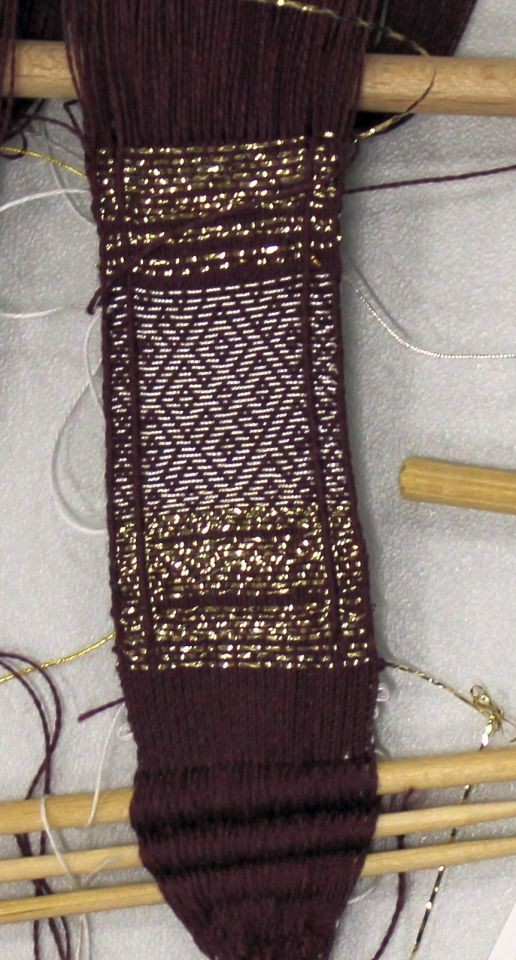
I was sorting some photos and came across this lovely example of how important the right brocading thread is: 

As you can see, there's a nice difference between shiny (in the middle) where the thread was nice and smooth, and glittery (before and after), where the thread had some kink to itself - and the pattern is much, much less legible. So, again, the thing is to choose wisely...

(You can also see some quite big differences on how tight the threads sit, and how neatly the weaving was. Fortunately the image does not tell whose hands it was... ; ) 

0

By accepting you will be accessing a service provided by a third-party external to https://www.pallia.net/

Kontakt