Latest Comments

Guest - Aislinn Dyestuff Citizen Science.
09. Oktober 2026
This is a great project. I look forward to the results. Thanks for letting us know.
Guest - Aislinn Time for...
09. Oktober 2026
Looks delicious!
Guest - Katrin Sprang Discussion
18. September 2026
Hi Rachel, I have looked for more photos of you, but that was not very successful. I found a link on...
Guest - Beatrix Sprang Discussion
15. September 2026
That lozenge pattern element is not a photograph, but a scan. So it should be to scale. But I pinned...
Guest - Katrin Sprang Discussion
15. September 2026
I was not referring to Rachel's reconstruction (is the reconstruction you refer to the one photograp...
JUNI
28
4

Hairnets.

For years now, one of the almost forgotten techniques that are dear to my heart is (filet) netting. If you've seen one of those dainty, almost-nonexistent hairnets in the medieval part of a museum exhibition? Those are made by netting.

Contrary to what some people think (and some write), this is not the knot and the technique used for making fishnets. It's a different tool, a different method, and a different result - fine, small-meshed nets that can be used as hairnets as is or embellished with embroidery.

To keep the technique from dying out, I've tried to do my part - I sell the filet needles (replicas after a find from 14th century London), I demonstrate netting, and I teach the technique. Since many visitors do not know what that peculiar double-eyed needle is for, I usually place a finished hairnet close to the netting needle in my stall.

And occasionally, I will get The Question. The Question is a variation of "Do you make these for sale?" or "How much is such a net?" and is hard to answer - because most of my demonstration hairnets are ones that I used to try out a new technique, or material, or embellishment (like the ones with the pearls). Some of the work time was also clocked during demonstrations or at events, and you never work full speed on events, due to all kinds of distractions. That means that even though I recorded the time needed, it's not the realistic time for making one simple full net with suitable material, in the surroundings of the home workshop.


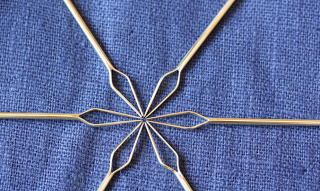
Netting needle eyes.

This has happened more often lately, so I have set out to do exactly that: Make a reference net of sturdy, white silk thread, in 4 mm mesh, aiming for the finished measurements of the late 13th century hairnet from London. I have started out yesterday, and I've about finished the crown part - next will be the interesting bit of doubling the number of mesh. (This, together with the start, is one of the fiddly bits in making a hairnet in the round.)

The clock is running. A hairnet, let me tell you, is not a thing made in an hour or so... it takes its sweet chunk of time. I'm not sure on whether it will be saleable, as it is - I have been pondering some alternatives to making it completely by hand, in order to offer a more affordable variation, but that will need some more planning.

If you have considered getting a hairnet, or have made one yourself, I would be happy to hear your input - such as how much you would be willing to pay for a (completely handmade) net, or how long it took you to make yours. Cheers!
0
JUNI
27
0

I only look into them for the piccies.

I will admit it: I'm one of those who only look into books for the piccies. Well, old books, that is. While I can read Middle High German well enough to get most texts once they are transcribed and can read some very little Middle English (and thank you, Chaucer, for your tweets!), I have yet to read a manuscript in its original state.

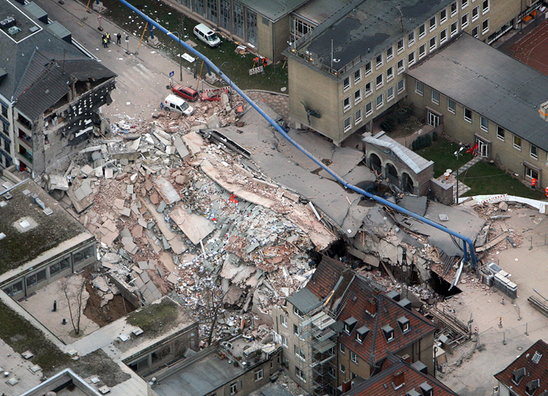
Every time I run across a digitised manuscript library on the internet, I do a little happy dance (yay! More accessible manuscripts, and more manuscripts that will be there for posterity even if something dire happens - remember the archives at Cologne?) and then... I do a search.

I look for the search terms "spindle" and "wool" typically, both in English (if there is an English archive version) and in the archive's native language. Sometimes I'm lucky, other times I'm not.

I was not lucky in the St. Laurentius Digital Manuscript Library from Lund - but if you are looking for pics of nice medieval manuscripts, with pretty initials, you will really like this page. There's 64 digitised manuscripts from the 9th/10th century to the 16th century, and they are worth a look if only for the initials. (At least that's what I think.)

While I'm at links to libraries online: Umeå University has rare old books digitised as well, accessible via their "special collections" page. It was very slow for me, but if you are looking for an old print - you might get lucky there.

Oh, by the way: There is a lot of work still to be done on the Cologne archive material - the city has an info page about the damages and the work being done here (German only, but there's pics).
0
JUNI
26
0

Food, Games, Old Norse, and Daleks.

First of all, food: There's a new transcribed recipe on Medieval Cookery, so if you've always wondered how you should cook your Bruet of Almayne - here are several options.

Good food is one of the ingredients for a nice evening of games with friends - if you are looking for a nice medieval-style game board for backgammon and nine men's morris, take a look at Niklas' latest blogpost (in German, but there are pics).

If you're rather looking for a more intellectual pastime, maybe you would prefer to learn the language of the Vikings? There's a new book out there to teach you Old Norse and Runes, with a second volume for deepening your knowledge and reading skills forthcoming soon. (You can also look at samples from the book here.)

Speaking of books and Vikings, Marianne Vedeler has a new book coming out titled "Silk for the Vikings". It's available for pre-order at Oxbow books.

And if this has totally stressed you out now, and you need to relax, the Daleks will help you:


0
JUNI
25
0

And where's my coffee?

Today it's getting back on track - there are quite a few things lined up for me to do from before Herzberg, even though I still feel like I could sleep all day and then some. With no proper clue as to why - yes, it was a little less sleep than I'm used to during the last week, but not that much, and I should have caught up by now...

Anyway, there's catching up to do for me. Plus some new things  - several people, by now, have asked me how much a medieval hairnet made in filet technique would be. It has been a while since I've made the last one, so I could not give a really good answer... looks like it's time for me to net again and do the maths for a net price (haha).

First thing today, though, is slug through my emails and then set down to do some reading... I have been sent things to proofread. And they have a deadline...
0
JUNI
24
0

Back home.

I'm back home from the event, which was a truckload of fun, a wild mixture of all sorts of weather (we had a bad storm though we were spared the walnut-sized hailstones that came down a few kilometres away), and lots of old and new friends. Oh, and delicious food. Lots of that, too.

With the stormy night and then a full-moon night both in that week, though, I ended up sleeping very, very late today (hence the late blogpost). The storm flattened quite a few tarps and tents on the camp meadow, but nobody got hurt. The little TGV held up, too - though I lost a wooden peg that connected the upright pole near my bed to the top beam, and consequently spent about an hour holding it up myself before the wind had calmed down enough so I could make an emergency construction with the two poles that usually hold up the awning. This action was followed by some creeping through the tent to take care of stuff that had become wet, and to check on the other pole, and then - blissful sleep.

I'm still feeling sort of not up to full capacity, brain-wise, though. Good thing that today was scheduled as being a day off, which I am very much looking forward to.


0
JUNI
21
1

Tablet weaving stuff.

Time for some tablet weaving stuff! (In my next life, I will manage to get more time for tablet weaving. And for napping in the sun.)

First of all, a blog post about an Estonian shawl, 13th/14th century, with a tablet-woven border.

Cathy thinks about the Køstrup find, which also has a tablet-woven border. (There's a link to another post with pics in there, should you want to look at brownish textiles.)

And the final tablet-weaving-related bit: Maikki Karisto & Mervi Pasanen have published a book about Finnish tablet-woven bands, called "Applesies and Fox Noses". It's bilingual in Finnish and English, and if I understand correctly, at least a good part of the patterns are taken from original Finnish bands, including medieval ones. The book is available for pre-ordering here, and it's scheduled to come out on June 20.


0
JUNI
20
0

Modert tech to learn about ancient dyes.

There's a new technique on the block that can be used to detect and identify dyes, for example in leather: a variation of Raman spectroscopy coupled with laser blasts.

Here's the link to the Chemical and Engineering News article about it, and if you feel so inclined, you can also read the original paper in analytical chemistry. Lasers! Pricey spectrometers! Madder dye! What is not to like? (Well, it's not a loss-free method, so there's always that - but colour detection can rarely, if ever, be done without sacrificing a little bit of the material.)
0

By accepting you will be accessing a service provided by a third-party external to https://www.pallia.net/

Kontakt