







Latest Comments

Guest - Aislinn Dyestuff Citizen Science.
09. Oktober 2026
This is a great project. I look forward to the results. Thanks for letting us know.
Guest - Aislinn Time for...
09. Oktober 2026
Looks delicious!
Guest - Katrin Sprang Discussion
18. September 2026
Hi Rachel, I have looked for more photos of you, but that was not very successful. I found a link on...
Guest - Beatrix Sprang Discussion
15. September 2026
That lozenge pattern element is not a photograph, but a scan. So it should be to scale. But I pinned...
Guest - Katrin Sprang Discussion
15. September 2026
I was not referring to Rachel's reconstruction (is the reconstruction you refer to the one photograp...
APR.
23
7

Yikes.

I grew up in a house without a microwave - mostly because nobody in my home felt like this would be necessary, but partly also because my gran, many years ago, had head surgery with an inset metal plate and was not allowed near working microwaves.

So my first contact with microwaves, apart from a few times of seeing them in use at a friend's house, was when I studied; and the most I used it was for warming up the milk for my coffee (I'm fond of coffee with lots of milk, and it's much nicer when said milk is warm).

Our kitchen later was more or less too small to conveniently fit a microwave in, so we never got one. I was thinking about getting one approximately, oh, once or twice a year or so, whenever it would have gotten in really handy... but now, I don't think I will ever want one.

Why? A young lady, several years ago, conducted an experiment with plants for her school science fair. Two plants were watered with pre-boiled (and then cooled-down) water, one boiled in a pot on the oven, one boiled in the microwave. This seems to have made a small tour of the Internets back in 2011, but I only stumbled across it these days.

There is also a lot of weird pseudo-scientific information tossed around regarding microwaves, with a goodly-sized bit of scaremongering. Things like microwaving your food will make you more receptive to thought-control. Reading the comments on some of these articles... they are quite hilarious quite often.

Anyway, there is an easy way to test whether the plant-death thing is true (provided you have a microwave): just do it for yourself. It's an experiment, it is meant to be reproduced for sake of outcome verification. Take two healthy plants, keep them in a similar place, water them both with normal water for a bit until they have acclimatised and you can be sure they are both well, and then start the test. (And if you do, please let me know what the outcome was!) Myself? I will add "is possibly not good for you" to my list of things that speak against getting a microwave. That, by the way, has other things on it like "no proper space for it", "will take up lots of space while only getting used rarely" and "means production of another appliance which is not very green". And then I'll go on like before, with my trusty oven and my set of pots and pans.
0
APR.
22
2

Home, sweet home.

Due to my internet access not going as planned, combined with a little forgetfulness, you are now getting a very, very late blog post for today.

I am back from the IRM where I spent the weekend together with Sabine, and though I can't say exactly why, it was really, utterly exhausting. Some of that might be due to the lack of oxygen in the rooms (as is often the case, you get the choice between freezing but fresh air and being warm and cozy, but having bad air). Some of it might also be due to a few weird encounters that left me standing there and wondering what that was about (or why).

In any case, I'm really glad to be back home and enjoy a quiet day tomorrow before we start the preparations for the next event - Freienfels.
0
APR.
19
0

English Language proficiency?

We're talking about something more exciting than learning normal, modern-day English here, of course. We're talking about... Middle English.

My grasp of that language is, well, middling at best, and reading Chaucer for any length much longer than a tweet is quite demanding on my brain. My excuse is, of course, that I am a) an archaeologist and b) English isn't even my native language.

If you would like to learn Middle English, there's a METRO for you. That is short for Middle English Teaching Resources Online and something like a virtual classroom where you can learn how to read (and read aloud) texts from Chaucer, the Wakefield Plays or the Gawain-Poet. And even if you are not planning to learn this slightly outdated language, you can enjoy a few audio snippets from their site.
0
APR.
18
0

More radiocarbon stuff.

Just in case that you have now gotten totally hooked on that radiocarbon stuff, here are two more links:

First, a database listing 14C-dates from Slovakia, Czechia and neighbouring countries. There's about 860 dates in there already, with more to come, and the database can be downloaded as MS Access file.

If you ever come across uncalibrated radiocarbon dates given as "xxxx BP", it's not just a matter of doing the maths back from 1950 (the "present"). Radiocarbon content in the atmosphere did vary, and science is working on making even better calibration curves to get the dates correct. So instead of whipping out the calculator and getting a date with an offset, you can go here and have OxCal calibrate it for you.


0
APR.
17
1

Crowdfund some archaeology!

Crowdfunding has become a thing, and I am quite fond of the idea. It's innovative, it's nice, and it opens up a lot of opportunities for projects that would otherwise have no chance.

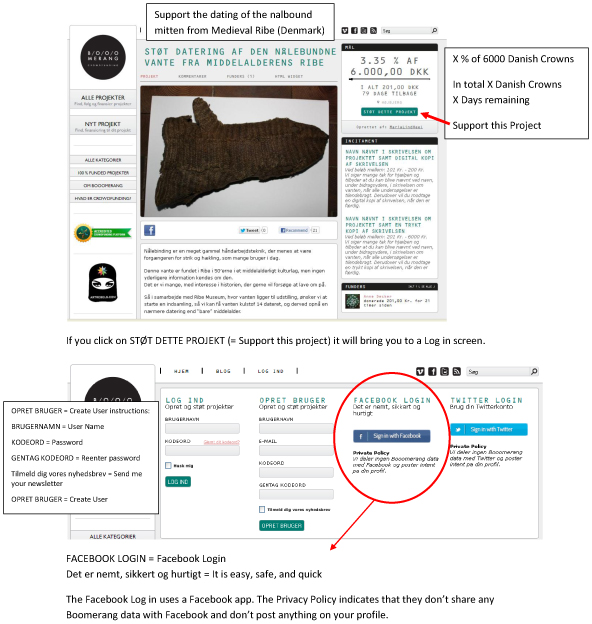
So it was only a question of time until some archaeological projects come up... and currently, there is one running to fund the 14C-dating process of a nalebinding mitten found in Scandinavia.

The story behind? Apparently, there's not much known about this mitten. The initiator of the crowdfunding got into contact with the museum, trying to find some more information, and the museum indicated they'd like to do a radiocarbon dating if they could get the funds.

Just in case you wish to refresh your knowledge about radiocarbon dating: Here's an explanation including details about preparation and calibration, courtesy of Oxford. And another info page, with a little poetical citing of scientists at the start. The thing I find most curious, by the way, is the convention of dating "before present" - which means 1950. This is somehow so fitting for archaeology!

Anyway, back to our Ribe mitten: Maria Lind Heel has initiated a crowdfunding project to collect funds for the dating. Radiocarbon dating is not the cheapest of things to do, so the project's goal are 6000 DKK, which translates into roughly 800 €. The page is on a Danish crowdfunding site which means it's all in Danish - but fear not, you can still chip in, since Anne Marie Decker already made English instructions:


The project will run for about another month, and is already a bit more than halfway, funding-wise. Yay for crowdfunding!

0
APR.
16
0

Do you read French?

If you read French and are looking for medieval embroidery examples, this forthcoming book might be of interest to you:

Sur, Francois. La chape de Saint-Louis-d'Anjou :
Trésor textile du XIIIe siècle de l'opus
anglicanum. Basilique Sainte-Marie-Madeleine,
Saint-Maximin-la-Sainte-Baume. Paris: Horizon,
avec l'Association des Amis de la basilique
Sainte-Marie-Madeleine de
Saint-Maximin-la-Sainte-Baume, 2013. 28cm., pbk.,
112pp., 110 illus., most in color. ISBN: 9782757206898
Available June 2013 Shamansky

Summary: Investie du poids de l’histoire et de la renommée d’un personnage à la destinée hors du commun, la chape de saint Louis d’Anjou reçut l’onction d’un classement au titre des monuments historiques le 31 mai 1897. Ce tissu brodé aura eu les honneurs de cinq expositions de renom, entre 1867 à Paris, lors de l’Exposition Universelle, et 2012 quand il se confronta au parement d’autel des Cordeliers de Toulouse, antependium de semblable facture. Ménageant son aura de relique, elle a certes cessé d’être honorée en tant que telle, mais, par le truchement d’une vénérabilité de plus de sept siècles, elle y a graduellement surajouté la dimension de trésor d’histoire et d’art. Tout est paradoxe dans la vie de Louis d’Anjou. Fils de Charles II, comte de Provence et roi de Sicile, il a passé toute son adolescence en captivité. Dans les forteresses du roi d’Aragon. Il est étroitement surveillé par des gardiens sans grande humanité. Ayant recouvré la liberté à 21 ans, il entreprend aussitôt de répondre à sa vocation religieuse. A Montpellier, quelques jours après sa libération, il veut prendre l’habit des Frères Mineurs. Ce choix répond à son idéal. Comme les disciples de saint François, Louis entend vivre dans la pauvreté la plus complète. Il ne s’agit pas seulement de ne rien posséder, mais encore de vivre en mendiant et de parvenir à un détachement du monde qui fasse accéder aux plus hautes vertus, en allant de l’humilité à la plus fervente charité. Avec une ténacité étonnante pour son âge, il persiste et finit par obtenir du pape Boniface VIII une prise d’habit secrète. Quelques jours après, le 30 décembre 1296, il est sacré évêque de Toulouse par le pape lui-même. Ce compromis lui permet de prendre l’habit publiquement au début du mois de février suivant. Il est prince aux fleurs de lys, il est évêque, il est franciscain. Il vit cet incroyable paradoxe avec lucidité. Cette réponse permet d’expliquer comment un franciscain épris de pauvreté peut avoir dans son trousseau une chape qui est un trésor. Ce somptueux vêtement épiscopal, il ne l’a pas commandé lui-même, car il faut plusieurs années pour le réaliser. Or, Louis d’Anjou est décédé le 19 août 1297, moins de huit mois après sa consécration épiscopale. C’est un cadeau, don de ses parents ou de Boniface VIII. S’il l’a portée, c’est en public pour faire honneur au culte. Dessous, il avait gardé l’habit qu’il tenait de saint François. L’oeuvre d’art est restée, témoignant d’une sainteté qui va au- delà des apparences. L’apparition en Europe des premières chapes brodées de ce type fut une révélation. Les vêtements liturgiques ornés de broderies anglaises étaient réellement les plus beaux cadeaux que l’Angleterre pouvait offrir à un prélat : ils captaient la lumière et spiritualisaient les gestes de l’orateur. Les motifs de la chape font écho à la liturgie médiévale qui vénère la Vierge Marie. Les scènes bibliques ne sont pas seulement décoratives mais aussi destinées à créer une enveloppe spirituelle. Broder est un art qui consiste à réaliser à l’aiguille un motif ou une décoration sur une étoffe préalablement tissée. Sur son textile opaque, le brodeur traduit l’impression de lumière et d’éblouissement. Les broderies de l’opus anglicanum sont caractérisées par une ornementation rehaussée de perles, pierres précieuses ou semi-précieuses.
(h/t to MEDTC Discuss list, where info including summary were posted.)
0
APR.
15
1

Roman stuff found in London.

There has been stuff found in London - Roman stuff. In an excavation due to a construction project at Bloomberg Place, really amazing finds from Roman times have been made, including very well-preserved organic material.

You can read more about it in this BBC News thingie, or on the Museum of London archaeology site (where they have a pic of a shoe).

This is really, really wow - and even though I am usually not so enamoured with the Romans and their stuff, I am looking forward very much to what else will come out of that dig, and what all we can learn from it!
0

By accepting you will be accessing a service provided by a third-party external to https://www.pallia.net/

Kontakt