Latest Comments

Guest - Aislinn Dyestuff Citizen Science.
09. Oktober 2026
This is a great project. I look forward to the results. Thanks for letting us know.
Guest - Aislinn Time for...
09. Oktober 2026
Looks delicious!
Guest - Katrin Sprang Discussion
18. September 2026
Hi Rachel, I have looked for more photos of you, but that was not very successful. I found a link on...
Guest - Beatrix Sprang Discussion
15. September 2026
That lozenge pattern element is not a photograph, but a scan. So it should be to scale. But I pinned...
Guest - Katrin Sprang Discussion
15. September 2026
I was not referring to Rachel's reconstruction (is the reconstruction you refer to the one photograp...
JUNI
25
0

Is it Monday again?

I had a truly wonderful weekend - a little bicycle ride for a visit to family, relaxed evenings, having lovely cake with friends and planning our summer holiday trip together, and finally having a nice meal (which included eating this year's harvest of red and white currants).

And now my brain is absolutely free of blog-worthy archaeological or textile-related things. It's summer, and I blame the slack season for slack in my brain as well.

So I will at least share with you my favourite way of eating red currants, which is also a very easy dessert: pluck red currants, wash and de-stalk them, and put them into the bottom of a bowl with a little sugar so they are not incredibly sour (only very sour). Prepare vanilla custard (Vanillepudding) and pour the hot pudding over the currants. Let it cool a little - can be eaten still warm or cold. That's it - a summery dessert that reminds me of my childhood and is something of a comfort food for me.

And next year, I hope our currant bushes will carry enough berries for at least two preparations of this dessert!
0
JUNI
22
0

Nothing exciting, for a change...

I have done some more spinning on the Great Wheel (because I can, and because it's fun, and because it's set up for a little spinning video to be made one of these days), some more carding (now I know two totally different but both functioning techniques for carding wool, and trying to find out which one suits me better) and the usual paperwork stuff besides.

Spinning time is limited by the amount of spinning my arms can take. They have not yet completely recovered from Saturday night, which is not helped by me going at it again and again. But hey, I'm having fun, it counts as training, and I so enjoy having a smoothly running spindle wheel! All this has brought me to think that I should do a test - use pre-prepared wool rolags or top and try spinning normal type and thickness thread for an hour each on the spindle, my two treadle wheels and the Great Wheel and see how the three compare. That's not going to happen during the next two weeks though - before I do that comparison, I will have to get better acquainted with my newer treadle wheel and be sure I can do one hour non-stop on the Great Wheel. It should be a fun, and enlightening, test though!
0
JUNI
21
7

More Wheel Pics!

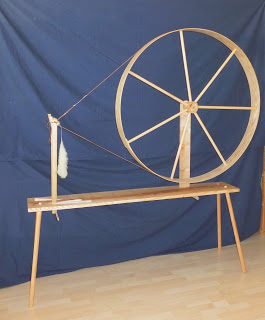
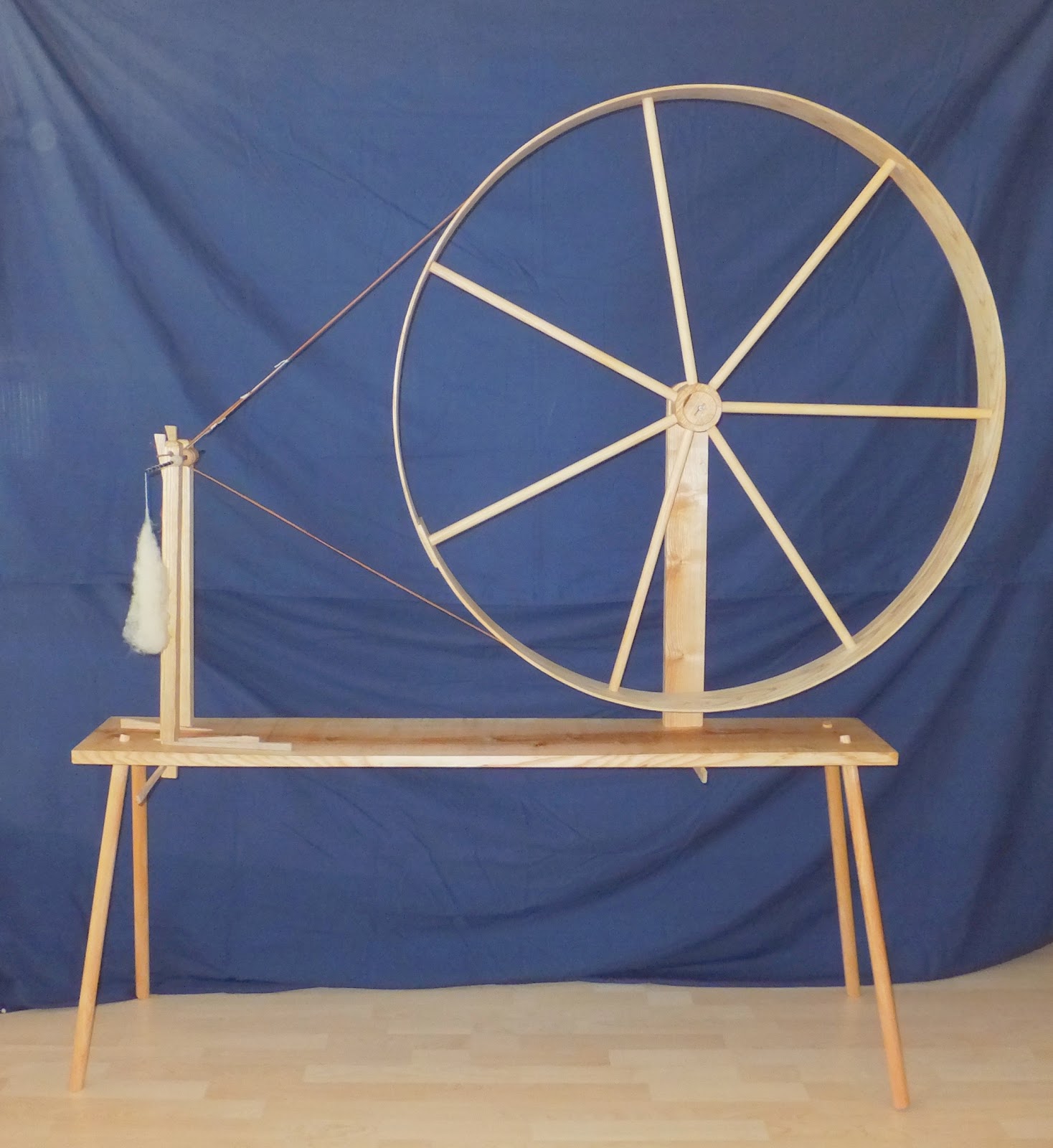
Here are some more pics of the wheel, this time in better quality and in front of a proper background. The photos are all quite large, so you can click on them for a more detailed view.


The complete wheel is about 1.7 m long and almost 2 m in height, thanks to the large wheel with 1.15 m diameter. It's mounted with the axis between my breast and shoulder height.


The extra wedges at the foot of the spindle holders is a concession to the transportability - they serve for adjusting the spindle holders and spindle. For a stationary wheel, I would adjust the holders once and then mount them to stay - but for transportable, this is of course not helpful.


There's only one wedge to keep the wheel stand in place - just like in the medieval depictions.
0
JUNI
20
1

Info Backlog.

There is a bunch of emails with interesting content in my inbox, and it's time for me to finally post all that stuff here.

First of all, the knitted 16th century cap collection of the Museum of London is now online. The
73 caps, coifs, cap fragments, linings and earpieces have been newly photographed, with captions containing contextual and technical information. All the pieces will have their full captions in the next two weeks.

The caps and their parts are of a large group of material excavated from sites around London by
workmen in the early 20th century. They represent an insight into everyday urban clothing and a high level of technical skill in their knitted, fulled and napped construction. Caps of this style are in collections across Europe and North America and are the focus of a lot of research interest, so we are pleased to make a large group available to the wider research community.

To browse the caps, go to the Collections Online site and enter ‘cap’ in the Keyword field with the date range 1500-1600 in the search fields.

---

If you are in the mood for a conference in the winter, here's a call for papers: ‘Crafting-in-the-World: the temporal and spatial dynamics of craft and its practitioners’. It is a proposed session for the 34th Annual Meeting of the Theoretical Archaeology Group, which will be held at the University of Liverpool, United Kingdom, from the 17th-19th of December 2012. You can view the conference website at: http://www.liv.ac.uk/sace/livetag/index.htm and get more info there. 

Crafting-in-the-World: the temporal and spatial dynamics of craft and its practitioners.
Whilst the last two decades have witnessed a prolific interest in craft studies, which have increasingly acknowledged the sociality of craft, the role of choice, and the importance of the body in the development and transmission of craft traditions, there remains an uncomfortable dichotomy between the temporal and spatial understandings of craft practice. The abundance of existing research has traditionally focused on either describing production processes or attempted to theorise how the finished products of craft acquire meaning. The separation of object from process has resulted in the products of craft looming un-tethered to practice, devoid of spatial and temporal understandings of craft practice.
In addition and despite claims to the contrary to this, there has been little coherent collaboration between academic specialisms, which has only served to heighten the fragmented nature of craft study and impeded our understanding of the subject as a whole. In an attempt to address these issues this session will encourage multidisciplinary engagement with the topic of craft, focusing on the temporal and spatial embeddedness of craft activities; what we term Crafting-in-the-World.
We are seeking contributions that will discuss the acts and arenas of production and the reunification of products with their formative processes to embrace a holistic approach to the study of innovation, production, and consumption. To complement this we invite papers that examine the intrinsic relationship between practice and space, exploring the ways in which practice is manifested in the landscape through time, looking at both the physical remains of production and the expression of crafting traditions. Contributions addressing experimental work are particularly welcome.

Papers for the session could address the following themes:
•       Reconciling continuity and change: redundancy, innovation and change (every innovation involves loss and gain); re-contextualisation of innovations; why some things change and others don’t (i.e., there is no such thing as progress).
•       Spatial articulation of craft: technological ‘features’ as architecture; space shaping practices and practices shaping space; compartmentalization of space and time geographies.
•       Tangled web of technological practice: communities of practice; Complementing, referencing, incorporating aspects of other crafts; mobile crafts (i.e., itinerant crafts people).
 
If you wish to submit to the session, please email Diese E-Mail-Adresse ist vor Spambots geschützt! Zur Anzeige muss JavaScript eingeschaltet sein. by the 27th of June with the following:
 •       Paper title (maximum of 20 words)
 •       Paper abstract (150 words max)
 •       Your name, affiliation and contact details.

---

There's a  new magazine (or e-zine) out called Kritische Archäologie (Critical Archaeology), and it seems to be at least partly in English. The whole first issue can be seen on their website.

---

And finally, there's another online database of stuff: OPAL, Lower Saxonia's portal of artefacts. I have not (yet) found much textile stuff there, but it's worth a browse nevertheless.

That's it for today - hopefully you have found something that interests you!
0
JUNI
19
1

It's really summer here.

We have full-on summer here now, ripe strawberries, lots of sunshine, dry weather (the lawn has become Extra Crispy Summer Edition again) and heat, heat, heat. The season for iced coffee and icecream and hanging out in the garden in the evening and enjoying the sun.

Unloading the car yesterday was a quite, quite hot affair, so I am happy that I did not have to do the presentations in heat like that, but in a rainy night instead. And today's agenda mostly lets me stay in the comparatively cool indoors, where I shall endeavour to catch up with all the paperwork that has accumulated again... boring to do, but a good excuse to stay in the cool.
0
JUNI
18
3

The Wheel - with pictures.

The Museum Night in Mainz was very nice, if quite taxing - it's just a difference whether you are doing all the showing and explaining during the day and normal working hours with good lighting or during the night. We had a rather warm night, but unfortunately not a dry one! The visitors who braved the spouts of rain, however, were a wonderful audience, and it was a delight to show them crafts with wool.

The wheel did very well on all accounts, from an easy and unproblematic setup to its performance all during the night, even with changing air temperature and changing humidity levels. The only little thing that needs fine-tuning is the adjustable connection for the leather drive band - but I already have an idea for that. 

And here, finally, are the promised pictures of the new Great Wheel:

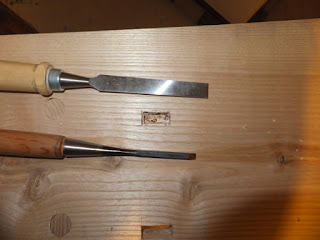
 The last step in construction - cutting the mortises for the spindle stand tenons.

 Fitting the tenons.


The finished, disassembled Wheel - a base board, four legs, spindle stands, wheel stand, the wheel itself and a box of small things for assembly and adjustments.


It fits! It fits! That's the car with the presentation stuff, just before I left for Mainz. The wheel is hanging under the car roof, and the rest of the parts are hanging out with my other wood utensils and furniture.

And here it is finally, in action! Wedges hold the stands, and additional wedges under the spindle stands and in the leather spindle bearings allow adjustment of the whole setup so spinning is smooth. One night's worth of testing says: It's a fine, functional tool!
0
JUNI
15
2

Fine-tuning.

Today's blog is a little later than usual, because the first thing I did this morning was sneaking off into the workshop again. I've managed to fully install the wheel stand yesterday plus almost install one of the two spindle stands, and I wanted to see if I couldn't get the second one finished and installed (that is, mortise and tenon done) before blogging time.

Well, it did not quite work (there's still the very last bit of installing and fine-tuning to do) but almost. I'm almost, nearly, virtually done now - there remains to measure in, drill and clean two more holes for two small wedges and then fine-tuning of the drive band and spindle stands. Oh, and cutting and filing the axis, plus drilling a hole for a cotter pin to secure it... but then it's really, finally done.

Since the wheel is made to come apart for transport, all those fine-tuning things and a lot of small details have to be just a little different from what they would be for a fixed wheel - a good amount of things has to be adjustable, or has to fit just snugly enough but not so snug that it won't come apart again. So I do hope fervently that the fine-tuning solution for the spindle stand that I just thought of will work... if not, I'll have to think of something else quickly. (Spoiler: I already have a if-really-necessary-I-can-do-that solution in the back of my head.)

So. Off into the basement again.

Oh, and by the way: You know that your woodworking tools are sharp enough when you only realise you've nicked yourself when you see brightly red spots appear on your working piece...
0

By accepting you will be accessing a service provided by a third-party external to https://www.pallia.net/

Kontakt