Latest Comments

Guest - Aislinn Dyestuff Citizen Science.
09. Oktober 2026
This is a great project. I look forward to the results. Thanks for letting us know.
Guest - Aislinn Time for...
09. Oktober 2026
Looks delicious!
Guest - Katrin Sprang Discussion
18. September 2026
Hi Rachel, I have looked for more photos of you, but that was not very successful. I found a link on...
Guest - Beatrix Sprang Discussion
15. September 2026
That lozenge pattern element is not a photograph, but a scan. So it should be to scale. But I pinned...
Guest - Katrin Sprang Discussion
15. September 2026
I was not referring to Rachel's reconstruction (is the reconstruction you refer to the one photograp...
OKT.
15
0

A Lovely Loom.

Yesterday's blog post fell by the wayside - I was away all day going to set up the loom for the exhibition in Bamberg... and it was great fun. (I also learned a lot! Including a new knot, which is actually a big deal for me, as I seem to be a bit of a knot dyslexic sometimes.)

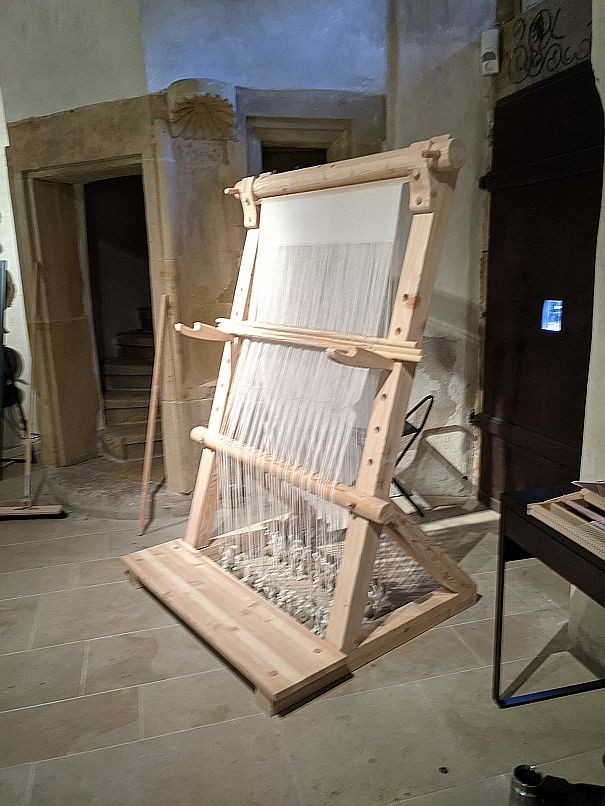
The loom standing in the exhibition now was the result of a lot of thinking, planning, and the effort of many people. Our idea was to show something about weaving in the era around 1000. Now... that's the time when there's already an inkling of the horizontal loom, but we have next to no good evidence for that (as in "good enough to build a reconstruction from"). So we decided to make a warp-weighted loom.

The original plan was to have a regular one, but the building (which is old) does not allow for a loom to touch the walls. (That's also a possible security issue in an exhibition, as a loom only leaning might fall, and attaching it to the wall was out of the question, as the building itself is under heritage protection). The second plan, having an iron/metal holder for the loom, was out because of budget reasons, so we did end up with a free-standing wooden loom.

It's a proper, nice one, though, not looking as if somebody went collecting a few sticks in the wood and cobbled them together.

(The curious thing is that you can build a functional loom from mostly odd sticks from the woods, provided you make sure that the essential bits that need to be straight are straight. That's harder to do nowadays, though, than making one from cured, available, straight bits of wood, though. So that's what we have.)

The main thing that we wanted to do with the loom was to show that textile production at that time was a high-standing, important, and highly developed part of production, and the resulting objects were of high quality. So we found an expert in warp-weighted loom weaving in Sweden - Marie Wallenberg - who worked together with us to get the idea across to the woodworker, who made an almost perfect loom. One of the folks from Kaptorga made the loomweights (scaled down a little to be lighter, because that helps to not wear out the threads over time - the normal fitted loom is not intended to stay for months or years with the loomweights hanging), and Marie wove a fabric to fill the loom.

If you've seen warp-weighted looms in exhibitions, they are often a crooked thing, with a crooked bit of coarse weaving on them. While that may have happened occasionally, it is not what we would expect them to be in general - after all, they were used to make fine, straight, high-quality fabrics in the past. And that is exactly what we wanted to portray.

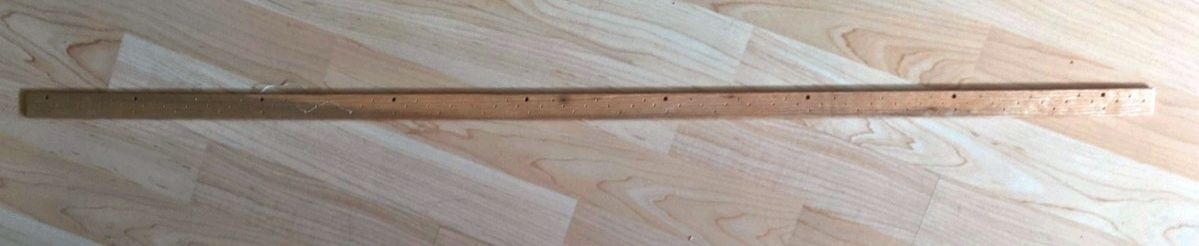
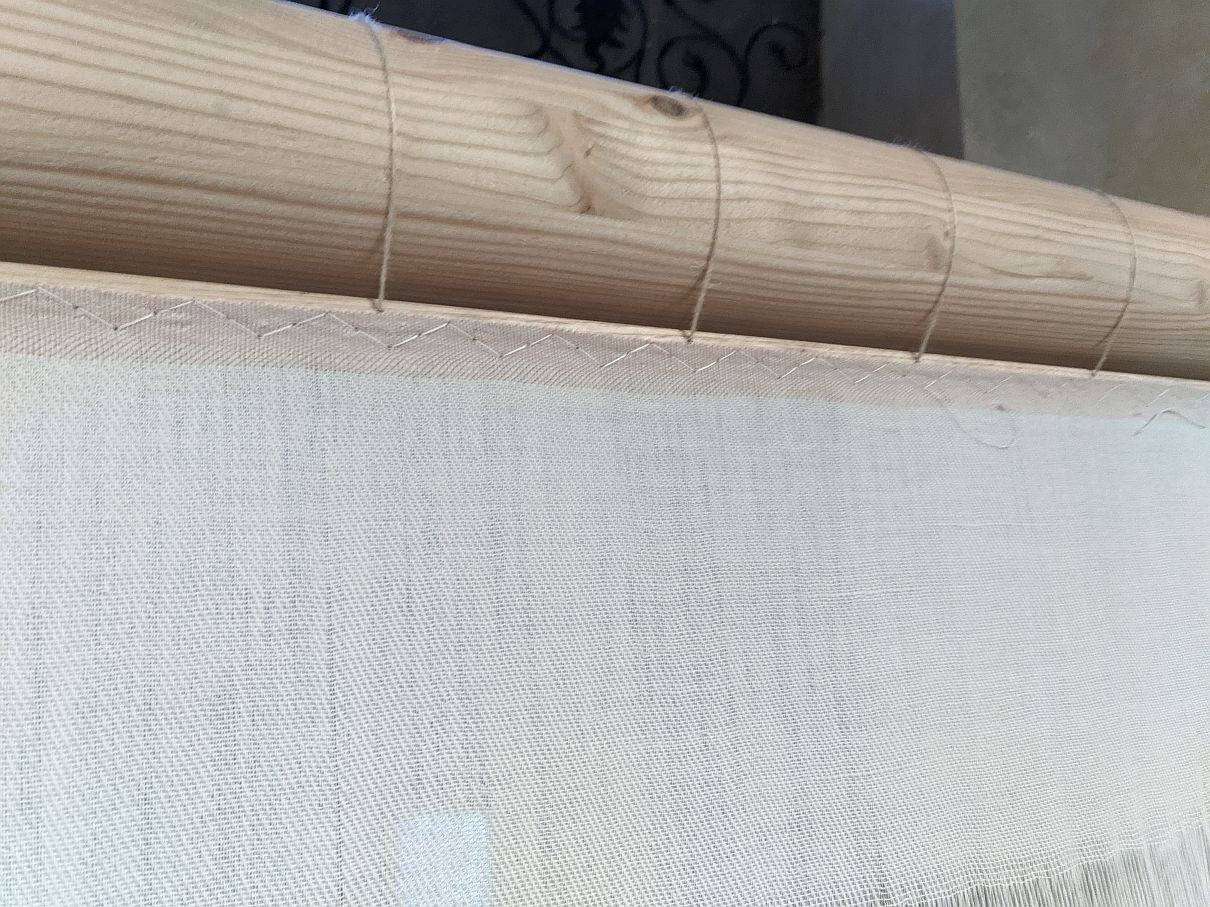
So once the loom had arrived from the woodworker and the fabric had arrived from Sweden and I had finished making the Rod of Many Holes to attach the weave to the loom's top beam, I set out to set things up in Bamberg, with Marie coaching me through the process. 

 And now we have a "little clay army" (my new favourite expression for clay weights hanging on the loom) and a white wool waterfall, showing off nicely that yes, you can weave a fine 2/2 twill on a warp-weighted loom. I really love the beautiful starting border as well! 


The exhibition will be open from October 25, and even though the info page is German only, the exhibition itself and the catalogue are fully bilingual German and English.

1
OKT.
11
0

Many Holes Were Made.

One of the things I really love about my line of work? Getting to work with professionals from adjacent fields and learning new things. Another thing I love is getting to work with many different materials - especially since I'm also working with textile techniques and tools, that does not just encompass the many different variations of fibres, yarns, and fabrics, but also other materials. Wood. Clay. Metal.

It has definitely proven helpful to have a little bit of basic skill working with these things, and a small but versatile selection of tools. One of my favourite ones: The so-called "Bssst". (You may guess why it's called that.) 

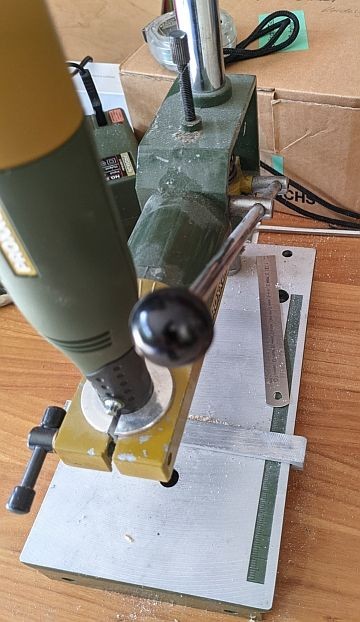
 I have this stand and another stand/holder for it, and it's been drilling holes and polishing things for me a lot. (My dad bought the original Bssst many years ago, and I've just recently had to replace it with a new one, as it absolutely refused to do anything anymore.)

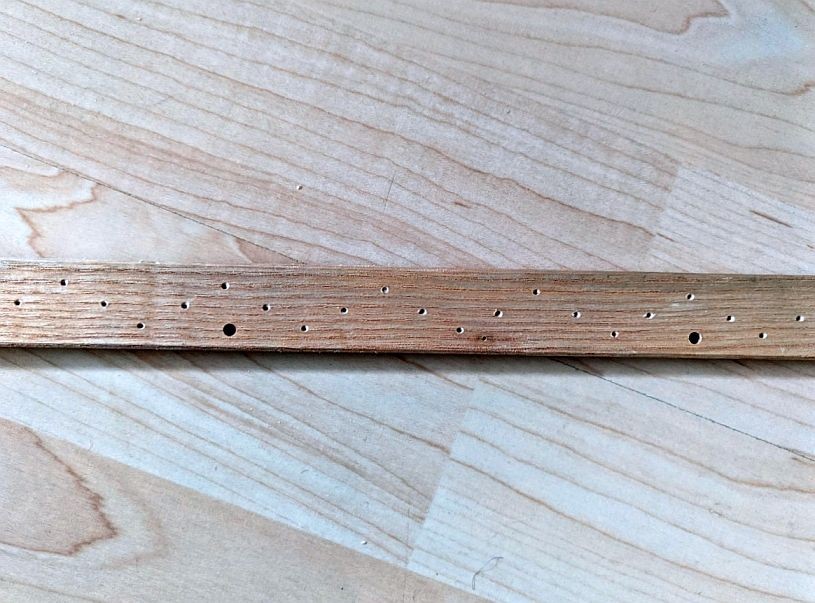
This time, it was my little helper drilling many, many holes in a stick:

That will be the connecting part between the horizontal top beam of a warp-weighted loom and the fabric. While it's technically possible to sew the fabric starting band directly to the top beam, adding in the Stick Of Many Holes makes things easier, and more comfortable, and uses less string overall. The larger holes are to attach the stick to the beam, and the smaller holes to sew the fabric to the stick. 

That will happen on Monday - and I'm already looking forward to that!

0
OKT.
10
0

Digital Exhibition "Zwei Geschenke für Hitler"

In the NS era, archaeology was used for a lot of propaganda things, usually to show that Germans are The Best Thing Ever and everybody else was, at best, second grade, and that from the Stone Age onwards. Or so. (This, by the way, is said to be one of the reasons why German archaeology after the war became this hard-facts-only science that is rather sparse with interpretations, if compared to how things are done in other countries.)

The Kreismuseum Syke is working on a case that will give some information about archaeology in that era, and while doing the prep and research for that, they stumbled across an interesting history surrounding a Thanksgiving present to Hitler. If you read German, you can follow that story in a digital exhibition on the museum website. (If you don't read German, you're welcome to look at the pictures and old letters there, but the whole thing is heavily reliant on the texts - and it's quite interesting how the writing styles changed over time.)

I think it's a very good idea to do that exhibition case, and the digital exhibition too!

0
OKT.
09
0

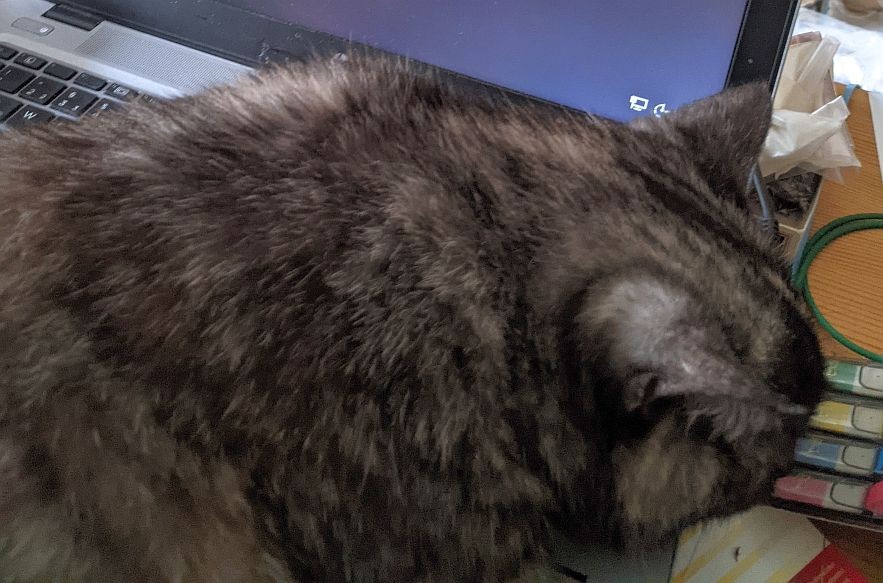
Because everything is better with a cat picture...

...here is one:  

Unfortunately, I was not so happy as to sleep on the computer, as there were things to do on it. (The paw placed strategically where it was not supposed to go did not help...) 

Some things are taking on shape, though. Including a credit card payment method for the webshop, which will hopefully pass the testing phase soon! 

0
OKT.
08
0

Close-Ended Braids

It's quite amusing how some fields suddenly have a cross-over with an entirely different one. Remember the pdf I linked to a while ago, with the vegan sausages? Published under "physics of fluids". 

Similarly, braids have been a topic for mathematicians as well, and that for a good while. Maybe you have seen one of the "mystery braid bracelets" at some point, usually a three-end braid made by cutting two slits in a piece of leather (so that the three ends that makes are still solidly connected at both top and bottom) and then braiding it. Yes, that works. Go try it if you've never done so before, it's fun!

Anyway, there's a whole mathematical paper written back in 1962 about braids that can be done with both sides of the ends connected. If you'd like to see it, it's available at JSTOR (where you should be able to get a free account with limited free articles per month to read it). 

0
OKT.
07
0

Survey on Narrow Wares Weaving Apps

If you weave narrow wares (inkle bands, rigid heddle bands, tablet woven bands), you could help Mari with her research if you participate in her survey on dedicated apps and other digital aids used in narrow wares' weaving. Mari's reason for the survey?

I am a weaver and teacher of narrow wares' weaving, but I also study IT. My bachelor's thesis for Laurea University of Applied Sciences
researches digital aids used in band weaving with a rigid heddle or string heddles and tablet weaving. My main focus is on the use of
dedicated narrow wares' weaving apps, but I also look into other digital aids used for designing and weaving warp-faced bands and for
teaching band weaving and tablet weaving. The purpose of this survey is to find out which apps and other digital aids are used at the
moment and which features in the apps are or would be important to weavers, designers, and teachers of narrow wares' weaving.

The survey is short and quick to fill out; you can find the survey form here. 

Please read the terminology note at the top of the introduction before scrolling down to the survey itself. The survey does not ask for any personal information and even the obligatory background questions all have the option of not telling anything. Survey responses will be destroyed as soon as the thesis has been approved by the university, at the latest by the end of 2024.

You have a week to participate, responses are collected until the end of October 10, 2024 (the survey closes at midnight Finnish time [EEST/UTC +3]). 

Feel free to share the survey form link with others, too - it definitely helps to have many responses on surveys like that!

0
OKT.
03
0

Some time off...

It's time for a few days off - I will be back on the blog on Monday! 

Meanwhile, if you're interested in finding out a little more about AI, take a look at this "AI productivity guide" - maybe it's helpful. (I haven't looked into AI support for stuff yet, but in the way and speed that this develops, it's only a question of time for it to become part of daily life and daily work life...)

0

By accepting you will be accessing a service provided by a third-party external to https://www.pallia.net/

Kontakt