Latest Comments

Guest - Aislinn Dyestuff Citizen Science.
09. Oktober 2026
This is a great project. I look forward to the results. Thanks for letting us know.
Guest - Aislinn Time for...
09. Oktober 2026
Looks delicious!
Guest - Katrin Sprang Discussion
18. September 2026
Hi Rachel, I have looked for more photos of you, but that was not very successful. I found a link on...
Guest - Beatrix Sprang Discussion
15. September 2026
That lozenge pattern element is not a photograph, but a scan. So it should be to scale. But I pinned...
Guest - Katrin Sprang Discussion
15. September 2026
I was not referring to Rachel's reconstruction (is the reconstruction you refer to the one photograp...
SEP.
21
1

Bielefeld spinnt - how it went.

Bielefeld spinnt is over, and I've sort of regenerated a bit - thanks to a nice, relaxing day off work yesterday. It's sort of funny to turn a Tuesday into a personal Sunday, but nice in its own way. Plus you can go shopping (which in Germany is not possible on a real Sunday, as all the shops are closed.)

The fair was lovely, but altogether also quite a trip, and quite exhausting. Going to a fair with a booth is always a wild ride, with a lot of delight but also a lot of stress. (In case you are interested, I can give you a rundown on my days - let me know!)

In Bielefeld, Margit and I were in the larger hall of the main building, on the ground floor. That meant we were smack dab in the middle of a light, airy room, and right beside a coffee booth too. It's always good to be near a coffee source!

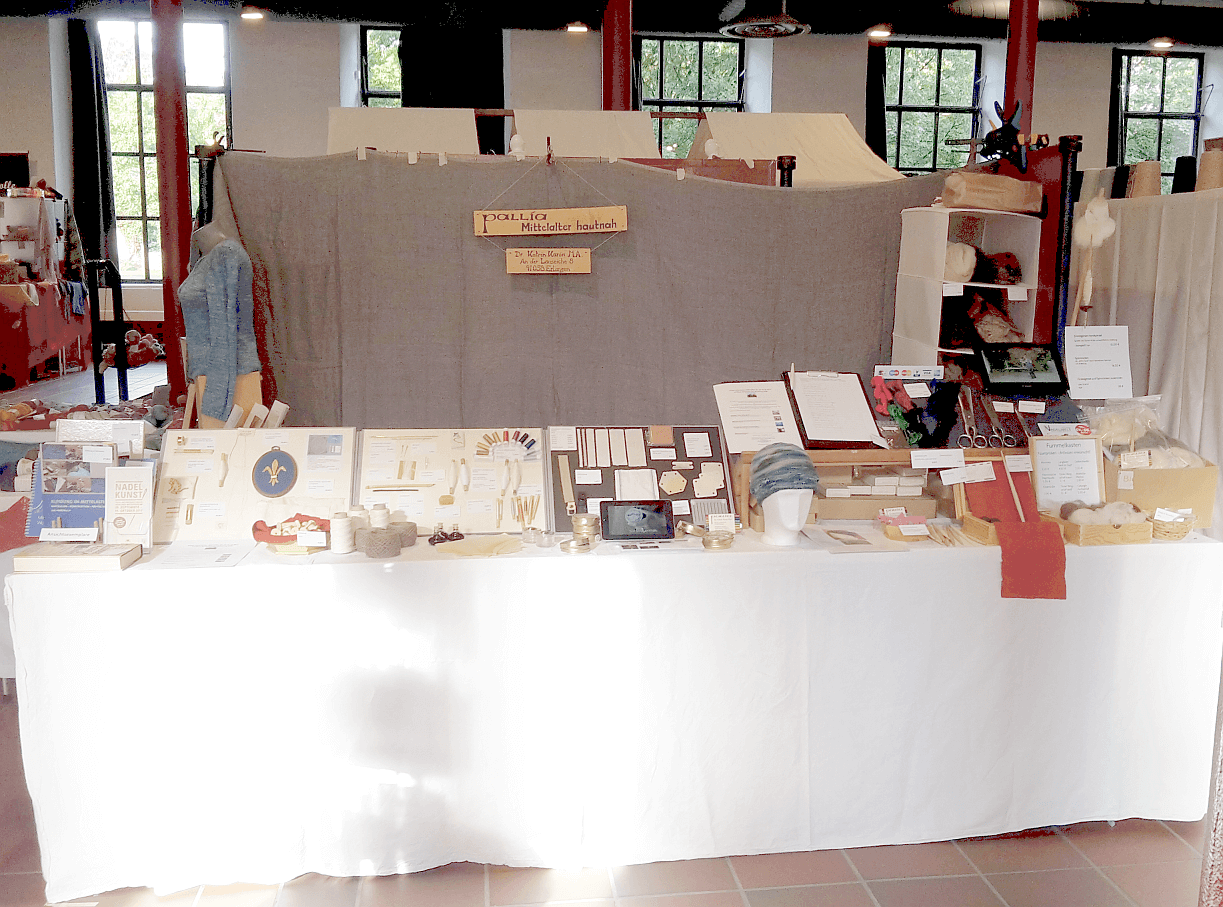
[caption id="attachment_3386" align="alignnone" width="1223"]stand_bielefeld View of my bit of the fair - the table all set up and ready for the fair!


With the courses that both Margit and I gave, together with alternately manning both booths when the other was teaching, we did keep busy all weekend long.

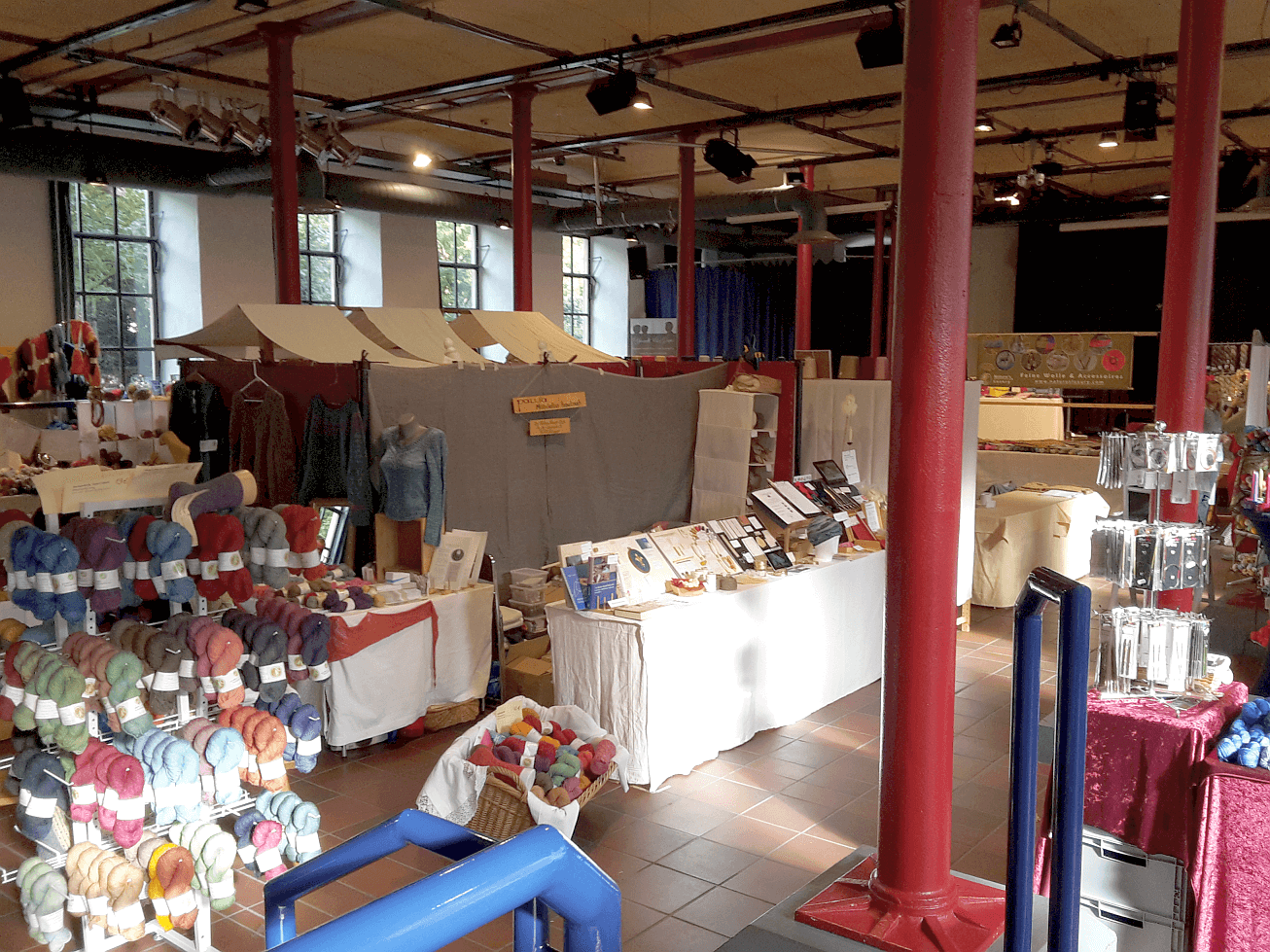
[caption id="attachment_3385" align="alignnone" width="1306"]stand_bielefeld_2 Margit's stall and mine, side-by-side or whatever you call it when two stalls form an L-shape...


So busy, in fact, that I didn't get to knit a single stitch the whole weekend, including the evenings. Which means that neither the Baton Rouge jacket nor the Moyen Age sweater are finished yet.

But after all, I can knit at home and all the time, but at the fair, I had the opportunity to meet and chat with lots and lots of nice people, and I sold so many distaffs and spinning kits that I have to make more straightaway to have a bit of a selection to bring to Weikersheim. That's part of the obligatory After-Fair-Homework. (There is no fair without homework. Never. There's always something you discover that needs mending, or changing, or some other kind of attention - and that's on top of the usual after-fair work such as taking stock and doing the book-keeping.)

So thanks to the organisers for all their hard work, and thanks to all the helpers at the fair - I had a lovely time, and I'm looking forward to the next German Ravelry meetup!

 
0
SEP.
12
0

Filming...

Part of category "fun things I get to do under cover of my day job": filming. In the most current case, filming a short explanatory video about the oil light swimmers that I carry in the shop - to show when I'm at fairs.

I'm still completely delighted with the fact that a company in Nuremburg has been making these oil light swimmers for way more than a hundred years. I absolutely love using them as the eco-friendly (and cheap!) alternative to tea lights. No aluminum waste, no pricey beeswax tealights, and there's vegetable oil in the kitchen anyways, so also no extra space required.

The concept of this kind of lighting, though, has been out of common use and knowledge for so long that the little round and tri-bladed thingies need a lot of explanation when they sit on the table in my market stall - so I've played with the idea of making a bit of an explanatory video for a good while now. Finally, this has happened, and it ate most of yesterday's work time.

Just like taking good photos of things, it's not as easy as it seems to take a good video of things. It can be astonishingly hard to keep everything inside the frame - good thing I've been doing theatre stuff before, so I knew about the magic that can be wrought by a few bits of tape at key places.

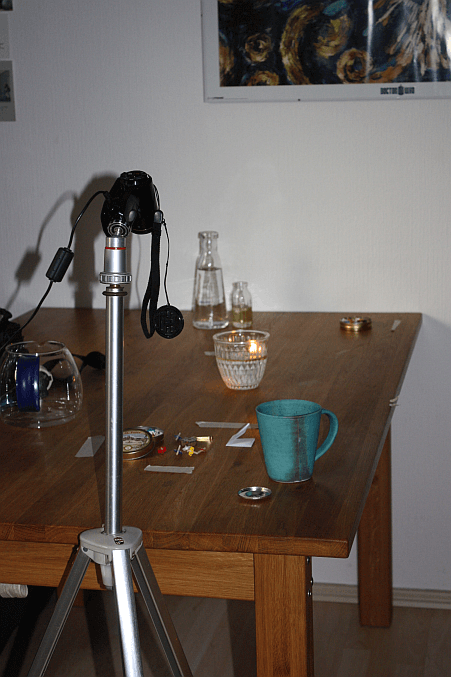
[caption id="attachment_3366" align="alignnone" width="451"]oellichtfilm Video setup. It's not looking very spectacular, is it?


Also there was a problem with the SD card I used in the first go, so I got to take all the shots again. Sigh. Now the video-ing part is all done, and only (hah!) the cutting and text-setting part remains - which will hopefully not take a lot longer, so I can take the video along to Bielefeld...
0
SEP.
05
0

Coming Up: Presentations I'll do.

There's two events coming up where I will give a presentation or paper: the European Textile Forum in November and, shortly after that, the Symposium to celebrate 30 years of Living History by IG Wolf, and I'm really excited about both of them.

The European Textile Forum, as a dear child of my heart and Sabine's, will be focused on silk, that lovely luscious material, and the preliminary programme is already rather lovely and varied. There's still a good bit of organising work to do for me, scheduled to happen during the next few days (whenever I'm not busy preparing for the fair at Bielefeld), but so far, everything is fine and I'm already really, really looking forward to it. The presentation I've planned means that I will have to sit down and do some more nice, brain-bending tablet weaving, too... something I'm also looking forward to. Yay!

The second one - IG Wolf is one of the groups doing Living History, and LH demonstrations, with lots and lots of attention to detail, and lots of love and enthusiasm to go with it. They have been going strong for 30 years now and are celebrating in style: not with a party, but with an actual symposium for a whole weekend, featuring a number of papers under the motto "Theorie trifft Praxis". I'll be talking about spinning and fabric reconstruction/recreation, with all the many problems that can (and probably will) come up.
You can have a look at the programme here - and if it tickles your fancy, there's good news: they still have space available and take registrations until September 15, so you can register here and join the fun!

 
0
JULI
25
0

Currently going on...

Things currently going on? Lots.

Knitting is progressing, slowly but surely, so there might be a new sweater this winter. There's stuff for the next museum project hanging out here, waiting for the next step. I also have to take stock of the things in storage for the shop and re-order a few items.

Apart from that, planning for the next European Textile Forum is going on, which includes figuring out the programme, which will most probably include a nice excursion. (If you're interested in the Forum, or know somebody who might be - please spread the word, and if you are planning to come, register soon. We have a few places left, but not many, and having people register early makes things much easier all around.) Together with the planning, I'm trying to solve a few not-yet-issues at the website, which - as usual - takes way more time than it should.

Then, there's article writing and conference preparation for other talks - which is, fortunately, mostly under control at the moment (which means I'm not ridiculously behind schedule, and can still sleep at night).

To balance all this, there's cake, and tea, and coffee. Because everything is better with cake, tea, and coffee...
0
JULI
07
4

Workshop Planning - final stage: done.

The workshop planning for the tablet-weaving is finally, finally finished. I've done a testrun on Wednesday, with three lovely ladies volunteering to be my guinea pigs for trying out the concept and the materials - and it was a good thing, and a fun afternoon to boot.

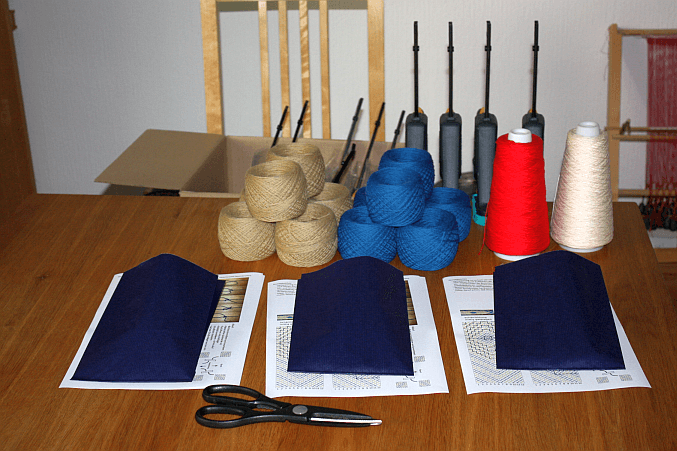
[caption id="attachment_3229" align="alignnone" width="677"]All ready for the testrun! All ready for the testrun!


The good news (for me, at least): the materials, setup things, and general concept are all sound, and they all did work as I had hoped them to. The timeframe of about 4 hours, a little more if necessary, also works.

Of course, though, there were a few issues. "No battle plan survives contact with the enemy", right? They were, however, mostly small, and to my relief, all of them can be fixed easily. One of the small issues was a sort of back-firing effect from handing out pattern sheets - they were intended to help with visualising the patterns, and as a reminder on how they are done for after the course at home. They turned out to be rather distracting, as they were either not understood easily or, in one case, were understood well enough to be used to tick off the wefts that were already done. Which is, of course, a perfectly valid method to approach one's tablet weaving - getting or writing a pattern, then following it - but exactly the opposite of what I want to teach, which is knowing what kind of pattern you want to do, looking at the band, and then seeing what needs to be done in order to get the pattern you want. This, admittedly, is a bit more of a brain exercise than reading a written pattern and following it step by step - but it does give you the possibility to weave without a pattern, and the flexibility to change things on the go without getting (too) confused.

Well, this is easy to remedy - I just won't hand out patterns. Saves paper, too...

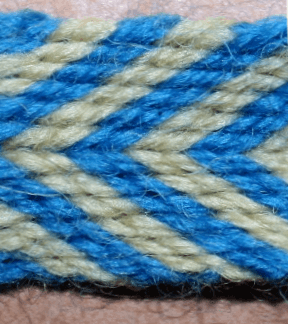
The biggest issue was my intended approach to teaching the 3/1 twill structure. Tabletwoven twill is basically a doubleface with staggered colour sequence - when you turn all tablets into the same direction, you get diagonal stripes. When I learned how to twill, I got taught with the band set up to make a chevron pattern when all tablets turn forward, so you get V-shaped stripes.

[caption id="attachment_3230" align="alignnone" width="218"]Band with chevron stripes. This will still be done in the workshop - but not as the basic setup for the twill part. Band with chevron stripes. This will still be done in the workshop - but not as the basic setup for the twill part.


This has the advantage of having a mirror-image in your band, so if you mess up on one side, the other side can help you in correcting your mistake. The problem for teaching a group with this method? You need a broader than feasible band in order to clearly see the twill structure, and get into the twill rhythm. When I did my concept and test-weaving, this didn't occur to me - I've done enough of the twill stuff to see the pattern emerge almost instantly, and with it the rhythm. With time, it becomes totally natural how the tablets move, and what you expect from them - and that is good and necessary, as twill patternwork will tend to twist your brain, so everything that is automatically done following a strict rule is one thing you don't need to pay attention to. (This is also why I have firm procedures when weaving and firm rules in how to set up the band - I need to know what direction of turning gets which diagonal, or my brain busts.) For the course, though, and beginners in twill, the areas worked in twill and in regular structure in this setup are too small, and things are following too closely on each other, and thus it gets too confusing.

Fortunately, this is also easy to remedy - with a different setup, and slightly different explanation with a different emphasis on what to look for. Which, with a few small changes to the handout, settles all my remaining problems with the course concept. Yay!

So now my script is updated, the handout has been changed, my list has been checked and amended with a few details, and the course is ready to take off. First instance, according to current plans, will be at the Nähtreffen (there's still spaces left, if you'd like to join us). And then - who knows? With about 4 hours, the course is fairly long to offer it at events like the Ravelry Meetup, but it's not completely out of question. And of course, it's always possible to book the course for a group of like-minded folks, either taking place here or where the group is based.
0
JUNI
30
2

Course Prepping.

I had a lot of fun yesterday preparing for a tablet weaving workshop testrun - which, unsurprisingly, proves to be a lot of work. I last posted about this almost one and a half years ago, so it's been stewing for a really, really long time now. That is mostly due to logistics problems. One of the large stumbling blocks for me were the questions "How do you enable up to eight people to warp simultaneously?" and "How do you get the warps tensioned?"

The answer to both, in my case: F-clamps. I love those things, especially those single-hand F-clamps, and I've used two tiny ones for years now. I should probably say "abused", though, because, well, they are not intended to be clamped down onto something upside down and then get stuff attached to the stem sticking upwards. There's high-quality ones that will withstand this kind of abuse, though, and cheap ones that will eventually give up and come loose with rather little tension on their stem. Which means the sensible thing is to go for the higher quality tool... with the higher price.

Unfortunately, regarding my two questions, "F-clamps" is not the full answer. The full answer is "a shitload of F-clamps", and it has taken me a while to get to terms with that, bite the bullet, and invest. But I have found a good clamp, they have arrived, and I'm now working on finalising my teaching script, getting the handout (which will be a how-to-make-your-pattern cheat sheet) all done and lined up, and then there will be three nice guinea pig ladies coming over next week to try their hand and my teaching ideas.

It's all quite, quite exciting - and if it all works as planned, the course will cover warping in the "endless" method, the basic system and mechanics underlying all tablet weaving, how to read and write patterns, and how to do 3/1 twill on tablets, including how to work (and design) patterns in this method.

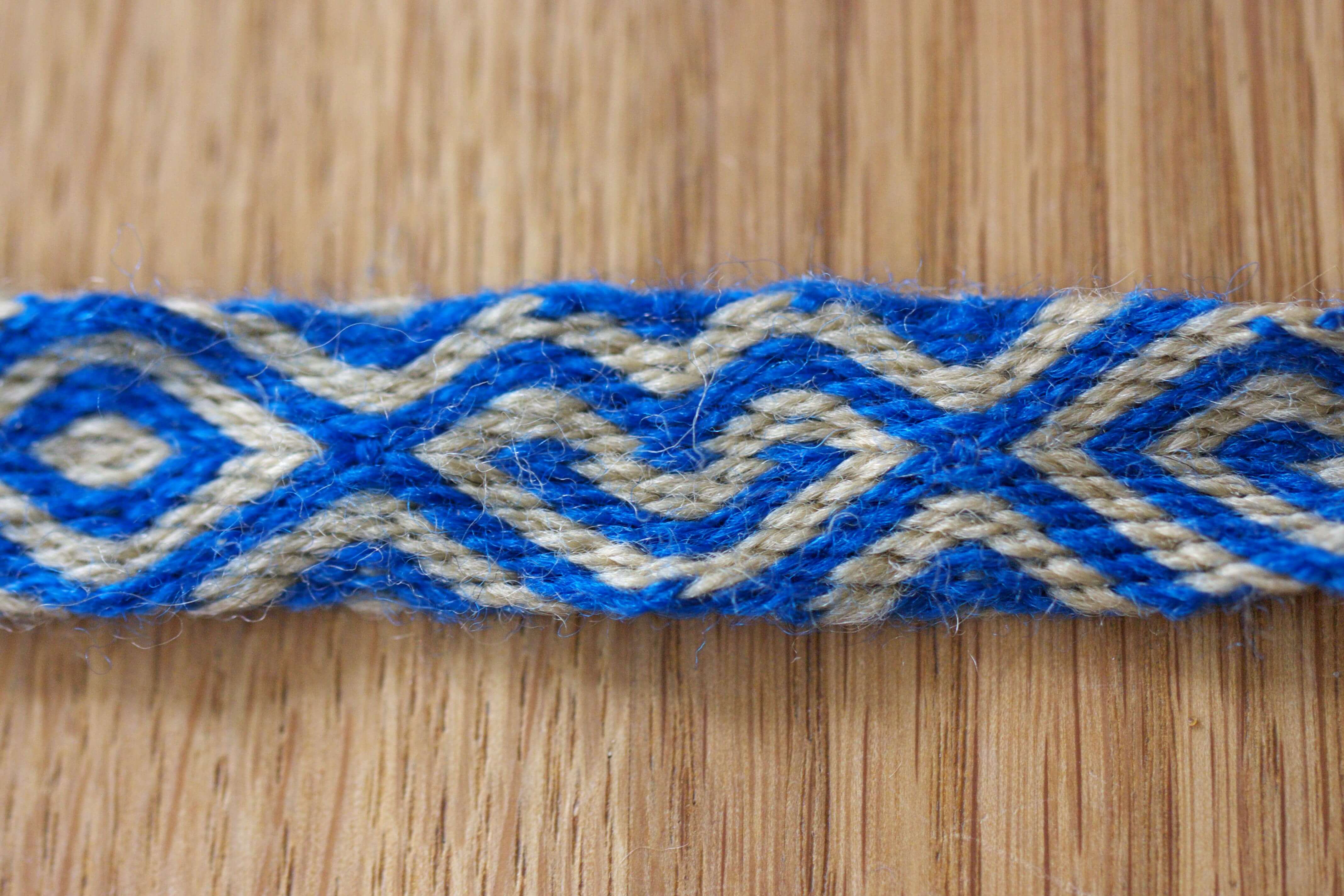
[caption id="attachment_3213" align="alignnone" width="4272"]One of the possible pattern bits that will be part of the workshop - and part of learning how to design swirls and stuff. One of the possible pattern bits that will be part of the workshop - and part of learning how to design swirls and stuff.


The course will then have its first proper appearance at the Nähtreff in October - which right now seems rather far in the future, but with the way time is flying, it will probably be happening before I know it!
0
JUNI
29
0

... and more NESAT presentations.

Speaking of things from NESAT, and continuing the blog from yesterday - Beatrix Nutz, Rachel Case and Marion McNealy, who did a presentation about the Lengberg finds at NESAT, have also put their presentation online for you to watch (in fact, they were a lot faster than me!), and they even re-made the audio part as the audio quality from their recording was not brilliant.

So here's a little bit more of NESAT for you to enjoy:
0

By accepting you will be accessing a service provided by a third-party external to https://www.pallia.net/

Kontakt