







Latest Comments

Guest - Aislinn Dyestuff Citizen Science.
09. Oktober 2026
This is a great project. I look forward to the results. Thanks for letting us know.
Guest - Aislinn Time for...
09. Oktober 2026
Looks delicious!
Guest - Katrin Sprang Discussion
18. September 2026
Hi Rachel, I have looked for more photos of you, but that was not very successful. I found a link on...
Guest - Beatrix Sprang Discussion
15. September 2026
That lozenge pattern element is not a photograph, but a scan. So it should be to scale. But I pinned...
Guest - Katrin Sprang Discussion
15. September 2026
I was not referring to Rachel's reconstruction (is the reconstruction you refer to the one photograp...
FEB.
22
2

The next talk is coming up.

I'm currently preparing the powerpoint slides for my paper at the "3000 years of Colour" conference, and I'm having the usual problem again: I need an intro bit explaining what I was doing, then some words about methodology and experiments, then the intro to the experiment design and the data gained from it.
And by the time I can get into talking about the analysis, this means quite a lot of time has gone already. And I need to keep it much, much shorter than I would like to. This is such a common problem when you're working in a niche field - I usually end up taking about 5 minutes to explain what I am doing, and why, in a conference paper. Many of the conferences on experimental archaeology only give you a 20 min slot, so that means a quarter of my allotted time is gone before I can get properly started with my research and results presentation.

Can somebody please invent something to slow time during a talk? That would be so, so nifty sometimes.
0
FEB.
15
0

Odds and Ends.

Today is a day for taking care of odds and ends - all those small annoying things that need doing. Like checking for updates for my programmes, or fixing small oopsies on websites, or updating some things in the shop, or answering mails and phone calls. It's amazing how many of these small tasks keep coming up - some garden gnome or something like that to take care of stuff would be really helpful!

While I am working on diminishing the annoying-small-tasks list, maybe you would like to check out the programme for the next conference of the European Association of Archaeologists (EAA), which will take place in Helsinki August 29-September 1? You can find their homepage here, and the call for papers will be open until end of March.
0
FEB.
10
0

Whew.

The last three days were quite intense - sitting in the car for about four hours, followed by a long afternoon and a long full day of unleashing my inner geek to get a website set up, organised and running, and finally a nice and interesting meeting at LEA to discuss future events - including the Textile Forum.

I had seen plans and pictures, but it really is different to stand in the rooms and halls and see how much has been done. The building is in the process of drying out and still needs a good clean, but then (almost) the only thing that's left to do is to put in the rest of the fittings for the two workhalls. One will contain a smithy, but they are both designed to be very flexible in their uses. There are two dorm rooms that are very light and friendly, a large room for meetings and conferences and papers, a nice well-fitted kitchen with lots of light and room for a little staff meeting or conspirative cooking (or doing on-the-stove experiments, like dyeworks with good control over surroundings and temperature). And last but not at all least, the folks from the Volcano Parc are lovely neighbours.

Now I'm even happier to be there in September - and I'm very, very much looking forward to our event!
0
FEB.
09
0

Textile Forum preparations.

Today is the day we will be visiting LEA (or at least LEA's building site) - the Laboratory for Experimental Archaeology that is being built in Mayen and where the Textile Forum 2012 will take place.

Sabine and I are both very much looking forward to this - we have seen plans and pictures, but it's always totally different to be there in person. I know that a lot of thought and effort went into this project, so I am very thrilled to see it come into reality!
0
FEB.
02
0

The Textile Forum.

In case you are reading this and did not yet know, the Call for Papers for the Textileforum in September is still open - so if you would like to participate at the Forum with a paper or poster presentation, please register on our registration page. (I hope I managed to fix the bug with the UK postcodes - it was only accepting figures and no letters.)

The Textile Forum this year will have the focus topic "Metal in Textile Crafts", but any other topic is very welcome as well. It will take place in Germany, and we can offer the whole week including full board for only 300 €. This means you can have all meals together with your colleagues and will not have to think about where to get fed. We also can offer simple lodging included in that fee for the first dozen or so people who register - so don't wait too long!
In addition to being an event where crafters working in historical techniques can get together with one another and exchange tips, tricks - and questions, the Forum is always a boatload of fun and a perfect way to meet and get to know others who are working in the field of historical textile crafts. We are open to everyone with an interest in the crafty aspects of textile works, be they living history folks, conservators, professional textile workers, archaeologists, or hobby spinners - as long as you are interested in the crafts part of these techniques and in how things are (or can be) actually done, the Forum is for you. Don't miss this opportunity!
0
FEB.
01
0

Friends are the awesomest thing.

Since I had some more little troubles with xmgrace yesterday, I used the Phone-a-Friend Lifeline and did just that. And thus got myself a nice little one-on-one, flesh-and-blood Grace tutorial.

Where I learned the following Two Rules for Getting Grace:
Rule one: If plotting or importing data does not work, you probably have a dumb user problem and screwed up your dataset. Which is easy to do - just add a line break at the wrong place, or leave a string in.
Rule two: When working with grace, pretend it's a jump-and-run game or an egoshooter - save early, save often, save lots of different versions. Grace has no undo function, and hitting the wrong button (or even the right button) at the wrong time can permanently screw up things.

I'm not sure whether there's a third rule - insist on grace being totally cool and a very good tool no matter how much trouble it can make - but I will find that out (probably).

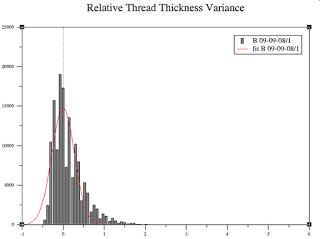
For now, though, I know how to get stuff like this:


so I'm perfectly content.
0
JAN.
27
2

Statistics, statistics.

It really, really is amazing what one can learn (and has to learn) just because of some spinning. I have learned on Thursday last week that Excel will find the median of a list of numbers by... choosing the value in the middle of the list. Which means that instead of finding the statistical median (half of the values are larger than this number and half of the values are smaller than it), it finds the number in the middle of a list. Thank you, Excel, I could have done that myself. By placing a simple link to the cell in the middle of the list. Because yes, I can count! So I worked on a little more, using the average instead, and grinding my teeth (figuratively speaking only, though).


In case you do not have your own version of a spinning experiment that you need to evaluate and analyse, and have no clue what I'm talking about: the average is made by summing up all numbers in a dataset and then dividing it by the amount of numbers. The median is the value in the middle of the dataset. Why do I want the median instead of the average? Median is way less vulnerable to outliers in the data. Case in point - let's assume we have a list of values that goes 1, 2, 3, 4, 100. Average is (1+2+3+4+100) divided by 5, which is 22. In contrast to this, the median of the same dataset is 3.

And Friday morning, I had a little private time with Mr. Google again, and I found out that yes, you can force Excel to get the statistical median. You can tell it to find the x-largest number in a bunch of cells. Which means that if you know how big your list of data is (I do) and see if it's an odd or even number of data (I do) and, if it's even, can divide said number giving the length by 2 (I do) and can make Excel calculate an average (I do) you can tell it to calculate the average between the two numbers in the middle of the list. Gotcha.

Oh, and I need the median... because after some fiddling and trying out and looking at data and getting brain-dead and trying something else, the most patient husband of them all and me came up with a possibility to give relative variations of thread thickness. Which uses a simple formula built around either the median (good) or the average (not quite as good). And now please excuse me while I try to get my now nicely-sized histogram bins into a good graph form.

Which will include giving my computer a split personality - because the programme I plot to do my plotting with is only running on Linux machines.
0

By accepting you will be accessing a service provided by a third-party external to https://www.pallia.net/

Kontakt