Latest Comments

Guest - Aislinn Dyestuff Citizen Science.
09. Oktober 2026
This is a great project. I look forward to the results. Thanks for letting us know.
Guest - Aislinn Time for...
09. Oktober 2026
Looks delicious!
Guest - Katrin Sprang Discussion
18. September 2026
Hi Rachel, I have looked for more photos of you, but that was not very successful. I found a link on...
Guest - Beatrix Sprang Discussion
15. September 2026
That lozenge pattern element is not a photograph, but a scan. So it should be to scale. But I pinned...
Guest - Katrin Sprang Discussion
15. September 2026
I was not referring to Rachel's reconstruction (is the reconstruction you refer to the one photograp...
JAN.
24
0

Rags and Riches - Call for Papers

As requested in the call for papers, I am spreading the word about the conference "Rags and Riches". 
It is a one day interdisciplinary conference "Rags and Riches: dress and dress accessories in social context", to be held at the University of Reading on the 21st April 2012. This conference aims to bring together archaeologists, anthropologists, historians and others from related disciplines to discuss current issues of methodology, theory and interpretation of dress and dress accessories, from prehistory to the present day.

Details about the call for papers can be found at http://www.reading.ac.uk/archaeology/Events/arch-rags-and-riches-conference.aspx. The deadline for submissions is the 17th February 2012.
Announcements will be posted at the web address above, but we can also found on facebook (https://www.facebook.com/events/212400145506326/) and twitter (@riches_and_rags).

It does sound nice, but I won't be able to justify going to England for a one-day conference...but if any of you end up going, I'd love to hear about it!
0
JAN.
18
2

Image Tweaking.

It really is amazing how much time a single small macro can gobble up.

Especially if, when you are almost through, you decide that the process might be even better suited to the aims if done a little differently. Because it does make a difference whether you run a median filter first, or whether you filter out outliers first, or make a transformation to binary first and run filters later on.

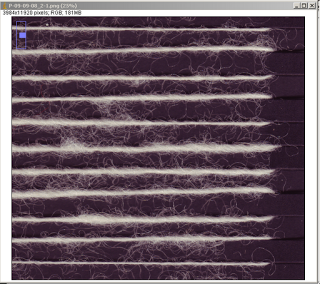
Anyways, I now have a method to turn a scan of thread samples like this:

into this:


and then read out the thread thickness of every single one of these threads.

Now I only need to wrangle the gazillions of datapoints into something resembling histograms or some other form of legible visualisation. And be amazed again at how much time a single little spinning experiment can eat.
0
JAN.
13
1

More things that may have gotten lost before the holidays.

And here's another heads-up regarding a symposium - I will be there as well:

On the occasion of a three-year research project on 'Dyeing techniques of the prehistoric Hallstatt-Textiles' funded by the Austrian Science FWF [L431-G02] at the Natural History Museum of ViennaTextiles' funded by the Austrian Science FWF [L431-G02] at the Natural History Museum of Vienna both an exhibition and a symposium will be organized. In co-operation with the University of Applied Arts Vienna, the University of Natural Resources and Life Sciences Vienna, the Austrian Society for Textile-Art-Research and the Cultural Heritage Agency of the Netherlands at both events, a colourful spectrum of research and art is presented.

Exhibition:
colours of hallstatt |textiles connecting science and art
hallstattfarben | Textile Verbindungen zwischen Forschung und Kunst
Venue: Natural History Museum Wien
Date: 17th January to 29th of June 2012

Symposium:
3000 Years of Colour – from Tradition to Art and Innovation
2nd International Symposium on Hallstatt-Textiles
Venue: Natural History Museum Wien
Date: 21st to 23rd March 2012
Registration and further information: http://3000yearsofcolour.nhm-wien.ac.at

Hallstatt in Upper Austria is famous for its prehistoric salt mining. Due to the conservation by the salt, organic finds survived more than 3000 years. Among them are the oldest dyed textiles of Europe, from the Bronze Age (15th - 13th cent. BCA) and the Early Iron Age (Hallstatt-Culture, 800 - 400 BCA).

During both the exhibition and the symposium scientists and artists will provide you with a thorough insight into the unique world of prehistoric textiles and their colours. It will be shown how prehistoric dyers succeeded to use the colours of nature for dyeing textiles and what these colours mean to us today. The last three years scientists investigated the prehistoric dyeing and textiles techniques, analysed the dyes and fibres of the prehistoric finds, collected dye plants, cultivated woad, performed dyeing experiments and experimental textile archaeology and produced replicas of Iron Age ribbons. By the archaeological textiles, by ancient dyeing and textile techniques, by colours and ornaments artists were inspired to create objects of contemporary art.

In the exhibition the various topics will be presented together with prehistoric textile finds from Hallstatt, the reproductions of the ribbons and the art objects.

The three-day Symposium will include lectures of these topics, an art performance and tours of the exhibition and of the textile collection of the Papyrus Museum. A social program will enable you to exchange your experience with an international audience in a relaxed atmosphere and will complete your own "Hallstatt Experience".
0
JAN.
12
2

Things that may have gotten lost before the holidays.

I gathered yesterday that launching the call for papers for the Textile Forum shortly before Xmas season may have led to this going under - with all the other seasonal things to take care of and the end-of-year frenzy of work.

So here it is, again:
We will be having the next European Textile Forum in Mayen, Germany, with the kind support of the RGZM. Our focus topic will be "Metal in Textile Crafts", which we think is a very exciting and very interesting - and also very broad - topic, covering everything from the conservation processes of archaeological textiles by metallising via the use of metals in the embellishment of textiles or the use of metals in the mordanting and dyeing process to the manufacture, importance and use of metal in textile tools.
The Forum will take place September 10 to 16 in the brand-new Laboratory for Experimental Archaeology and will include the usual evening lectures, one extra lecture day, an archaeological experiment to find out about the possible influence of the lead dye pots from Pompeji dye workshops on the resulting colours, and of course plenty of time to work on projects and exchange knowledge, tips and tricks or complain about problems to colleagues. The full conference fee of 300 Euro covers full board and lodging in simple dorm rooms (lodging is of limited availability).

If you are interested, you can find out more via our website www.textileforum.org - there you can also register for the Forum. And if you are not interested, but know someone who might be - please spread the word!
0
DEZ.
20
4

It's updated!

We have finally wrapped up all the prelim discussions and clarifications, and now the Textile Forum homepage is updated.

As previously hinted and announced, the Forum 2012 will be held at the brand-new Laboratory for Experimental Archaeology, a new research facility of the RGZM. Our focus topic will be "Metals in Textile Crafts", and we are looking forward to an exciting time with this very wide and fascinating topic. You find the Call for Papers and more info about registration here.

As of now, you can also register for the event, which will take place September 10-16, via our registration page. And please spread the word about the Forum!
0
DEZ.
16
0

Three things at once.

Or is it only three? Anyways, here's the news on three things I'm working on:

The Textile Forum. We are in the process of wrapping up the planning stage, and I'm already working on the update of the web pages so we can go live. And yes, that includes the call for papers, which will officially be sent out when the website is updated, and a brandnew registration form. Said form or rather its making and adapting, by the way, ate a good chunk out of my workday yesterday. Because I do basically not know how to do php stuff.

Connected with the Textile Forum, I have also finally changed my newsletter-sending software arrangement, which will hopefully end the weird formatting that newsletter recipients have had to endure the last few times. If you wish to subscribe to the Textile Forum Newsletter to receive announcements and the call for papers (and that's about all that is going over the list, so you won't be inundated at all), you can do so via this form.

And also connected with the Textile Forum, and the famous 2009 spinning experiment, I have further developed the method of how to measure thread thickness variations. The good news: Yes, it works, and will so very well. The bad news: I have to do some filter-testing and script-writing and macro-wrangling to really make it work, and my programming fu is about as nonexistent as my fu in all the other things that I actually don't really know stuff about but try to fumble my way through them anyways. (In German, I would call it "herumeiern", which is more or less wobbling around somewhere and not getting to the point, or traipsing around more-or-less-aimlessly. Just like an egg does when you roll it. And I love that word.)

At least it's Friday! So once my brain is in shambles due to too much pressure on the logic circuits, I will have all weekend to relax and recuperate.
0
DEZ.
13
0

Still busy.

Things are still busy here, and a good bit of that is due to a bit of additional research I'm doing on the Spinning Experiment data. And totally related to this, we have figured out most of the things we needed to figure out for the next Textile Forum, and I will be working to update the website during one of the next days, and writing the call for papers for the Forum.

If you are already thinking about it: We will be in Mayen, Germany, from September 10 to September 16, and the focus topic will be "Metal in Textile Crafts". Stay tuned to learn more about it soon!
0

By accepting you will be accessing a service provided by a third-party external to https://www.pallia.net/

Kontakt