Latest Comments

Guest - Aislinn Dyestuff Citizen Science.
09. Oktober 2026
This is a great project. I look forward to the results. Thanks for letting us know.
Guest - Aislinn Time for...
09. Oktober 2026
Looks delicious!
Guest - Katrin Sprang Discussion
18. September 2026
Hi Rachel, I have looked for more photos of you, but that was not very successful. I found a link on...
Guest - Beatrix Sprang Discussion
15. September 2026
That lozenge pattern element is not a photograph, but a scan. So it should be to scale. But I pinned...
Guest - Katrin Sprang Discussion
15. September 2026
I was not referring to Rachel's reconstruction (is the reconstruction you refer to the one photograp...
NOV.
06
0

Images!

If you like to look at weird marginalia and illuminations from medieval manuscripts (and who doesn't?), you likely knew Got Medieval. Sadly, that blog has been dormant for more than a year now.

Yesterday, thanks to a hint from a friend, I have stumbled across something not quite similar - but at least featuring weird (and beautifully weird) images from manuscripts: discarded images.

In contrast to Got Medieval, where you usually got a fun (but also enlightening) text about the image and why it might be there, discarded images just gives you the pic with its source plus a funny caption. Still, if you were looking for a regular fix of medieval marginal fun, it is probably a good place for you to check now and then. (Also featured: cat pics.)
0
NOV.
05
0

Gratuitous cat pic. And Codex Manesse.

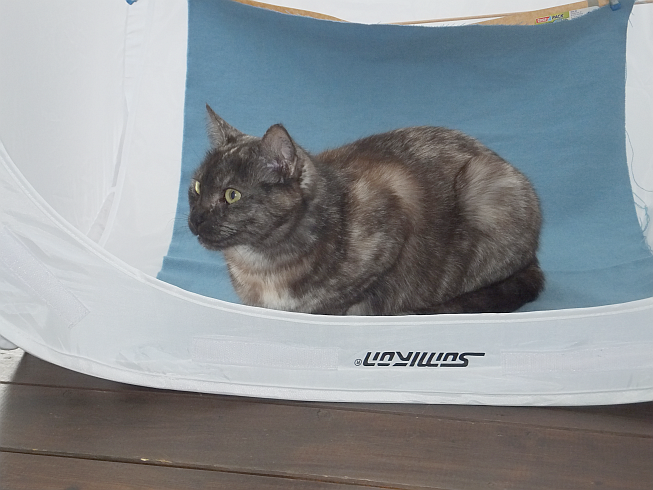
Whenever there is something new for the shop, I have to take a photo of it... for which I have a photo tent that gets a blue (indigo-dyed) background. Everything gets placed in there, pictures get taken, and then I can put the photobox-tent-thingie away again.

Except this time... it did not unfold as well as it should have. It had probably been stored a tad too long, or twisted somehow differently than normal - it did unfold, but not completely. So I decided to let it sit open for a while longer than it takes to photo the new things.

Which, naturally, led to this:


The cat, however, will not get a place in the shop... even if she tried her best to be a photogenic cuddly model.

You mean you did not want to look at cat pictures? You can look at the Codex Manesse instead - it's completely online and downloadable, all 871 pages of it - here. There's a big and a small version for the download, and it's free. Or, if you just want to browse the pictures, click on the link Bilderschließung in HeidICON which brings you to just the pics, and all of them. All praise the Universitätsbibliothek Heidelberg who made this possible!
0
OKT.
29
1

Tape loom plans.

I've gone through my list of things that I might want to blog about, and as usual, the list is long... but not all of the topics make for a quick blog entry, or a link list.

What is in there of potential interest to you, though, is this: Plans for making a tape loom. They are from a magazine that was published a while ago, and then went through bankruptcy. It's a relatively simple tape loom, though not as simple as my contraption (which is basically a stick in a board with a holder for the rigid heddle).

If you haven't tried band weaving yet, but get the chance - give it a go. It is a really nice pastime, a rather quick way to get some tapes or bands, and since it's quick and does not use oodles of material, it is a nice possibility to try out some funky colour combinations, too.
0
OKT.
22
1

Links to cool things.

Yesterday was a day that I took things easy, to accommodate for the weekend spent working (in a thoroughly enjoyable and wonderful way - it was a lovely workshop!).

Some of that taking-it-easy-time was spent rootling around the internet, and I came up with several really cool links.

First of them: Gamers have probably solved a puzzle that scientists had not been able to solve before (using computers). The reason? Humans are (still) much better at spatial reasoning than computers. Not only did they solve it, they also were pretty quick about it! The game is called "fold.it", it's an online game that you can download for free, and there's links to a protein database where you can learn, for example, about Amyloid beta precursor protein - in a way that will not bore your proteins out of your brain.

I've mentioned gender quite a few times on this blog - and I'm not alone. Magistra et Mater blogs about the now available new Handbook from Oxford Uni Press: Oxford Handbook of Women and Gender in Medieval Europe.

And the last "wow" thing for today: A 2000-year-old seed has been successfully sprouted into a sapling date tree. Isn't that amazing? There's a nice article about it at National Geographics.
0
OKT.
17
0

This and that.

In today's random list of things that I found interesting:

Are computer searches making us dumber or smarter?

A very personal, and very impressive, answer to someone depressed and thinking of suicide.

A piece on gender behaviour and its possible biological roots.

The journal Archäologische Informationen is now online and open access. h/t to tribur.

Norway is trying to break the Australian record for sheep to sweater, and it will be televised.

And finally, should you be looking for inspiration on how to quit your job in style - look at the art of quitting.
0
OKT.
15
1

I blame the internet...

... for this especially late blog post. Because I got distracted. By not one, not two, but three repositories:

Fornvännen, a Swedish journal, has searchable archives online. The articles are (of course) in Swedish; if you search for Inga Hägg, you will get several articles by her about Viking garments.

Also online, also for free: the London and Middlesex Archaeological Society's Transactions. Plus their newsletters and special papers. The archives go from 1860 to 2005, and the Transactions themselves are quite substantial.

And thirdly, the Durham e-theses - you can browse by department, see the newest additions, or search for a term.

I will get back to digging some more in these three places now. Yay for research to be found online!

0
SEP.
30
0

There are things on the internet...

... that you would not expect. Well, me, at least.

Newest case in point? Old Bailey Proceedings.

Old Bailey is the central criminal court in Britain, and has been active since the 16th century. The court proceedings from 1674 onward are published, and they are also digitised and put online as a fully searchable repository.

You can go to the project website here, where you can learn more about what is digitised and how to use the search functions. And then, of course, browse through the records... Use for non-commercial purposes is free of charge, by the way, too.

This is one of the reasons why I love the internet. So much.
0

By accepting you will be accessing a service provided by a third-party external to https://www.pallia.net/

Kontakt