Latest Comments

Guest - Aislinn Dyestuff Citizen Science.
09. Oktober 2026
This is a great project. I look forward to the results. Thanks for letting us know.
Guest - Aislinn Time for...
09. Oktober 2026
Looks delicious!
Guest - Katrin Sprang Discussion
18. September 2026
Hi Rachel, I have looked for more photos of you, but that was not very successful. I found a link on...
Guest - Beatrix Sprang Discussion
15. September 2026
That lozenge pattern element is not a photograph, but a scan. So it should be to scale. But I pinned...
Guest - Katrin Sprang Discussion
15. September 2026
I was not referring to Rachel's reconstruction (is the reconstruction you refer to the one photograp...
JULI
05
1

Spinning Output, part 2

Yesterday afternoon, I got to have half an hour of quality time with my favourite hand-spindle - one of my spindle sticks and a whorl that I bought somewhere, ages ago, and that remains my firm favourite for about any hand-spindle spinning tasks I get.

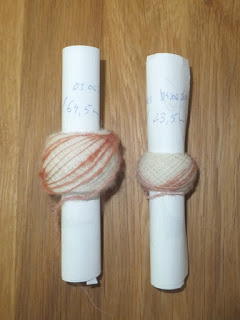
The results? Half an hour of concentrated spinning with spindle (and distaff, naturally, need I even mention that?) yielded 23.5 metres of worsted yarn.

Here's the two little balls of yarn side by side:


Next up: doing the same with my treadled spinning wheels...
0
JULI
04
0

Spinning Output, part 1

I did the first of the spinning output tests yesterday, using the Great Wheel. I had settled on trying for half an hour spinning for each test, and that was quite enough for untrained me on the Great Wheel.

To have the material as alike as possible I will be using industrially prepared Merino top for all the tests (at least four of them, one with each spinning implement). That is, naturally, nothing really spinn-able for the Great One, so I transformed a portion of it into rolags for long-draw first, using my hand-cards.

And the result of half an hour spinning were 64.5 m of yarn (which would add up to 129 m per hour). I aimed for rather thin yarn (to match what I will be doing with the other tools) and for rather high twist (since that is historically more correct than low twist), and once the spinning tests are all done, I plan on plying each sample to have them in a more stable condition - I want to take them with me for demonstrations.

So. When you are reading this, please keep in mind that they are all very, very squishy figures - it's just one spinner, my tools and their quality are unknown to you as is my proficiency with each tool, and you only have my word that the wheel is functioning quite well and that I have not had much practice at all yet with the Great Wheel. (All of which, by the way, are reasons this post is not labeled Experimental Archaeology!)
0
JULI
02
0

Wheel Tuning.

A good while ago, I posted about the time I needed to ply close to 600 m of yarn on my old, small foot-driven spinning wheel.

That little wheel, bought during my teenage years, was sold to me as a young girl's spinning wheel. I learned how to use it, I learned a lot about wheels on and through it, I dragged it around and I spun and spun. But it's a small wheel with, accordingly, a rather slow spinning ratio. And with the years, I wanted to spin more strongly twisted yarns, and thin very high-twist yarns, and do so faster than the little wheel would allow me to, even when treadling very fast.

So I started to keep my eyes peeled for a production wheel, and finally decided to buy a double-drive wheel, second-hand, from a Finnish producer who had long gone out of business. And this weekend, I started tuning it - replacing the whorl with a new, much smaller one (thus upping the ratio from drive wheel to whorl) and glueing additional discs to the spool to bring that ratio up too and really close to the whorl ratio. (Really close, in my case, meaning nominally1:1 for the bigger of the new discs and almost 1:1 for the smaller one.) The fastest setting needs a little more running in, or a little more tweaking, but it does work already, and the slower setting works really nicely already and will yield a spinning output of high-twist yarn, my usual thickness, of about 120 m/hour according to my first tests. Spinning output, that is, not plying output. And I am planning on doing those speed tests... soon.
0
JUNI
22
0

Nothing exciting, for a change...

I have done some more spinning on the Great Wheel (because I can, and because it's fun, and because it's set up for a little spinning video to be made one of these days), some more carding (now I know two totally different but both functioning techniques for carding wool, and trying to find out which one suits me better) and the usual paperwork stuff besides.

Spinning time is limited by the amount of spinning my arms can take. They have not yet completely recovered from Saturday night, which is not helped by me going at it again and again. But hey, I'm having fun, it counts as training, and I so enjoy having a smoothly running spindle wheel! All this has brought me to think that I should do a test - use pre-prepared wool rolags or top and try spinning normal type and thickness thread for an hour each on the spindle, my two treadle wheels and the Great Wheel and see how the three compare. That's not going to happen during the next two weeks though - before I do that comparison, I will have to get better acquainted with my newer treadle wheel and be sure I can do one hour non-stop on the Great Wheel. It should be a fun, and enlightening, test though!
0
JUNI
06
0

Tools, anyone?

Since I've been working with tools now, it's very fitting that Gillian shared this lovely bit of knowledge with me: the publication of the Maestermyr tool chest is available online. It's the full publication from the 1980s, in English, so it includes the full catalogue.

The site it's hosted on is some kind of e-library, though I could not figure out whether it's a private or an institutional one.

If you would prefer today to test your knowledge on experimental archaeology, you can go here and try to solve a crossword puzzle about the topic. I did not manage to do it without some cheating, but my excuse is that I'm not in the UK or US and thus do not know the masters there... and I'm a textile person, anyways. Best excuse ever.

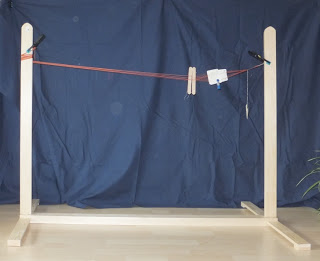
Speaking of textile person: the cross-and-post tabletweaving thingie is finished. It could do with some more neatening at a few places, but it's done, it's functional, and it comes fully apart. Yay. Plus I now know how to do mortises. This was the mortise-practice-piece for the spinning wheel parts that need mortises, after all.

Here's the thingie - the weave is just clamped to the posts for now, but I will wind it on properly for working with it.


The wheel is also coming along, slowly but steadily - on today's agenda is to saw and construct the jig for the wheel rim and the jig for drilling the leg holes for the stand.



0
JUNI
05
0

More woodworking today.

I spent a few hours in the workshop yesterday, having a lot of fun. It's been ages since I last used powered tools extensively, and I still never used them as much as this time around. I can absolutely appreciate the beauty and the special feeling that comes with doing everything the slow way and by hand, but I'd never build a wheel in that way.

And now I'll finish my tea and bumble off to the workshop again, for a little intermezzo: the tablet-weaving "loom" is on today's agenda. And maybe I'll even remember to take some pictures...
0
JUNI
04
0

The Spinning Wheel!

Finally, all things necessary have come together: The wood that I need, the machines and tools that I need, and the lovely upstairs neighbour with time on his hands to show me how to use the machines. So on the weekend, I started work on the new wool wheel.

As German strategist von Moltke once said, "No battle plan survives contact with the enemy" - I have already made some changes to the plan that I drew in meticulous work. The board that will carry all the rest of the wheel has gotten somewhat slimmer (so that it could fit into the planing machine), and it's not all even (though that does not bother me a bit), and it's about 5 cm shorter than intended originally. But all that is no big deal, since the plan was more or less drawn after a Psalter illumination and part of the plan was to adjust as necessary.

In addition to the wheel, and in some way also to practice some of the procedures, I am also planning to build a crossbar-and-post tablet weaving "loom", which means a run to the hardware store today. And the loom will come in very, very handy for my latest weaving project which will also travel with me to the RGZM in two weeks. Fortunately, the thing is an utterly simple affair... rendered even simpler by my planning on how to build it.
0

By accepting you will be accessing a service provided by a third-party external to https://www.pallia.net/

Kontakt