Latest Comments

Guest - Aislinn Dyestuff Citizen Science.
09. Oktober 2026
This is a great project. I look forward to the results. Thanks for letting us know.
Guest - Aislinn Time for...
09. Oktober 2026
Looks delicious!
Guest - Katrin Sprang Discussion
18. September 2026
Hi Rachel, I have looked for more photos of you, but that was not very successful. I found a link on...
Guest - Beatrix Sprang Discussion
15. September 2026
That lozenge pattern element is not a photograph, but a scan. So it should be to scale. But I pinned...
Guest - Katrin Sprang Discussion
15. September 2026
I was not referring to Rachel's reconstruction (is the reconstruction you refer to the one photograp...
SEP.
05
1

Spinning with a Distaff

Thanks again for all you input on the headwear thread - and for the replies to the Spinning thread. I'll tackle the first two now.

fiofiorina said...
I use a hand distaff when spinning "Roman" and a long one for medieval displays. I still sling the thread under the whorl, as it made the difference between whorl falling to the ground and breaking and spindle falling to the ground and whorl surviving. For modern spinning I prefer working with the short Roman distaff than holding the wool in my hand. But that's me.  
I have had better experience with the whorl not breaking if it was not firmly attached to the spindle, since it can then slide off the spindle when it drops - the stick takes most of the impact, and the whorl survives. But if the spindle drops, there's always some danger of the whorl taking damage, whether firmly attached to the stick or able to slip loose. Key with spinning with a whorl only slid onto the stick is to make sure it really sits firmly enough so it does not just slip off and fall down from the stick during spinning. (Though mine have done so frequently, too, and they did survive.)

Lady Lamb said...
I learn to spin for myself with the help of some books and YouTube. I don't need to pass the thread under the whorl, and in case it helps you can make a small opening at the tip of the spindle. At events I try to use a distaff but this is my problem. I'm not used to it. I try to support it on my belt so it won't fall and my left hand it's free to grab the fibers, but sometimes I find that difficult. Another problem is that with a distaff I have some tendency to break the fibers. I don't know if you can give me some tip, or maybe I just need to get used to the distaff.
You have several different possibilities to use a distaff - hand-held if you use a short stick, tucked into the belt if you have a long one, or tucked under your arm. Have you tried to place the distaff in your armpit? If you let your arm hang down, it should fix the distaff firmly in place.
If all this does not work, or if you feel too distracted by learning how to hold the distaff and learning how to draft with the new arrangement, you could also fix it to something else and stand or sit beside or in front of it until you are used to the new method.
If you have a tendency to break the fibres, maybe you are drafting too slowly with the new arrangement?
0
SEP.
02
8

From Headwear questions to Spinning questions.

First of all, thanks to everybody who commented with links or hints to medieval headwear on yesterday's post. I will go hunt all those things down and have a good look at them. And if anybody thinks of any more, please comment to yesterday's bleg - it really is helping me!

And today's post... is going to be something similar-but-different. I am preparing a workshop on historical wool preparation and historical spinning, and I'm very, very much looking forward to it. However, I have been mucking around with this and that and fibres and spindles for a good long while now, and my spinning skill was never acquired in the traditional teacher-to-student manner. Thus, I have learned many things differently. And I do not have good insights into what makes a switch to historical spinning difficult for somebody who has learned hand-spindle spinning the modern way. (If you need to brush up on the difference, the two most important bits in my opinion are that historical spinning uses a distaff for holding the fibres, and there's no slinging the thread around under the whorl before fixing it at the top. There's more, but those are two very common differences.)

Hence, I will make you an offer. Are you spinning with a hand-spindle? Have you tried spinning historically? Whether you are spinning historical or modern, I would like to hear about what problems or questions you have. Is there something you just can't get to work? Or something you wanted to try but cannot figure out?

I will try to answer your questions here in the blog - and use the material for my teaching. This way, everybody wins: I get to know common problems, and you will get an answer. And I will try my best to make it a helpful one!
0
AUG.
29
2

Wool, wet. And dry.

Since I seemingly promised you wool pictures and Heather reminded me of that, here they are. All were taking during the test runs for a washing wool procedure (and the test run was, by the way, quite successful).

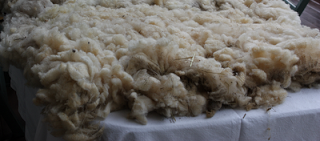
This is Rhönschaf-wool before washing, laid out on a cloth.


All the wool was pretty clean, as wool worn by sheep hanging out outside goes. And I discovered during washing that a lot of the darker colour is due to dust and fine earth particles hanging in the fleece.


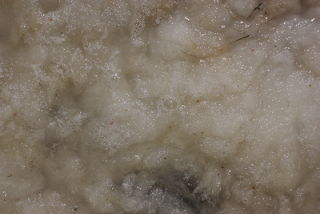
And this is wooly magic happening right there. This is the wool soaking in rainwater, and it's basically cleaning itself. You see the little bubbles about in the middle of the picture? That is the result of a reaction between sheep urine, lanolin, sheep sweat and soft water. It's... soap bubbles. Which will remove a bit of the lanolin and all the urine and sweat, leaving the wool...


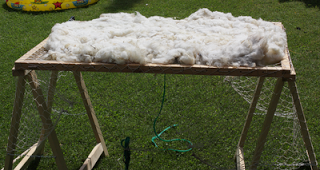
... nice and clean after rinsing. It's spread out for drying on my beating frame here. And yes, I have managed to wash a whole fleece's worth of wool at once, thanks to well-timed rainfall hereabouts.
0
AUG.
22
0

Good things have happened.

I had a wonderful weekend, spent with friends doing nice and weekendy things like playing boardgames (among them a few hilariously bad ones), chatting, eating cake and planning future craft projects (theirs, not mine).

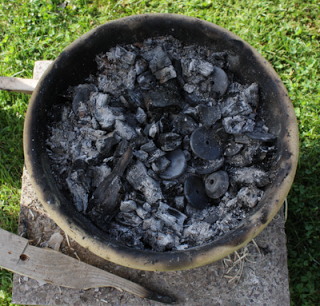
But before that, on Friday evening, I finished off the workweek with some... work. Hot, interesting, adrenaline-flush-making work. I dragged our firebowl and wood and stuff out in the garden, and I started layering in wood and the now bone-dry clay whorls I made. Which makes that procedure some weird cross-over between kilnless firing and pitfiring.


As expected (because you always have them in a kilnless firing procedure), there were losses.


Most of what you see in that box, though, are not whorls, but the remainder of two of the three medieval type piggy banks that I put in as well, even though I knew there was a very, very high probability they would not survive it. (Because their time for drying... let's just say it was not generous. At all. And my mum taught me better.) But I still wanted to know, and I don't know when I'll be doing this again, so...

Losses on the pieces that had dried out properly were not so high. And most of the whorls came out whole and nice and black:


I have a thing for reducing-athmosphere fired pottery. I mean I like pottery colours, especially white and off-white, but I just dig the black stuff. I now have one (non-functional) very very crudely made piggy-bank that has no piggy shape and 57 spindlewhorls to re-stock the online store with. Not all of the thicker whorls are perfectly round, so I might have to test a few and maybe take them out, but overall they do look good. And my fancily decorated disc whorl even survived as well:


That, my friends, was a really nice Friday evening.
0
AUG.
19
0

Looking happy while getting wet.


As all the long-term readers of this blog know (because I’ve written it repeatedly), I am naturally lazy. I am also aware of efficient working procedures and non-efficient working procedures, even if it is not always in my power to change from the latter to the first.

Washing wool is a high-consumption activity: It needs obscene amounts of water, some work time and a huge lot of waiting time, especially for the wool to completely dry again so it can be put back into storage. It also needs some equipment to make wool washing sustainably efficient. Plus, the wool that still has its natural oils is a joy to work with, and wool that has been scoured heavily or washed with too much agitation is prone to felt, making the following processes harder and maybe even severely damaging overall fibre quality.

So my first impulse (and more or less my wish) is to leave the wool as it comes from the sheep, washing-wise, and start with the process of beating, combing and carding straight away. However, there’s dirty wool and there’s clean wool, and dirty wool is harder to work with in some circumstances. Much harder to work with. So much so that the investment of water, work time, wait time, and equipment seems to be an efficient investment again.

Currently, I’m testing the waters for wool-washing – checking how much time I need for a batch, how much water, what works better or not in my scale of material amounts, which might be roughly equivalent to the processing amounts of a very small medieval industry or a large household. And that, in turn, means I’m very happy that it is raining right now, and that I have just gladly ran out into the rain, getting wet while bucketing rain water from the container being refilled to an extra storage container. And will do so again in case it rains enough to fill the first container completely again.

And now I’ll dry off with a cup of coffee and some nice work.
0
JULI
21
0

Links, finally.

I have this habit of keeping browser tabs open and mails unarchived until I have blogged off the links that they contain (or reminded me of). And I really have to clean up my browser and mail window... so here you go.

A nice little video (well, not so little, with 15 min running time) about how linen is made today. There's plenty of newfangled machines, but there's also plenty of manual work involved.


BE LINEN MOVIE from Linen and hemp community on Vimeo.


If you don't want to watch the whole thing, here's a link to the short version (4.5 minutes).

There's a beautiful silk pouch with tassels on blogged by Medieval Silkwork. It's yummy.

And now for something completely different. I really cracked up over this post from The Bloggess, featuring a giant metal chicken. (Yes, I'm easily amused.) I stumbled over it via this video of her giving a speech and setting off the Zombie Apocalypse in Utah.

Now my browser has four less tabs open. Unfortunately, all the rest requires some proper action by me... which I'll be off to do now.
0
JULI
13
0

Backstrap Weaving.

The week before last, I had a nice evening with a fellow textile person who is researching about Peruvian backstrap weaving (connected with a find of a woven band). During our evening together, we scourged a bit of the Internet for weaving patterns and instructions, and stumbled across this:

Introduction to Backstrap Weaving

It's a nice, concise and very well-made introduction, and in case you are interested at all - go check it out. A few lightbulbs went off over my head during the course of the evening and the reading of the article, and that's always something nice to share.
0

By accepting you will be accessing a service provided by a third-party external to https://www.pallia.net/

Kontakt