Latest Comments

Guest - Aislinn Dyestuff Citizen Science.
09. Oktober 2026
This is a great project. I look forward to the results. Thanks for letting us know.
Guest - Aislinn Time for...
09. Oktober 2026
Looks delicious!
Guest - Katrin Sprang Discussion
18. September 2026
Hi Rachel, I have looked for more photos of you, but that was not very successful. I found a link on...
Guest - Beatrix Sprang Discussion
15. September 2026
That lozenge pattern element is not a photograph, but a scan. So it should be to scale. But I pinned...
Guest - Katrin Sprang Discussion
15. September 2026
I was not referring to Rachel's reconstruction (is the reconstruction you refer to the one photograp...
MäRZ
25
0

Oh no, she's talking about embroidery again!

Things are progressing nicely here - the sawing work for the frame is all finished, and now I need to drill holes (lots of holes) and join up the parts. And then attach a strip of fabric or a band to the rollers top and bottom so I can dress the frame.

In case you are wondering how dressing the frame works, there's a nice, detailed description on Mary Corbet's blog "Needle 'n Thread". She also gives a lot of tips, tricks and hints on embroidery technique, though it is of course modern embroidery. Mostly, the difference is in the materials - cotton ground fabrics and cotton yarns, or synthetic silks, or modern metal threads. But there's also a difference in the approach to the materials. Modern stitchers are not as opposed to wasting a bit of the embroidery thread as I am (though that might just be me), and stitches can often have as much or even more thread running on the backside than on the front. Finally, judging from Mary's blog, it seems as if showing the back of the work is something usually not done.

Personally, I think that looking at the back of the work is at least as important as looking at the front. You can appreciate design and shading work from the front, and you can appreciate efficiency and stitching technique (and in my case, historical correctness of said technique) from the back. I am actually a bit miffed if somebody looks at my embroidery, tells me he or she embroiders, too, and then doesn't turn it around.

I am also of the opinion that there should be a law for the publication of surviving historical embroidery. A law that makes anyone writing about an embroidered piece to post at least three good quality photographs, showing a) the complete piece with measurements given in the text; b) a close-up of a detail, showing all the stitch techniques and materials used on the piece, if possible with a ruler or other size indicator on the photo; and c) a close-up of the back side of said detail, also with a size indicator on the photograph.

Why that? Because it's darn hard to find out how they did it without being able to see the flip side of a piece! With a photo of the flip side, it's at least possible to try it yourself and then compare to see if it's more or less matching the original. That is of course still not as good as sitting in front of the real original embroidery, but it's a good start. With only the front... all you can do is stitch it up and hope for the best. And that, my friends, is just not cutting the mustard - at least not for the nitpicky folks like me.

Now where do I propose that law? Any suggestions?
0
MäRZ
24
0

Well. Could be worse.

This morning, I woke up at the wrong time - and not the usual wrong time. On most weekdays, I have  the tendency to sleep longer than planned, so I was quite surprised to find myself wide awake at shortly past five in the morning. Much too wide awake to go back to sleep.

Now, I could have gotten up and done something productive and necessary - like working on the half-finished new dress for the next season (I have nothing to wear, you know? Shoemaker's son goes barefoot, as they say). Or I could have gotten up and done something productive and not strictly necessary but already started upon - like spinning some more wheel-spun yarn to make a nice, thick skein of two-ply once that second bobbin is full.
Instead, I got up, slunk down into the cellar to fetch some wood, did a few pencil strokes in strategical places and started setting up the wood... for sawing. To get parts for a proper, medieval-style embroidery frame. Before I go to Vienna. And to have and hold afterwards.

I can always rationalize that this is also necessary work. It's a good tool for me to have, it's product development in case I decide to carry such frames at some point in the future if there's interest in it, it's good for demonstration of medieval embroidery techniques, and I really don't much care for those common round embroidery hoops that are never holding the fabric at the tension I want. And I decided to take this uncommonly early awakening as "extra time" for not-strictly-necessary-things just like this.

There was a little flaw in my plan, though. Since I didn't want to wake up the Most Patient of All Husbands, I had to stop after setting up things. So much for the extra time. Still, I did a good chunk of work yesterday evening, so... I'll be over there, sawing.

Oh, and by the way, what does the zombie embroiderer want? Fraaaaames.... fraaaaames...fraaaaames...
0
MäRZ
18
1

All Hail the Mighty Internet.

Thank goodness it works again!

Yesterday's stint without the 'Net was not too bad, since I was able to work without the usual distractions. Plus, not reading or answering mails and not blogging did make itself noticeable in the time available for other stuff.

On the other hand, I do rely on the 'Net for some routine things, like checking translations or finding the best English word with the help of online dictionaries (I can type much faster than I can leaf through a paper dictionary) or explanations for stuff that I need to read up on (like, to take one of yesterday's examples, the definition of standard deviation). So I'm guessing that the time loss and the time gain probably even out for me.

And the reason for me to look up standard deviation? I'm working on a final write-up of the spinning experiment results, and trying to find the best way to visualise the different results and connections (or non-connections) to make it all understandable for the non-spinning reader. The article is planned for the conference proceedings of last year's OEGUF conference and might even appear in electronic format - I'm looking forward to see what medium will be chosen!
0
MäRZ
16
2

Weird and awesome textile stuff!

During the past two days,  I stumbled across some very awesome and teeny-tiny stitchery. Check out these websites showing miniature stitchery of landscapes on background skies painted with textile colouring and embroidery for dollhouses in scale 1:12 (scroll down a bit, to "Beispiele"). While personally I'm not really a fan of petit point (contintental tent stitch on the Wikipedia page), because there's more embroidery thread in the back of the work than in the front, and I am much too cheap for that, those examples on the website are incredibly impressive and almost make me want to try it.

Just almost, don't you worry. I'll stick with my nice, large stitches over two threads on 20-threads-per-cm linen for a good while longer.

And finally a really nice video (h/t to Arachne, who facebooked this) with indubitable proof that textile works, creativity and innovation are never very far from each other:

0
MäRZ
14
0

Inky Goodness!

This was a nice and busy weekend - I finished my test-stitching, both in regard of the stitches and the ground fabrics that needed to be tried out.

And another thing is also done: 


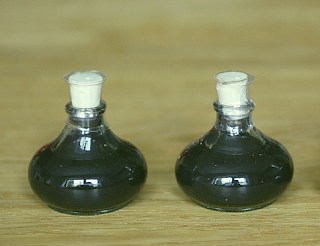
The ink has arrived, and I already bottled it off into nice little flasks that are quite close to some that can be seen on medieval illustrations of scribes.

And the ink... ah, the ink. It's wonderfully black, just the right viscosity to work really well for nice, thin lines on the linen test cloth, and it does what it's supposed to do: Dry up and then stay where it has been put, no bleeding, no creeping, no nothing. So after being annoyed for a bit more than a year by not having proper authentic medieval ink for proper authentic pattern transfers, I finally have ink to do it the medieval way - and ink to sell for all of you who want some, too. Hooray!
0
MäRZ
11
0

Counted Work - Brick Stitch

I've finished one pattern bit in the counted work technique now, using the "versetzter gerader Gobelinstich", as they call it in the book. It's really easy - you go over the linen for four threads, then one to the side and two down. And that's it. Repeat ad nauseam or until you can't see anything anymore because your eyes water... because, as I said before (and I'll say it again): medieval embroidery is tiny. T-i-n-y. Minute. Exiguous. Puny little stitches. Exquisitely small. Very diminutive stitch-wise. Tiny. And very, very small on the stitch part - though they did work really large pieces in these techniques. Those Freaks. I'm sure they all did it just to make me sweat over doing it too.
 
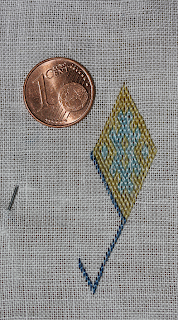
So here's what the test scrap now looks like from the front, medieval brick stitch worked to scale, on the appropriate linen fabric, with the appropriate plant-dyed untwisted silk yarn:


Yes. Did I mention it's tiny? I'm seriously short-sighted, and I work it without my glasses on, which does help a lot.
I also made a closer-up of it:


It's not perfect coverage everywhere, but my impression is that the threads will "spread" a bit more after a while in comparison to when they've just been worked, so it might cover completely after a rinse to relax the threads in their new position. However, it does come pretty close to the look of the original already.


And for those of you who are now feeling that itch in your fingers to flip it over, here's the backside (click the pics in this whole post to make them larger):


And that also is pretty close to how the originals look (sans the unclipped threads that still hang from my work of course). So I'm quite content with this little sampler. One more linen now to test for its suitability as ground fabric for counted work, and then that part of work will be done.
0
MäRZ
09
0

Still testing.

I'm still testing the embroidery stuff on different linen fabrics - I have a few new samples now, and there might be the right one among them.

And I know I've said it before, but boy! is medieval embroidery done-to-scale tiny! It really needs good lighting and good hand-eye-coordination - and probably being short-sighted will help a lot as well...
I hope to be able to show you a photograph of a sample piece one of the next days - at the moment, it's just a very short row of very few stitches in grass-green untwisted silk, and not looking like anything remotely spectacular or embroidery-y yet...
0

By accepting you will be accessing a service provided by a third-party external to https://www.pallia.net/

Kontakt