







Latest Comments

Guest - Aislinn Dyestuff Citizen Science.
09. Oktober 2026
This is a great project. I look forward to the results. Thanks for letting us know.
Guest - Aislinn Time for...
09. Oktober 2026
Looks delicious!
Guest - Katrin Sprang Discussion
18. September 2026
Hi Rachel, I have looked for more photos of you, but that was not very successful. I found a link on...
Guest - Beatrix Sprang Discussion
15. September 2026
That lozenge pattern element is not a photograph, but a scan. So it should be to scale. But I pinned...
Guest - Katrin Sprang Discussion
15. September 2026
I was not referring to Rachel's reconstruction (is the reconstruction you refer to the one photograp...
AUG.
17
0

Spinning for Hallstatt

To give you more than just text and promises of broken-off thread bits at the Forum, here are a few pictures of the spinning.

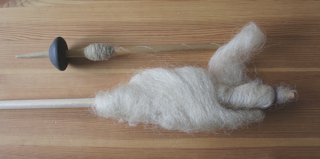
This is the single for the first of the three different plied yarns, on the spindle. That should be enough for the length required, so I will start to spin for the second ply now, with a different spindle stick.


You see the "full" (well, not really, but full enough for my purpose) spindle and the distaff with the fibre stored on it both in the picture. I will not sing the praise of the distaff now, since that would make this post explode. I'll sing it tomorrow for you.

And this is my little comparison card to check if the threads I spin are like they should be:


You can see the three different threads used in the tablet-woven band that is going to be reproduced. Thinnest of the three is the Z-ply on the right, thickest is the one in the middle. I am currently working on the leftmost, medium-thickness S-ply. The little comparison card - the white bit - is an old business card of mine. That should give you a first rough idea about the thread thicknesses.

But I'll make it easier for you. You probably know Gütermann Silk sewing thread? The one on the blue spools, Nm 100/3? Yes?

That's the extra thread meandering across the card in this picture.


I've left the first picture quite big, so you can click it and zoom in quite far. And these are original thread sizes of the thread used in the tablet-woven band.

If you'd like to find out a little more about the band, there's a tiny picture of the original at the bottom of this (German) page, and there's a German text about the project I am spinning for on this page.
0
AUG.
16
5

Wool Spinning

I have already mentioned the Vienna wooly week, and I've been busy doing some more spinning during the weekend. Those of you that know my spinning style know that I have a tendency to do thin to very thin threads, and I have my own theory why that might be as it is (which I won't go into today).

Just like with hand-woven fabrics nowadays compared to those hand-woven (naturally, since there were no automatic or semi-automatic looms) in the middle ages, there's this basic difference in "look you aim for". Today, a hand-woven fabric is usually quite coarse (to keep the price in a somewhat affordable range) and slightly uneven on purpose - because that's how you see that it was hand-woven, right? And if you buy a pricey hand-woven textile, you want people to see it is special because it's hand-woven, right again?
The medieval weaver did surely not aim for the modern irregular look, but for as smooth and even as possible. And we have the same phenomenon in spinning. I have actually been told by people that "you'll want to make your thread a bit more irregular, or nobody will see it's hand-spun". Being a good medieval-minded spinner, no, I do not want that. And then there's this yarn thickness problem, too. Most modern hand-spuns are way, way thicker than yarns used in medieval weaves - which makes the fashionable irregularity of yarn thickness possible.

If you spin a thread that, on average, contains 120 fibres at any diameter, you can easily add or omit ten or twenty fibres and still get a reasonably even yarn. If you add or subtract more - I'll just make up some number here, say 50 - you will get an uneven yarn, but one that will still hold up to the weight of the spindle.
If your starting thread contains, on average, only 50 fibres at any diameter, you don't want a thinner bit with twenty fibres less - that will break your thread because it cannot support spindle weight anymore - and you don't want a thicker bit with twenty fibres more, because that will really show up as a slob. Which means the thinner you spin, the more even you have to spin, because every weakness will show up and every slob will too.

Fighting occasionally with my yarn while spinning those deliciously thin threads used in the Hallstatt bands, I have meditated quite a bit about irregularities. Not letting slobs occur will take quite an amount of concentration, and so does not making thin and thus weak spots. I work with a comparatively heavy spindle, since I like to know that each individual thread in the final 2-ply will be strong enough to take some tension.* The thread coming out of that process is insanely strong and elastic compared to a same-thickness plied yarn made of commercial merino wool** and really, really beautiful to behold - but very slow work. Really slow work. I manage to spin about 0,5 grams of fibre in one hour, and that's fibre spun in the grease, and with the accompanying amount of dirt and dust coating each fibre.
Slow work that needs full concentration, meaning I have to be fit, there needs to be good light, and I don't spin for more than two hours at the very most in one day - but it is very satisfying work as well!

*I have spun on light spindles that many people prefer for thin threads, but I don't like the insecurity - I much prefer to have the spindle earn its name from time to time... and don't tell me that you never thought about why it's called a "drop spindle".

** which finally converted me to an absolute lover of old sheep races
0
JUNI
25
2

Storing (and Winding) Thread part three

In the discussion about thread storage and the bobbin find from London, Suse said
Tony said the end maybe looks a little bit like any technical adapter, but that´s really speculative ;-)
And this made me remember again a post on the Medieval Silkwork blog, where there are two pictures showing some sort of spooling/thread winding concoction. I have been idly speculating about this in relation to the London bobbin before, but now it makes even more sense to me.

In a normal household, even where a lot of sewing is done, the amount of thread needed is not too huge to wind by hand. Yes, of course it is faster to use a bobbin-winder or a ball-winder, but you could also wind your threads in the evening when it's too dark for other work or hand it to one of the household children to wind. For some techniques, it might not be necessary at all to re-wind your thread from the skein into some other form first, but you can take what you need from the skein directly and then re-store the rest. Even knitting is possible from an unwound skein.

But there are situations when this is just not practicable, and where some faster method of winding is needed - like in readying thread for the shuttles while weaving. And that is also the context in which the winding gadgets (which these things clearly are) are shown, in a weaver's workshop.

And this leads me to thinking that maybe the ends of the London find thing might be an adapter of some sort after all - and not a residue from turning it on a lathe (an interpretation I heard from a wood-turner once) or a whim of the maker. Maybe it was used on a winding contraption in the context of a weaving workshop?
0
JUNI
24
7

Storing Thread - more thoughts.

First of all, thank you to all you commenters who shared their method of storing thread!
Seems that I am not uncommon in my approach to re-wind only some of the threads, and on different things.

One fact that I have found is that some threads are better suited to being wound on a simple stick or paper roll or similar item with no flanges at the ends, while other threads still have a lot of "spring" in them (usually because they were overtwisted slightly during the manufacturing process) and tend to spring off the smooth thread holders. Flat thread winders or bobbins/spools with flanges are definitely the better choice for such pieces.

If speculation is allowed, I can imagine thread winders made from parchment, too (and I am planning to make some to try): parchment is light-weight, smaller bits of it will accumulate anyways when cutting parchment sheets for book pages out of the whole parchment skin, and it should be very well suited for making thread-winders. Small bones might also have been used, with the thicker joint ends making for a more secure storage of threads even of the "springier" sort. Storing threads on the spindle (especially just until the second batch for plying has been spun) also makes a lot of sense to me.

So maybe lathe-turned bobbins are that rarely found because there really weren't many of them in use - people preferring to use stuff that was handy, or less hard to get and less expensive. Scraps of parchment, slivers of wood, short bits of smooth twigs, small bones, bits of reed, spindle sticks, or simply little balls of thread with or without something as a core. I know that if I need to wind some thread on something today, I'll just use whatever useable thing I can grab at once, so I've torn off some paper from chocolate wrappers, folded that and used it as a winding core more than once. Seen this way, it sort of makes sense to me to just use cheap, available things that do not scream "thread storage item" to the archaeologist and save the money available for textile tools to invest in things not found or substituted as easily. And as far as I see, the habit of using precious, shiny and expensive matching sets of needlework items only comes up much later - so representation of personal affluence by having precious thread storage items was probably not done in the middle ages.

Hm. Maybe I should have some nice roasted chicken soon and keep those practical little bones...
0
JUNI
22
5

Storing Thread

Yesterday's post and Cathy's link to little thread winders make me think about all the different ways to store and organise different threads.
There's flat thread winders; there's round or differently-shaped bobbins, there are bobbins with or without "stoppers" at the ends. Some modern embroiderers store their threads by hanging them from a ring or into a hole in a card with lark's head knot, pulling out one piece at a time.

Myself, I have a wild mixture of things - brown paper rolls as spools, a few spindles with the thread still on them, some lathe-turned bobbins, a couple of thread winders from wood or cardboard, and even some totally non-historical plastic bobbins (those the thread came on when I bought it). I store most of this odd assortment in a cloth-covered box to keep the individual thread keepers from jumbling about too much; since the box does get tilted from time to time, though, of course they get disordered after a while. (My rummaging around in the quite-full box probably does not help with keeping it orderly either.) Neither this box nor the assortment of threads and thread holders in it are really very historical, so I tend to keep the box closed and out of sight - I only take out the bobbin or so that I need and either display it (if it is on a historically acceptable bobbin/winder) or hide it somewhere so I can get at it easily.

It would be nice to have all threads on historically accurate holders - but I can't see this coming up soon; there are too many other, more important and urgent projects for me than re-winding many, many metres of thread onto different holders.

Those of you doing Living History - how do you handle your threads?
0
JUNI
21
2

Oh those pesky sources.

This weekend, an e-mail with a research-related question fluttered into my inbox:
Some months ago, I was doing websearch on nalbinding and ran across a blog entry about ancient scrivner tools that actually may have been misidentified nalbinding needles.

Unfortunately, the author of the mail can't find it anymore and thus asked if it might have been on my blog. Where it is not (or at least I can't remember writing it at all, which usually means I never did write it). But the Internet is large and full of knowledge - any of you know this article and maybe even where it is?

And while I'm blegging: Recently, historical spools and bobbins for thread have come up again and again as a topic, and I remember that I had already taken one foray into the library to look for some more examples - but these little buggers seem to be hard to find. The one that is cited (and reproduced) most often is the spool from London, and I know that there are some thread spools, including simple reed cutoffs, in the finds from Kempten. But apart from that? There's only little mention of "possible bobbins" or so in most of the publications that readily come to mind. Have I missed the compendium of thread spools and bobbins? Or is there really so little of these small helpful things out there?
0
JUNI
18
1

The World is getting better, I'm sure.

At least I get the feeling that awareness of the techniques that are in danger of extinction is growing, and I think that is the first step to do something against that extinction.

Why I have that feeling? I'm finding more and more mentions of "plant-dyed" or "naturally dyed" fabrics and yarns when I'm looking around. And just yesterday, I stumbled over this beautiful video on the Internet:


Go Natural Colours!
0

By accepting you will be accessing a service provided by a third-party external to https://www.pallia.net/

Kontakt