







Latest Comments

Guest - Aislinn Dyestuff Citizen Science.
09. Oktober 2026
This is a great project. I look forward to the results. Thanks for letting us know.
Guest - Aislinn Time for...
09. Oktober 2026
Looks delicious!
Guest - Katrin Sprang Discussion
18. September 2026
Hi Rachel, I have looked for more photos of you, but that was not very successful. I found a link on...
Guest - Beatrix Sprang Discussion
15. September 2026
That lozenge pattern element is not a photograph, but a scan. So it should be to scale. But I pinned...
Guest - Katrin Sprang Discussion
15. September 2026
I was not referring to Rachel's reconstruction (is the reconstruction you refer to the one photograp...
JUNI
21
0

Ah, The Joys of Updating.

After putting it off again and again, I've finally sat down today and did the long-overdue update of the website again. In the end, it wasn't as bad as I had feared, but, ah, there's always something that gets toasted with a larger update... or something that quietly, with a short sizzling sound, fried itself a while before and then you do an update and discover that something is not looking like it should, or doing what it should. Plus... that it might have been in that state for a while as well!

So, long story short: The last slightly larger shop update that I did, a good while ago by now, totally fried all the template tunings that I had done when doing the migration to the newest Joomla version. That was a lot of work just made useless, and it irked me quite a bit. However, there was no time at that point to sit down and re-do all of it for the new version, so I only did a few tweaks to remedy the worst issues, tried for functionality, and then decided that ugly (or at least not looking like I had imagined) and functioning would be good enough, and is definitely better than theoretically beautiful but offline or looking nice but not working.

Today I was feeling a little brain-dead inbetween, and in that state I figured that it would be a great idea to do the site update. Because, as we all totally know, figuring out website stuff needs no brains at all, right? Yes, exactly. 

Of course clicking the correct buttons in the correct order (backup first, then updates of the extensions, then update of the system) doesn't need much brain power. But afterwards, it's time to check if everything works as it should, and looks as it should, and figure out what needs to be done where in case it doesn't. Which... well. You can probably imagine that these tasks do require some of the grey matter to be online, and a neuron or two here or there able and willing to shoot an impulse somewhere... 

Fortunately my little bout of frustration was remedied by a cup of coffee and some uplifting words from the Most Patient Husband of Them All (who also thinks that not-looking-perfect-but-functioning is a fine state), and then I sat down again with a bit more brain power.

And instead of trying, as I did the last time, to re-do the template more or less from scratch... this time, after the update removed my tweaks, I did some more tweaking in a similar manner, and now it's looking acceptable again, or at least I think so. Hopefully I've also managed, this time, to place stuff into the correct override folder so it will not have to be re-done next time.

And while I was at it, I've also updated the Textile Forum website (which was not that far behind, version-wise...) and finished sending out the latest Forum newsletter. Now I sort of feel on top with the technical stuff again - so tomorrow, I can get back to all the other, not-so-technical stuff!

0
JUNI
20
2

Back home from lovely Düppel.

Here I am, back home - after having a lovely time at Düppel for the textile day on Sunday!

It was an absolute pleasure to show and tell about distaff spinning, and have some people join me to give this wonderful technique a try. The weather was sunny and warm, but fortunately there was always a little bit of shade to stand in. There were lots and lots of interesting questions by visitors, and at one point I was even taking a group of them further back into history... to starting out textile works (or proto-textile works) with plant fibres and splicing. It was a fortunate coincidence that some nettle plants grew behind my stall.

It was also the first time that I did distaff spinning with a "join in and try" stall. It did work satisfactorily - but has shown me, once more, how important good conditions are for teaching. There is a reason why the amount of participants for a workshop is limited, and why I much, much prefer having a nice closed room to doing a workshop outside, even though it may be nice and pleasant to be outdoors, and I generally enjoy being outside a lot. Distractions are a thing, and do have an impact on the learning curve. 

Apart from that extra bit of added difficulty, there were the usual problems when learning how to spin with a distaff - some of them easier to solve than others. One issue is always movement of the distaff (which is easier to remedy when I have the very large clamps that I bring to workshops, and that I could not bring to the Middle Ages, due to obvious reasons). Another very common issue is problems with remembering which direction the spindle is turning, and that's something that I've not yet found a solution for. (Sometimes I have left-handed people in the workshop who have been re-trained to use the right hand in their childhood, and they often have this issue. But it's not limited to them, and makes the whole thing really hard.) 

It was a lot of fun, and also an opportunity to try slightly different methods for teaching and explaining, and now I can feel the back of my brain processing everything and trying to see if there's things to change for better teaching in the future... because you never stop learning.

1
JUNI
15
0

Fascinating Fabrics.

I've been delving into fabrics (well, images and descriptions of them) for a current project - and I am once more amazed at the colours, patterns, and complicated weaves of the Middle Ages. So many different possibilities offered by silks and human ingenuity, it really is mind-boggling.

Tomorrow will hopefully see one more step of this research and request part of the project done and dusted - and after sending that off, I will be packing for the event in Düppel on Sunday. 

I'll be in the "Museumsdorf" with my spinning equipment, and if you are close to Berlin, stop by, say hello, and have a go at spinning with spindle and distaff if you feel so inclined! 

Because I'll be working on the weekend, and will be travelling back on Monday, the next blog post will be on Tuesday. Have a nice weekend everybody!

0
JUNI
14
0

CfP European Textile Forum 2023

And we go on with the series of CfPs - this time, it's sort of on my own behalf:

I am very happy to announce that the Call for Papers for the European Textile Forum 2023 is now open!

We will look into "Dimensions of Dyeing: Colours, Mordants, Processes."
The European Textile Forum in 2023 will take place in Mayen, Germany, in the Laboratory for Experimental Archaeology (part of the Leibniz Research Institute for Archaeology), November 6 to November 12. It is a small conference which aims to explore archaeological and historical textiles in both theory and practice. For this, we combine paper presentations and workshops or practical sessions on the paper's topic. These practical parts are either led by the presenter, for instance to teach a reconstructed method or technique and have the rest of the participants try it, or they can take more of a "community brainstorming" form, if the method is not yet known. With this combination, we also want to connect practical specialists and theoretical specialists.

This year it is time to look at colours and dyeing. Colours played an important part in historical textiles. Bright colours did not only show off wealth, they could also have symbolic meanings. Dyeing processes can range from very simple, with little knowledge and effort needed, to very complex, just as the dyestuff can be very cheap - such as leaves or walnut husks - to extremely expensive, such as Murex snails for true purple. At the Forum in 2023, we want to look at the many dimensions of dyes, dyeing processes, and the use of colour in textiles - including special cases such as the re-use of coloured textiles to make painting pigments, or the use of paints to colour textiles. Mordants and their role in dyeing should, of course, not be forgotten.

We'd like to invite you to do a presentation or workshop, or both, to explore the different procedures, tools, and materials related to mordanting and dyeing or otherwise colouring textiles. Work space outside and inside is available, so it will be possible to dye on open fire, or indoor using heating plates or similar equipment. Presentations can be between 15 and 45 minutes, with workshop time or time for practical exploration afterwards as necessary.
For more information, take a look at the full Call for Papers on our website. Registration for the conference is also open now, and you can find the registration form here.


Please do also pass this Call for Papers on to others who might be interested - thank you!

0
JUNI
13
0

Manuscript Curtains.

Just in case you'd like to see some medieval textiles... there's a 9th century manuscript, written in Mainz and in the care of the Bayerische Staatsbibliothek that has been digitised.

The really nice thing about it? (Well, apart from the fact that it's a really beautiful old book, with miniatures.) This book still has its curtains. That are pieces of fabric sewn to the pages to protect, or maybe hide, or maybe both, the illuminations - reminding me a bit of the spidery translucent paper that is used in photo albums. (Except in this MS, it looks to me like the fabric is not attached, but only placed between the pages. Hm.)

Anyways - this book still has its curtains (a lot of them were removed at some point from manuscripts, and have either gotten lost or are kept separately), and they were also digitised, and that means you can zoom in on beautiful medieval silk fabrics. 

Here, for example. There's a number of pages with curtains, and it all seems to be the same fabric. It looks like a selvedge at the top and the bottom, which would make it a relatively narrow strip of woven fabric, and there's hems with sometimes discernible stitches at the right and left side. 

0
JUNI
09
0

Calculations.

Well, after a very nice day off yesterday, today was eaten up by doing this small thing and that one and another one, all good and necessary, but somehow it led to me not getting done what I wanted to do today. Mind you, my brain was quite scattery anyways, so the flitting from one small task to another suited the day's mood, but still - the main task for today did not get dealt with. (Yet. I am planning to squeeze in a little bit more time to at least get it pre-organised.)

Part of today's planned and not-yet-done task involved calculations on the costs of fabric reconstructions. Only approximate ones at the moment, but they are still complex to do, and need some brain power and checking of lists (of previous similar, or sometimes not-so-similar tasks), and checking of material availability and costs.

On a similar vein -  I've been asked if the membrane thread will eventually make its way into the online shop. Ah. Well. Theoretically... it could. But practically... I'm not convinced it will be a well-selling item. It will, however, definitely be a very, very pricey item.

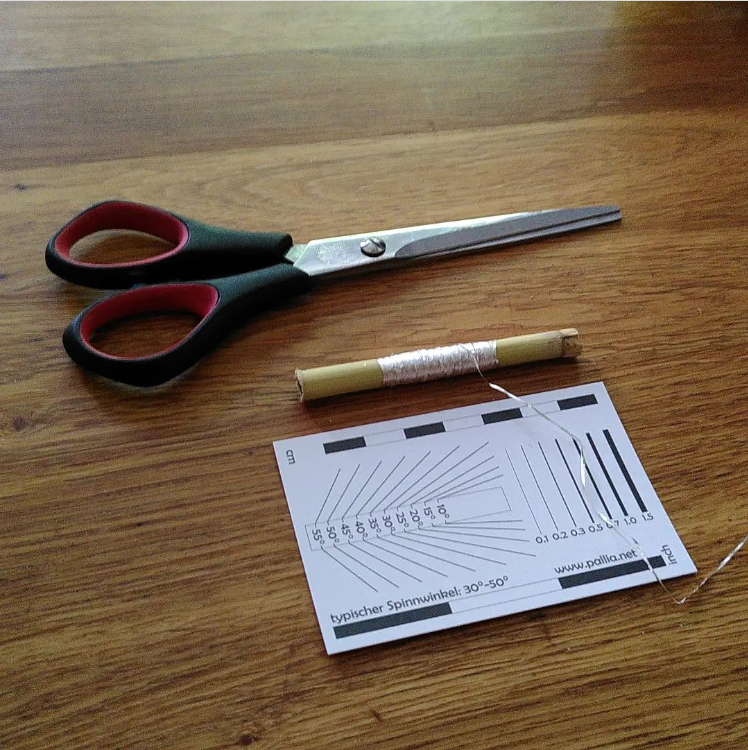
Membrane strip, wound up, my current favourite tool for cutting it, and a little helper card - this time not for yarn thickness or twist angle check, but for strip width check!
The easy part for calculating the price of membrane silver thread like this is adding up the material costs. There's the goldbeater's skin as the basis, the parchment glue (which has to be prepared, too), the leaf silver, and the core thread. The core thread I currently use is vintage linen yarn, and I can't really remember where I bought it, but it's possible to find comparable yarn and see how much that costs. For the rest, I have the numbers... and adding them up, they are not pretty. But that, of course, is only the first part of the calculation process.

Now that I've more or less gotten the hang of cutting the strip and winding it around the core, I can do some time measurements for how long things take, and add those up. For the gilding process, though, I will have to estimate - I have not done that often enough yet to have a good established process, and the last approaches at stretching the skin in a frame for the glueing and gilding did work, but took a disproportionate amount of time. 


Those bits in the calculation process are the hardest for me. I don't want to shortchange my customers, but nor do I want to end up with a much lower wage than intended because I underestimated the time necessary by a lot. And unfortunately, when you do those estimations for work time, that is very easy to do. 

So... I've made a rough guess on where I will end up, per metre, if I calculate properly. I can tell you that the material costs for about 30 metres of thread are at around 40 €. Added to that is the work time necessary to do all the steps from naked membrane to finished thread: Framing the membrane, treating it with glue, gilding it, glueing it into a cylinder, cutting the strip, preparing the core thread (which means winding two single yarns onto a spindle), and finally wrapping the core thread with the cut strip.

Want to guess along with me? Then let me know in the comments where you'd see the price for a metre of the membrane thread end up!
0
JUNI
01
0

Spinning Gold.

If you're following me on Instagram, you may have seen some pictures of this on-going project already. It is, so to say, a left-over from last year's European Textile Forum, where we tried to explore the making of membrane gold threads.

Membrane gold threads are the cheaper version of real gold threads - it's a gilt animal membrane wrapped around a fibrous core. In our case, we built on the analysis results of some Italian threads that Cristina Scibé is researching.

There's a lot of unknowns or insecure things in the reconstruction of the process, and we were (and mostly still are) unfamiliar with most of the materials involved, so there was a really steep learning curve and there were plenty of "d'oh" moments.

But we have arrived at a process that is working, and that would be plausible also for production.

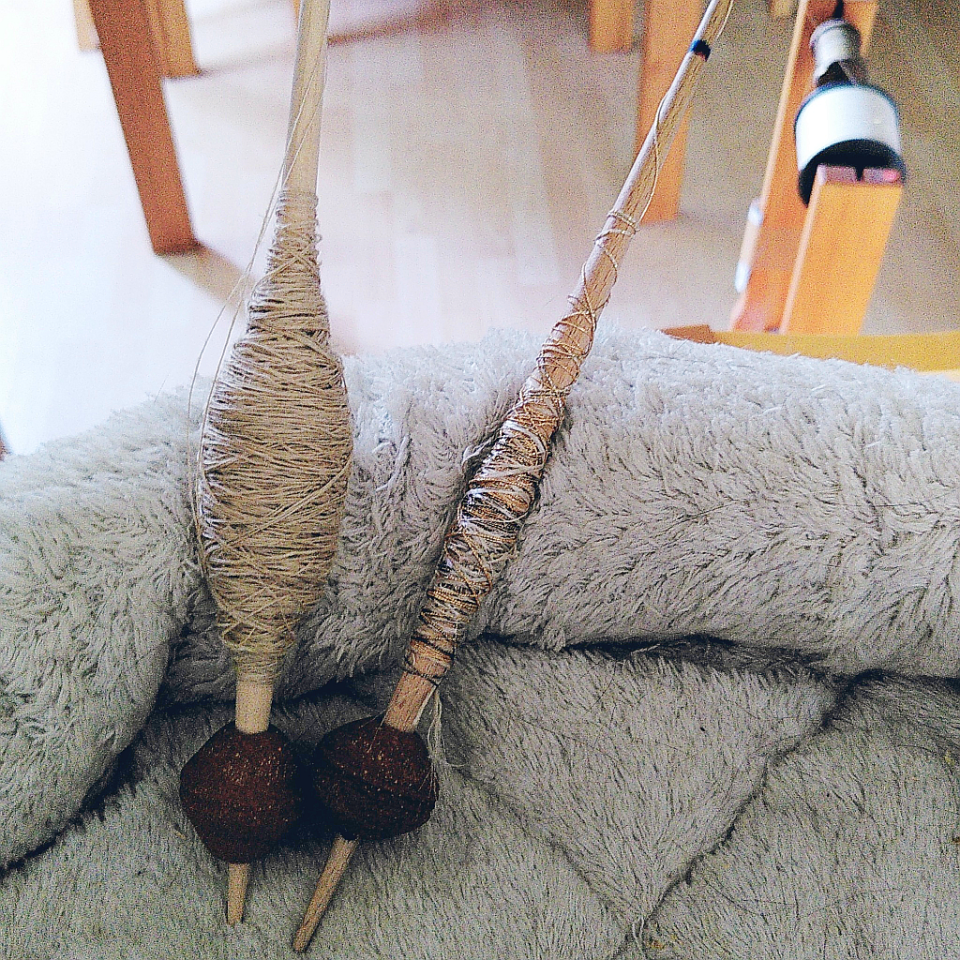
The photo shows the two spindles I am working with for wrapping strips of stuff around the core - one with the two linen single yarns, and the other with the wrapped yarns. These are not membrane strips, but modern metal and metallised plastic strips, done for practise purposes, as the membrane is a little too much work and too much of a resource to use as training material.

It's an utterly fascinating project... and I will give a little presentation about it on the EAA in Belfast this year. I'm already very excited about that!

0

By accepting you will be accessing a service provided by a third-party external to https://www.pallia.net/

Kontakt
