Latest Comments

Guest - Aislinn Dyestuff Citizen Science.
09. Oktober 2026
This is a great project. I look forward to the results. Thanks for letting us know.
Guest - Aislinn Time for...
09. Oktober 2026
Looks delicious!
Guest - Katrin Sprang Discussion
18. September 2026
Hi Rachel, I have looked for more photos of you, but that was not very successful. I found a link on...
Guest - Beatrix Sprang Discussion
15. September 2026
That lozenge pattern element is not a photograph, but a scan. So it should be to scale. But I pinned...
Guest - Katrin Sprang Discussion
15. September 2026
I was not referring to Rachel's reconstruction (is the reconstruction you refer to the one photograp...
APR.
28
0

Round up the usual suspects!

Today was a day where I tried to finally take care of a stack of small tasks, some of which had already been on the to-do-list for a good while, and some that had just come up quite recently. It feels nice, somehow, to do those maintenance tasks! Some of it was writing mails, some was sorting through files, some was trying to figure out new software. There's been a change in my newsletter thingie not-so-recently, and I was looking to acquaint myself with some of the features of the new version, but when it was time to send the last few newsletters... well, I didn't get around to do it. Today, I finally managed to sit down with it and we had some quality time, so to say. 

Now I think I might test it with the current newsletter - and if it works well, I will switch over to the new version. Hopefully it will! 

Apart from all this, there's also been some conference preparation and pre-packing prep today. I'll be off to a EuroWeb workshop on Tuesday, where I will be meeting a number of my lovely colleagues for discussions about making, wearing, and displaying textiles and the body. I will also try very hard to stay within the 15 minutes timeslot for my presentation - talking (shortly) about subtle movements in crafts, especially in relation to teaching things. It's a fascinating topic for this meeting, and I am so much looking forward to it.

My going there, however, means that you'll be treated, again, to a few days of blog silence while I am off. Starting on Monday, as that is a public holiday - I'll be back on the blog on Wednesday, May 10. I hope you'll be able to enjoy a few lovely spring days until then, too!

0
APR.
27
0

Experimental Archeology Conference coming up!

My blog thingie is, it seems, trying to make me look like a bit of a fool - I used one of the post drafts that had not gotten through, but the progamme then obligingly posted it under a different date. Very nice of you, blog thingie, thank you so much. Not.

On to nicer things than wayward software, though! There is a large Experimental Archaeology Conference coming up, running May 1-3. It's in Torun in Poland, but will be a hybrid event, so if you'd like to join in on short notice, you can.

13The full programme is here: https://exarc.net/meetings/eac13 and there is a session with focus on textiles on Monday, May 1, starting at 14:30 (Session 3.B).

You can follow the presentations online via https://www.youtube.com/@exarc. Links will also be included in the website. For extra chats and discussion there's a Discord server you can join. For more information on the conference, go here: https://exarc.net/meetings/eac13/how-attend.

So I hope there's something interesting on the programme for you, and that you will have fun participating!

0
APR.
26
0

Exhibition coming up!

In the last years, I had the pleasure of doing demonstrations and having museum cooperations that involved quite a bit of travel. There was work to be done in Brandenburg, Lübeck, Emden, Berlin, just to name a few of them. It's lovely to travel there, get to see those places, meet the people and (important part of any travelling I do) sample the local delicacies. 

I'm just as delighted, though, to have a museum cooperation just in front of my own doorstep for a change, though. 

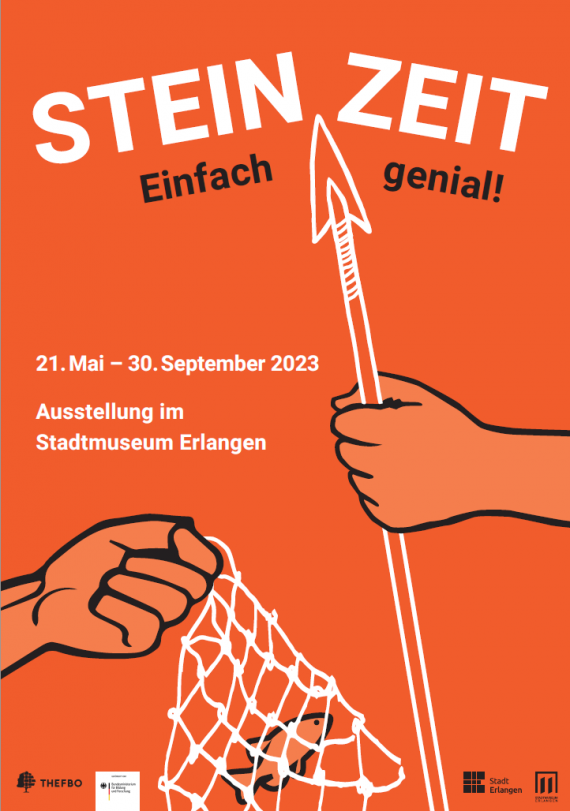
So I am very happy to share with you the  news about an exhibition coming up in my local museum, the Stadtmuseum Erlangen:

Die Ausstellung zeigt, wie vielseitig Gräser, Bast, Rinde und andere Materialien schon vor tausenden von Jahren eingesetzt wurden und lädt dazu ein, steinzeitliche Techniken selbst auszuprobieren.

I will be doing demonstrations of early textile techniques on the vernissage of the exhibition on May 21, starting after the official opening. There will be additional demonstrations on September 10 and on October 22, starting at 14:00 - plus one for the "Long Night of Science" on October 21, starting at 20:00.

I'm very, very much looking forward to this already. Almost no travel time! (There might still be sampling of the local delicacies, though. I will take any excuse for having delicious food of both the sweet and the savoury type... and Erlangen does offer nice specimens of both. Bonus: No exploring and luck necessary, I already know places to go to for the good stuff!)

0
APR.
25
1

Mystery Bone Item.

Apparently the planned blog post for both Friday and yesterday never got through - if you can rely on anything, it's modern technology doing weird things once in a while.

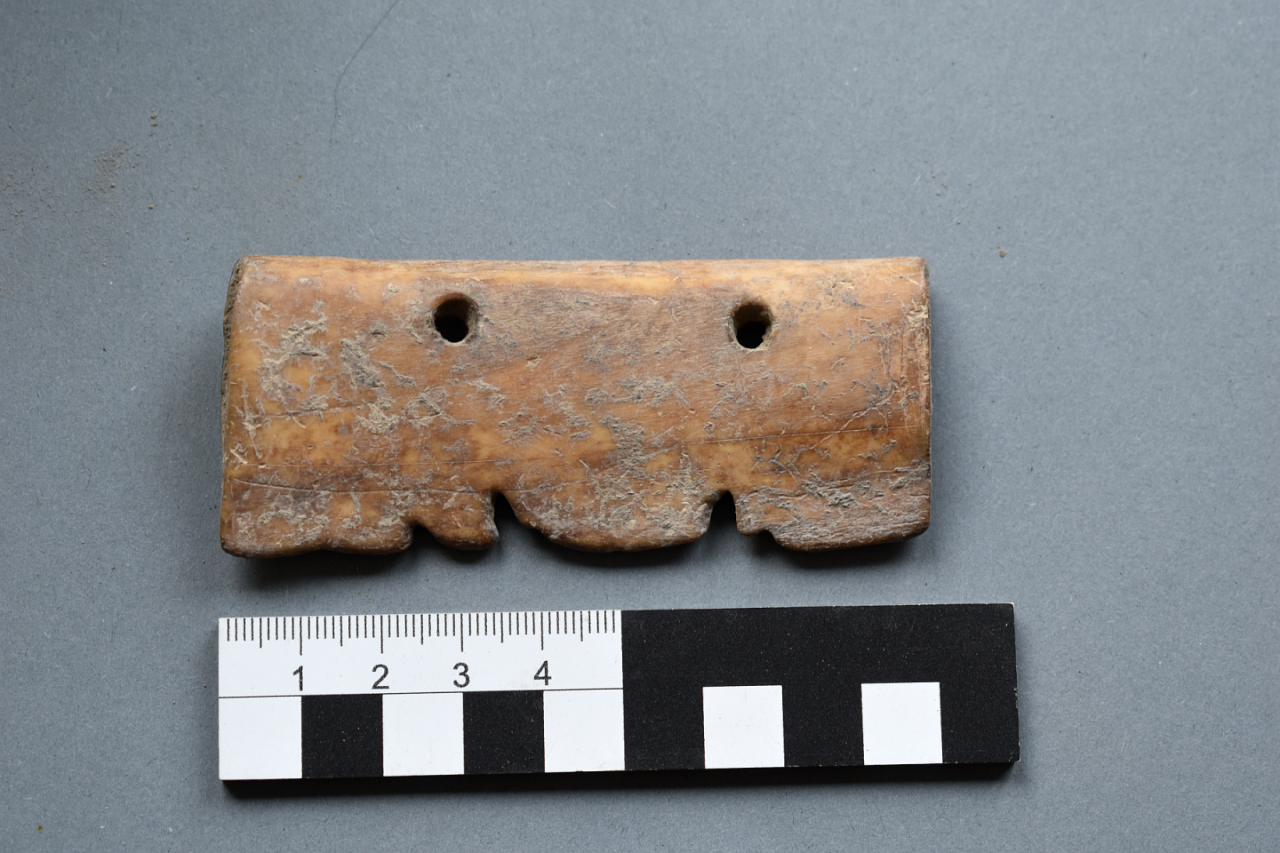
To make it up for you, I have something very special today: A mystery! This piece of bone was found in a dig in Austria. It's rib bone of either horse or cow, with sawed-off sides (not polished or smoothed). Both lengthwise edges are worn smooth or wear-polished.

If you've seen anything like this before, or have an idea for what it could have been used, please let me know!  

0
APR.
14
0

Teaching Thoughts.

I've been thinking about teaching again recently - because of teaching some more again, in different settings, and because of an upcoming conference where I will do and give a short presentation about the topic.

Teaching is fun, and fascinating, and has its own special challenges and rewards. There are some things that are easier to teach and some that are harder. Personally, I find that the hardest technique to teach from the many textile techniques that I have on offer is filet netting. The knot, once you have it in your muscle memory, is not hard to do. It's a nice, fluid set of motions resulting in a nice tight knot that has the correct size every time.

However... there is no good way to split up that set of motions, at least I have not found any way to do that yet. To form the knot, you have to do all the motions and all the passes over and under the different threads, and you have to do all of them correctly. So learning that knot requires you to memorise the whole sequence in one go, which, according to my experience teaching this, is a significant challenge.

I remember learning how to do that knot myself; I used the instructions provided by Therèse de Dillmont in her book, the Encyclopaedia of Needlework, and I read them bit by bit following the sequence for many, many times until the whole process had settled in my brain. 

So - teaching long, complex (sort of) sequences that have to be done in one block is definitely a challenge - but it is something that can be taught. Other things just cannot be taught (as in directly giving instructions or passing on sequences of movements) at all. In some cases, the difference between individual bodies means that every body needs an appropriate solution for a given problem; one may work for many or most of them, but not for all. In these cases, you can only assist. 

My favourite example for this is tensioning the yarn when knitting Continental style. For most knitters (according to my own anecdotal evidence of looking on hands), wrapping the yarn around the left forefinger works very well. Many knitters wrap twice, some once, some even three times, and the number of wraps may also depend on the yarn. So this is the way how to tension yarn that most people get shown and taught when they start out knitting. 

However... for some people, it does not work. That includes me - if I wrap the yarn around my forefinger, it just won't slide at all, and I get higher tension all the time, or if I jerk more of the thread loose, uneven tension. For me, it works wonderfully to just weave the working yarn through the fingers of my left hand: over the ring finger, under the middle finger, and over the forefinger. When I was learning how to knit, finding my personal way for tensioning the working yarn was actually one of the biggest challenges, because nobody showed me that method; I stumbled across it when trying out different possibilities.

So as a teacher, you can be aware of the possibility that a given method or process might not work for everybody because of physical reasons - and then you can, if you know of alternatives and options, tell about the other possibilities that the student could try. But of course you cannot slip into their skin and try out the options yourself to see which one feels best, and you might not be able to demonstrate the other options well as they might not work well, or at all, for you. In the end, they will have to find their own solution by trying out things. 

Have you come across similar things - in learning a skill, or in teaching? I'd love to know!

0
APR.
13
0

New Book!

One of my lovely colleagues has a new book out - Maria Mossakowska-Gaubert has written a monograph about monastic (not only monastic, though) garments and Greek terminology. Here's her description of it: 

This book focuses on clothing customs and their evolution in the Egyptian monastic environment of late antiquity and the early Arab period. It falls within the realm of studies on ancient societies as seen through their languages, material culture, daily life and religious practices. The research presented here contributes to a general discussion on the clothing worn in Egypt and its role as a social marker. The designations and forms of monastic vestments are explored through a meticulous lexicographical study and an investigation of the garments that have been preserved or are represented in iconography, in order to place them in the context of ancient "fashion" and to shed light on the technological changes that affected their production.
The idea of a costume specific to the monastic rank seems to have appeared in Egyptian society in the middle of the 4th century. This "official" garb was reserved for special situations, such as participation in the liturgy, while "ordinary" garments were worn by the monk for everyday tasks and for sleeping. Considered separately, the elements that made up the "official" attire were commonly worn at this time (with the exception of the apron and scapular), and it was only when worn together that they distinguished a monk from a layman.

The book is titled Le vêtement monastique en Égypte (IVe-VIIIe siècle) and has been published by the Ifao, in the series Bibliothèque d'études coptes, no 28. 

0
MäRZ
16
0

Teaching Thoughts.

 With the pandemic lasting for rather long, I started (like some other people) to offer some of my workshops or courses online. So far it's the sewing workshop (about medieval stitches, seams, and hem types) and the spinning workshop.

I've been asked at some points about offering other workshops as well, and I've thought about it, but not every one of my workshops is online-able, at least not in my reckoning and how I teach it.

The most recent in-person techniques that I taught were the tablet-weaving workshop and the loop-braiding one. I can definitely say that I will not offer the tablet weaving one as a digital version. There are several reasons for that.

One of them is that there's often little movements or little habits that influence how smoothly the weaving goes. I need to see these, and in my experience from the spinning workshop, that is just not possible via a small screen and with limited camera positioning possibilities. It's not as crucial in the spinning workshop as it is for tablet weaving, and there it can already cause issues. 

I also need to be able to see the band, in detail and from up close - because occasionally, threading errors happen, or a single tablet flips or goes out of alignment, and, well, see above.

Those are the visual issues. 

Warping is another thing where I have a set-up in the workshop that works well, but it requires using my favourite all-purpose-tool: the clamp. To be more accurate, four clamps per person. These are used for warping, then two serve as anchor points for the warp for the rest of the workshop, and then I pack them up and take them home again. That means that participants in an online version would have to warp with what they have at home, or get clamps on loan and have to send them back, or have to buy clamps, or I'd do the warping and send the finished warp for the workshop. The last would be the easiest version logistically, but it would also mean that warping - which is an important thing to learn - would not be part of the experience.

And then... there's the touching. Warp tension is one thing where it's helpful to touch and see, but that is the least of the points. There's this stage in the workshop when we're going off to weave freestyle patterns based on diagonals - diamonds, X-shapes, diamonds with a swirly centre, diagonals branching off each other. Mistakes happen, confusion might occur, and then I need to orient myself to see what happened, and what needs to be done, and I do that by leafing through the stack of tablets, checking each one.

And this is where, at the very latest, the idea of doing this virtually would die. I'm still hoping to some day, when it gets less busy here, finish filming and making the instruction video for tablet weaving planned and started oh, way too long ago - but transforming the in-person workshop on tablet weaving to an online version is just not possible. 

(In case you're wondering about the difference between a video course and the live online version: The video can be watched again and again if there's something unclear or difficult. Since different people tend to have their problems at different places, watching individually and re-playing the passages in question would not be an issue. Explaining something online live without the possibility of showing it on the band, and having potential visual problems caused by the participant cameras, well... let's say that this is sure not to work out well. It would also mean factoring in a good amount more time for the workshop in advance, making an already rather long one... impossibly long.)

0

By accepting you will be accessing a service provided by a third-party external to https://www.pallia.net/

Kontakt