

Latest Comments

Guest - Aislinn Dyestuff Citizen Science.
09. Oktober 2026
This is a great project. I look forward to the results. Thanks for letting us know.
Guest - Aislinn Time for...
09. Oktober 2026
Looks delicious!
Guest - Katrin Sprang Discussion
18. September 2026
Hi Rachel, I have looked for more photos of you, but that was not very successful. I found a link on...
Guest - Beatrix Sprang Discussion
15. September 2026
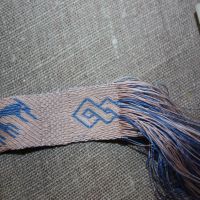
That lozenge pattern element is not a photograph, but a scan. So it should be to scale. But I pinned...
Guest - Katrin Sprang Discussion
15. September 2026
I was not referring to Rachel's reconstruction (is the reconstruction you refer to the one photograp...
DEZ.
03
0

Japanese Weaving Exhibition in London.

If you're in London, or going there in the next two months, you might want to visit the Japanese Embassy building to have a look at their exhibition Hakata Ori: Weaving Through to the Present.

Hakata Ori is regarded as one of most well-known examples of woven textiles in Japan. Weaving in Hakata (now known as Fukuoka City) is said to date back to 1241 and this year is an auspicious one for local weavers as they celebrate 777 years since the beginnings of Hakata Ori.

Traditional Hakata obi (belts) became highly regarded for their strength and durability, enjoying popularity amongst samurai for the ability to hold their swords in place and also the patronage of the shōgun for many centuries.

This exhibition retraces the history of weaving from this area of Kyushu at the same time as putting the spotlight on its modern weaves. Protecting the heritage and customs of the past whilst preparing for the future is essential for any traditional craft to prosper in modern times. Today, Hakata Ori craftsmen create a broad array of items for display as well as for everyday use.

The exhibition runs until January 31, 2019; the embassy (101-104 Piccadilly, London W1J 7JT) is open on weekdays 9:30 to 17:30, closed on weekends, 25-26 December and 31 December – 3 January inclusive. Admission is free, but photo ID is necessary to gain entry to the Embassy.
0
NOV.
30
2

It sprang from the frame.

With the sprang workshop at Rothenfels coming up, I have caught another instance of the sprang fever - so when there was a little time at the Forum, I made a very narrow but long-ish setup for sprang, and I did a few twists and turns on it now and then.

Today, during my lunch break, it came off the frame... finished, with some random patterning (and a few mistakes I was too lazy to fix). The patterning was made to explore transitions between s- and z-slanted interlinking, and to take a close look at how things look when they are right. I also got to test how alternating s- and z-interlinking makes a true braid in 1/1 oblique interlacing - the actual thing I did have in mind to try when I made this setup.

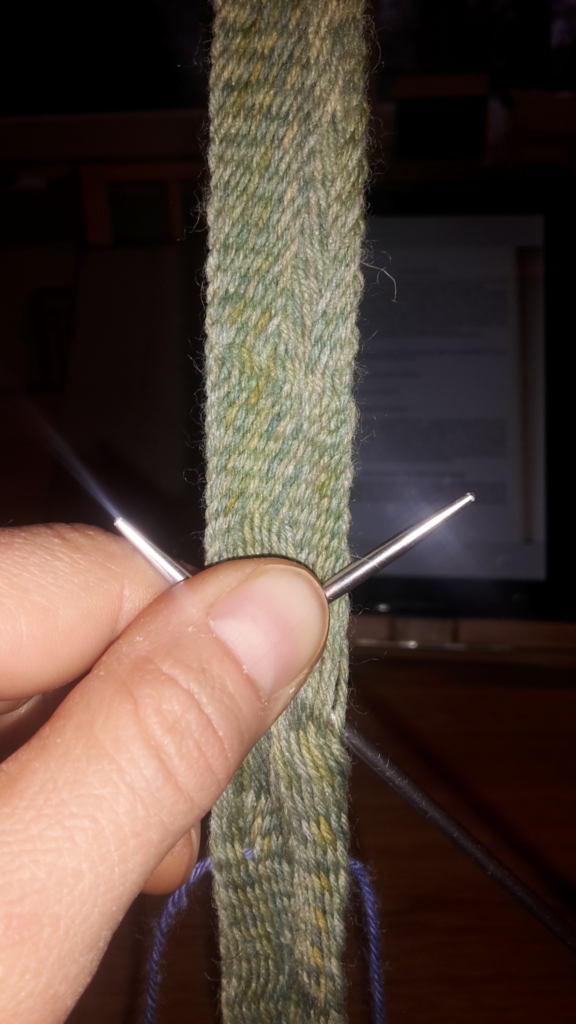
Towards the end, it looked like this:


I remember how utterly awkward it was when I tried the first time to work the last centimetres with knitting needles... but at one point, it sort of clicked, I found what kind of motions I need to make with the needles in order to sprang my way happily across the threads, and now it's actually comfortable. There is a point, in fact, where I find it much more awkward to still press my fingers into the shed, though still entirely possible, than to switch to nice thin pointy sticks.

Anyway, I worked my way across, I tried (succesfully) combined s- and z-interlinking with the needles instead of my fingers, then finally chained up the thread bits in the middle... and then I sat there with one long, narrow strip of stuff.

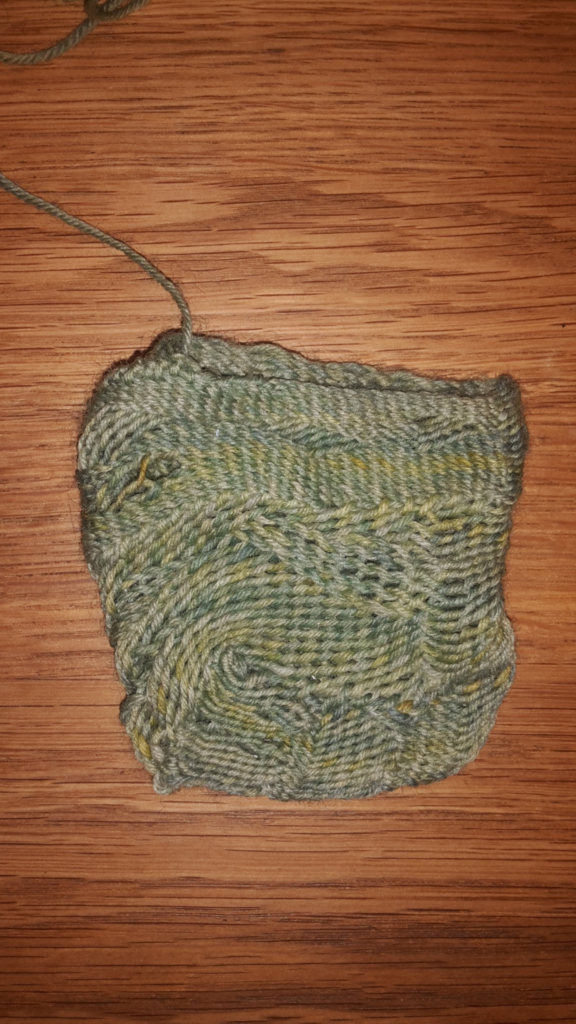
Which I promptly coiled up, sewed together, and now I have a small, fancy-looking bag with an unstretchy top edge:


Now I only need an idea what to use it for...
0
NOV.
29
0

I have questions. Many of them.

One of the many questions is: Where has this day gone? Somehow, part of it got sucked away by my carrying stuff - or, to be more precise: carrying parts of a storage shelf down into the basement.

As the stuff accumulation goes on, so does the need for storage space, so I've finally given in and ordered a large shelf, to be set up in the basement. It arrived today, and thus I've been bringing the parts of it downstairs and did some re-arranging of the things hanging out in the room, to make space for actually putting it together.

Next question: Where has November gone to? Somehow it has sped past even faster than months usually do. Which, I admit freely, is a weird question in combination with the next one - why is it not Friday yet?

Ah well. At least the German newsletter has gone out today, on the edge of it being still November. Also - baking season has started yesterday, as usual with the Vanillekipferl (because I always feel they need the longest to get to their best taste).

And after all these questions that are probably of no real interest to you, here's something that might amuse you - a crowdfunding campaign to save (and possibly reconstruct) a castle in France: Chateau Ebaupinay. I'm not entirely sure what to think of these plans - I am definitely and totally for saving the castle and preserving the building for posterity, but I'm not so sure the plans for something which sounds like a huge Living-History-Meets-Live-Roleplaying thing...
0
NOV.
28
6

Helpful, helpful cat.

As usual, the month is running out and I am assembling my monthly (German) newsletter with news from the shop (plus some additional info I find interesting) juuust on the edge of it... somehow, every month, there is something happening to delay things.

This time around, it was the Textile Forum first, then I caught a cold (again! I am of the firm opinion that one instance of winter-related sniffle-containing illness is more than enough per year or cold season), and now... now I still need to take the last photos.

Because, you see, I finally have embroidery frames back in stock. Nice, large, wooden ones - slate frames, like they were used before the small round ones came up in the 18th century. And while you do not need a frame for many kinds of embroidery, including counted stitch work, when you do need a frame, this kind will provide you with very nice, very long-lasting tension and a large area to work in.

So after being out of stock for a while (it took longer than expected for the woodworker and me to get together on some changes to make the frame even nicer), I now have the frame not only in beech, but also in birch wood and maple wood. Even more important than this mostly visual thing: The top and bottom slates are formed a bit differently now, which means they can accommodate a wider fabric.

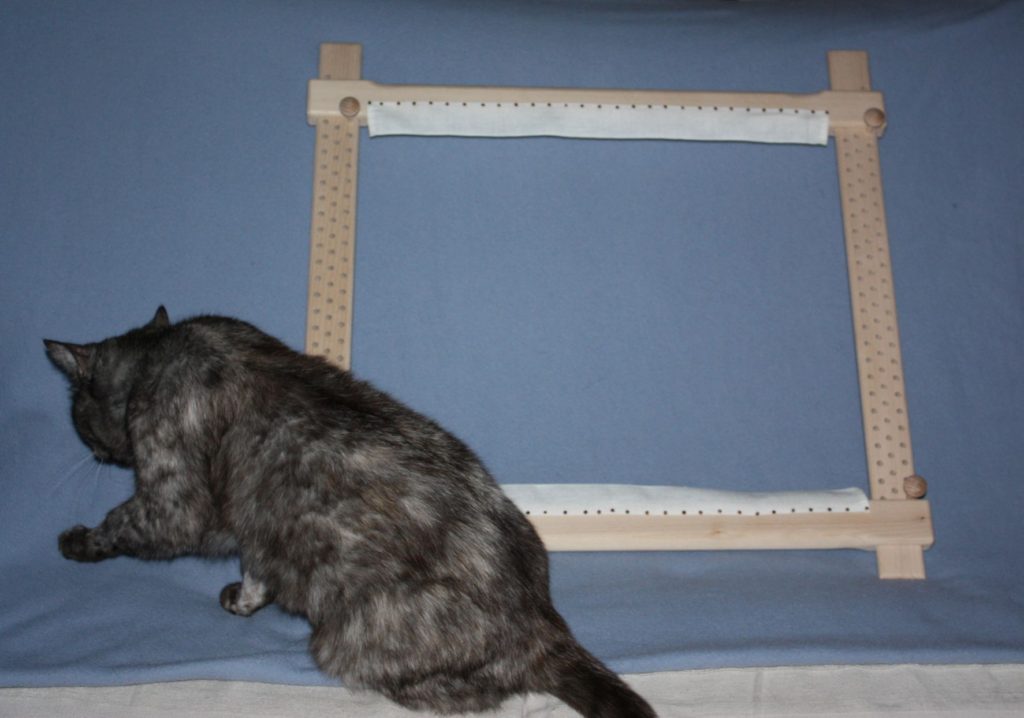
Well. If I want to link to this lovely new thing in the newsletter, obviously, this has to go into the shop first. Which means I have to update the description... and the photos. The frames are too large to photograph with my usual setup, though, and when I whipped out an alternative background fabric and placed it on the couch, then set the frame on it, guess what happened?

Yes.


I got cat-bombed.

Thank you so much, little cat, for making my work easier. Not.


Though maybe I could use this picture with the remark "cat-approved" and "cat not included with purchase"?
0
NOV.
27
0

Gingerbread House?

A friend is pondering making tiles for gingerbread houses - so I think a recipe is in order. This is a classical one for gingerbread houses, based on flour (as opposed to Elisenlebkuchen, which are based on nuts and contain little or no flour at all).

But if you are going to build things with it, Elisenlebkuchen are not the best suited... so here you go, a flour-based recipe for Lebkuchenteig. (In contrast to the other recipes I'm posting on this blog, I have not made this myself. I have baked similar gingerbread for houses some years ago, though, and they are all pretty similar, and - if you use butter and nice honey and a good spice mix, all delicious.)

400 g honey
150 g butter
200 g sugar
2 eggs
10 g gingerbread spice mix (vary to taste)
1 pinch salt
800 g flour
4 level teaspoons baking powder
20 g cocoa

Melt honey and butter in a pot, add sugar and stir until sugar has dissolved. Set to cool, then stir eggs and spices into the mass. Mix flour, baking powder and cocoa powder and mix into the honey mass, first with a spoon, then knead the rest of the dry ingredients in. Let the dough sit for about one hour.

On a floured work surface, roll dough into a sheet of about 1 cm thickness. Cut into desired shapes for the house (or use cookie cutters to cut out cookies).

Bake for 10-15 minutes at 175°C. Let the pieces cool completely before gluing them into the house; best to let them sit over night and glue them the next day.

(Translated from a Chefkoch.de recipe)
0
NOV.
26
0

Links, semi-random.

You are getting links today!

Here's a little post about a wooden stick with runic inscription found in Staraya Ladoga.

The CIETA has old issues of their Bulletin available as pdf online - the most recent one is from 1986.

Finally, a short video about a fascinating pleating technique (in French, but the text is not about how the pleating is done anyways, so you won't miss information by not understanding French):

 
0
NOV.
23
0

Online Digital Archive.

Just in case you are looking for something to read on these darkish winter afternoons and evenings, there's an On-Line Digital Archive of Documents on Weaving and Related Topics - which includes articles, books and illustration not only about weaving, but about a large number of topics, down to spinning (though mostly modern spinning on machines), lace, nets, and needlework.

The site had its last update back in 2016, but the articles are still available, so if you are looking for a pdf or five to read - that might be your thing.
0

By accepting you will be accessing a service provided by a third-party external to https://www.pallia.net/

Kontakt