Latest Comments

Guest - Aislinn Dyestuff Citizen Science.
09. Oktober 2026
This is a great project. I look forward to the results. Thanks for letting us know.
Guest - Aislinn Time for...
09. Oktober 2026
Looks delicious!
Guest - Katrin Sprang Discussion
18. September 2026
Hi Rachel, I have looked for more photos of you, but that was not very successful. I found a link on...
Guest - Beatrix Sprang Discussion
15. September 2026
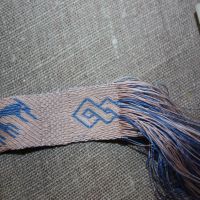
That lozenge pattern element is not a photograph, but a scan. So it should be to scale. But I pinned...
Guest - Katrin Sprang Discussion
15. September 2026
I was not referring to Rachel's reconstruction (is the reconstruction you refer to the one photograp...
FEB.
05
0

Getting back to normal. Again.

Today is earmarked for finally, finally sitting down and getting the book-keeping up to date. Tax day is coming up, and I'm woefully behind with the keeping of the bureaucratic side of things, so it's paying bills today, marking bills with little numbers, matching the little numbers in my software, and then (with a very happy sigh) putting away a stack of paper at the end, sending off the tax report and after it, sending money to the Finanzamt (who kindly expects to hear something from me every quarter of the year, plus twice more for the main taxes and for the final version of my VAT balances).

To my great surprise, it actually feels good to sit and do this stuff - a job I usually don't like very much. I'm still not over the moon about it, because it always means some amount of searching for this receipt or that email, and checking stuff, and occasionally doing some research on the 'net on how and where to book something, and much of this feels like a waste of time. However, I've had so many other (and time-critical) things to do and prepare in the last weeks that this time around, sitting down for this calculated waste of time means that all these nice, exciting, but also exhausting things are over for now, and I can get back to breathing calmly and get into "normal mode" again... which also, hopefully, means I get to whittle down the to-do-list some, and get re-started on a bunch of projects which had to fall off the list for a while.

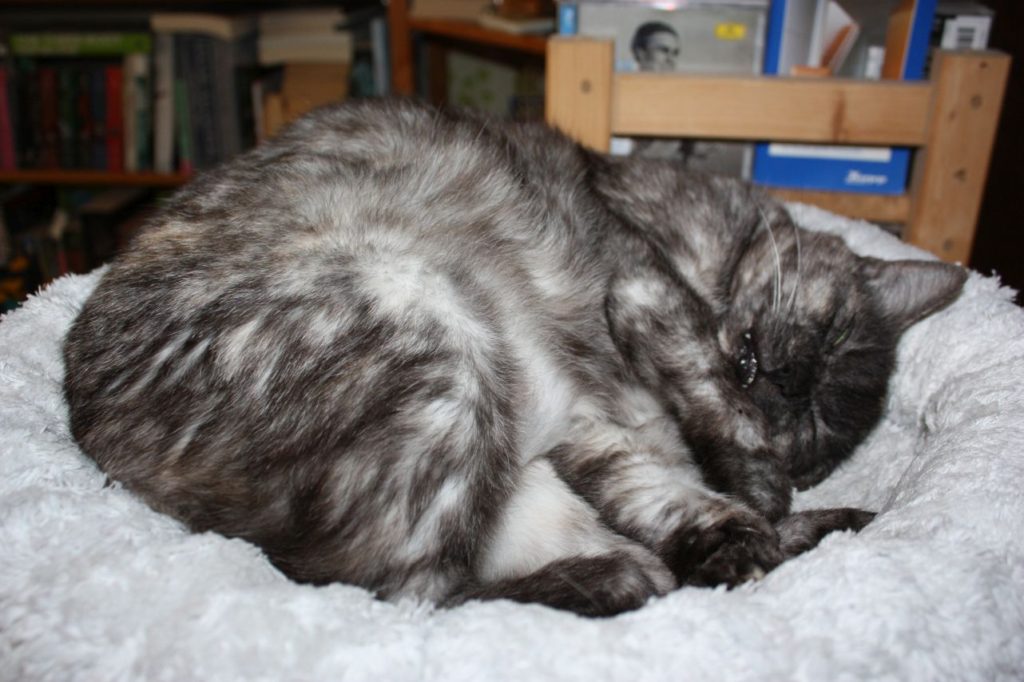
Other inhabitants of this lair here, of course, have never left normal mode:


Which, in this case, means a lot of napping, especially now that there is quite a bit of snow on the ground - which Madame does not appreciate a lot...
0
FEB.
04
2

Pfakofen - the answer...

Bruce's comment about the multi-spouted pot being maybe used as a lamp (thank you, Bruce!) was, it seems, not the first one. There's a German article about special forms, though, that comes to the conclusion that these multi-spout pots generally do not work well as a lamp. (See "Lampen im Barbaricum", p. 222, in Armbruester, Tanya, and Morten Hegewisch. Studien zur Archäologie Europas, edited by Joachim Henning, Achim Leube and Felix Biermann, vol. 11, Bonn 2010).
So... the spouty pot is probably not a lamp. Though it may have been used for some kind of drinking games, the one in Pfakofen was found in context with a spindle whorl, and there were cochineal lice inside the pot - placing it nicely in a textile work context.

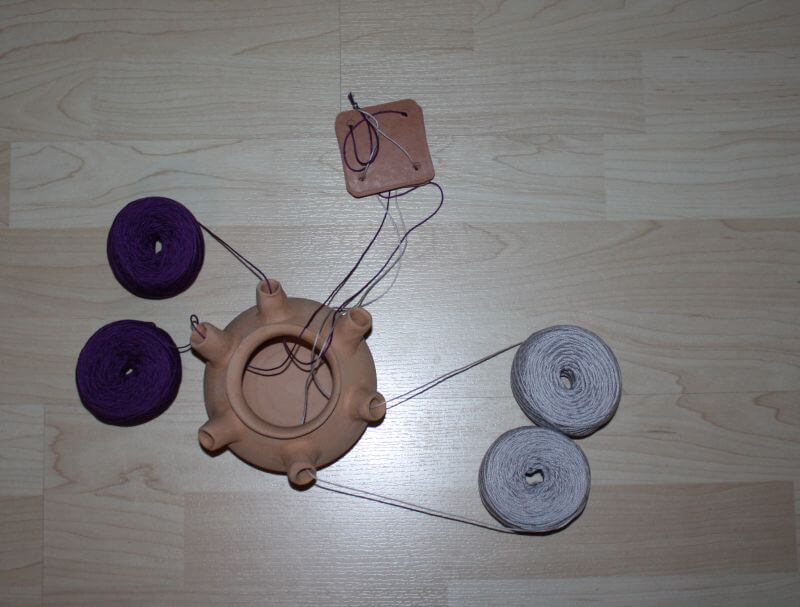
When we were in Eindhoven with the first Textile Forum, there was also one of these pots replicated - and Viktoria Holmqvist mentioned that she'd always wanted to try one as a warping helper for tablet weaving. And so she did - with very good success.

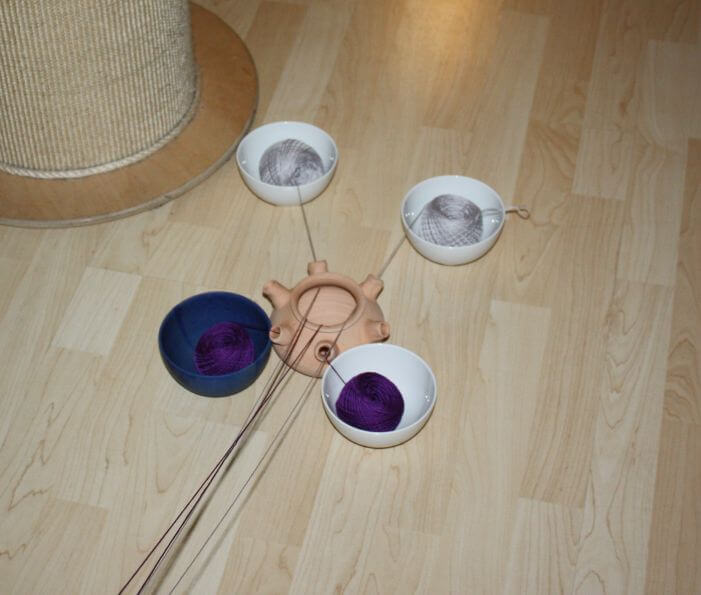
It works like this: You thread the yarn ends through the spouts into the pot and out the middle hole, and then thread your tablets with them.


Then you place the balls of yarn into bowls or similar containers, so they don't roll about the floor like crazy, and you can start warping.


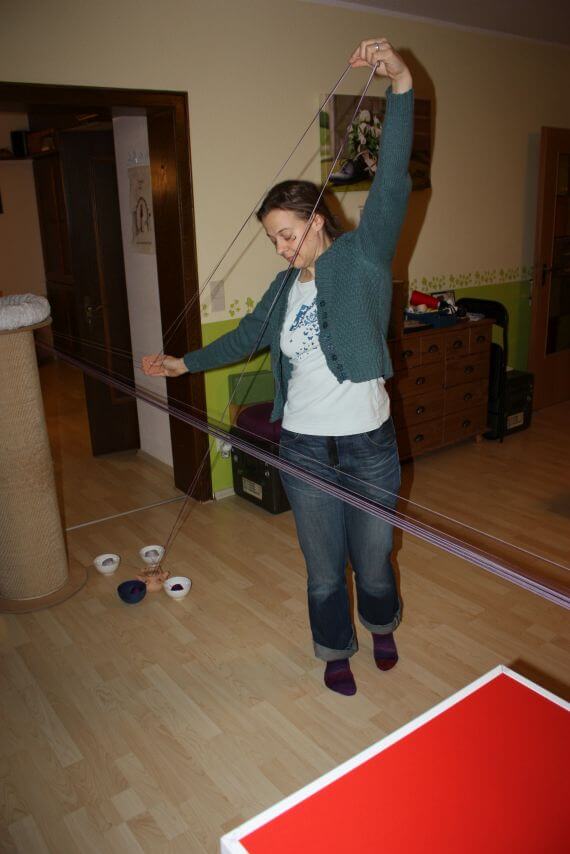
The trick is to pull upwards - if you do that, you will get a really smooth, evenly-tensioned flow of yarn from your spouty pot. I've tried this with a 5 m stretch between the warp end posts, and it still worked nicely, provided you pulled up (or as up as possible); for an even longer warp, I'd set a zigzag course instead of a straight line for warping, and then more length would not be an issue at all.

I've made quite a few warps, and pulling up is always a good idea, but using the pot makes things just... smoother, more evenly tensioned, and much, much more fun.

Bonus feature: It looks like dancing.


Second bonus feature: I now have a 5 metre warp with 20 tablets to play with...
0
FEB.
01
2

Pictures!

Yesterday was a day for taking photos - because, well, the Newsletter for January was still to go out, and I actually had an exciting new thing for that one, which unfortunately had to be put into the shop before I was able to link to it...

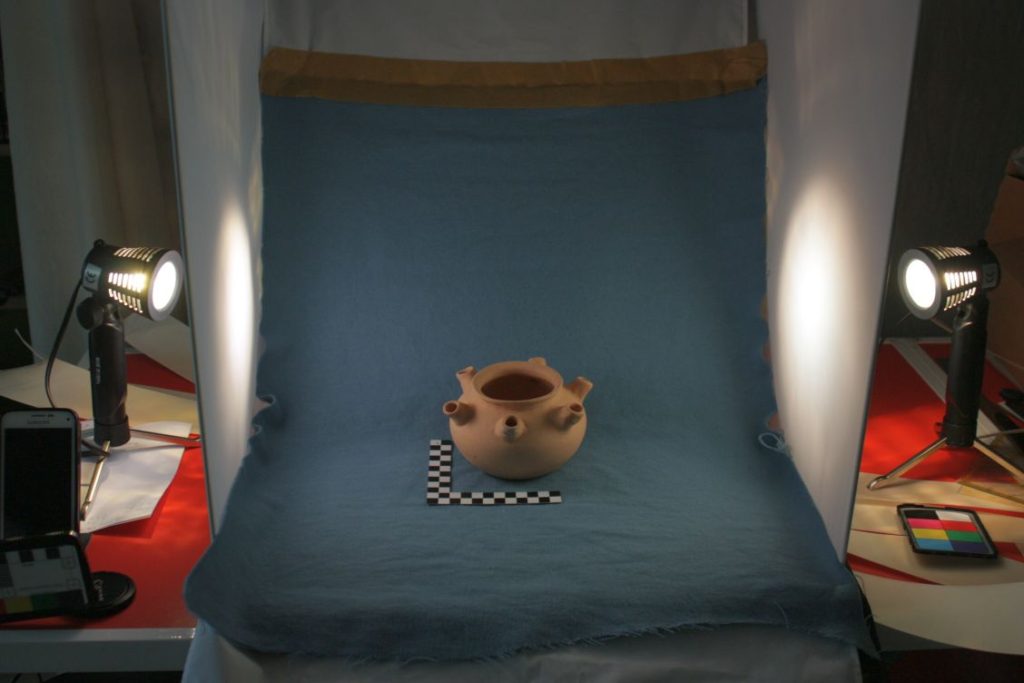
so there I was, having to take product photos. I'm sure I have complained in the past about how hard it is to take good product photos. Usually, I try to go for a nice, bright day and set up the photo equipment in the wintergarden, but yesterday, I missed the time of bright sunshine... so I was very, very glad that the photo tent thingie came with suitable lamps:


So... who knows what this is, and what it can be used for?
0
JAN.
31
1

Finishing Stuff.

One of the things about archaeological experiments is that they always take longer than expected... and then, in the aftermath, there's... the aftermath.

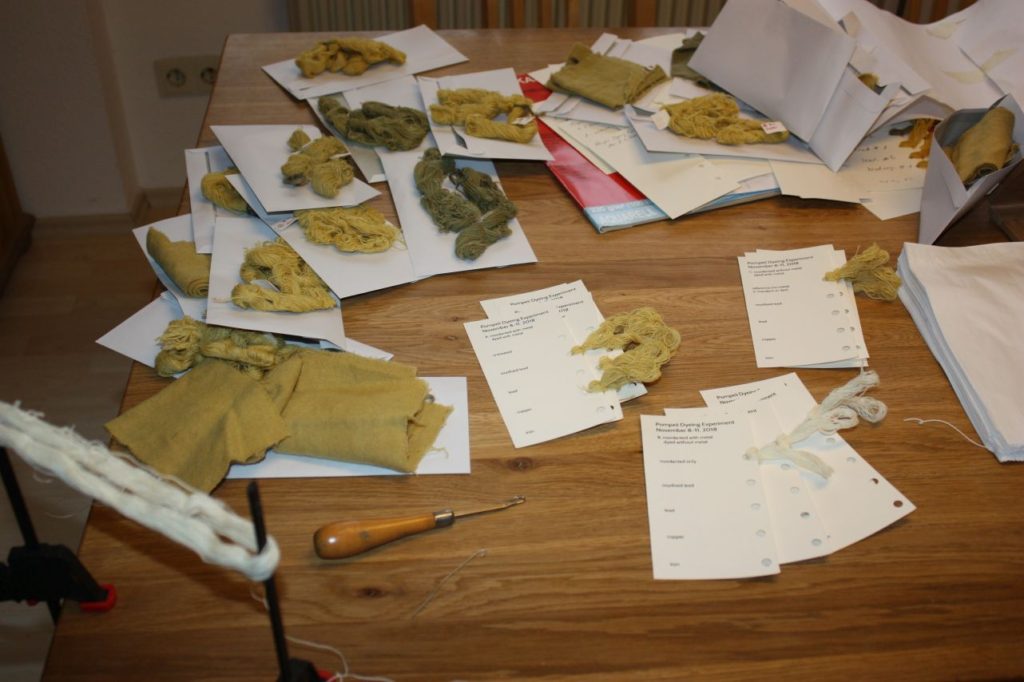
Which, in the case of the Pompeii Dyeing Experiment, involves making reference cards for the different dyeing results. Which means labeling sheets of cardboard, punching holes next to the labels, and then winding off tiny skeins of yarn which are in turn pulled through these holes and fastened.

If you have never done something of the sort, let me tell you: it takes a ridiculous amount of time, and it is stunningly boring work, and I can totally, utterly understand if a dyer does not do yarn colour reference cards (which are only an indication of what colours are possible anyways) and even better why they are not handed out to customers.

[caption id="attachment_4258" align="alignnone" width="640"] Work in progress - I'm less than halfway through here. Altogether, it's four sets of three cards with five skeins each, so it's sixty samples to wind and attach. Can you feel the boredom oozing through the picture?


Now, though, it's finally done, and I can send off the cards to their respective owners (among them the Lab for Experimental Archaeology, for their archive of experiments done at their place). And then, some samples will go into a different lab for testing - so there's a post office run in my near future, which will be followed by a deep, heart-felt sigh of having finally finished that part of the Textile Forum Aftermath!
0
JAN.
30
0

Back from the Nähtreff Weekend!

I'm back, and now there's the usual things that need to be done after an event which included the shop going for a little travel: Putting everything back into place, for one thing, and re-filling stuff, plus re-ordering, in some cases.

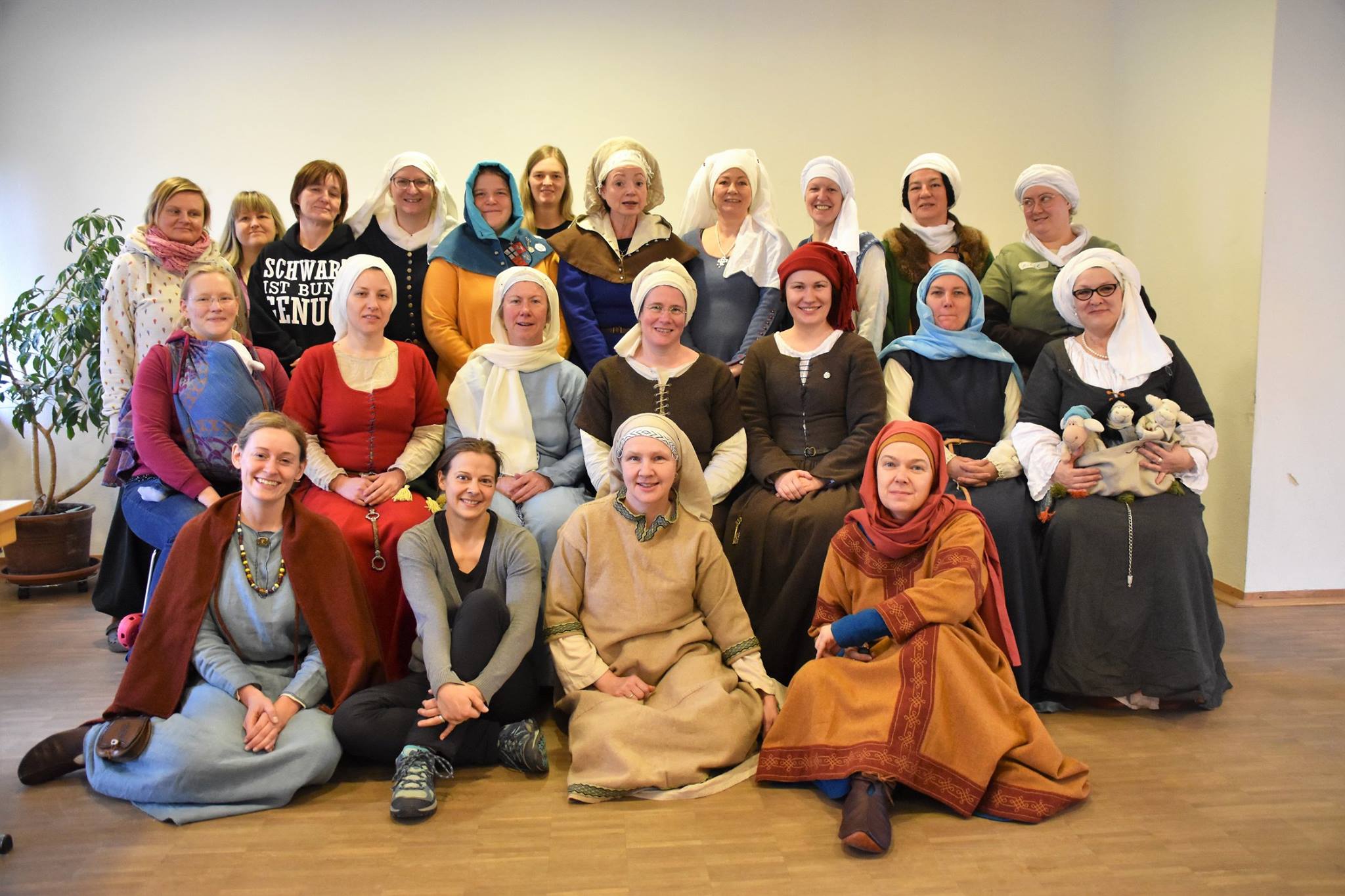
I had a wonderful, wonderful weekend, with a group of lovely people. There was chocolate, and tea, and coffee; there was a large table full of books to browse; there was a nice, light, large room to sit in and chat and work on projects brought along; and then there was the workshop room, where I spent most of the time.

[caption id="" align="alignnone" width="960"] Our group - as you can see, it was a mixed bunch, doing Living History of a good number of different times! (I was one of the people opting for modern clothing - it's easier for me to put on and take off layers as I need to when I'm hopping around the room teaching.)


I had a lot of fun teaching a variety of courses - though, as sometimes happens, one of the courses went a little bit different than I had planned for. Apparently, my method of explaining how to sprang does work for some people - and for others, it does not work at all, and causes more confusion than clarity, which is not a good thing. (The workshop taking place on Saturday afternoon may have had something to do with it, too - with all the talking, book-reading, sewing and cutting, plus the other workshops taking place before, and the night probably not being too long for most people, learning something new is a tad more difficult than when you're all fresh and rested.)

There also were a few bouts of frustration about threads not going quite where they were supposed to be - and that is one of the category 2 problems, the ones involving motor skills and only being solved by practice.

In spite of all the pitfalls, we got it all figured out by the end, and all of the participating ladies had a nice bit of sprang to show for their efforts when we ended the workshop, with some of them even making holes where they wanted them to be. So the next time I'll give a sprang workshop, I will change things a bit, in hopes it will be clearer and easier for everybody.

"While we teach, we learn", said old Seneca the Younger - and he's still right about that...
0
JAN.
25
0

Off teaching... again.

Everything here looks like it always looks just before I am leaving for some event: There's clothes and other overnight stuff on the bed, stacked up and waiting to be put into my "personal belongings" bag; there's stacks of boxes with the shop wares, ready to be transferred to the car, sitting next to the door; and there's stacks (or heaps, depending on their nature) of things necessary for the different workshops or other special requirements.

My workshop scripts are printed out and sitting at their respective places, my "office box" which contains paperworky stuff (such as the newsletter infosheet, and receipt forms, and the card reader) is with the other shop goods to be transferred, and all that is left to pack is the computer (as in this case, I will be taking it along) and, of course, my trusty thermos mug.

That one is still on the kitchen counter, waiting to be filled with some delicious fresh hot coffee just before I hop into the (then fully loaded) car, to make me happy while I am on the road...

So it's prep business like usual, and I'm already looking forward to the afternoon, when I will meet up with the whole group at the Historisches Nähtreffen... and then get started spinning tonight.

As I'll be spending the weekend working, I will take my break afterwards - and see you back here on the blog on Wednesday. Until then, I hope you'll have as much fun as I am seeing in my own future!
0
JAN.
24
0

Teaching Thoughts (part 3)

So... I've covered the explanations, and the hunt for words - that is one of the challenges when teaching, and it relates to the mind part of the task, the understanding only.

The things I am teaching, though, are crafts. Which means that there is not only theory (understanding how things work, and how the process should look at every stage of the work and why, and how to check if it is correct) but also practice. Which, in turn, means fine motor skills - getting your hands to do exactly what they need to do to turn those tablets, spin that spindle, control these fibres, tighten the thread, hold and swap those loops.

Motor skills of that kind are not as easy to confer to someone else. Once you've found the right words and gotten that concept across, it's there (and hopefully there to stay), but you can show someone a movement, a motion, a way of holding the body or parts of it, and it might just be so uncomfortable or new or hard to do that it is not really happening for that student. Even worse, there might be issues that prevent someone from successfully doing something - a finger that once was broken, latent tendonitis in a hand, arthritic joints, limited range of motion in a shoulder. The human body is astonishingly strong and resilient in some ways, and astonishingly ill-designed and prone to failure in others.

Even when there are no illnesses or accidents or other things that have left their traces, some folks will get there quicker, and some will need more time to learn that motion. It has to do with what one is used to doing - having mastered other, similar movements for something else before will be helpful, and having never done anything of the sort of motion needed will make itself felt. So some students, naturally, will be faster and some will be slower.

And also naturally, the slower ones will tend to be frustrated, and look at the others who are quicker and start to doubt themselves and think they will never get it. This, for me, is the hardest thing to deal with when teaching crafts - because I would so love to help them be just as fast as the fastest student in the class, and spare them the frustration. I would love to transfer them my own muscle memory, my own experience of how to grip, how to loosen, how something feels when you have to let go just a little more, or hold on a tiny bit harder. Of how the fibre should feel when it is running through your distaff hand, how that stack of tablets resists a bit and then you loosen your grip in one way and turn a little more and there it is.

But this, alas, is not possible. Everyone has to find these little treasures of practical knowledge for themselves. Experience cannot be transferred directly. There is no quick fix for the muscles not getting it as fast as the brain did.

It's frustrating when you know exactly what you want to do, and your body just refuses to do it. It's also frustrating when other people do just the same task with an apparent effortlessness that makes you doubt yourself. Believe me - I know that feeling very well. Not from textile crafts (where I have been doing so many things over the years that I usually get the new motion very quickly). I know it all too well from bouldering, where I regularly have fits of frustration over not being able to do a problem that others just dance up - or so it seems to me. I am still not very strong, so some moves are right out (pull my body up with one arm? Oh forget it!), and I'm still not very tall, so sometimes my angles are different and it makes things very different indeed, and sometimes my hands are too small for a specific grip on a hold. But sometimes, all these things cannot serve as an excuse, or an explanation why something is harder for me. Sometimes I only lack the strength, or the muscle knowledge of how a motion is done, or both - and consequently, I  fall off. Again and again and again, while other people (including other women, and sometimes other women who are a similar height) just... you know... float up.

There's only one solution to this problem: Keep trying. Keep practicing. Even if it is hard, even if it is frustrating, every time of trying and failing means one more time exploring possibilities, making new connections between muscles and neurons, learning something. Eventually, it will click, and the motor part of the brain will realise that oh, this is how the movement should feel, and this is how the muscles here and there and there have to work together, and suddenly it works, not all the time at first, but the seed is laid and with some more practice, it will grow.

There's no shortcut here - but if you have a hard time getting your muscles to do just what they are supposed to do, you can at least have this consolation: The next time you try to learn motor skills similar to the one you are struggling with now, it will be easier, and even easier the next time, and at one point you will be floating along, effortlessly. Don't give up. Keep practising. Be gentle with yourself - you will get there.
0

By accepting you will be accessing a service provided by a third-party external to https://www.pallia.net/

Kontakt