Latest Comments

Guest - Aislinn Dyestuff Citizen Science.
09. Oktober 2026
This is a great project. I look forward to the results. Thanks for letting us know.
Guest - Aislinn Time for...
09. Oktober 2026
Looks delicious!
Guest - Katrin Sprang Discussion
18. September 2026
Hi Rachel, I have looked for more photos of you, but that was not very successful. I found a link on...
Guest - Beatrix Sprang Discussion
15. September 2026
That lozenge pattern element is not a photograph, but a scan. So it should be to scale. But I pinned...
Guest - Katrin Sprang Discussion
15. September 2026
I was not referring to Rachel's reconstruction (is the reconstruction you refer to the one photograp...
SEP.
12
2

I've done it.

For ages and ages, I have dreamt of this. Well, admittedly, my dreams were a little bit more spectacular, but still - I've done it.

I have woven an animal.


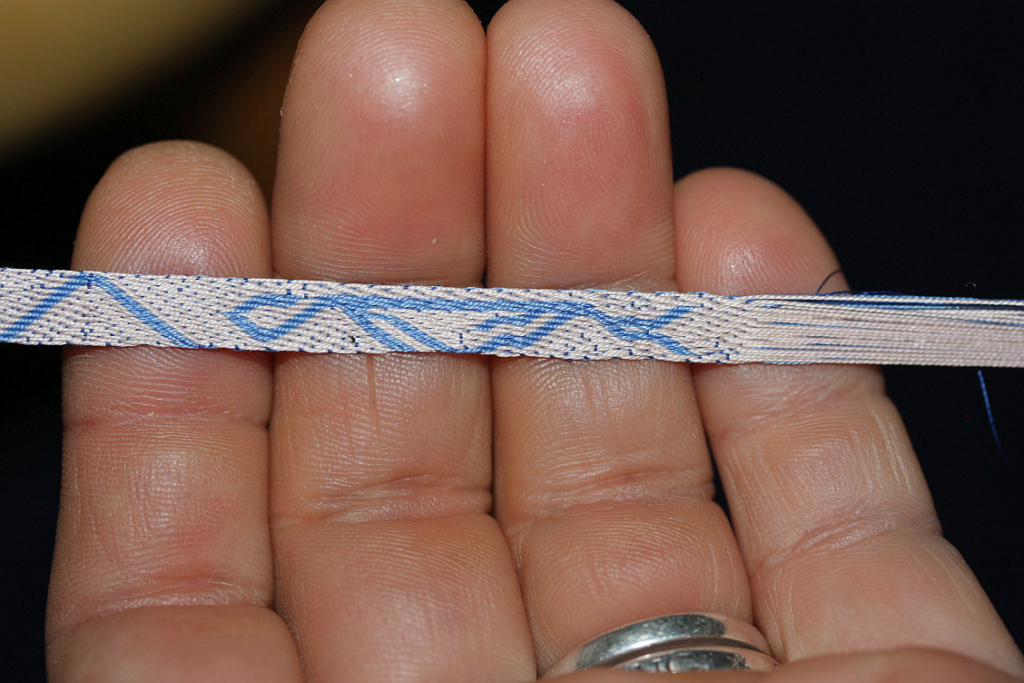
It's not looking very spectacular, and it's not a very complicated animal (which would actually be rather difficult to achive on only 12 tablets), but it is one. And I was utterly, utterly happy to have managed this...

... not because it is the most beautiful little animal that was ever woven (far from it!). But because it means that I have finally cracked that nut and figured out the system to weave patterns freehand on a twill background.

This was done without any pattern or sketch, starting from a base with all diagonals running into the same direction, using the newly-rediscovered system to change diagonal slants. It's a humble, ugly little animal that looks a bit like it is vomiting, but I'm very, very proud of it.

So... now I will progress. To more, bigger, more complex animals that might actually resemble real living beings so much that you might be able to recognise what it's supposed to be...
0
SEP.
11
2

More Tablet-Weaving Shenanigans.

I haven't progressed to the wide playband as quickly as planned - I got a little held up figuring out some more things with the narrow one, as there are (as always!) one or two little more details that need some more verification.

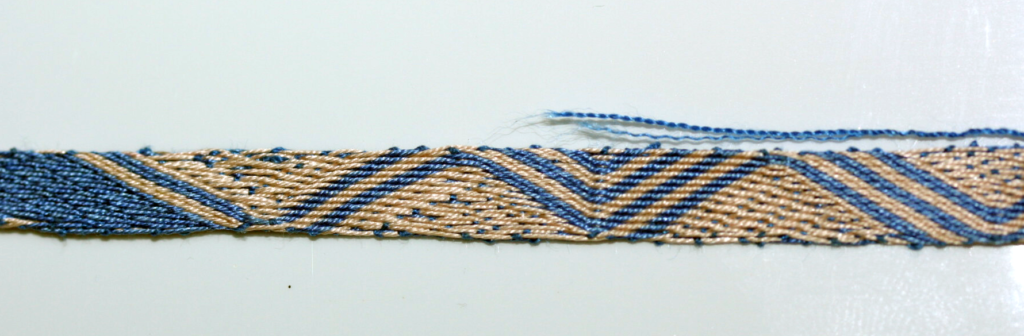
Making the direction change at the end of the pattern section, where the block of tablets turning together to form the different-coloured stripe serves as orientation, though, works very well. It also has the nice side effect of keeping appearances neater - probably because the slightly increased wonkyness of the fabric is counteracted by the firmer structure of the several-turns-in-one-direction band.

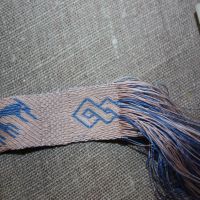
[caption id="attachment_4019" align="alignnone" width="640"] The two light triangles on the left are woven with the directional change at the start of the pattern, the ones to the right with the change at the end.


Or it was sloppier weaving on my part in the section before... or it was all the mistakes made. Hm. Whatever the reason - whether fewer mistakes or better weaving - it does look nicer now, and it is so, so much easier to work.

After figuring this out, I played around some more... and obviously I ran into some new, exciting (well, more or less exciting) problems. One of them was quickly solved, thanks to the input of the Most Patient Husband of Them All - I had accidentally done a second direction change after five picks instead of six. Odd numbers are, in this case, not a good idea, and five is right out. Aaaah. So you don't only have to tell left from right, count up to two (or multiples of two), and tell dark from light, you also have to tell odd from even.

That, though, is something I should be able to do. In fact, it's not hard at all - you just need to look at whether your shuttle is on one side or the other side of the band, and then remember that there is a "good side" and a "bad side" (which has no cookies, but horrible things in store for you) and only do direction change shenanigans when the shuttle is on the good side.

So next time I sit down at the band, there will be some Y shapes... and hopefully my current theory will work out.

Also up for getting solved? How to pour all these little rules and theories and things to know and keep track of into a format that will let others follow me when I talk about all this patterning craziness at the European Textile Forum...
0
SEP.
10
0

D'oh.

Sometimes, you puzzle over something and puzzle over it and try to find a good way to keep track of what is happening and how to count to two and keep right from left. At least that happened to me in the occasionally ongoing tablet weaving project, where I'm still trying to figure out how the weavers back then managed to weave those intricate patterns without swathes of graph paper.

So. I finally sat down once more and tried to count to two, keep track of those double-turns, start with double-turning the correct tablet, and keep left from right. Like so many times before, I was not able to do it. Again.

Short explanation of these semi-coherent ramblings: When tablet-weaving patterns on a twill base, you need to make sure your base slants in the correct direction. If your slant is wrong, the pattern comes out wonky.

This means that if you want to weave a triangle, you have to change base direction somewhere inside it, or the second side of the triangle will look really, really shitty.

There are two ways to change that slant, one more modern and one historical. The modern one is easy - you weave to the middle of your triangle (or triangular section of a larger pattern or motif), then swap the turn direction of all your tablets, done. This works, but gives you lots of float lines in the middle of the pattern.
For the historical one, you only change turn direction of every second tablet, and you do that sequentially. For this, you either let a tablet stand idle or double-turn it, and one of my problems was knowing which one to pick to start the sequence.

Sigh.

And then, suddenly, I was wondering about the rule to know which tablet to start with. Because there must have been a rule, depending on, probably, slant direction and number of tablets in the pattern part. And then I was thinking that this would mean thinking ahead and figuring out beforehand how many tablets would be involved in that pattern part... and that would mean even more counting, and more keeping track of things, so more brain work. Which is, according to my theory, something you want to avoid.

Not because I'm thinking folks back then were stupid. No, because you want to have as much brain capacity free for keeping track of the things you have to keep track of, and on making your pattern look nice and shiny. So my rule for the tablet weaving system is that everything that can be made a rule and shoved into the backbrain will be made a rule.

Such as the direction the tablets in their packs are turning (always towards each other) and the direction the stripes are running when I turn the whole pack into one direction. That does make things easy because I only need to look and I know what my base pattern slant is, for instance.

As I was wondering about these possible, yet still-unknown-to-me rules for the double-turn tablet, I suddenly thought about trying to do the direction change not at the start of the triangle... but at the end. After I have decided, spur-of-the-moment, that the thing is large enough now and I am going to close it.

Well. What can I say except "D'oh" and "why didn't I think of this much earlier". Turns out that this makes finding the tablets that need to double-turn so, so much easier - it basically reduces all the problem to "look at your tablets, check if they stand correctly, and if not, make it so". Which is totally fitting in with how I figure that a lot of the original weaving was done, and makes things much more relaxed and much more logical.

So now I'll be going for a little more practice with this stuff, first on my 12-tablet trial warp... and then on the larger, 42-tablet trial warp. Because sometimes you just need some room to play, right?
0
SEP.
07
0

Friday Funnies.

I stumbled across this snippet from an American comedian a few days ago, and a Friday is just the day to share it with you. It amused me immensely, I hope you enjoy it just as much:

Also fun, and proof that we are living in the future right now: A company is bringing out augmented reality smartglasses for cyclists to help in their training. (Similar article in German.)
0
SEP.
05
2

The Humble Pancake.

There's a few things I love, but am not really good at. One of them? Pancakes.

I like pancakes. I like them a lot. My gran always made them in her old, enameled pans, and they always turned out perfectly, not a single scrambled one. Me? Well. Mine had a tendency to stick to the bottom of the pan, getting all scrambled and ugly in the process - and driving me near crazy.

But I think now I've cracked the secret of baking pancakes... which is:

Turn the heat on high enough. (On our stove, that means 6 out of 9 in the setting. 5 is right out. Yes, really, the one works, the other... doesn't. I have not tried 7, but it might result in too-dark undersides of the pancake.) Have a bit of fat in the pan, though it's not necessary to have the whole pancake-thing swim in it. Make the batter rather liquid, and don't pour too much at once. And then be patient for long enough.

The batter goes into the heated pan, and then I tilt the pan so there's no heap in the middle, but the thing gets a more or less even thickness. And then the next bit of the secret is to wait long enough for the top to solidify slightly and for the bottom to become done and slightly crusty - then it will become unstuck all by itself. All that remains to do is gently unstick the edges all around, then flip it to give it a little bit of quality baking time on the other side.

I finally figured this out, and I'm really happy about it. Proper pancakes! No more impromptu pan cleaning while making food! No half-done scrambled thingies! (Well, they still were nice to eat, but not, you know, pancakes.) So... achievement unlocked. Now I can go to the next stage: find the perfect recipe...
0
SEP.
04
0

Even more links.

Here's a short article about the earliest plant fibre technology: Splicing (not spinning). One of the many techniques that I still haven't found time to get into deeply. It's on my list, though. Very much.

If you're interested in embroideries, there's a new(ish) German book out: Christiane Elster: Die Textilen Geschenke Papst Bonifaz' VIII. (1294-1303) an die Kathedrale von Anagni. Päpstliche Paramente des späten Mittelalters als Medien der Repräsentation, Gaben und Erinnerungsträger. Petersberg : Michael Imhof Verlag, 2018. And here on Paroles d'Arts you can find a French review about the book, including some images so you can get an idea.

A very modern type of clothing - like out of a sci-fi book - is being developed: Clothing that extracts oxygen from water to let you breathe. It's not efficient enough yet to provide a human with the necessary oxygen, but I'm totally floored that this is possible at all!

Now for a bit of archaeology - a game board on stone that might be a clue to the spot where a monastery once existed.

Some more archaeology shows that cheese-making is a very old thing, and cheeses may have been connected to social status - and may have been a step in promoting the freaky gene that lets European adults produce lactase.

And some conservation issues, though rather modern ones: Plastics have become a part of our history, and they start degrading in bulk now, so conservators are struggling to keep that part of human cultural history intact.

 
0
SEP.
03
0

Season's Delights, part four.

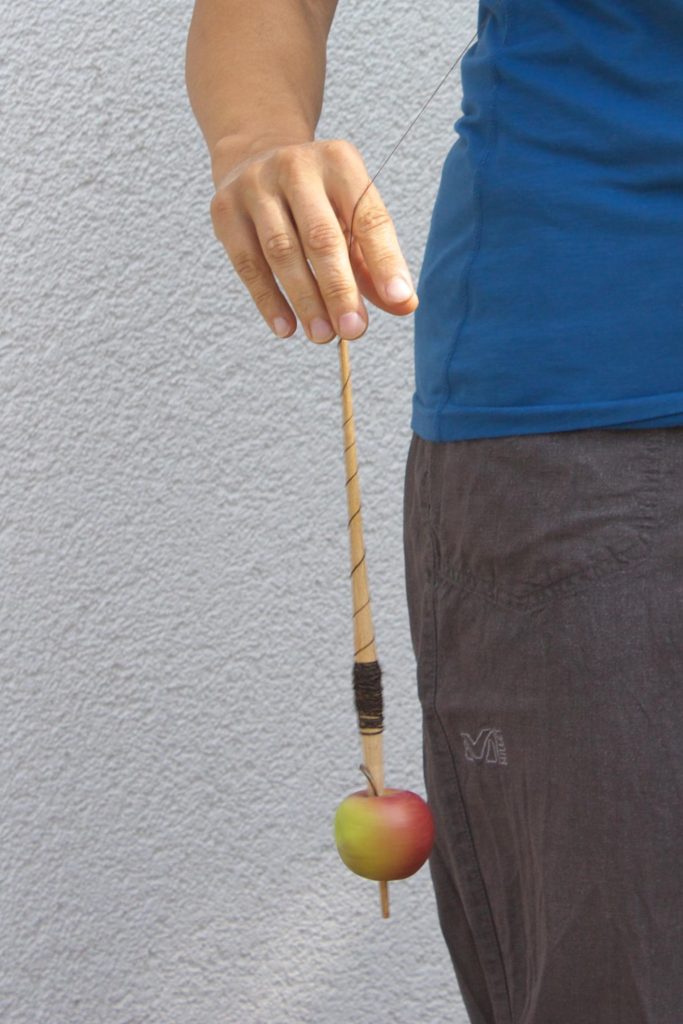
More apples. Well, to be precise: One apple.

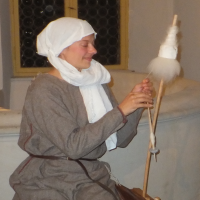
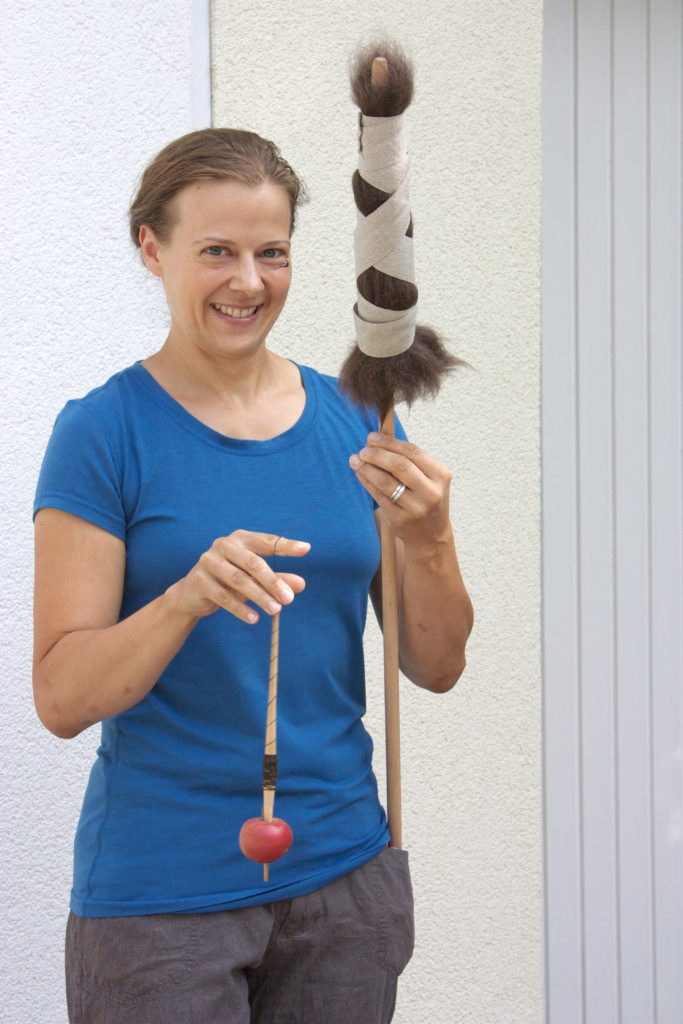
Remember the post about choosing whorl weights a few days ago? You can now also find that post on my main page, both in English and in German, as part of the spinning info material. And because things are always nicer when there are a few pictures to go with them, I asked one of the best neighbours of all time if she would take some photos... of me spinning.

With an apple on the spindle stick.


One apple to make the spindle weigh 50 grams. It spun nicely, even though it was a tiny bit lopsided, and actually a little heavier than I would have felt was necessary, but it was still no problem to spin my usual thickness with it.

Also... fun was had while doing it. Much fun. And if the spindle is too heavy, you could always make it lighter by carefully nibbling your way around the whorl!

0

By accepting you will be accessing a service provided by a third-party external to https://www.pallia.net/

Kontakt