
Latest Comments

Guest - Aislinn Dyestuff Citizen Science.
09. Oktober 2026
This is a great project. I look forward to the results. Thanks for letting us know.
Guest - Aislinn Time for...
09. Oktober 2026
Looks delicious!
Guest - Katrin Sprang Discussion
18. September 2026
Hi Rachel, I have looked for more photos of you, but that was not very successful. I found a link on...
Guest - Beatrix Sprang Discussion
15. September 2026
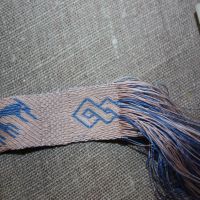
That lozenge pattern element is not a photograph, but a scan. So it should be to scale. But I pinned...
Guest - Katrin Sprang Discussion
15. September 2026
I was not referring to Rachel's reconstruction (is the reconstruction you refer to the one photograp...
JULI
06
0

It's too damn hot.

We're still in full-on heatwave mode here, and though there are a few clouds in the sky, it remains brightly (and hotly) sunny. Well, at least this year nobody can complain about a nasty, cold grey summer!

In spite of the weekend's heat, we managed to have fun at a wedding party, relax, and get a new (and larger) rainwater tank installed at the back of the house. Now if it should rain, we'll get all the water that lands on half of the roof of the house (it's a saddle roof, so naturally you only get half the roof with one tank). I'm very excited to see how much water will come through into the tank from one "normal" rain. (I could do some maths and estimate how many square metres the roof has, and calculate from there, but... it's too damn hot for maths.)

I also spent some time during the weekend on website updating work*. You don't see anything of that yet, though - I have managed to clone the online shop to my local system, where it's now happily running on an installation of XAMPP. Installing that was the easiest part, though! It took a few tries and thus quite a bit of time to get everything running...

The first issues were with getting the backup extension for Joomla! to run. Akeeba backup and my hoster have sort of a strained relationship, it seems. After a while, that did work; so then I got to figure out how to get the copy to run locally. And then... several tries of updating from Joomla 2.5.x to 3.x. There's a number of steps that has to be taken in the correct sequence, and in the end I had to manually unpack the update package into the root directory and run the database fix. Main problem seems to have been template issues... but now it seems like it's running.

So I'm currently updating the shop system on the local copy, and then I will have to find a nice template for the new site. It will probably take a few months before I'm ready for the relaunch, but at least the most important step is done now - getting the upgrade to Joomla 3.x to work.


* I'm a firm believer in "never change a running system" and "if it ain't broken, don't fix it". Case in point? My graphics programme is 19 years old. But that's an old programme that works, and there are no internet security issues connected to it. In case of my website, support for Joomla 2.5 is running out, and that will in time leave the website open to attacks. And make it become more and more outdated, so... nothing left but to embrace the change. At least it's a nice reason to finally tackle the website and get it up to date again!
0
JULI
03
0

Sunny Friday.

It's getting hotter and hotter outside; too hot to think or to do a lot of stuff. Even the cat prefers being inside today, out of the sun and heat.

In fact, she prefers lying on my arms. As I sit at the desk, trying to work. If she weren't so cuddly and cute as she's curling up between the computer and myself, with her one paw on my one forearm and her shoulder and head on the other... it's not conducive to good and typo-free typing, though. Especially not when her paw is on the touchpad, doing things with the cursor it's not supposed to do.

Thank goodness it's Friday, though, and there's an end of the week's work in sight. On the list for today, among other things: Looking at pictures from 12th and 13th century German manuscripts, preferably pictures that show peasants. The image database at the British Library is my friend for this, for now.

Searching takes time, though. Especially if you want to make sure you get as complete a picture as possible - because then you can't narrow down the search terms too much. After all, the search terms only find the things other people have identified and tagged as such a thing.

This means you might find mis-labeled items and miss a lot of unlabeled ones. So I learned a long time ago that if you want to have the bigger picture, or a proper overview, nothing beats using a very general search term and then just going through every single entry in the massive list of hits. Yes, it is a nuisance, but I have hit a lot of paydirt with this method.

So, even though I cannot search for "peasant" and get all the things I want to find, advanced search is still really, really helpful. I'm narrowing down place and time, and then I look at the pictures. Which is a nice task for a hot Friday afternoon...


0
JULI
02
0

So many things.

Today's blog is late, and it will be short, because much of the time that has passed until now has been spent on getting things ready for the blogtour Gillian and I have planned. There will be exciting things to announce very soon!

In other news, I've found out that it might be a good idea to do a little update to my shop system, so I'm looking into this. (Which includes making a site backup and the usual other stuff...) I'm also drinking tea, because that is always a good thing, and planning two presentations, one due very soon and one due in August, when I will travel to Berlin to give it - I'm already very much looking forward to that!

To make up for post shortage: gratuitous cat pic for you.


That's not her friendliest expression - she's probably thinking hard about something...
0
JULI
01
0

Someone is always bound to notice.

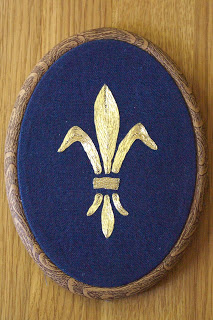
Yesterday, I posted the picture of the finished fleur-de-lis embroidery on Facebook - and promptly got a reply that the form of the fleur is not corresponding to the typical medieval form.

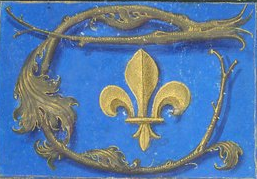
The side petals on the historic versions are much wider, much more curved, and they go out more to the sides. Does that explanation even make sense? Here, let me show you:


British Library Royal 16 F II, f. 137, detail.
Netherlands, around 1500. 


This should make it pretty clear what the differences are. If you search the British Library database for fleur de lis, you'll get some more hits, some of them shapes that are very far from what a modern eye would expect.

So why have I opted for something so different? Part of the differences are due to the medium. The motif is much clearer if you have gaps inbetween the individual petals, as my first tries did show - so running the individual parts together as in the 1500s version would not work just as well. Partly the decision is also due to the shape of the frame - a taller, more slender version fits better with the oval frame shape than the more squat version.

Finally, my personal experience is that motifs with the pronounced changes between slender and fat (as in the leaves of the medieval version) are harder to embroider for a beginner than shapes with only gentle changes in thickness.

The whole embroidery kit is a hybrid of medieval and modern things. Gold thread and silk thread? Medieval. Basic technique? Medieval. However, a medieval gold embroidery on linen fabric would usually cover all the ground fabric, not only a little bit of it - so having the ground fabric dyed blue with indigo, and only embroidering the lily, is a compromise as well (because embroidering everything with blue silk... that's lots of work, and quite a bit of material too).

The frame itself, with its rubber rim and plastic inner rim, and its oval shape, and the hanger so it can serve as a picture frame is very, very modern as well. So are the needles that I will supply with the kit.

It's a hybrid, a compromise to offer a chance to do gold embroidery without investing insane amounts of time and money in trying it. A compromise between appealing to today's embroiderers and offering the experience of working with historically correct materials. A compromise that results in a piece with a lot of decorative value without the need to mount it into a proper frame first.

I've put a lot of thought into this, and I hope that it will turn out to be a good compromise. Let me know what you think, please?
0
JUNI
30
3

Things are coming together.

There's a couple of things running in the background that are finally coming together - I will be getting different kinds of needles in addition to the ones already in the shop, sort-of-soonish (these things tend to take a while). Other things are in the pipeline, but not in a stage where I can blog about it - yet. But I'm having hopes to post exciting new things here this autumn.

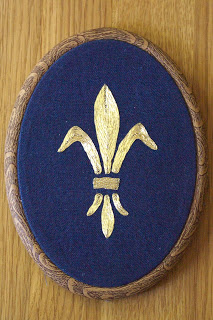
Also scheduled for this autumn, but something that I can already blog about: The Fleur de Lis Gold Embroidery Kit. Here's the finished prototype, finally:

It does look much nicer in real life.

I did the last stitches yesterday in the evening, when the light was already dimming down, but it was still rather light. That minimises the sparkle of the gold thread, which makes the work hard to see.

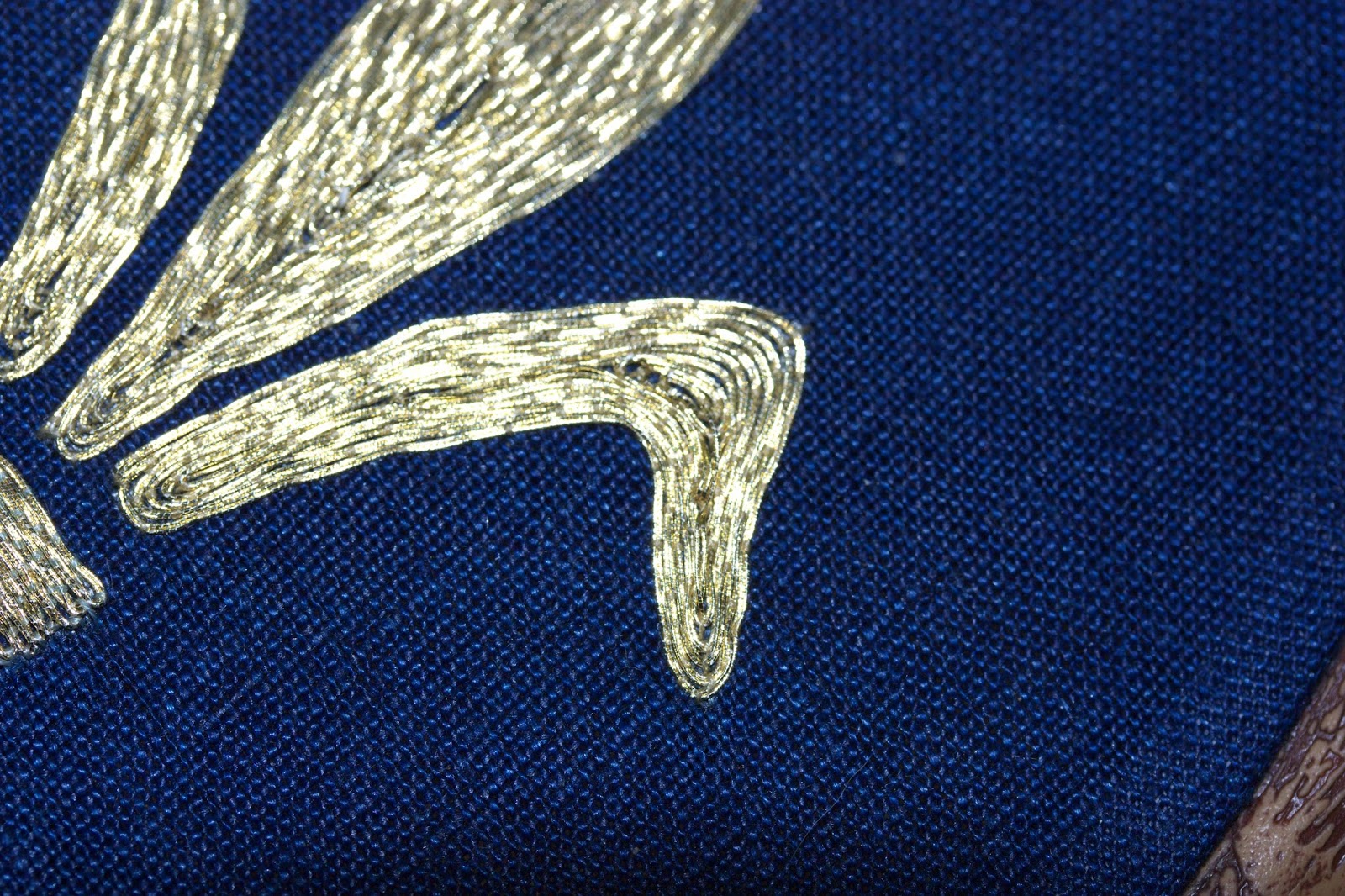
Speaking of hard - gold embroidery is really, really hard to photograph. Especially if you are in kind of a hurry, which I was this morning (and that usually leads to a bad photo day). The trick is to take the picture with underexposure, and with no direct light to avoid any sparkles. Then it can still be tricky to get the thing in proper focus, as the autofocus often has trouble with the sparkly bits; or to get the exposure right because of strong contrasts between the gold and the dark background.

So you're not getting the world's best piccies of the finished prototype yet, but I had the strong urge to share with you. Including these bad closeups:


This, by the way, is how it looks if you take a picture with flash:


Hint: Flash is not helpful...

I had such a bad photo day that I even botched the pictures of the back of the embroidery, which technically should be no problem to take a picture of. So you're getting only this bad detail shot this time (you know, because of the law).


I'm really happy to have this finished, though. The template stencil for the final version is done as well, and looks very much like the prototype here, with only a few tiny changes. The fabric for the final version is off to be dyed already, and as soon as it arrives back here, I'll cut it into pieces... and then I will gild the lily once again, a third and final time, taking photos of the individual steps for the instruction booklet.

(And those photos? I'll take them in a softbox, with the camera on a stand, and with plenty of time planned for that shoot...)
0
JUNI
29
1

Archaeology News.

There's been a Bronze Age find, with residues of food (which is really, really special) in Cambridgeshire.

In sadder news, the C14 lab closest to my home, situated in the Physics Institute Erlangen, is closing down this summer, after twenty years. They don't say why they will close down, but Mathias' blog Schauhuette hints that it's due to budget cuts.

Finally, though a little older news already: The remains of a medieval knight whose skeleton shows damage consistent with jousting injuries.
0
JUNI
26
1

And that's why you need maths.

When I was starting to study archaeology, I was happy to leave some of my less favourite school subjects behind me. Those included chemistry and maths.

One of my companion subjects with archaeology was heritage conservation, though, and that included "Bauforschung" - documentation and analysis of historical buildings. For that, one of the things you do is draw an accurate plan of floors, walls, and so on. Which means you will need to measure. Everything.

And then... there was this complex process of taking the distances and the angles you had measured, along your main lines or around the outside of the building, and calculate whether your measurements were accurate enough or not. It included things like sinus and cosinus and tangens, and when the prof explained it, you could hear half the room go "aaaaooouuugh". There I was, thinking I'd happily escaped those numbers and calculations... until said day.

Guess what I needed these days? More of those old and slightly dusty maths skills, especially that stuff about angles. So much of maths skills, unfortunately, that I also needed the assistance of the Most Patient Husband of Them All, who graciously agreed to help me tackle a complex formula to calculate the typical spinning angles of industrially-spun warp yarns from wool. (To my great delight, my calculations were not completely wrong. In fact, all I had not done was an additional, and not-really-obvious step to transform kilometres into metres. That step was so non-obvious that it also took my husband a while to track down the cause of the impossible result and figure out why it had happened.)

Oh, and the result of that formula-cracking? Warp yarn angles run between about 14.7° and 17.1° - while medieval yarns usually are above 30°, and very frequently at about 40°. No wonder modern spinners tend to spin soft stuff, it's the only thing we are used to!


0

By accepting you will be accessing a service provided by a third-party external to https://www.pallia.net/

Kontakt