Latest Comments

Guest - Aislinn Dyestuff Citizen Science.
09. Oktober 2026
This is a great project. I look forward to the results. Thanks for letting us know.
Guest - Aislinn Time for...
09. Oktober 2026
Looks delicious!
Guest - Katrin Sprang Discussion
18. September 2026
Hi Rachel, I have looked for more photos of you, but that was not very successful. I found a link on...
Guest - Beatrix Sprang Discussion
15. September 2026
That lozenge pattern element is not a photograph, but a scan. So it should be to scale. But I pinned...
Guest - Katrin Sprang Discussion
15. September 2026
I was not referring to Rachel's reconstruction (is the reconstruction you refer to the one photograp...
MAI
27
0

Looking for manuscripts?

If you are researching sources, be it written or image sources, on the internet or in real physical publications, you will have run into the how-to-find-stuff problem: There is a bunch of things very easy to find, as they are quite prominent. So everybody finds them, and everybody knows them.

Then, of course, these things get cited, and linked to, and re-published, which makes them even easier to find. The books less looked at, the sites less often linked to? Not so visible. Or, as digitizedmedievalmanuscripts.org puts it:

Finding digitized medieval manuscripts is not an easy task: the most prominent libraries are easily found and pinpointed on the maps. Problems arise for all the other digitized libraries that are not discoverable through search engines for many reasons (the website is not optimized or not accessible by crawlers and doesn't appear on web searches, the library is in a language different from English only, or, more in general, the website is difficult to access due to poor web design).
That, of course, is not only true for manuscripts, but DMMapp collects digitised medieval manuscript libraries. There's a long list of libraries that have manuscripts digitised and online, for free - so if you are looking for some things less often looked at... look no further. (Or do, and make sure to tell them about the library if it's not yet in the list.)
0
MAI
26
3

Coffee!

A while ago, I was presented with a little coffee cup filled with coffee beans. Except that the beans were not roasted, and someone had dropped them into some soil inside a little flowerpot inside that coffee cup, and poured some water over all that, and watered them again and again and... the result were a couple of small coffee plant sprouts.

The largest one, meanwhile, has grown to look like this:


Some day, the Internet tells me, this thing might actually bloom and have coffee cherries later on. It also tells me that this will probably take another three or so years... well. I think I'll just go on buying coffee in the meantime, and I won't hold my breath for home-grown! It makes a nice plant, though. Not as decorative (yet) as the Ecuador Purple Chili:


but then purple chili fruit is really hard to beat, decorativeness-wise.

Final fun fact about coffee: The plant belongs to the same plant family as madder... does that explain why plant dyers love their coffee?
0
MAI
22
0

Thank goodness it's Friday.

How nice that it's Friday again! And even better, it's the Friday before a long weekend, since it's a public holiday on Monday here in good ol' Germany. (That also means there will be no blog post for you on Monday.)

Even though the last long weekend wasn't so long ago, I am very much looking forward to this one. There are tomatoes that need to be set out into the garden, I have beans that should be planted, and we're planning to go on a paddle with friends this weekend as well - so there will be plenty of nice activity for us. And maybe I'll even finish the gold embroidery prototype that I am still working on, as there's not much left to do.

First, though, there's less pleasant work lined up for the afternoon: filing invoices and taking care of tax paperwork...


0
MAI
21
0

Garden photos.

It's sunny outside, warming the water in which a sheep fleece is soaking. It's wool-washing season again!

And it is a joy to be outside in that beautiful weather (although wool washing season also means that I am waiting for a good, heavy rain to re-fill my water supply). Plus the view is nice - it's one of my favourite times of the year for looking at our living willow fence: the time when it's all lush and green, but it is still possible to see a bit of its structure through the leaves.


The peach tree that we planted on an espalier last year has actually bloomed this spring, and now it has three or four tiny fruits. I hope they will hang on there until they are nice and big and ripe!
0
MAI
20
0

Eating is a social thing.

It has been a long while since I posted about my food issues, but I was made painfully aware of them again during the last (long) weekend. As is traditional for me, I spent a few days hanging out with friends that I see once a year to share these days for our common hobby: doing bookbinding work.
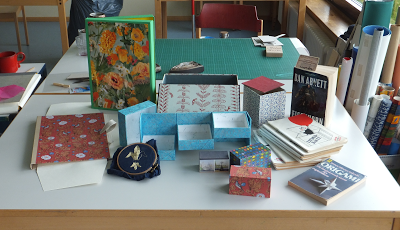
What I did last weekend - repaired books and brand-new boxes and folders. And some gold embroidery :)

This was the first time I stayed at a youth hostel since developing (or, more correctly, since becoming aware of) my food intolerance issues. So, as a good guest does, I handed in the shortlist of things I cannot eat well beforehand... and hoped for the best. (There's a shortlist and a complete list of things. The shortlist is the really important stuff, the complete list also contains things I can eat occasionally, but try to avoid.)

It was not a very nice experience. First of all, some of the information seems to have gotten lost between admin and the kitchen, leading to an awkward situation admirably solved by the cook.  Secondly, the foods that were available to me often were the kind that I consider borderline acceptable: industrially made and thus laced with conserving agents, modified starches, glucose syrup and other things I try to avoid. Under normal circumstances, I will eat these occasionally, for example if there is no other choice or if I really want to, but not on a daily basis or several times a day. Thirdly, there was a lack of salads or vegetables in general, which was cutting down my options of avoiding the borderline foods.

I could feel all this in sinking energy levels, a dip in my general happiness, a craving for fresh foods and some other symptoms that clearly showed me I was not eathing things that are good for me. All that is not nice - but the worst thing, and what caused me most stress in retrospective, was having to ask for my food.

Now, in a youth hostel setting, there is usually a buffet style setup. You get your plate and cutlery and help yourself to whatever you would like, in whatever amounts. For vegetarians, or for those with intolerances or allergies, there's clearly labeled food on the buffet, and you are supposed to eat what you were booked for and not plunder the food of the special needs folks. Sometimes, when there is only a single person having a special serving and lots of other people, your serving might not be out on the buffet but brought out when you come, or when you ask for it, eliminating the danger of someone else consuming the special stuff.

That is all very understandable. However, when that means that
a) you do not know whether there is anything special for you or not, and you have to ask the serving people if the normal food is okay for you, and they look at you in a confused sort of way and have to go ask the head cook, and
b) you tell them you need to avoid wheat, but they consistently refer to you as needing gluten-free, or ask you if you have booked gluten-free diet (which I had not), and  get confused if you tell them that gluten-free will work for you but you have stated wheat-free and not gluten-free when booking, and
c) serving people are not always available and you may need to wait, or shout for them, to get an explanation of whether you can eat the stuff available or not, and then wait for your special-snowflake-food or get in line with all the others -
well. It made me feel difficult, and cranky, even though the kitchen people did try their best to help (but were stunningly under-informed). It also let me end up with meals that were not very satisfying, regarding taste, composition, and amount. I could probably have asked for more this or more that, but I did not want to go and wait (or holler) and ask again.

Worst of it all, though, having to state my special needs almost every single meal made me painfully aware of the intolerances instead of letting me handle them matter-of-factly, as I usually do. That will make anyone feel like the odd one out, and rather sick instead of healthy. It was not a nice experience. At all.

So in case you ever need to cater to someone with food intolerances? Try to make things easy for us.
Sharing food is a very social thing, so getting special servings sets you apart from the group. This may be necessary due to the dietary restrictions, and we do very much appreciate getting food that we know will be safe to eat, but getting different things all the time will, over time, do things to your soul. If the special serving is handled efficiently and matter-of-factly, it is not so bad, but every little issue on top of getting something different from the others - having to ask, having to explain, having to wait, even having different plates - will add up to emphasise that we are not part of the group in this respect. Eating is a social thing, and sharing food is a powerful symbol of belonging together. So being set apart continuously is also a powerful sign - of not really belonging.

We're feeling the odd one out or left out often enough - there are so many foods and snacks and things you cannot eat if you cannot eat wheat, for example. In a setting where a group is catered for, anything that makes us feel like our requirements are easy to meet will help. We approach foods prepared by others with a good dash of insecurity about what is in them and whether we will be able to have them or not, so labeling foods to indicate they are clear for us to eat will be a huge relief. Kitchen staff who know about our needs and do not have to run and enquire first help, too (though it's preferable that they run and enquire to serving food they don't know about). The more normal you make us feel, the easier things are for us, and the more pleasure we will have from eating in the group. The optimum would be, of course, to have foods for everybody that we can eat, and to communicate clearly that this is the case (without us having to ask). Reassure us that we can have more (if we can have more). Tell us how you have booked our needs if you decide to let wheat-free run as gluten-free (perfectly okay with me if that is easier for the kitchen, but I need to know what to ask for). Don't make us ask every time for every single thing... because that makes us aware, again, of how much we are the odd person out.
0
MAI
19
0

Planning for the Autumn.

One of the things I have learned in the last year-and-a-half is that I am having a lot of fun going to fairs. Not just medieval fairs, but actual trade fairs. LonCon was the first one that was not a medieval or historically themed event, and our time in the dealer's hall was pure, pure fun. (Chatting with Robert Silverberg about old scissors. Packing a bag for Ben Bova. Getting a ninja gig from Talis Kimberley. Those were grand times, and make grand memories for me.)

Then came the Kreativ in Stuttgart, and Backnang. And now I'm looking forward, very much, to the next fair: the Nadelkunst at Schloß Weikersheim.


I will be there with Sabine from the Wollschmiede - and I'm already excited about the event, even though it is still several months until October. But I've been told that the premises are beautiful, we will get to stay with friends (that I see far too rarely) who live very close to the castle, and the organisation team is very nice and extremely helpful.
The best thing, though? The first item in the requirements sheet for participants is "no sale of items from industrial mass production". There you go. That alone, I am sure, makes this event very much worth going to.

I'll be there - come and see me!
0
MAI
18
0

EU VAT madness ramblings, part II.

(To go to part one, click here.)

There's still more things in that EU memo that make me scared, or sound weird, or plain unfeasible, so I'm not done rambling. Here's the next bit:

Why does the Strategy include measures on parcel delivery?

Today only 15% of consumers shop online from another EU country – which is not surprising, if the delivery charge ends up being higher than the actual price of the product. The measures to be taken will address frequent complaints by e-retailers and consumers concerning a lack of transparency (what are the available delivery options and conditions?); the excessive costs of shipments (especially of small parcels sent by SMEs); the lack of interoperability between the different operators typically involved in a cross-border shipment (resulting in the absence of affordable track-and-trace solutions); the lack of convenience for the final consumer (not being offered last-mile delivery or convenient return options). These issues have already been identified in a Green Paper in 2012, followed up by a Roadmap in December 2013. The postal operators have committed themselves to introduce a number of improvements in the area of quality of services (e.g. track-and-trace services for small parcels sent across borders, easy return procedures, etc). The focus of the future EU measures on parcels is, however, on problems not addressed by the postal industry's own commitments initiative. This includes excessive prices and insufficient regulatory oversight. The Commission is today launching a public consultation to collect views from all the interested parties on the main issues and possible areas for improvement.

I have two bits to say about this. First of all, how are "customers" defined? Anybody who is already buying things? That would include the five-year-old who is going to the bakery to get a piece of cake. Small wonder, then, that the figure seems so low. But is it? And is it that bad, being so low?
There will always be people who do not shop across borders, due to language barriers, not enough internet access, or, yes, because they think shipping costs are too high. I have often not bought something small somewhere online because of high shipping costs - but that applies to German shops as much as to non-German ones.
However, let us not forget that many of these 85% of customers might not shop internationally due to the plain fact that they do not have the need to shop in another country. Because they can get everything they want or need inside their own. And that is perfectly, perfectly fine! Or what happened to "think global, buy local"?

Now for the second bit. Shipping, for a small supplier, is a pain on several accounts. Especially if you have a range of goods with very different shapes, and sizes, and do not ship a load of stuff every week, but do ship to a number of countries plus domestically.

You have to check weights and sizes for pricing, and have to get suitable boxes to ship with. Being in Germany, you also have to register and pay for any new packaging you are going to send out, because it might end up in the Dual System (a recycling system) and you have to pay processing costs for your things. That's all nice and fine theoretically - but for a very small supplier it means registering for a minimum amount of packages, and paying for them, that you will never ever reach. If I ship out paper and carton, inside of Germany (because that only counts for domestic shipping), of about 7 kg per year, but I have to register and pay for shipping up to 200 kg of paper - well, go do the maths yourselves. It's weird.

Then figuring out shipping costs. Yes, it is true that generally, shipping outside your own country will cost significantly more than shipping domestically. Yes, large companies have such a high shipping volume that they can cut special deals with the shipping companies and thus can offer lower prices for shipping, or free shipping. So for your shipping pricing, you have to calculate the cost of the packaging including cost of labels, cost of the shipping itself, plus the time required to do the related logistics (such as filling out customs forms), and the logistics of getting it to the post office. (If that sounds nitpicky and mean, let me tell you that it does add up, and all of these things get easier, faster and cheaper again if you do it often and in bulk.) There are instances where your set shipping price will be a bit above your actual costs, but there are also instances where you pay more for shipping than expected, and the fee you charged does just cover the shipping cost itself, or not even that, and unless you wish to calculate a gazillion shipping cost options and present your customers with a huge list of possible prices... you're stuck with that.

Why is action needed specifically on pricing? Will you regulate prices?

Recent studies confirm that the cost of delivery is still an obstacle to shopping cross-border. Shipping costs is the most common reason (57%) in Europe for not completing an online purchase. 62% of companies that are willing to sell online say that too high delivery costs are a problem (see the newly released Eurobarometer on e-commerce).Tariffs for cross-border small parcel delivery charged by postal operators are often two to five times higher than domestic prices. An example? It costs €32.40 to send a 2kg parcel from Belgium to Austria – over five times the price of €6.40 within Belgium. From Austria to Belgium it costs €14.40 – over three times the price of €4.50 within Austria. Competition appears to be the most appropriate and effective way of addressing today's concerns in terms of affordability. However, for such competition to unfold in a fair and efficient manner, all market participants – retailers, delivery operators as well as consumers – need to enjoy a certain degree of price transparency. Price regulation is only a means of last resort, where competition does not bring satisfactory results, and is not considered at this stage. Close monitoring is essential in order to identify and address any market failures. The situation will be reviewed after two years.

Yes, it can cost an arm and a leg to ship stuff outside Germany. Weirdly, however, I have also had circumstances where shipping the exact same order to Australia, or to England, or to Sweden did cost me less money for the postage than shipping it domestically. What about that? Will you force the German Post to stop offering these cheap international shipping possibilities, to level the playing field? Please don't. As with so many other things, yes, it's not a good thing that we have so many different fees and different structures and different rules - but by imposing even more rules in the hope of making things better, I'm afraid that we will end up being worse off.

Shipping cost calculation, for small companies, will remain a pain. It's just due to the nature of the thing, because there will always be different prices and sizes and weights for the shipment ranges - and they are necessary. How are you going to get "price transparency" across borders when shipping prices inside a country are already so diverse that there are calculating tools to help you get the best possible deal for your shipping? That sounds like a pipe dream to me.
0

By accepting you will be accessing a service provided by a third-party external to https://www.pallia.net/

Kontakt