
Latest Comments

Guest - Aislinn Dyestuff Citizen Science.
09. Oktober 2026
This is a great project. I look forward to the results. Thanks for letting us know.
Guest - Aislinn Time for...
09. Oktober 2026
Looks delicious!
Guest - Katrin Sprang Discussion
18. September 2026
Hi Rachel, I have looked for more photos of you, but that was not very successful. I found a link on...
Guest - Beatrix Sprang Discussion
15. September 2026
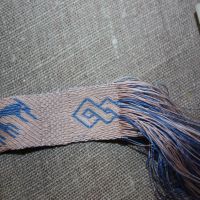
That lozenge pattern element is not a photograph, but a scan. So it should be to scale. But I pinned...
Guest - Katrin Sprang Discussion
15. September 2026
I was not referring to Rachel's reconstruction (is the reconstruction you refer to the one photograp...
MAI
15
0

EU VAT - the madness goes on. (part I)

 It's been quite a while since I posted about the EU VAT madness... and things are developing.

There is, thank goodness, talk about a threshold or maybe even an exemption for small businesses regarding the VATMOSS registration, as hinted at in a recent PR paper from the European Union.

It says there are plans for
Introducing a common EU-wide simplification measure - VAT threshold - to help small start-up e-commerce businesses.

However, right above that it also says
Extending the current single electronic registration and payment mechanism to cross-border online sales of physical goods.
 People. Please. There's been issue after issue after issue with the Digital VAT rules, and lots and lots of small businesses are suffering. I have stopped selling my pdf knitting pattern and have scrapped plans to offer more pdf instructions or patterns in the future - even though there are lots of customers who would prefer a pdf pattern and will not buy the physical version, and offering printed patterns (if you want to do that in an appropriately high quality) means a significant expense, and a need for storage space, and more logistics in getting it to the customer.

There are a few points in that memo that make me scared silly for my future as a small business entrepreneur. This one, for example:

How will the Commission make e-commerce easier?

The Commission will put forward clear contractual rules for online sales of both physical goods like shoes or furniture and digital content, like e-books or apps. It will fill in the existing legislative gap at EU level regarding digital content and will harmonise a key set of rules for physical goods. This will create a level-playing field for businesses, allow them to take full advantage of the Digital Single Market and sell with confidence across borders. At the same time, it will boost consumer trust in online purchases. Consumers will have even more solid and effective rights. For example, if the e-book you just bought is defective, it will be easier for you to obtain a remedy against the trader. Europeans will be able to shop in other EU countries as easily as in their home countries and get the best products at the best price.
I get a twitch when I read "level playing field". Oh you people making up these plans, please be aware that the level you will most easily achieve is that where all the small businesses give up.

I can tell you, from my own experience of having a small business based in Germany that there are already so many rules and regulations to follow, I'm glad if I manage to keep up with all the changes. And I'm one of the people trying hard to do so! I know a good number of colleagues in similar small businesses who do not know about many of the rules, and just ignore them, or have heard about them and still ignore them, hoping for the best. Because trying to conform to them would break their backs with bureaucracy, or would mean hiring help that would cost so much that all their profit goes into conforming with rules. Many of these rules are just stupid, too. Case in point? A while ago, it became obligatory to exchange the text on your "buy now" button in the online shop from "kaufen" (buy) or something similar to things like "zahlungspflichtig bestellen" (order with an obligation to pay). If you don't do that, technically your customer can renege the contract because it is not considered valid. Or some law sharks can serve notice and fine you because you do not conform to law.
When I learned about contracts for buying and selling in school, I got taught that the agreement between two parties is sufficient. How is "buy now" less of an agreement than "order with the obligation to pay"? (I'm waiting for the day when something similar will be required for buying a bread roll from your baker, or a sausage from your butcher. How about a little ritualistic dance after ordering, before paying, such as twirling around your own axis three times, then stomping your right foot thrice while declaring in a sing-song voice "Yes, I spend my money now, yes I buy I buy I buy, here you go, I do declare!" I think that would match the ridiculousness nicely.)

For textile stuff, there are things like a special law on how to mark your skeins of yarn that you sell. Which means, as my dyeing friend tells me, that sometimes you are not allowed to give your customer all the information they might want to have because you may only declare things in this or that way, and if you want to tell them the additional info that might be crucial to them, you have to hide it in the name of the yarn, or tell them (knowing that anything just told, not written on the band, will be forgotten soon).

Then there's so many grey areas, and things where someone tells you one thing and the next guy (professional, mind you!) tells you another one. A few years ago I actually shelled out money for counseling by a lawyer, who instructed me in how I could file the allowance money for any days spent travelling due to job reasons. (There are quite a few days per year for me.) I did that - and received my tax statement back with the allowances cancelled and the explanation that this was not an available option for me. So who was right? The lawyer, specialising in that field? Or the state official who was filing my taxes? And would it have been worth it to contact the lawyer again, and the tax official, to find out who was really right, spending more time (and possibly money) on the issue? (I didn't. I just accepted that and stopped filing allowances.)

And that's just three tiny bits of the current situation, from personal experience or immediate contacts. Don't even get me started on the vaguenesses that you will encounter in book-keeping. (Is it "Werbekosten" or "sonstige Ausgaben"? Is it "computer hardware" or "office supplies"?)

So. Will these "clear contractual rules" REPLACE all the rules that we have now? Is that even possible, for so many countries, so many different structures? Or will I have to keep up with an additional set of rules, themselves as complicated as the domestic rules? There is a point where keeping up with all that stuff is nigh impossible for a single person. This point has already been reached for Germany - if anything more is added, there will be even less compliance. Not because we don't care, or we don't try, but because we just cannot keep up.

There's more, though. Continued in part II.
0
MAI
14
1

Lovely Linkfest.

There is a stack of links to things you might find interesting again - time to clear out those browser tabs and send you careening through the internet!

First of all, Cathy writes about Greek sprang hairnets.

Erik Kwakkel writes about rare medieval name tags - from foundlings.

Neil Gaiman was interviewed about reading by Reading Rainbow, and talks about comfort reading (among other things).

An Anglo-Saxon recipe for an antibiotic has tested succesfully against a modern resistant bacterial strain - the Independent has an article about this (though I wouldn't call the recipe revolting, as they do).
0
MAI
13
0

Sounds from the Middle Ages.

We are so far removed from the Middle Ages that there are very, very few sensory things left that we can still experience in the knowledge that people in the twelfth century would have had the same experience. We can try to recreate recipes, for instance, but we will never know if a medieval cook would have seasoned something to the same taste... and even deeper than that, many of the foods available today have changed a lot through breeding, so in some cases it has become impossible to use a similar basis for the cooking itself already.

There are some things that have remained much the same, and we can still experience them. Wood fires are an example of this - wood will burn just like it did in 1140, and if it's dry it burns better than if it's wet, and different kinds of wood burn with a different heat, and burning wood gives off light and warmth. And smoke.

However, for most of us today, a fire is something special, not an everyday tool - which is very different from medieval times. Fire was an omnipresent tool, the heat and light supplier, and wood smoke consequently permeating everything. All the time. Which means... when we experience a fire today, we tend to notice the smell of burning wood as something special, while it would have been just like a city smell in our times: so much part of everyday life that it is hardly ever noticed.

We might get a little closer with something that has not changed as much from everyday to special, though - something that would have been noted in the Middle Ages, due to its significance, as it would be noted still today. Such as a church bell.


This bell is called the Theophilus-Glocke (Theophilus Bell) and was cast around 1140 by "Meister Wolfger". It is one of the oldest surviving church bells we have. The fact that we can still hear it ring? Absolutely utterly awesome.

(h/t to Matthis from the Schauhuette blog.)
0
MAI
12
3

Spinning instructions!

As posted a while ago, I wrote up some spinning instructions to go with a hand-spindle kit.


It did get ready in time for the wool festival at Backnang, and now I have finished translating the instructions into English.

The German version is already available in the online shop - it should be downloadable for free, if there should be any trouble, please let me know. Before I post the English version to the shop, though, I'd like to have a native speaker give it the once-over to catch any stupid bits of Denglish (which tends to happen when translating, unfortunately).

Any volunteers?
0
MAI
11
0

Springtime Lily. Gilded.

The lily of the valley outside in the garden bloom like there's not tomorrow, smelling sweetly, and the iris (who in German are called Schwertlilie, literally sword-lily) are getting ready for their bloomtime too.

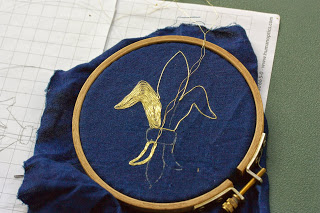
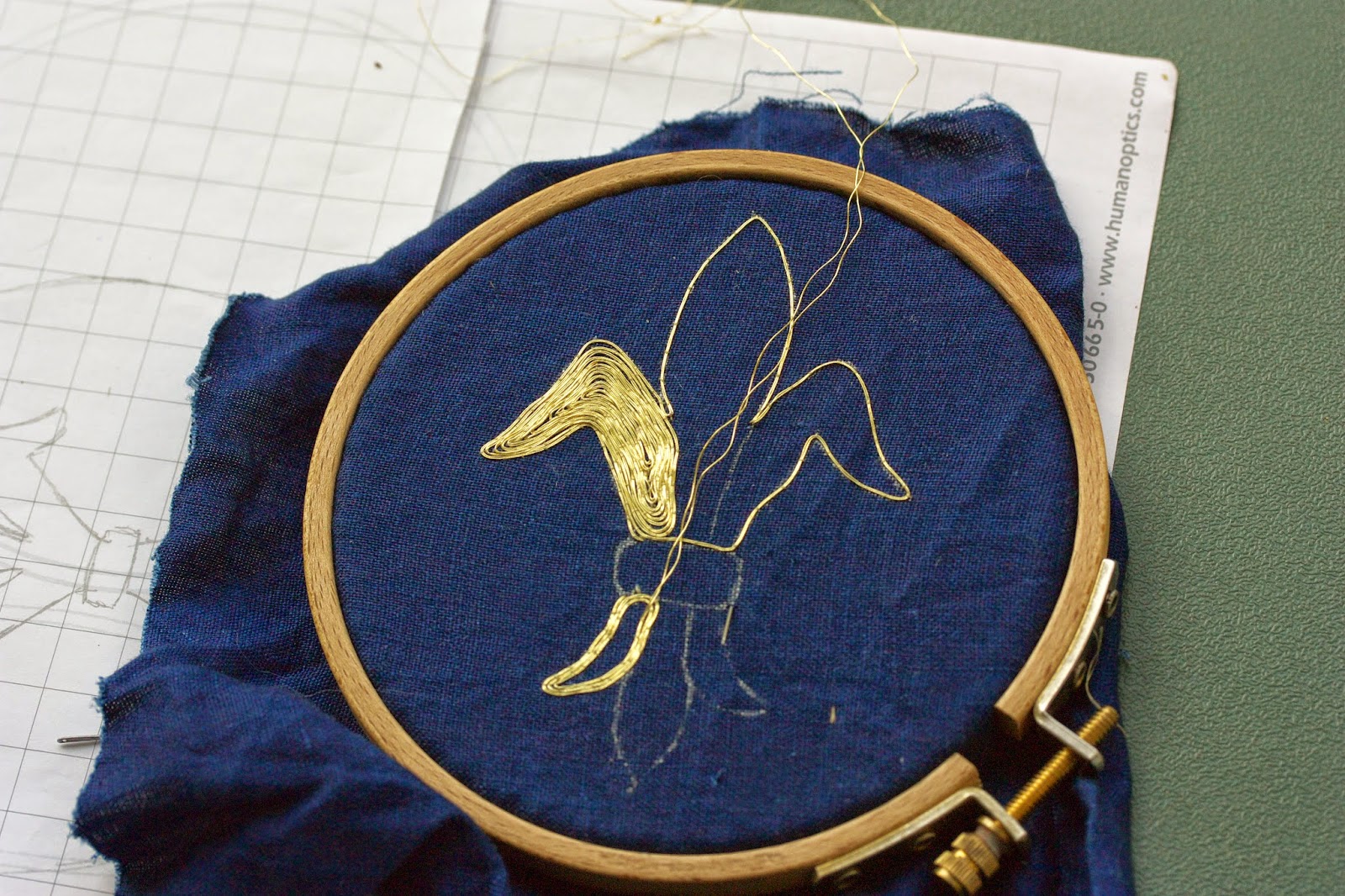
So what better time of the year to finally do the prototype for a new gold embroidery kit? I've been offering the starter kit for a good while now, but several people have told me they would prefer something that comes with a motif, thus making the start easier.

Gold embroidery, a nice motif that will appeal also to non-living history folks, preferably not hard to embroider for a beginner? There's a clear winner for this: the French Lily, or fleur-de-lis.

So with the Beast off the table and a lovely fair coming up in the autumn (more about that soon), I finally found time to do some maths, some planning, and now I'm working on the prototype:


If all goes according to plan, the final assembly will be an all-you-need kit, including detailed step-by-step instructions, suitable needles, indigo-dyed linen fabric with the motif pre-drawn, gold and silk thread and an oval embroidery frame that, after finishing the embroidery, can be used as a frame to hang the piece on a wall.

This will make the kit a mix of medieval and modern - historically correct fabric and yarns, but modern tools (especially the frame). This will, however, be very clearly explained in the pattern instructions - and I think that giving more people the opportunity to enjoy this fascinating technique is the main object here!


0
MAI
08
1

Friday Links.

Friday, linktime...

Amica and Maria, two textile nerds (according to their own description) have started a new blog called Historical Textiles.

Gillian Polack is collecting recipes from SF fandom, and she wants yours too. The recipes will end up in a book - fandom deliciousness!

apc has a monograph about an excavation from York online, and it includes textile-related finds (among them a needle): Blue Bridge Lane & Fishergate House.

More research literature? Uni of Groningen has a publications database that might make you happy.

If you prefer something with more pictures, here's a collection of bizarre images from medieval manuscripts.

Sad things are happening too, unfortunately: The Tsock Tsarina has returned to her blog, but for the worst of all reasons - to announce that she has terminal cancer. I learned how to knit while following her instructions on how to make socks in "Tsocks 101", and her sock designs are something that always make me smile. Fuck cancer.


0
MAI
07
2

The Joy of Non-Cooperative Software.

I've been working on new stuff for the online shop - distaffs, for instance, and little glass containers for the oil-light wicks. And now I'm all blocked in my enthusiasm, as somehow my shop system refuses to let me upload the pretty pictures.

It stumps me - I've already checked the usual culprits, and everything seems to be in order. I've updated the shop system and checked the database... nothing. So I will have to add the things without pictures for now, and hope I can solve the problem soon.

Meanwhile, have some more pictures taken at Freienfels, where I did an outdoor test of the oil light wicks in a medieval-style glass lamp:


 The lamp and the chains were a present to me from several years ago, together with a different kind of wick-holder - a metal bridge that was supposed to hang across the oil surface and hold the wick. It did work, but not very well, as the holder and wick needed very frequent adjusting for a good flame.


Not so with the floaters - as long as there is oil to burn, it burns quietly and like a charm. Towards the very end, there are some quiet sputtering noises, warning you that the lamp will soon run out of fuel, so you have time to refill with some oil, or you can just wait until it has burned itself out.

We had the lamp hanging outside, and with the water level low enough, it was even relatively wind-resistant. I really enjoyed having it hang there, and it was giving a lot of light all around: the beauty of the glass lamp is that it's also illuminating the things right below the lamp, as opposed to a lantern or candle-holder. I will definitely use this lamp a lot more often in the future!
0

By accepting you will be accessing a service provided by a third-party external to https://www.pallia.net/

Kontakt