







Latest Comments

Guest - Aislinn Dyestuff Citizen Science.
09. Oktober 2026
This is a great project. I look forward to the results. Thanks for letting us know.
Guest - Aislinn Time for...
09. Oktober 2026
Looks delicious!
Guest - Katrin Sprang Discussion
18. September 2026
Hi Rachel, I have looked for more photos of you, but that was not very successful. I found a link on...
Guest - Beatrix Sprang Discussion
15. September 2026
That lozenge pattern element is not a photograph, but a scan. So it should be to scale. But I pinned...
Guest - Katrin Sprang Discussion
15. September 2026
I was not referring to Rachel's reconstruction (is the reconstruction you refer to the one photograp...
JUNI
18
0

Aargh. And Sprang Musings.

Aaargh. Sometimes I still manage to click that button necessary to do the blog publishing and not do the confirmation thingie. With the wonderful result of  the post, you may have guessed it, not going out. 

Which is, you may also have guessed it, what happened yesterday. You didn't miss much, though - I finally got around to doing a little maintenance stuff, such as sorting the new stamps, tidying up things in the main stock shelves, and checking if the amounts I have listed for this and that are still more or less correct, and if and what I have to re-order and re-stock.

The little cat, meanwhile, was making the most of the summer heat and has been napping in the wintergarden all day. The wintergarden, of all places, where even with as much shadow as the curtain-like roof thingies will provide and the doors open, it gets very warm. I jokingly refer to it as the cat oven in the summer. But, well, she insists (and could go somewhere cooler any time).

When I took a break and joined her, it was definitely no place where you'd want to do work of any kind. Napping, though... yes, that might work. Unfortunately there's still a few bits to take care of here on the desk! (Where it's also nice and cool compared to outside, so I have no real excuse to slack.) 

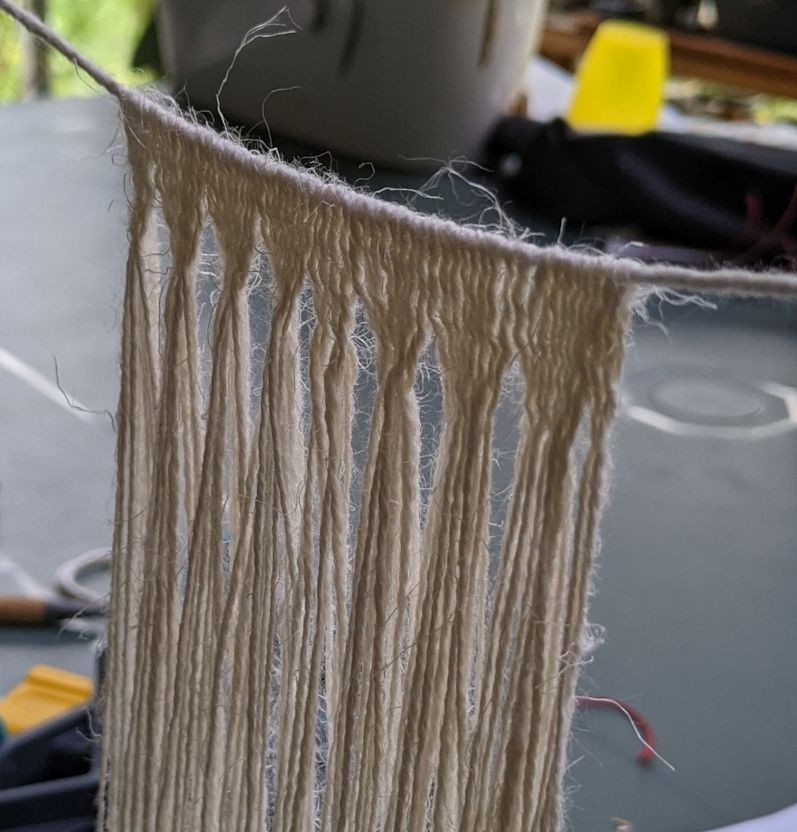
This morning, though, it was still cool enough that I could keep the cat company and do a little bit of sprang. I'm getting closer to the required length for the Lengberg cap, and it's really nice to work in that technique again.

One of the things I find fascinating is that sprang also shares that rhythm of "stuff can happen - nothing happens" that you also can get in tablet weaving, and that you sometimes have in knitting (when there's no pattern on the wrong side row and you only purl back). 

In sprang, you do your patterning in one row and then just confirm and get things nice and orderly in the following one. I have done sprang stuff before, but it was mostly solid things, partly with interlinking in the opposite direction and partly with double layers - but I have not worked with a larger hole pattern before. 

My guess before starting out on this would thus have been that with a heavily patterned sprang I will have one slower row (to read and follow the pattern) and one faster row (just go over everything to set up for the next slow one). I've found, however, that it's not as pronounced for me here as I would have guessed.

The main reason for that is... edges. Sprang, when done with the basic interlinking as the main structure, acquires a curl or twist after a while. That's just normal, and with a solid piece, it means you will have some curling, and thus potentially crossing threads, at the start and at the end. Which, coincidentally, is also where the usual selvedge effect happens and your threads are a little looser than the others. (That happens because they only have one neighbour, and thus don't get as nicely fixed down in the fabric, and there's also a little less take-up, so they can get longer compared to the others after a while. It's annoying, but can be found as an edge effect in many techniques.) 

So with a plain thing in sprang, done with only interlinking, I get slowed down a little at the start, where I have to take care the threads are in the correct order, and at the end, where there's the same issue. The rest is breezing through, more or less. With patterns in the sprang, though... Patterns in this case are made by working holes. And holes are, in fact, a right edge and a left edge happening in the middle of the fabric. 

These edges behave, for all practical purposes, like edges. That means they will also try to curl up a little. So instead of having two places where you have to pay a little extra attention, you now have as many extra places that will try to mess with your flow as you have holes. Actually... double the amount, as each hole has a left edge and a right edge.

I've measured time, and it does look like I am almost consistenly as quick doing the pattern row as the unpatterned one. I'm working with fairly little tension on the threads, which might make things a little more difficult sometimes, but definitely helps with getting a nice, tight interlinking. Quite often in sprang, there's rather big holes even in the (technically solid) base fabric; one reason for that is the use of sticks to save the previous sheds, just in case you made a mistake and have to go back. I haven't worked with sticks in a long time, but for the Lengberg sprang, it needs not only no sticks, but also enthusiastic pressing in of the new crossings. Which is made easier by having low tension on the threads, as they will be happier to stay crossed over and not stretch out again.

Very long story short: I am having fun. In both rows. Even though I don't appreciate the edges trying to be difficult.

0
JUNI
16
0

Brain Health.

From time to time, something pops up in my newsfeeds or newsletters or something - about brain health, and dementia, and related issues.

It's still not being spoken about much in public, but once I started talking about dementia to friends and other people around me, I realised that it's much more common than I had thought, as almost everybody had been in more or less close contact to someone suffering at some point. (And about everyone agrees that it's an asshole illness.)

There's still no real cure for dementia, and while there's research being done about the causes (with the result, unsurprisingly, that both genetics and lifestyle will play a role), a lot is still unknown. One of the confirmed things is that loss of hearing does play a rather big role, as do social connections (one negative, the other positive for keeping it off or at bay).

The UK Alzheimer's Research has now launched a "brain wellness check" that you can do. It's on their website - some of the hints refer to the NHS, but it's not strictly geared towards UK.

(Spoiler alert: Having what is considered a generally healthy lifestyle is also good for your brain.)

0
JUNI
13
0

Hello Weekend!

And while I am finishing up the last bits before heading into lovely laziness and sunshine and trying to match the cat in being utterly relaxed, here's a song for you: 

0
JUNI
12
0

Thursday, Already?

Well, not much to tell about here today - there was stuff to be done on the computer, so there wasn't even sneaking away for a good bit to do some more sprang. (Which is still growing too quickly, by the way, so I'll only need about half the original row count for the original length. Grrr.) The Little Cat had a vet checkup today to get blood drawn, and she was understandably not very amused. The vet was, though, when I told him that the Little Cat's newest medication seems to be the tastiest thing ever available to a cat, and goes absolutely bonkers for it. (Apparently that's not normal.)

Otherwise, texts, reading, phone, writing, emails, stuff. And because you deserve something not as unexciting as hearing about this, here's a link for you to a new kind of sock heel that can be knit in top-down or toe-up, and a link to a paper about cats doing the "fetch" thing. Enjoy. 

0
JUNI
11
0

More Sprang Stuff.

So in case I have gotten you curious about sprang, but you have never really heard about it... let me introduce you to Carol James, who has done an insane amount of sprang in all imaginable shapes, sizes, and colours, and who does a very nice job of explaining holes, patterns, and her notation system (which is also how the Lengberg tree of life pattern is published): 

0
JUNI
10
0

Long weekend and a new addiction.

I spent a part of the long weekend (thanks to Pentecost) taking extra naps (thanks to a cold I managed to catch). As Murphy wills it, now that the weekend is over, I'm back to health again, and of course also back to work.

(Not really complaining here, though. Even though I could have done very well without the cold, at least the timing was only mildly annoying, slowing down the weekend, as opposed to horrendous, as in "could have hit me while abroad and needing all my brain and energy".)

Plus side of having some extra time to just sit and do stuff: I managed to do a little bit of sprang. The story behind it is that I might need to make a piece of sprang for a museum project, and that means I have to do at least a rough calculation on how much it will be, and that is, obviously, hard to do without a basis.

For things that I've done before, I have all the data written down and collected, so I know how long something takes when it goes smoothly (or, as it usually does in best case, mostly smoothly) and how long it will take if something explodes. (Figuratively, not literally.) Yes, I always take time measurements when working for work purposes. Yes, I still do it even once it's clear I am way beyond my initial estimate. Even if it hurts to see how much it's going off estimate - it will be really, really helpful for planning the next similar project.

(In case you are planning to track your work times now, too: My recommendation is a simple stopwatch to place at where you work. That way, you can pause whenever you get up for tea, or a phone call, or whatever - just in case it takes longer than planned and then you forget when you stopped.)

So now I'm spranging again. Last time was a good while ago, and this time I am supposed to follow a pattern to get, well, a pattern, so it was a little different. It took me a bit to get back into the flow and figure out how to get a fabric density similar to the original, but now I'm getting there. 

The threads are not optimal, but they have about the right thickness, and were what I had on hand quickly. 

As always with textile techniques, it pays to have a good, even set-up - differences in tension when doing the setup will mess with your work later on. And then...

There's a pattern to sprang, to the normal, very basic crossing pattern. It involves two threads from the front getting closer together as you pull one thread from the back, and then you split the pair and pull one more from the back and have a new pair to split. It's rhythmic and beautiful and mesmerising, and it only gets tricky if you have a tension issue, or if you get to the edge (where tension is normally a little bit off, too). This pattern will be persistent throughout work, only broken at edges (which includes edges of holes, making everything a bit more interesting). 

So basically, this means you have a running feedback on whether you are still correct, or if you have messed up. That requires adequate eyesight (very thankful for that!) and adequate light (thank you, Joseph Wilson Swan, Thomas Edison, and successors) and adequate concentration.

And then it's just... beautiful. It helps if you have a firm fabric, and if you take care to keep all threads nice and orderly, so I like to work close underneath the top fell. One of the hardest things, really, is now to stop in time before concentration wanes and I mess up, or to stop and do other things that need to be done. (I'm looking at you, bills I need to pay and orders I need to send out.)

By the way, my hack for getting an even warp when warping, or an evenly tensioned sprang setup: Don't tension your threads more than necessary to just keep them from sagging. You are measuring them off on a horizontal thingummy, so start with the thread completely slack and only tension it so it just goes straight. Continue with this technique throughout. 

Gravity helps you get it right here, because you always need the same amount of tension to just get it straight, no more. If you always adjust to that exact tension from slack, there's no danger of you building up more tension gradually as you are working - which is a rather common, if unwelcome, effect. In case you have accidentally tensioned more than desired (because your yarn stuck, for instance, and the ball/cone/reel/spool un-helpfully tensioned it for you), just let it go all slack, then re-tension to just straight. You do not need to make the set-up at the exact amount of tension that you want to have later! You can add all the tension you want or need for working with your  bits of string measured off this slacky way later on, and they will be deliciously even. Works with every technique where you do a set-up step measuring off threads that have to be the same length.

0
JUNI
06
0

There I am again.

I'm back from the workshop with colleagues, where - for the first time ever - I got the pleasure of having a moderated discussion with some teambuilding elements thrown in. It was a fantastic experience, and I did learn a lot about the meta elements of how a group forms and what happens. We were, for instance, introduced to the stages of teambuilding after Tuckman's Theory.

I had never heard of this at any point before, but it does sound familiar, and I found it immensely helpful to know that there will inevitably be some discordancies before everyone has found their place and the group can start to really perform. 

Wikipedia has, of course, an article about the four stages of the original model, and also some additions and further developments, so if you are curious now, you can read up on this here. 

As for me, I have some stuff to catch up on now, so I'll be off performing in my workgroup of one...

0

By accepting you will be accessing a service provided by a third-party external to https://www.pallia.net/

Kontakt