Latest Comments

Guest - Aislinn Dyestuff Citizen Science.
09. Oktober 2026
This is a great project. I look forward to the results. Thanks for letting us know.
Guest - Aislinn Time for...
09. Oktober 2026
Looks delicious!
Guest - Katrin Sprang Discussion
18. September 2026
Hi Rachel, I have looked for more photos of you, but that was not very successful. I found a link on...
Guest - Beatrix Sprang Discussion
15. September 2026
That lozenge pattern element is not a photograph, but a scan. So it should be to scale. But I pinned...
Guest - Katrin Sprang Discussion
15. September 2026
I was not referring to Rachel's reconstruction (is the reconstruction you refer to the one photograp...
SEP.
04
0

Breathe in, breathe out, pack away, prep again.

The spinning workshop stuff is packed away and sorted away again, the orders are, for now, all sent out, I have replies on most of my requests - so the next things are some more Forum planning, and preparing a two-day workshop I will give in September at the Abegg-Stiftung. I'm already looking forward to that a lot!

In the meantime, I'm trying to polish up my French for the conference in Clermont-Ferrant this October. To my delight, we found out that the DVDs we have of the old TV series Babylon 5 had French dubbing - the perfect training to watch. To my even greater dismay, we found after finishing season 1 that all the others are only German and English; there is a French dubbing, but it's not included in the German audio DVDs. Bummer.

Now I need to find some other interesting, yet understandable, French audio stuff to watch. Preferably also with French subtitles (makes it a little easier to understand sometimes). Recommendations are welcome (especially if it's on the 'Net and streamable without hopping through too many hoops). 
0
SEP.
03
0

The Power Of Asking!

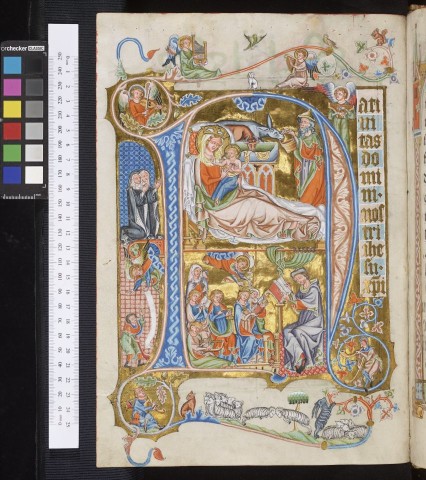
A little while ago, I asked here whether anybody knew where the bowloom tablet weaving scene was from.

And, of course... that worked. (I love it when that works.) Not only this, I also got a bonus heads-up of my blog comment function acting up and not accepting the comment there, so I got this info, plus the source of the image, delivered into my inbox.

A big thank you to Carolyn Priest-Dorman at this place -  who was smarter than me and looked a little further on an old copy of Viktoria's blog, who had posted the mystery image in 2009 (it originated in a yahoo group, she writes, by the way). I had found out that the post contained that image - however, I had obviously not found the right copy of the post on the wayback machine, because at some point other than where I looked at... somebody solved the mystery. 

Or, to cite the comment in question:

Tuija Ainonen said...

We found the mystery image! I happened to tweet the image (https://bit.ly/3h8Z9fO) & prof Henrike Lähnemann knew of your search. (As this is an older post, perhaps you already found the reference?).

The image is from Bodleian Library, MS. Douce 185, fol. 35v (Lower Rhineland, 14thC). The manuscript has just recently been fully digitized by #PolonskyGerman project (see https://hab.bodleian.ox.ac.uk/en/ ).

You can find the image at https://bit.ly/3vNk4c7 and the catalogue description of the manuscript at https://medieval.bodleian.ox.ac.uk/catalog/manuscript_4553. The lower panel of the full page image depicts the education of the Virgin at the Temple, with her classmates being busy with various activities.

The image from Bodleian - to be found here: https://digital.bodleian.ox.ac.uk/objects/43f84a7d-2160-4cfc-9e68-c3981788a4f6/surfaces/b2dede3e-49fb-4c3f-91cd-84c000bb829d/

So thanks to Carolyn and her Search Fu, Vix's blog post, Prof. Henrike Lähnemann's knowledge, and Tuija Ainonen's comment, and actually also Beatrix Nutz who sent me the image and the "whereisit"-question... here we go. 

 I am, as I probably don't need to say, utterly delighted. 

0
SEP.
02
0

Maths and Weaving.

Mathematics and weaving go rather well together - it starts with calculating the amount of yarn needed, goes on with doing divisions for the heddle rods and pattern repeats, and then there's calculating the shrinkage, too.

If you're tablet weaving, you can apparently use maths to help you generate patterns, at least of a specific type. There's a freely downloadable short paper here, titled "Markov Chains, Coptic Bananas, and Egyptian Tombs: Generating Tablet Weaving Designs Using Mean-Reverting Processes" written by Joshua Holden.

There's even a link to the code online. So in case you are looking for another way to get some tablet weaving patterns... 

1
SEP.
01
0

Fun At Worms for a Good Cause.

I spent the weekend in Worms, at the Wollcraft Festival - meeting lots of lovely people that I get to meet way too rarely, and having a lot of fun. Some time was spent working - I had my own two spinning workshops to give, after all - but since it was the very first wool fair in my life that I actually went to without a stall, I also took the opportunity to just stroll around, have some ice cream, and look at everything.

For a while, I hung out with Cordula Becker, who had a "wind your wool for a good cause here" stall. You could use the skein holders and ball winders provided to wind your skeins into balls right at the fair, and I somehow got myself involved in helping some people who had not done that before to use the setup, and even wind a few balls for some folks. It was on give-what-you-want donation basis, and the donations will go straight to the current donation cause for kila mtoto.  Kila mtoto means "every child" in Swahili, and it's a small non-profit organisation with the aim of helping children in Kenya with projects that will give them a better life - such as providing them with school meals, hygiene items, books, and so on. The current donation run, however, is special: There is an ongoing collection for 14-year-old Sandra, who is in urgent need of heart surgery, at a cost of 12.000 € altogether.

Kila mtoto is a small organisation on purpose - because on that scale, the people running it can make sure that the things they work and collect donations for are sensible, sustainable, and what the communities there actually need. Cordula runs this with all her heart, and money donated there will always make a difference - so if you can, even though you didn't get to use the wool winders in Worms, please consider to help with a donation for Sandra, or maybe even by longterm sponsoring of a child.

(Or you could donate indirectly by buying the current charity yarn from Alte Künste, doadoa (sprinkled). (The Webpage is currently in German only, and there's no shipping to the US because of the tariff stuff, just like from my own shop, but if you're in Europe... there you go. I'm sorry if you happen to leave more money there than planned, but you're welcome.)

0
AUG.
29
1

Done.

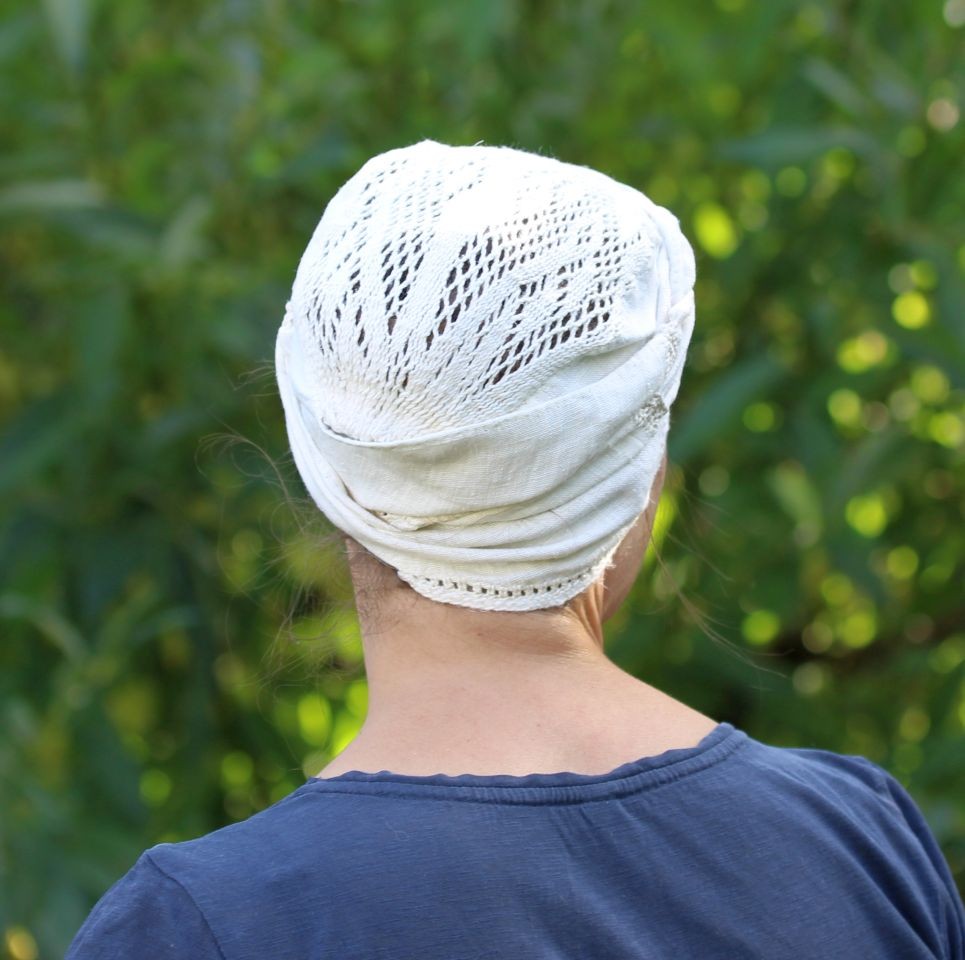
The Lengberg caps are done, and will go off into the post start of next week. I'm very happy with how they turned out - and very glad that in the end there was the decision to include the trimmings. The needle lace around the main edge really adds a lot to the look, as do the lace connection bits between the main part and the bands. 

The Most Patient Husband of Them All didn't only help with the pictures (arranging it to be photo-perfect and taking the photos), he also tried it on so I could be sure that it doesn't only fit my rather small head. (Though with my hair bunched up it tends to be larger, too - in different places.) 

 I found it quite pleasant to wear; the sprang is a little elastic and will help with the fit, but it's never going towards shapeless as the firm front band will keep it at a set width in the front. The way the sprang shows the lace pattern with darker hair beneath it is also very beautiful, if you ask me!

Only downside is that making a sprang panel like this will take a good bit of time. In the original it's 197 rows plus seven rows of doubled threads in plain sprang, and it's 120 threads to handle in each and every of these rows. In addition, the original has an extremely dense fabric as the result, so some extra time after doing the crossings each row is spent tightening the latest and, as far as possible, re-tightening the previous rows.

I'm also a little miffed that the bits that I found really annoying to sprang - the double-crossings, where you have two threads from the back and then two from the front, and which are always trying to mess with their relative positions in the next row - turn into that really beautiful large-hole pattern. Meh. I guess there's nothing to do but getting used to them, then.

0
AUG.
28
0

Dunning-Kruger Effect Revisited.

You might be familiar with the Dunning-Kruger-Effect - which can be more or less summarised as "people who are bad at something are so bad at the thing that they are convinced they are really good at it, and can't even see how bad they are". 

There's been some more tests done, with the results and the conclusions published at clearerthinking.org. The short version is that there's additional effects, both statistical and psychological, that may skew results when trying to learn about people's self-evaluation. 

I found it an interesting read, even though I missed a few of the effects that I personally have found to happen, at least as anecdotal evidence. At least in quite a few cases, I have found people who are extremely good at what they are doing to more or less downplay their skills. One reason for that, as far as I see it, is that they know the field so well to be very much aware of what they do not know. Also, very good people tend to have contact, and possibly compare themselves, to people who are in the same league, which can potentially skew self-assessment. Another reason for this can be a desire to stay under the radar. If you hop out and about telling everyone that you are really, really good at programming JavaScript, guess what will happen sooner or later? Exactly. So to avoid having to defend yourself from extra work, or having to do extra work, keeping mum about your skills is sometimes just the thing.

If you have thoughts - or personal experience with something that could have been a Dunning-Kruger - let me know! 

0
AUG.
27
0

Und jedem Anfang wohnt ein Zauber inne.

That's one line from a poem by Herman Hesse, and it basically says "every beginning is magical somehow". Roughly translated.

This, I think, is quite true. There's always something magical (and quite often also a little daunting) when something new is happening. There's this phase when an exhibition gets planned, for instance, when it feels like you will be able to do so many wonderful, stunning things. There's this time when planning a reconstruction where you look at all the possibilities, and all the things that could maybe be done, and there's so much to learn and to discover.

And yes, that is true even if you (or in that case, me) know that a good amount of it won't ever happen. Because, well, things happen, and there you go, here a little compromise, there a little budget oopsie, here a little health and safety, there a little political issues, and you find yourself with less and less.

The beautiful thing, though? If you play your cards right, you will still end up with something glorious. Sometimes something entirely different will come together almost magically. Sometimes an oopsie means you reconsider things, and find an even better approach. And sometimes... well, to be honest, sometimes you kill one of your favourites, and that sucks. But that, too, is a part of this job.

Why am I writing all this? Because I have had a request for a maybe-reconstruction, and I spent a good part of today, well, dreaming up possibilities. (And checking notes of past timelines, and work times. Gotta keep it real, and based on something documented, if doing a first estimate...)

0

By accepting you will be accessing a service provided by a third-party external to https://www.pallia.net/

Kontakt