Latest Comments

Guest - Aislinn Dyestuff Citizen Science.
09. Oktober 2026
This is a great project. I look forward to the results. Thanks for letting us know.
Guest - Aislinn Time for...
09. Oktober 2026
Looks delicious!
Guest - Katrin Sprang Discussion
18. September 2026
Hi Rachel, I have looked for more photos of you, but that was not very successful. I found a link on...
Guest - Beatrix Sprang Discussion
15. September 2026
That lozenge pattern element is not a photograph, but a scan. So it should be to scale. But I pinned...
Guest - Katrin Sprang Discussion
15. September 2026
I was not referring to Rachel's reconstruction (is the reconstruction you refer to the one photograp...
FEB.
19
0

Kent Archaeology Journal.

Here I am, late-blogging again. This time, though, I have more than my own feeble words for you - there is a link. The Kent Archaeological Society has a journal called Archaeologia Cantiana, existing since 1858, and it's online, with many, many .pdf articles that might be of interest to you.

It covers a huge variety of topics, from architecture to Kentish dialect in the late Middle Ages to wall paintings and coinage. Check it out. I'm sure you will find at least one article that will interest you!
0
FEB.
18
0

How long can it take to finish up a manuscript?

The answer? Very long. It can take very, very long indeed.

We're making progress, though. The list of pictures is slowly growing, as is the number of references in their final format. That's not hard work, but nitpicky stuff that includes lots of looking up the missing details in the references. Final edit has been done, and there are only a few last little issues that need discussing, checking, or clearing.

Which is very good - since the clock is ticking. Soon now. Soon.
0
FEB.
17
0

I'm back!

Well, more or less. I'm still feeling the strain of the editing marathon, but things have settled down a bit, and I can concentrate on the other stuff now. There also was a nice bit of resting time on the weekend, which was utterly necessary and did a world of good.

The other stuff is finishing up the picture collection, tidying up the reference formats, and taking care of stray odds and ends in the index word list. Which sounds like easy-peasy work, and it sort of is, but it's also mind-numbing and time-consuming. Not many days left to suffer from this, though!
0
FEB.
12
1

Totally swamped.

As this very, very late blog post might tell you, I've been swamped. I managed to finish the proofread yesterday, but I still need to transfer a good-sized portion of the corrections into the file, and well... other things have been set aside and need to be dealt with, too.

So I'll do the smart and sensible thing and will leave off blogging until next week - I'll probably be back on Tuesday.

And now back to my way-past-schedule manuscript corrections and back to the two Big Questions: Why on earth did we write that much? And why did it seem like a good idea at that time to make all these corrections?
0
FEB.
11
2

Guess what I'm still doing?

Right.


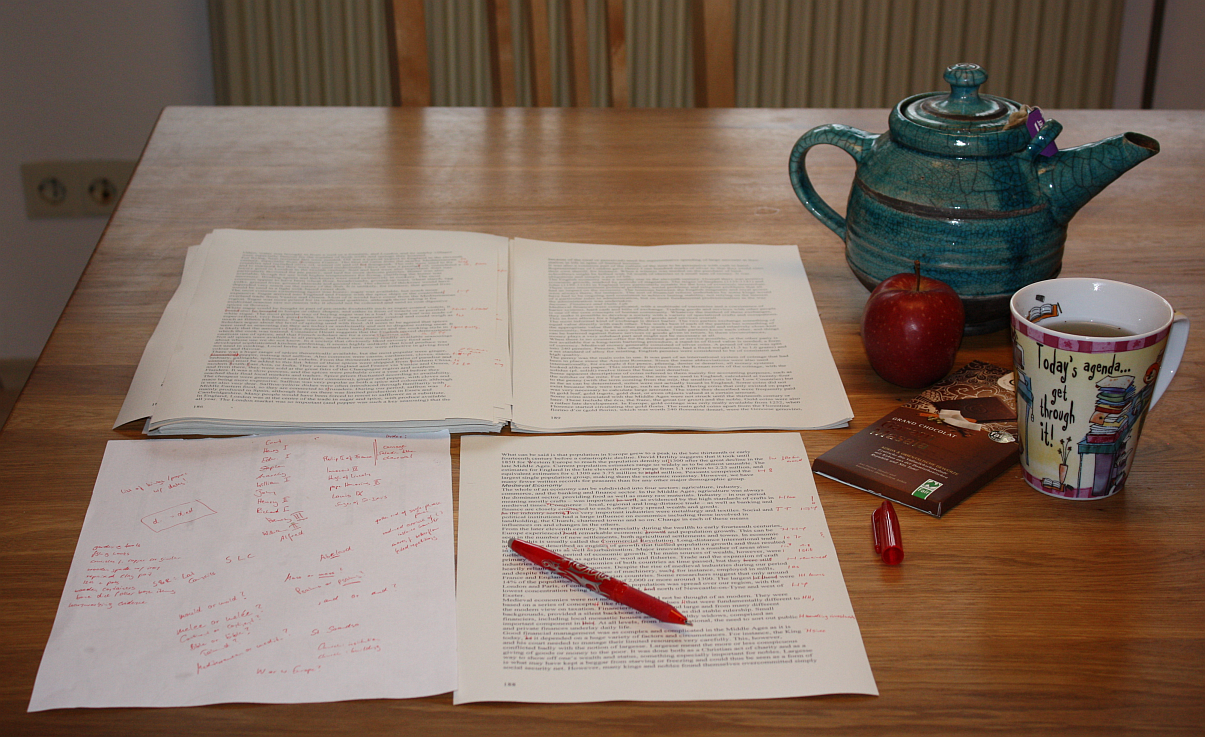
The end is nigh, though, as you can see from the much-diminished stack of paper to the right - the one without all the red speckles at the side and in the text.

In case you are wondering about the speckles in the margin, I'm using a standardised system of correction marks - Germany has that thing about standardising stuff, and this is one of the instances where rules come in really handy. I learned it out of the Duden (something like the Merriam-Webster for German), way back when I first started copyediting. The basic principle, and the most important one: You do a mark in the text where the correction is needed, then you repeat the same mark in the margin and write out the correction. For inserting commas, you strike the mark right through the last letter of the word, then repeat the letter and place a comma behind it in the margin note. For lots of corrections in one line, you need to be inventive with the marks - but it always remains very clear and very unambiguous, and you only need to scan the margin to see where your next correction will be. There are a few additional special marks, such as "close up margin" or "insert margin" or "italicise", but they are not as important as that basic principle.

I've edited many a manuscript using this system, as it's clear and works well even if lots of corrections are needed. The sheet on the bottom left is for note-taking so I can keep track of the things that need it. The chocolate and tea should be obvious, and the apple is there to make it look as if I might choose a healthy snack. (Hah. Maybe I will.)

The cup, by the way, states my intention for this thing and this day!
0
FEB.
10
1

Surveys for the EU VAT - and sheep!

The EU VAT Action group has posted an update on their site - they're looking for surveys from European countries that are not the UK. If you haven't taken the survey yet, please help.

If you would like to look at sheep after that, you can see some from the beautiful Lake District here.
0
FEB.
09
0

Time flies like an arrow.

It's been almost two years since I stumbled across HabitRPG, and I'm still using it. In fact, I'm using it daily. I can't believe it's been this long, and I am often amazed at the difference it makes in my life.

Case in point? Stressful times (like having an editing deadline) usually meant that a lot of the smaller, mundane things fell by the wayside. This includes things like getting some breakfast, or lunch, or putting away used dishes. It also meant long streaks of inactivity on maintenance tasks - getting the picture database up to date, for example, or remembering to defragment the HDD.

Chances of that happening have actually much, much diminished thanks to the "Dailies" column in Habit. Basically, I have a list of those recurring tasks that come up each week, and some of them each day - and they remind me to get my shit together and to get stuff done. For a lot of these smaller dailies, it means a frantic burst of activity towards the evening, but I won't complain about my timing here: they get done, and that is what counts.

For me, it serves as a tool to keep track of things I have to do, helps to motivate me when necessary, and helps me to structure my day. It's not always perfect, but it works very well for me, and it comes with a friendly community and is still growing new and useful features.

I've tried to infect a few of our friends with the Habit virus, more or less successfully so - it's not the perfect to-do list for everybody, or so it seems. I love it, though. (In case you have tried it out - tell me what you think about it in the comments! I'd be very, very interested to hear what you think.)
0

By accepting you will be accessing a service provided by a third-party external to https://www.pallia.net/

Kontakt