







Latest Comments

Guest - Aislinn Dyestuff Citizen Science.
09. Oktober 2026
This is a great project. I look forward to the results. Thanks for letting us know.
Guest - Aislinn Time for...
09. Oktober 2026
Looks delicious!
Guest - Katrin Sprang Discussion
18. September 2026
Hi Rachel, I have looked for more photos of you, but that was not very successful. I found a link on...
Guest - Beatrix Sprang Discussion
15. September 2026
That lozenge pattern element is not a photograph, but a scan. So it should be to scale. But I pinned...
Guest - Katrin Sprang Discussion
15. September 2026
I was not referring to Rachel's reconstruction (is the reconstruction you refer to the one photograp...
JAN.
19
3

Do your part.

If you are like me (as in living in a non-US state and not keeping up on politics), you may have been surprised yesterday to see Wikipedia blacked out. (Icanhascheezburger was also blocked out, which I found out when I wanted to amuse myself with LOLcats while scanning visual survey cards with 1200 dpi - which takes a long time.)

If you are not living under a rock like I am, you will have heard of SOPA/PIPA before me. The tl;dr version: a bill is to be passed by the US Congress that supposedly stops piracy but would effectively mean a go-ahead for censoring the internet. Censoring the Internet. The place that made Rule 34. The place where you can find about anything. Where people throw around links, search for stuff, buy whatever they need or like, and connect with other people - all this would be in danger with the act.

This video can tell you why.


I'm doing my share of blogging, and that means passing along links. Like this one here to a primer about SOPA/PIPA (to get the quick and dirty version in form of an infographic, just scroll to the very end). To you, the readers, because I think that they might be interesting, or helpful, or funny for you. Posting links, however, sounds like it is going to be a dangerous thing after SOPA/PIPA passes - especially since my blog is a "domestic" site (it's blogger.com). Oh, by the way, so is the Textileforum site. Even if its server sits in Germany.

If you're just a little like me... you won't find that a great thing. Even if it inspires nice filk like this.


So please do your share and protest! If you live in the States, it seems to be most efficient to call your congressperson or walk into their office to tell them what you think about the act. Links to lists and help to find person and phone number are all over the InterBloggoTubez. Unfortunately, it's not so easy to protest when you are no US resident - but we can at least spread the word!
0
JAN.
18
2

Image Tweaking.

It really is amazing how much time a single small macro can gobble up.

Especially if, when you are almost through, you decide that the process might be even better suited to the aims if done a little differently. Because it does make a difference whether you run a median filter first, or whether you filter out outliers first, or make a transformation to binary first and run filters later on.

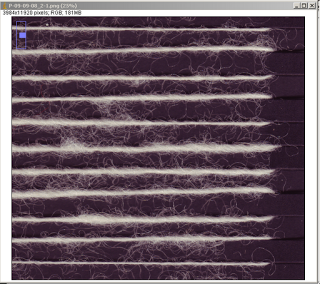
Anyways, I now have a method to turn a scan of thread samples like this:

into this:


and then read out the thread thickness of every single one of these threads.

Now I only need to wrangle the gazillions of datapoints into something resembling histograms or some other form of legible visualisation. And be amazed again at how much time a single little spinning experiment can eat.
0
JAN.
17
0

January seems to be the Month of Quests for Data.

Via an e-mail list, I have received another request for data from someone else, regarding users of warp-weighted looms.

Christina Petty is looking to ask other weavers using warp-weighted looms questions in context with her PhD thesis, so if you are a weaver or know one, please send him, her or yourself to her webpage with the questionnaire and help gather some data!
0
JAN.
16
13

The quest for numbers... again.

As you probably all know, I am working on getting my book, "Kleidung im Mittelalter", published in the English version.

I have found a publishing house that is very interested in the book, but they are unsure whether there would be enough interest in the book, and thus enough buyers, to make it worth their while (and their investment). With the translation costs and costs of print and binding, especially since it includes colour pictures, a book like this is not easy to calculate.

When I was at this stage for the German version, I set up a newsletter list for people interested in the book. This did work very well for everybody, so I am doing it again. If you subscribe using this form, I will keep you informed about any developments on the publishing front, and if there should be any special offers or subscriptions possible, it will make sure you hear of this. On the other hand, your name on the list and your input about pricing will make it easier for the publishing house (and me, of course) to gauge interest in the book.

The German version has 529 pages and more than 400 illustrations, some of them in colour. It features information about sewing techniques, textile techniques, how to critically look at sources for garment research, the development of medieval clothing, a reconstructed technique for tailoring historical garments and - last but of course not least - a catalogue of still extant medieval garments and garment fragments from 500 to 1500.

So if you are waiting for the English version of my book, please subscribe - and please pass on the information about this!


First Name
Last Name

Email


Confirm your email address


For the book, I would be willing to pay up to

70 Euro

90 Euro

120 Euro 

0
JAN.
13
1

More things that may have gotten lost before the holidays.

And here's another heads-up regarding a symposium - I will be there as well:

On the occasion of a three-year research project on 'Dyeing techniques of the prehistoric Hallstatt-Textiles' funded by the Austrian Science FWF [L431-G02] at the Natural History Museum of ViennaTextiles' funded by the Austrian Science FWF [L431-G02] at the Natural History Museum of Vienna both an exhibition and a symposium will be organized. In co-operation with the University of Applied Arts Vienna, the University of Natural Resources and Life Sciences Vienna, the Austrian Society for Textile-Art-Research and the Cultural Heritage Agency of the Netherlands at both events, a colourful spectrum of research and art is presented.

Exhibition:
colours of hallstatt |textiles connecting science and art
hallstattfarben | Textile Verbindungen zwischen Forschung und Kunst
Venue: Natural History Museum Wien
Date: 17th January to 29th of June 2012

Symposium:
3000 Years of Colour – from Tradition to Art and Innovation
2nd International Symposium on Hallstatt-Textiles
Venue: Natural History Museum Wien
Date: 21st to 23rd March 2012
Registration and further information: http://3000yearsofcolour.nhm-wien.ac.at

Hallstatt in Upper Austria is famous for its prehistoric salt mining. Due to the conservation by the salt, organic finds survived more than 3000 years. Among them are the oldest dyed textiles of Europe, from the Bronze Age (15th - 13th cent. BCA) and the Early Iron Age (Hallstatt-Culture, 800 - 400 BCA).

During both the exhibition and the symposium scientists and artists will provide you with a thorough insight into the unique world of prehistoric textiles and their colours. It will be shown how prehistoric dyers succeeded to use the colours of nature for dyeing textiles and what these colours mean to us today. The last three years scientists investigated the prehistoric dyeing and textiles techniques, analysed the dyes and fibres of the prehistoric finds, collected dye plants, cultivated woad, performed dyeing experiments and experimental textile archaeology and produced replicas of Iron Age ribbons. By the archaeological textiles, by ancient dyeing and textile techniques, by colours and ornaments artists were inspired to create objects of contemporary art.

In the exhibition the various topics will be presented together with prehistoric textile finds from Hallstatt, the reproductions of the ribbons and the art objects.

The three-day Symposium will include lectures of these topics, an art performance and tours of the exhibition and of the textile collection of the Papyrus Museum. A social program will enable you to exchange your experience with an international audience in a relaxed atmosphere and will complete your own "Hallstatt Experience".
0
JAN.
12
2

Things that may have gotten lost before the holidays.

I gathered yesterday that launching the call for papers for the Textile Forum shortly before Xmas season may have led to this going under - with all the other seasonal things to take care of and the end-of-year frenzy of work.

So here it is, again:
We will be having the next European Textile Forum in Mayen, Germany, with the kind support of the RGZM. Our focus topic will be "Metal in Textile Crafts", which we think is a very exciting and very interesting - and also very broad - topic, covering everything from the conservation processes of archaeological textiles by metallising via the use of metals in the embellishment of textiles or the use of metals in the mordanting and dyeing process to the manufacture, importance and use of metal in textile tools.
The Forum will take place September 10 to 16 in the brand-new Laboratory for Experimental Archaeology and will include the usual evening lectures, one extra lecture day, an archaeological experiment to find out about the possible influence of the lead dye pots from Pompeji dye workshops on the resulting colours, and of course plenty of time to work on projects and exchange knowledge, tips and tricks or complain about problems to colleagues. The full conference fee of 300 Euro covers full board and lodging in simple dorm rooms (lodging is of limited availability).

If you are interested, you can find out more via our website www.textileforum.org - there you can also register for the Forum. And if you are not interested, but know someone who might be - please spread the word!
0
JAN.
11
1

Open Access Archaeology Journal Database

If you are looking for a convenient way to search for Open Access archaeological journals, there is a database where you can search by geographic area, subject area, peer review and whether or not it's still publishing: Just go to Open Access Archaeology Journal Search.

In other news, I am slowly catching up with all the backlog that ran up here, and that really feels good! (Though there's more than enough work for the rest of this year hiding in corners here and there...)
0

By accepting you will be accessing a service provided by a third-party external to https://www.pallia.net/

Kontakt