







Latest Comments

Guest - Aislinn Dyestuff Citizen Science.
09. Oktober 2026
This is a great project. I look forward to the results. Thanks for letting us know.
Guest - Aislinn Time for...
09. Oktober 2026
Looks delicious!
Guest - Katrin Sprang Discussion
18. September 2026
Hi Rachel, I have looked for more photos of you, but that was not very successful. I found a link on...
Guest - Beatrix Sprang Discussion
15. September 2026
That lozenge pattern element is not a photograph, but a scan. So it should be to scale. But I pinned...
Guest - Katrin Sprang Discussion
15. September 2026
I was not referring to Rachel's reconstruction (is the reconstruction you refer to the one photograp...
NOV.
04
0

Experimental Drinkology.

Experimental Archaeology is cool. About as cool as the Internet, I would say - there are so many questions about our history still unanswered, and quite a few of them are suitable for designing an archaeological experiment around them.

Plus it's absolutely exhilarating to try out things and find out things at the same time - even if the trying out and finding out involves lengthy mind-numbing and tedious work. (It's a scientific method, after all - you don't get only the fun of doing, you get the work of analysing too.)

And then, impressive things can happen. Plus a successful archaeological experiment is almost always of interest for the public - so it also helps getting people understand how varied and interesting and yet unknown the past is. Case in point? This article here, exploring old alcoholic beverages reconstructed from organic residue in vessels.

Here's to archaeology - cheers!
0
NOV.
03
2

Praised be the Internets.

Internet is good. Well, since you read this blog, you will know that I think the internet is good. But sometimes, it comes back to me just how good it is - and then I have to say it again.

The internet helps me to connect with my friends. To find out when favourite musicians play somewhere I can go. It enables me to buy strange and useful things, like my new spinning wheel (yes, I have a new one). It continuously provides me with new programmes that are good to use and totally free for most private purposes (like Anti-Twin, a wonderful tool to find duplicate files, or Sequoia View, a programme that shows you how big a file is on your hard disk). It is a wonderful place to do research for writing and working.*

And it makes it possible to collaborate with people who live on the other side of the planet. All the way around, with no delay whatsoever, I can send things and messages and pictures, and we can discuss what is good and what is okay and what is not so good. And that, I think, is absolutely amazing.


*And yes, it also provides me with endless opportunities to get side-tracked, procrastinate, and waste time and money. But hey, that's the Internet for everybody, right?
0
NOV.
02
1

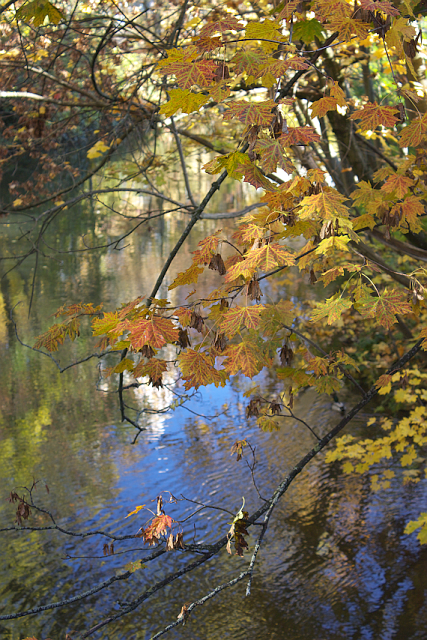
Autumn has come.

All the leaves are turning red and yellow outside, we have greyish foggy weather, and the small birds are already checking out possible nesting places for next spring - it's clearly autumn.

Now is the time of beautiful golden light and roasted chestnuts and hot chocolate and tea with spices in it.

And the best time to make autumny photographs - this picture was taken in Bamberg during the long weekend.

0
NOV.
01
0

Holiday!

Today's a holiday over here in good ol'Germany, so you are not getting a proper blog post.

Instead of blogging, I will be having fun and relaxing - but you might want to check out the open access journals that are still online for open access week, and there's a handy customised search engine right here, thanks to Doug's Archaeology blog.
0
OKT.
31
1

Literature managing.

Books are just like pictures. They are lovely to have, wonderful to peruse, and a pain to organise. And it's immensely helpful to organise them - having keywords and tags to search pictures, and having keywords and notes to check whether a book was helpful or not. Plus a bibliography programme can help with citations - and save a major pain when writing.

There are several programmes on the market, the two best-known of which are probably Zotero (a free plug-in for Firefox) and Endnote (a commercial stand-alone programme).

Just recently, I have re-assessed Zotero as a possible alternative to my usual bibliography programme (which is Endnote). There are pros and cons for each of these two programmes, but one of the best comparisons I have found yet is this one from profhacker. So, even though my version of Endnote is quite a few years old now already - from how everything in Endnote is integrated in my workflow, I'll stay with it.

If you do not have a bibliography programme yet or are not totally content with yours, though, you might want to check out Zotero. After all, it's free - so it can't hurt to try.
0
OKT.
28
0

Things happen, books do too.

The flip-side of my book-ordering binges from a while ago is now coming to gently prod me into the buttocks.

One thing I really love about the library where I get my books is the possibility to do easy and free inter-library loans. Now, since my topics tend to be rather non-mainstream, and since I then need to get a lot of books that are not in the local library, that is a real blessing.

Unlike the copies in the local archives, though, ILL means you put in the order, hope there's not a pink slip of paper coming back (always a bad sign - since it means that your request went through the system, was denied and now you get that on pink paper) and wait for your book to arrive. And that, depending on where it comes from and whether it was checked out by someone else before, can take a goodly amount of time.

So they come in, singly or with one or maybe two companions, spread out over weeks. And everytime one comes in... I have to go get it. Which is the case for today, which slightly skewers my schedule of things I wanted to do today into tiny and very irregular bits... but at least I will probably be able to have a coffee with a friend while killing the schedule.
0
OKT.
27
2

It's Open Access Week!

For those who have not found out about it yet, it is Open Access week this week!

Open Access is a model of publishing that aims to remove the paywall barrier to research knowledge - by granting open access to results. Now, if you've ever thought about getting an article via a portal such as ingentaconnect and were asked to pay, say, 45 USD for a 5-page paper where you don't even know if it will really hold that vital information, you will know about what "paywall barrier" means.

Open Access has its pros and cons, as every system has. But this week and for me, it has only pros - since the portal I just mentioned hosts journals by Maney Publishing house, and that house takes part in OA Week. You can find 22 archaeological journals on their page, and all the papers are free for you to read - no paying, no registration, no nothing - until November 4.

Also taking part, but only until October 30, is Internet Archaeology.

And finally, there's a long list of Open Access journals in archaeology on Doug's Archaeology blog.

And if this blog post is not going to steal at least half an hour from your life, I don't know what will...
0

By accepting you will be accessing a service provided by a third-party external to https://www.pallia.net/

Kontakt