Latest Comments

Guest - Aislinn Dyestuff Citizen Science.
09. Oktober 2026
This is a great project. I look forward to the results. Thanks for letting us know.
Guest - Aislinn Time for...
09. Oktober 2026
Looks delicious!
Guest - Katrin Sprang Discussion
18. September 2026
Hi Rachel, I have looked for more photos of you, but that was not very successful. I found a link on...
Guest - Beatrix Sprang Discussion
15. September 2026
That lozenge pattern element is not a photograph, but a scan. So it should be to scale. But I pinned...
Guest - Katrin Sprang Discussion
15. September 2026
I was not referring to Rachel's reconstruction (is the reconstruction you refer to the one photograp...
AUG.
24
3

Links.

When in doubt what to blog, blog things like links.

Is that a blogger's adage? If not, can we make it one? I will at least do what it says and blog some links for you.

First of all, for those of you who know about the Maaseik embroideries, here's a direct link to their pictures (among others) from the kikirpa database. In case you don't know about the Maaseik embroideries, they are a series of 8./9thc century gold and silk embroideries. In case you don't know about the picture database of kikirpa.be, go take a look - it's worth it.

And in less serious at lest as important news, highlyeccentric blogs about the fate of a penis tree mural.

Finally, totally unmedieval but fascinating: Art from somebody who merges photos with pencil drawings. Really worth a look too. Text is in German, but the pictures are not, of course.
0
AUG.
23
2

Updated the Shop!

The new spindle whorls are now in the shop, and it's possible to order both the discs and the new, hand-thrown ones. For the latter you can just tell me the weight you'd like - they are in a span of c. 10 to c. 47 g - and I will pick out one. (Or, while I still have most of them, you can tell me which one from the photo in yesterday's blog you would like.)

Plus there's something else in the shop. I will be giving a workshop in Erlangen on how to do medieval embroidery on October 29, where we will cover counted work, and October 30, where we will do uncounted embroidery (including a little gold embroidery). Both days can be booked separately via my Onlineshop - there's a category called "Kursangebot" - so you can come to one or the other or, of course, to both. Please be aware that there is only a limited number of places available. If you are coming from further away and need a place to stay, I can supply you with some info to help you find a place to stay as well.

I'd love to see you in October!
0
AUG.
22
0

Good things have happened.

I had a wonderful weekend, spent with friends doing nice and weekendy things like playing boardgames (among them a few hilariously bad ones), chatting, eating cake and planning future craft projects (theirs, not mine).

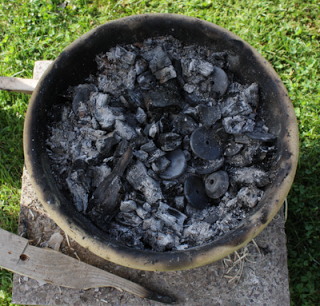
But before that, on Friday evening, I finished off the workweek with some... work. Hot, interesting, adrenaline-flush-making work. I dragged our firebowl and wood and stuff out in the garden, and I started layering in wood and the now bone-dry clay whorls I made. Which makes that procedure some weird cross-over between kilnless firing and pitfiring.


As expected (because you always have them in a kilnless firing procedure), there were losses.


Most of what you see in that box, though, are not whorls, but the remainder of two of the three medieval type piggy banks that I put in as well, even though I knew there was a very, very high probability they would not survive it. (Because their time for drying... let's just say it was not generous. At all. And my mum taught me better.) But I still wanted to know, and I don't know when I'll be doing this again, so...

Losses on the pieces that had dried out properly were not so high. And most of the whorls came out whole and nice and black:


I have a thing for reducing-athmosphere fired pottery. I mean I like pottery colours, especially white and off-white, but I just dig the black stuff. I now have one (non-functional) very very crudely made piggy-bank that has no piggy shape and 57 spindlewhorls to re-stock the online store with. Not all of the thicker whorls are perfectly round, so I might have to test a few and maybe take them out, but overall they do look good. And my fancily decorated disc whorl even survived as well:


That, my friends, was a really nice Friday evening.
0
AUG.
19
0

Looking happy while getting wet.


As all the long-term readers of this blog know (because I’ve written it repeatedly), I am naturally lazy. I am also aware of efficient working procedures and non-efficient working procedures, even if it is not always in my power to change from the latter to the first.

Washing wool is a high-consumption activity: It needs obscene amounts of water, some work time and a huge lot of waiting time, especially for the wool to completely dry again so it can be put back into storage. It also needs some equipment to make wool washing sustainably efficient. Plus, the wool that still has its natural oils is a joy to work with, and wool that has been scoured heavily or washed with too much agitation is prone to felt, making the following processes harder and maybe even severely damaging overall fibre quality.

So my first impulse (and more or less my wish) is to leave the wool as it comes from the sheep, washing-wise, and start with the process of beating, combing and carding straight away. However, there’s dirty wool and there’s clean wool, and dirty wool is harder to work with in some circumstances. Much harder to work with. So much so that the investment of water, work time, wait time, and equipment seems to be an efficient investment again.

Currently, I’m testing the waters for wool-washing – checking how much time I need for a batch, how much water, what works better or not in my scale of material amounts, which might be roughly equivalent to the processing amounts of a very small medieval industry or a large household. And that, in turn, means I’m very happy that it is raining right now, and that I have just gladly ran out into the rain, getting wet while bucketing rain water from the container being refilled to an extra storage container. And will do so again in case it rains enough to fill the first container completely again.

And now I’ll dry off with a cup of coffee and some nice work.
0
AUG.
18
1

Textile Stuff - Lengberg again!

Here's the promised textile centred backlog. I'll start you off with a conference date again:

The conference "Dyes in History and Archaeology DHA30", a joint meeting with the Royal Society of Chemistry Historical Group, will take place 12-15 October 2011 in the University of Derby Enterprise Centre, Derby (UK). For more information, please visit the conference's website. While this is one of the many conferences I will not be able to attend, a poster about the Hallstatt project that I took part in will be shown there.

Since it came up again on MEDTC, for those of you lusting after a view of the textiles in the V&A in London: They will be available for study again probably in summer 2013, since the collection is moving to a new location. It's not a progress report, but at least some info: Clothworker's centre.

And now the juiciest bit for today. Beatrix Nutz who researches the textiles from Schloß Lengberg (medieval bras, anyone?) has been busy again, and her article about the very early needle lace from the finds is online. You can find the article here; it includes pics, schematic drawings of lace structures, and you can all understand it - just scroll down for the English text. Enjoy!
0
AUG.
17
0

Backlog.

I really should not go check work emails before writing the blog, or it leads to severe late-blogging.

While I was away, a ton of mails (a small ton, anyways) came over the MEDTC-list. For example, this link that leads to a list of dissertations since 1994, with quite a few textile-related titles among it. I'm not going to re-post all the interesting bits from the list - if you did not join it in 2009 when I first wrote about it, or when you found out about it, you can join now by going to this old post, reading up on it and doing what you need to do.

There's the (annual) international conference „Experimental Archaeology in Europe 2011“ that will take place from 13.-16.10.2011 in Schleswig/Germany. It is organised by EXAR and the Archaeological Service and Museum of Schleswig-Holstein in castle Gottorf near Schleswig. Though termed "international", the conference is almost purely in German language. If you do not mind that, though, there will be a presentation about the Hallstatt textile reproduction that I was also involved in, and two other textile-focused papers. Unfortunately, I will miss the conference due to a date clash. If you think about going, you can find more info on the website www.exar.org.


And on the other side of Earth (more or less), there's a roundtable discussion about experimental archaeology:


Teaching Experimental Archaeology in an Academic Setting: A Roundtable Discussion

Increasingly, many archaeologists acknowledge the value of experimental archaeology and incorporate an experimental component into their research designs.   Simultaneously, numerous anthropology departments throughout the world are expose their students to the field by adding experimental archaeology courses to their departmental offerings or at least by including experimental components to more traditional archaeology classes.  The professors offering these courses come from various backgrounds and approach the material in very different ways.  Accordingly, we all have a great deal to offer one another.

In an effort to encourage dialogue between the instructors of these courses, a roundtable discussion focused on teaching experimental archaeology in an academic setting has been organized and is planned to take place during this year's Reconstructive and Experimental Archaeology Conference (REARC).  This conference will take place between October 14 and 16 at the Schiele Museum located in Gastonia, North Carolina (see: www.rearc.us).  If you: 1) currently teach or are planning on teaching an experimental archaeology course, 2) currently teach or are planning on teaching a course that includes an experimental archaeology component, or 3) are interested in how experimental archaeology is taught in an academic setting, please consider participating in this roundtable.  In addition to a lively discussion, I would like to also assemble a packet of hard copy and digital materials such as syllabi, reading lists, class activities, etc. that can be shared amongst the participants and interested conference attendees.  Please consider sharing these materials whether or not you plan on attending the conference.  If you are planning on participating in any capacity please respond to Bill Schindler (Diese E-Mail-Adresse ist vor Spambots geschützt! Zur Anzeige muss JavaScript eingeschaltet sein.) by September 15, 2011.


More of the backlog, but with a more textile nature, tomorrow.
0
AUG.
16
0

Distracted.

I'm doing all manner of things here that I have been not doing before the vacation, plus I'm involved with a brandnew (still top-secret) collaborative project that has gotten me all bouncy and inspired and enthusiastic. So inspired and enthusiastic that I'm getting sidetracked from writing this blog thingie again and again.


Which is really, really nice. Plus I have dirty wool soaking outside, and a ton of other nice things to do and look forward to. And stuff to share - but I will do that during the next days, when I'm perhaps a little less easily distracted and not as bouncy anymore.
0

By accepting you will be accessing a service provided by a third-party external to https://www.pallia.net/

Kontakt