Latest Comments

Guest - Aislinn Dyestuff Citizen Science.
09. Oktober 2026
This is a great project. I look forward to the results. Thanks for letting us know.
Guest - Aislinn Time for...
09. Oktober 2026
Looks delicious!
Guest - Katrin Sprang Discussion
18. September 2026
Hi Rachel, I have looked for more photos of you, but that was not very successful. I found a link on...
Guest - Beatrix Sprang Discussion
15. September 2026
That lozenge pattern element is not a photograph, but a scan. So it should be to scale. But I pinned...
Guest - Katrin Sprang Discussion
15. September 2026
I was not referring to Rachel's reconstruction (is the reconstruction you refer to the one photograp...
JULI
05
3

I almost forgot.

A while ago, I wrote a teaser post about a plying technique that I wanted to write about - and then I almost forgot I promised you a follow-up post. ZM15

While most of the ladies on medieval images have a long distaff that clearly holds fibres, like this:


Psalter of Fecamp. Ca. 1180. From Petzold, Andreas. Romanische Kunst, art in context. Köln: Dumont, 1995, p. 97.

and some fewer ones have a short distaff that also clearly holds fibres, like this:

Detail from Giotto: Annunciation to St. Anna. Scrovegni-Chapel, Padua. 1300-1320. From Flores d'Arcais, Francesca. Giotto. New York: Abbeville, 1995, p. 150.

something about this picture has always sort of tickled the back of my brain.
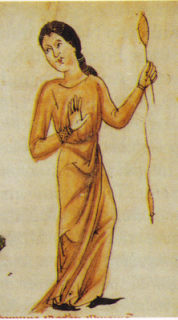
Young woman, Pseudo-Apuleius, 13th century. Vienna, Österreichische Nationalbibliothek, Cod. Vind. 93. From Kotzur, Hans-Jürgen. Hildegard von Bingen 1098-1179. Mainz: Verlag Philipp von Zabern, 1998, p. 336.

It's not the usual what she's holding; it's clearly a shorter distaff than usual, and the form of the stuff on the distaff is very clearly defined, very spindle-shaped and not fibery-looking at all.

Let's jump to another topic: the problem of plying. I don't know how well you manage to spin the same amount of length on two spindles or spools - I don't manage so very well; there's always some of the yarn left on one side when the other side has already run out. There's a theoretically very easy way to avoid this, though: To fold the yarn spun in half (from one single spindle, spool, or cop) and ply it with itself. When there isn't a foulup, you end up with a neat two-ply with no singles left.

There are different instructions on the 'Net on how to ply from a center-pull ball, and there's also the Andean Plying Bracelet which both are means to achieve the desired end-result: a skein of single folded in half and plied up. Both involve re-winding the spun yarn from the bobbin of a spinning wheel (where it's an absolute necessity) or from a spindle.

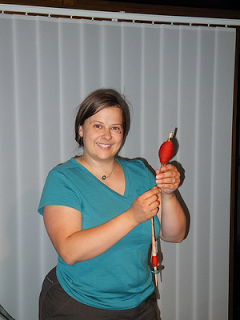
Me, I'm lazy. I like to be lazy. I promote winding spindles in a special way so that I can, after spinning, just slide that cop of yarn off the spindle onto a slim bit or stick of wood or so for storage. (Chopsticks, by the way, work fine.) And the way that I wind my yarn results in a stable, spindle-shaped cop of yarn that is essentially something not too unlike a center-pull ball. So I tested plying directly from the  cop (transferred to a slim stick) onto the spindle... and it works, and very very well too.

There's me doing it...
... and a close-up with a slightly different hand position that occurs quite frequently during the process.
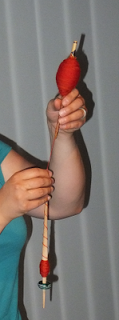

So... here's a method that is efficient, easy to use, will result in no waste of yarn singles, and does not require extra tools (you can use a spindle stick to ply from). And I'm hooked on this new technique.
0
JULI
04
0

Back from the weekend.

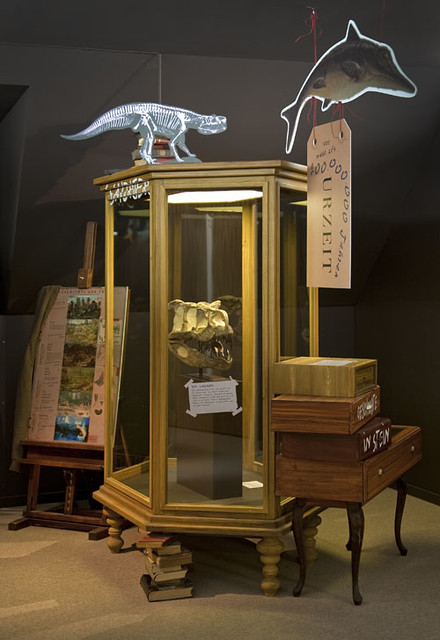
I spent Saturday and Sunday in Stuttgart at the "Medieval Times" event of the Junges Schloß Stuttgart. "Junges Schloß" is a museum concept especially for children - every object in easy view of children, things to touch, experience, try yourself and garments to dress up with. I had the opportunity for a quick walk through the exhibition on Sunday morning, and I was so bummed that I'm already older than ten years.

No, really. It is a wonderful museum for children (and me and the two grown-up colleagues also had a heap of fun sitting on the thrones and on the knight's horse), and if you are in the area with a child, or if you are interested in museum concepts for children, or if you are plain curious - do go there. I was really blown away by the exhibition.

If you are too far away (or if you want a look before), here's a picture of the main room, a renaissance "cabinet of curiosities" showing treasures from throughout time.

Wunderkammer Urzeit
(Picture from a photostream made by the museum that you can find here.)

And those glass cases can all be opened by the staff in the museum so that the young visitors can touch the original objects in there. Awesome, isn't it?

I had hoped to sneak off and catch another few minutes in the exhibition room, but the medieval event was so well received and so well visited that there was absolutely no time for it. I spent all Saturday and Sunday spinning, explaining about worsted and woolen, combing wool and spinning even more. And letting people try themselves. Oh, and threatening my neighbour with my distaff, because that's a very medieval thing to do (and always good for a laugh).

So go visit the museum, everybody who is able - I'm sure you will enjoy it!
0
JULI
01
0

More Conference Stuff.

Here's the rest of the conference info that found its way into my inbox; first of all, a conference in Aarhus:

Call for Papers: Prayer and Performance
Acts of belief as symbolic communication in the late medieval and Renaissance period
An international interdisciplinary colloquium examining the nature of prayer as performance in late medieval and early modern culture
  • Aarhus University, Denmark
  • April 23-24 2012
  • E-mail: Diese E-Mail-Adresse ist vor Spambots geschützt! Zur Anzeige muss JavaScript eingeschaltet sein.
This project seeks to explore aspects of prayer as a performative act in European culture during the late medieval and early modern period, considering these findings in light of the most current theoretical and anthropological perspectives.  An intentionally interdisciplinary effort, it will draw together studies of literature, material culture and religious anthropology.  The project intends to answer the following questions:
  • How was prayer represented in literature, plays or works of art?
  • How do prayers in plays by Shakespeare, Marlowe and Middleton, for example, register responses to the controversies and debates about what constituted true or effective prayer?
  • How did communities utilize prayer as a distinguishing feature for their religious identity, and how were these forms policed?
  • How was prayer bound up in the material culture of religious practice (funeral rites, for example) and the social practices that determined social status of different periods?
  • More importantly, how might these literary, social and material gestures serve as a marker for shifting social perspectives and customs, especially during the Reformation?
Call for Papers

Papers are invited from those who work on prayer during this period, either through language, material culture, social practice or from a more theoretical perspective. The aim will be share research, whether it be an examination of the architecture created to facilitate prayer, grave goods, the texts created to preserve, stimulate, guide or police prayer (poetry, hymns, sermons, or polemic), or more scientific attempts to define a person or community’s relationship to the practice of prayer.

Please submit proposals of 150 words for papers of 20 minutes in length.  Panels on specific aspects of early modern prayer will also be considered and should include a brief summary of the panel focus with 150 word proposals of each paper included in the panel.  All submissions should be made via Diese E-Mail-Adresse ist vor Spambots geschützt! Zur Anzeige muss JavaScript eingeschaltet sein. by 15 October 2011.
----------
 A one-day conference called "Why Leather?" will take place at the Institute of Archaeology, UCL on the 8th September 2011. You can find the schedule, prices, link to the registration form and abstracts on the conference webpage of the Archaeological Leather Group. The abstracts sound wonderfully interesting to me - there will be a talk about cuir bouilli and one about the importance of leather for the (old-style) textile industry, among quite a few other not-so-common angles of looking at leather and its uses.
archleathgrp.org.uk
 
And finally a non-conference announcement: The next issue of the ATN (Archaeological Textiles Newsletter) is due to go into print, so this would be a perfect opportunity to subscribe, if you have not yet done so. 
0
JUNI
30
1

Conference Calls.

During the last week, a few conference calls tumbled into my inbox... so you are getting the digest now.

Today's the last day of the reduced-fee (early bird) registration period for the 8th biennial North American Textile Conservation Conference in Oaxaca, Mexico. Regular Registration (US$325.) will be open from July 1 – Oct 7, 2011. 
Please visit the conference website   www.NATCConference.com  for more information on conference papers/posters, accommodations, pre- and post-conference workshops and tours. 

On August 6, there will be a tour opportunity called "Fashion at the Getty", with a guided tour through the two fashion exhibitions Paris Life & Luxury and Fashion in the Middle Ages. The registration is possible until July 25, but places are limited and probably gone soon. You can learn more and register via Heather A. Vaughan's blog.

More in my region (well, comparatively speaking) is the 7. Archäologenkongress which will take place in Bremen October 3-7, 2011. The programme (lots of interesting sounding papers and a very nice accompanying programme with excursions), info and registration info can be found on the (German language) homepage,  www.nwdv.org. There's also an early bird fee on this one, with the one-week conference ticket (including a public transport pass) for 60 instead of 80 Euros.

Even more conference invitations tomorrow!

0
JUNI
29
3

Back home.

I have returned from an amazing and wonderful week in Spain, and I'm still a bit Spain-lagged. That's like jetlag, only different - Spain is technically a different time zone from Germany (about one hour earlier than here), plus we are on that daylight saving time stuff - so it feels as if it's hours earlier than the clock shows. Then the Spanish have the habit of doin a Siesta during the hotest time of the day (very smart) and then, instead, stay up very late. It was not unusual to see small children, wide awake, playing outside at 11 pm.

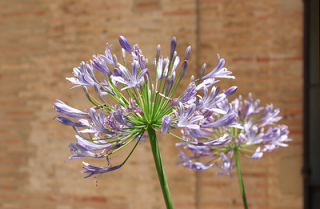
We spent the week doing lots of touristy things, and I took lots and lots of photos - quite a few of them like these:


(If anybody knows what those flowers are called, I'd be happy to know!)


So now I have to re-adapt to German timetables (and from the time this blog post is published, you can see that I was not doing brillantly today). At least we're not freezing here, it's about as warm as in Spain here...
0
JUNI
23
0

Hah. Summer blog pause.

Summertime is the time to get away (at least now and then), and I'm no exception - I will be non-blogging for a few days; I will be back with regularly scheduled posts on Wednesday the 29th.

I hope you have a splendid time until then!
0
JUNI
22
1

Leeds is creeping up.

It's amazing how time flies - the conference in Leeds which seemed so far in the future is now more like right around the corner. I'm not giving a paper, but I still have to prepare for this - packing (and figuring out what to pack before that), getting my conference gear together, choosing sessins that I want to attend, finding out what the exchange course is, all that stuff.

There are some things that I really like to bring to a conference:
  • working pens - that's a given, isn't it?
  • my conference book - so much neater than using a writing pad, and with the book, all my notes from conferences are in one place
  • something to read for relaxing in the evening
  • a usb stick
  • a camera
  • my computer - because there's heaps of stuff in there, and I might just want to show something to somebody
  • business cards (and maybe promo brochures)
I used to bring a laser pointer, too, since it can come in handy to have your own, but mine has somehow gone AWOL a good while ago.

Do you have a never-without-this-list for conferences?
0

By accepting you will be accessing a service provided by a third-party external to https://www.pallia.net/

Kontakt