Latest Comments

Guest - Aislinn Dyestuff Citizen Science.
09. Oktober 2026
This is a great project. I look forward to the results. Thanks for letting us know.
Guest - Aislinn Time for...
09. Oktober 2026
Looks delicious!
Guest - Katrin Sprang Discussion
18. September 2026
Hi Rachel, I have looked for more photos of you, but that was not very successful. I found a link on...
Guest - Beatrix Sprang Discussion
15. September 2026
That lozenge pattern element is not a photograph, but a scan. So it should be to scale. But I pinned...
Guest - Katrin Sprang Discussion
15. September 2026
I was not referring to Rachel's reconstruction (is the reconstruction you refer to the one photograp...
MAI
10
1

NESAT starts today!

One in every three years is a special year - because one in every three years it's NESAT year. NESAT, for those of you who don't breakfast textile conference proceedings, is short for North European Symposium for Archaeological Textiles (though it is not only northern Europe nowadays), and it's THE conference for textile archaeologists.

And I'm really happy, because today, NESAT starts - and I'm there. Not presenting, just meeting up with friends and colleagues and having a really good time with the lots of awesome papers and topics.

Though I'm away, blogging will continue - I've been busy pre-blogging, and if everything goes as it should, you will have a daily post as usual.
0
MAI
09
2

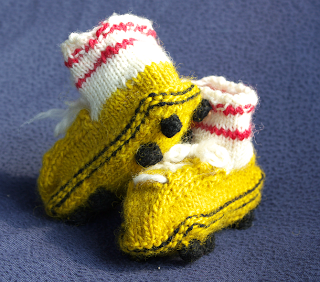
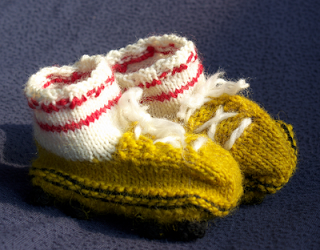
There they are. Soccer booties.

A few weeks ago, I wrote about a stealth baby knitting project. The item in question has, meanwhile, been finished, laughed about, gifted and has been favourably received by the mother-to-be.

And that means I can unveil them to you now...the soccer booties.
These soccer booties are based on a simple, basic bootie pattern with laces (Michelle Lo's "Sneaker Booties", free Ravelry pattern). The booties are worked cuff-down and in the round in the sock part, then the upper part of the shoe is worked in the flat. The sides of the shoe are worked in the round again, and the sole knitting closes off the bootie.
The booties were knit with different yarns, mostly about worsted weight, on 2.5 mm needles. I brought in colour changes and added bobbles to simulate the cleats on the sole. Working those in different, contrasting colours is what makes the finished item really pop – that, however, also means a lot of ends to weave in. You are duly warned.

Step 1:
Find out which colours to use. Do not skip this step – it is a safe bet that somebody who will be amused or delighted by these booties has a preference for a club. Clubs have their own colours. And choosing the wrong colours – that of the faved club’s main adversary, for example – will most probably lead to severe diminishment of both amusement and delight.

Step 2:
Decide on your colour scheme. You can work two colours in the socks or work the socks in one colour and the shoes in another (more or less neutral) colour. Modern soccer shoes are black, yellow, blue, red, white or brown; other colours are rather rare. The cleats come out best if they are knitted in a contrasting colour.

Instructions here are given for a two-colour sock (with two narrow stripes near the cuff) and two-coloured shoes. Photos are of the prototype; I tweaked the written pattern after that, which means it should come out a bit better now. Please let me know if you find mistakes!

Step 3:
Start knitting.
CO 36 sts in main sock colour. Join without twisting; place m to mark start of round.
Rd. 1-3: Work k2 p2 ribbing.
Rd. 4: k in sock contrast colour.
Rd. 5: sl 1st st, k in main sock colour.
Rd. 6-7: k in main sock colour.
Rd. 8: k in sock contrast colour.
Rd. 9: sl 1st st, k in main sock colour.
Rd. 10 – 15: k in main sock colour.
Rd. 16: k in main shoe colour.
Rd. 17: p in main shoe colour.
Rd. 18: sl 1st st, k to end.

Shoe upper starts now.
Setup row: k 18 sts, turn; purl 12 sts. Turn.
Row 1: (RS) k2, ssk, yo, p4, yo, k2tog, k2. If you prefer, you can slip the first st after turning in the shoe upper part; this can make picking up stitches easier.
Row 2: (WS) p4, k4, p4
Row 3: k4, p4, k4
Row 4: p4, k4, p4
Repeat R 1-4 two times more, then work R1 once.
Work 5 rows in stocking stitch (you end on a WS row). Turn.

Shoe sides start now.
Knit 12, do not turn. Pick up and knit 12 stitches along the edge; knit across live stitches; pick up and knit 12 stitches along the second edge. 60 st in total. Move m to current position (new start of round).
Rd 1-5: knit.
Rd. 6: purl.
Rd. 7: sl 1 st, p in shoe contrast colour.
Rd. 8: p 1st stitch in shoe contrast colour, change to shoe main colour, p to end of rd.

Sole starts now.
The sole is worked by knitting back and forth and knitting the last sole stitch together with the first live stitch from the shoe side rounds. You will work the basic rows (rs and ws), substituting a bobble row for the basic row in row 5, 11, 27 and 31.

Basic right-side row (odd numbers): k 11, ssk, turn.
Basic wrong-side row (even numbers): p 11, p2tog, turn.
Bobble row (work on r 5, 11, 27 and 31): k 2. Make bobble, k6, make bobble, k1, ssk, turn.

Make bobble: Bring in shoe contrast colour and work 7 st in next st by working the following: k, yo, k, yo, k, yo, k. (You can count the four knits to keep track.) Turn work, p 7. Turn, k 7. Turn, p 7. Sl 3 st to right needle, k 1, sl other st over this knit st, alternating between st from left and right needle. Take up main colour again and continue knitting with main colour. Snip off contrast colour, leaving a nice long tail.

When you have only 24 st left on your needles after R 36, graft the sole stitches together with the remaining live stitches from the shoe side rounds.

Finishing up:
Weave ends in securely. With the longer tail left after each cleat bobble, sew the bobble sides to the shoe sole for extra security. Block if desired, thread in laces.

Step 4: Laugh about the silly little soccer booties. Give to somebody-not-yet-walking to wear them. Enjoy.
0
MAI
06
2

Hooray! It's available - go download!

The moment has come - textile folks rejoice! Cathy stumbled across a new downloadable .pdf-publication on the Archaeology of York webpage, and this time, it's Textile Production at 16-22 Coppergate by Penelope Walton Rogers. That book has been out of print for a good while, and I dimly remember checking its price once, years back, and deciding it was way too pricey for my student's budget.

Now it's available for free download! You will find the download page behind this link. Enjoy!

And now I'm returning you to your regularly scheduled reminder post...
It's May already, and the deadline for the Textile Forum is drawing closer.

So please do not forget to register if you would like to attend this year's European Textile Forum in Asparn an der Zaya, Austria. We are going to focus on linen and other vegetable fibres, and it does promise to be very, very interesting!
0
MAI
05
0

Crafting and Fair Prices (again), part VI

 After the break for Freienfels and the CfP yesterday, here's finally the next post in the Crafting and Prices series - and probably the last one for a while.

Things are fairly easy from the buyer's side, as described in the last post - you either are willing (and able) to afford something, or you aren't. If there is no cheaper choice and you need (or really want) something, you have to pay whatever the asking price is.

If you are the crafter or the seller, you will have to figure out how much you need to charge per hour or per item to make a living. Pricing is a fickle game, because the market might be small, and there's competitors, and there's traps and pitfalls everywhere. If you charge too little, you ruin your own business and that of your competitors as well. If you charge too much, you might not sell, or might not sell much. And it's hard to tell whether you just need to find customers yet, or if your quality is too low for the price, or if there are other reasons why people do not buy. If you do not hold out long enough, or run into a streak of luck now and then, things can look pretty grim.

And the main problem in pricing, or at least one of the main problems for craftspersons, is the de-valueing by society. The system of demand and supply in itself has been tested over hundreds of years, and it does work. Things that are scarce are of higher value; things that take a long time, a master craftsperson, or lots of resources to make are scarce, and thus of high value. Items with a high value go for a high price, regardless of the reimbursement system.

Today, we have a trading system that can take into account the time and resources spent on developing and training, and that can make value easily understandable and translatable. It's money. A universal trading concept that envelops our whole world, that enables us to trade with somebody from the Philippines and somebody from Norway and somebody from Japan and US and Germany. Basically, there's nothing wrong with the system of supply and demand and currency as a general barter item.

The problem is one that has been there also for ages, and maybe only grown stronger with our globalised society: It does not take much to break the value of something. You only need to flood the market with something sold way under price, and people will flock and buy the cheap alternative. This will mean that you lose money at first. But if you are a large-scale entrepreneur and can afford to invest a few millions, or billions, or whateverillions, this is just a starting investment - because if everybody buys the item from you, the other people that offer the same goods, but for a fair price, will suffer. And eventually, they will have to give up. And once the competition is gone... you can up your prices however you like. Fat profits.

If you look around, that has been done again and again, on large or small scale. Buying good value for little money is a very tempting thing, and it's just human to do so. But there's a difference between getting a good (and still fair) price and buying something for much less than the asking price should be. Because the latter... it breaks the system. And we are all part of the system.

Buying for way under price, in time, will come back and kick us in the butt. Please consider this the next time you are tempted to buy cheap - especially textiles, but also other crafted things. Paying fair prices can help us all, while paying too little makes the system suffer. Buying fewer things, but for a fair price and in high quality does lend a different quality to life. It's not always possible, that is true - but do give it a try for yourself, and you will see that one-of-a-kind things, where you know the living breathing craftsperson who made it for you will change the way you look at things, and the way you value things.

We can break the system easily. But we can also be part of a revaluation of crafts, and handmade things, and high-quality things. In a world of mass-production, we can make crafted, bespoke items a status symbol and prestigious thing again, and craftspersonship a thing of value.

Think before you buy. Help making our world a better place to be.
0
MAI
04
0

Call for Papers - Renaissance Society of America

This came to me via the MEDTC-Discuss list, and I'm passing it on as per the request in the mail:

Call for paper: Annual Meeting of Renaissance Society of America, 22-24 March 2012 , Washington DC, USA.

Panel: Veil and Veiling in Europe, 1450-1650: Revisiting

From St. Paul’s letter to the Corinthians and Tertullian’s ‘On the Veiling Virgins’ to the decrees of the Council of Trent, the veil, and the custom of veiling women’s hair, has historically been the premise of discourse regarding gender and religious identity in early and medieval Christian societies. However, the significance and function of the veil became far more complicated in early modern Europe than in previous centuries as early modern European society experienced a crisis of order. Both religious and civic leaders reinforced the need for women to cover their heads and emphasized the veil, including its fabric, style, and colour, as an indicator of women’s different social statuses and, most importantly, their personal and familial honour or shame. Because social norms necessitated that every woman own some form of headcovering, the act of veiling, the refusal to don a veil, or even the way that a woman chose to wear the veil could reveal her regional or ethnic identity, political affiliation, or religious confession.

By using multiple disciplines and sources, it is possible for scholars to put forth a variety of questions about early modern veiling practices, including:
1) How did early modern Europeans define, or redefine, the veil?
2) How has the tradition of veiling challenged during the movements of the Reformation and the
Counter-Reformation?
3) What were the contemporary religious accounts of veiling women’s hair?
4) How did women consider the necessity to veil themselves?
5) Because the custom of veiling could vary from place to place, to what extent could women negotiate their right of expressing themselves under the legislation of local government and religious authority?
6) What were the consumption patterns of headcoverings, in general?
Above all, the session aims to question how we can reconsider the female experience vis-à-vis the veil and the practice of veiling in early modern Europe. Therefore, we would like to invite papers that focus on fresh materials, new angles, or special cases regarding the object of the veil and the custom of veiling.
Given that this was a global issue in the early modern world, papers concerning Asia and the Middle East are also welcome and will be presented as contrasting examples.

Please e-mail a short CV and a 150-word draft to both Mary Kovel (University of Arizona) Diese E-Mail-Adresse ist vor Spambots geschützt! Zur Anzeige muss JavaScript eingeschaltet sein. and Chia-hua Yeh (Queen Mary, University of London) Diese E-Mail-Adresse ist vor Spambots geschützt! Zur Anzeige muss JavaScript eingeschaltet sein. by the 20th of May, 2011.


Thanks to Hilary Davidson and the AHRC Early
Modern Dress & Textiles Research Network list for this announcement.

For more information about the conference see http://www.rsa.org/?page=Washington2012
0
MAI
03
0

I'm back!

... and I'm sorry for the blog silence yesterday; I had pre-written a note to tell you that I'm still on the trip home from Freienfels, but I seem to have missed hitting the "publish" button, so it did not go up.

Freienfels, while I'm at it, was very nice - we were situated nicely close to things, but still in a quiet side lane on the lower meadow, with nice neighbours and not very far to go to the loo container. (That is really an interesting fact if you have to make a dash to pee in a cold night!) Also, my husband came to accompany me, and that always means I get what I jokingly call "Freigang" - furlough to make a round over the market and hug hello to all the friends and colleagues.

In addition to the old friends, it was also a market with a few firsts: First time with a new brazier/fire bowl, first time on the lower meadow with the stall, first market with the full embroidery assortment, first time with a coffee pot in addition to the teapot we always take.

Most of the German markets require, as per their regulations, use of a brazier or fire-bowl to make fire. Fire pits - a very common thing a few years ago - are not allowed anymore. Most of the groups thus carry a small or large metal fire container, often round and with three longish legs to keep it well away from the soil and grass. We had an old slightly modified cast-iron barbecue, but were never using it very much. This spring, the most pationt of husbands stumbled across a ceramic fire bowl offered in an online shop, and we did buy it. Fire bowls or other fire containers are, I'm very sure, not what a medieval traveller would have lugged around, but ceramics are at least a more historically plausible use of materials for a fire bowl than metal. The bowl does not suck all the heat from a small fire, extinguishing it; it's not too heavy, and it does look nice. We are thus very content with how the first market with the bowl went.

Also concerning fire on markets, I'm very proud that after nursing my learning curve for a few years, in bits here and there, and most of the learning done by trial and error, I am now at a point where it is totally normal and no extra trouble at all to light a fire with steel, stone, and tinder. I have the method to build the fire pre-lighting down pat, and when there's wind, it is making fire the Zen way: just wait and watch, it will all burst into flames after a while. Fire-making has been made much nicer and easier by the addition of a wax-cloth bag holding straw (for the nest to put the tinder in) and small, thin slivers of dry wood (for building the fire). The bag goes into the basket that holds the firewood as well as a small axe, a folding saw (blatantly modern, so it gets hidden in the wood) and a pair of gloves to handle hot things. The rest of the kit for fire-making - a cloth bag holding tinderbox, steel and flint and a well-waxed wooden box with fine wood shavings - goes into one of the small chests that we have, the one that is holding my tableware and food-related stuff.

It feels like a good, solidly reliable arrangement now, and thus might last for a few years. And it was really, really satisfying to just start a fire, just so. And I'm already looking forward to the next time!
0
APR.
29
0

Crafting and Fair Prices (again), part V

read the start of the series

I left off yesterday with the question of an hour spent doing something that is part of general education and an hour spent doing something that you invested a lot of time for learning is really the same value.

If everybody knew that they will never get reimbursed for the time spent on learning a trade, on developing something, but only on the hours and materials used for actually producing the developed thing - what would happen? Would you like to spend a year living off your savings, knowing that you will never ever get back what you spent? Can anybody afford that?

If learning and researching and developing new solutions do not hold the promise of reaping the benefits of hard work and lean living later on, they lose a lot of their charm. If you could work one hundred hours on improving a loom to work half as fast again on the new loom, would you do that to churn out half as much cloth again - but lose the hundred hours and not get more value for your work, because you are paid in time-swap values, and not by metres of cloth? You lose one hundred hours' worth of value. Or you could use your old loom and get time-swap value for these hundred hours. It's an easy choice, I think.

Learning, reasearching, improving things and trying out new solutions is a cornerstone of our western culture. Learning of - apprenticing for - a specialised skill is the very foundation of our society. Division of labour means that I do not have to do my own dyeing, my own planting of food and harvesting, my own blacksmith work and tanning work - I find a trade that matches my interests and talents, and then I can trade with others. Everybody wins, because everybody gets better quality items: Fabric that is spun and woven properly and holds up to wear; crops that are healthy and nutritious because they were grown by an expert; knives that will cut through material, holding a good edge for a good while. Humans are not totally stupid all of the time, and I am convinced division of labour set in at a very, very early stage. It's just natural to ask your neighbour if he or she would be willing to tan this piece of hide for you, when in exchange you can retouche their household's flint scrapers into that new, more efficient form.


Learning, researching and developing have always been a valuable investment in our culture - because they hold the promise of more benefits later on. Of reimbursement. Because we are not calculating hours spent on producing something - we are calculating value of products. And that value of products is more than just the sum of time spent on the piece and materials used for making it - it's also the creativity of the maker, the years of research and experience, the special talent. And, of course, something can rise in value because it is coveted by a society and sink in value because it is not.

The value of an item is never objective. It is always a very subjective thing, and it can be vastly influenced by a person's current situation. If you are stranded in a desert and you really, really need water, you will probably be willing to pay a much higher price for it.

There's a scene in Out of Gas from Firefly that does say this beautifully: "Catalyzer's a nothing part, Captain." "It's nothing 'til you don't got one. Then it appears to be everything."

And this is the basic problem, and the ultimate opportunity as well. If we are trading value of products, I have to decide upon a thing's value for me and my situation, and that will tell me if the price asked - no matter in what form that price is to be paid - is acceptable for me. To evaluate the price of an item, I have to know a bit about it and its quality - whether the material and the production quality are good, and whether it will be as practical or decorative or whatever as it should be.

For this, I need to know things about the item. That will be no problem if it is something that I commonly work with - like textile or a textile tool; I know what I am looking for and I know what to look out for. But with something that I am no expert in? That's where I have to rely on the craftsperson selling to me. Or the sales agent. Or whoever does the selling - to give me good advice about the thing I need and to help me find the best match for my needs, for a price fair to everybody concerned. And then it's up to me to decide whether I want to pay this price or not.

continue with part VI of this series

0

By accepting you will be accessing a service provided by a third-party external to https://www.pallia.net/

Kontakt