Latest Comments

Guest - Aislinn Dyestuff Citizen Science.
09. Oktober 2026
This is a great project. I look forward to the results. Thanks for letting us know.
Guest - Aislinn Time for...
09. Oktober 2026
Looks delicious!
Guest - Katrin Sprang Discussion
18. September 2026
Hi Rachel, I have looked for more photos of you, but that was not very successful. I found a link on...
Guest - Beatrix Sprang Discussion
15. September 2026
That lozenge pattern element is not a photograph, but a scan. So it should be to scale. But I pinned...
Guest - Katrin Sprang Discussion
15. September 2026
I was not referring to Rachel's reconstruction (is the reconstruction you refer to the one photograp...
OKT.
12
0

Masterpieces.

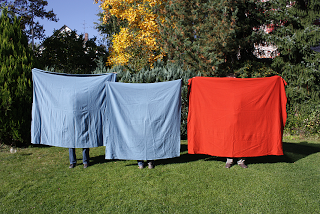
I'm not only working on the figurines, I have also now all I need for getting started on the garments - which means fabric. Nice, beautiful woolen fabric, plant-dyed to perfection.

That's indigo blue and madder red...


... and weld yellow and cochineal pink.


Spotless. Beautiful. I'm in awe.

Now to finish the two figurines far enough that I can start cutting garments from those masterpieces...
0
OKT.
11
0

Quod erat demonstrandum.

I finally have indubitable proof for a theory that must have existed since the beginning of humanity:

Men...


 ... are much more complicated...


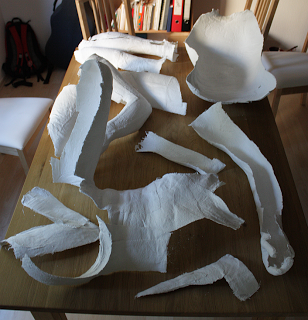
... than women. Really. Just count the parts.

The longtime readers among you might remember the two figurines that I made for the exhibition at Hartenstein, and there has been a second order - this time it's a man and a woman in normal, civilian dress. And yesterday, two of our friends came over and I took the plaster casts for the figurines off their bodies - a heap of work, but a lot of fun as well!

Now comes the assembly part - putting together the shell and filling it with construction foam and a wooden cross for additional strength and especially to attach the arms later on. The woman is already sitting on a table waiting for the first foaming steps - once I've finished this blog post, the glue on the wooden inner structure should have set and I can get going. Fun!
0
OKT.
08
0

Fascination of Fire

Those of you that know me in real life will know that I have a strong fascination with fire - if I see a fire burning and have access to it, I can seldom resist from sidling up and poking a bit around in it.

So it's no wonder that I spent a good while (read: too long a while) on YouTube yesterday morning, looking at fire-making videos. I had actually thought about embedding one that shows basic firemaking in yesterday's post, but did not find one that suited my purpose. Instead, I learned that punk wood (rotted dead wood) makes wonderful tinder material, and that there is a technique called "floating hands" for using a fire drill.

There's oodles of videos about making a fire out there, but actually I always found that getting the spark to catch on the tinder material is the easy thing (just takes more patience when it's damp), and making a nest for the ember and blowing that into flame is also not really hard (might also take a bit of patience when it's damp, but we've done it successfully with half-dry grass); I found that the hard bit is to get a real fire going from the good and hot nest - and there was no video showing that. Getting a fire going from the embers is, of course, easy with the perfect materials and in nice, dry weather, with a ground and wood that is not soaked through and cold, but in my experience, that perfect setup is rarely there when I want to make a fire - so you have to use techniques that will even work in the cold and damp, and with less-than-perfectly dry wood. And that was just what I couldn't find.

Still was time well spent. And now I finally know how to mix up that scrambled egg or that pancake batter with a whisk twirled between my hands without having to stop every five seconds to bring my hands to the top of the whisk stem again.

0
OKT.
07
0

Fire-making.

It's utterly amazing how many small things that would be nice to have or get done can turn up during a market/camp weekend - things like a new bag for my flint and steel, making new tinder, a bag for small woodbits and even smaller kindling to make starting the fire easier, mending a dress and mending a basket, and so on and so on. And this time around, I have actually more or less kept track of a lot of those small things, and a few of them are already taken care of as well - like refilling the tinder box, and starting work on a bag for kindling. I've even made new kindling already, since I know that I'm not so keen on getting to work with the hatchet once I'm getting hungry and cold, so if there's not tinder, hay for getting the embers started, wood and kindling readily available, I opt for buying something to eat and either going to an already burning fire or retiring into bed. And while both of these are good, nice and valid options, I'd like to have the possibility to just start a fire when I feel like it, and maybe have a nice cup of hot, freshly brewed tea while I have it running. Plus, finally starting a fire properly and all the way through felt so good at Tannenberg, after I had not done it for ages, and I found I really missed it.

We started trying to make proper, medieval-style fire years and years ago, and our first tries were more than pathetic - it would take us more than half an hour, several tries and three to four people blowing on the nest of ember, coughing in the thick, dense smoke coming out of it, and doing all kinds of things with a slight touch of desperation. And it did take a long time until we figured out the differences between starting a fire the modern way (with a lighter or a match) and starting it the old-fashioned way (with embers).

First of all, there's a huge difference in how the heat travels. Flame heat travels upwards, so if you want to light something with a flame, you light it from below and put the kindling on top. But embers work differently - they glow their way downwards and outwards from their nest of kindling. So if you want to light something with embers, placing the something on top of the ember won't work as well as placing it below them.

After that piece of insight finally found its way into my brain, it only took a medium long time for me to start realising something else: When the nest of embers and the kindling below it sit directly on the cold earth, there's a good chance that the heat from the little nest will be far from enough to counter all that cold. And the ember will die before the kindling has caught. That was when I began to start building the fireplace by placing a large-ish piece of dry wood with a flattish surface on top under the kindling and stuff - preferably a slab of wood that is already charred partly. This helps tremendously.

So my current setup is something like this: Slab of wood underneath it all; then comes the kindling in the middle of the underlying slab, set up mostly like a log cabin (two bits parallel to each other, then the next two parallel bits at a 90° angle across the previous two, and so on), but growing gradually wider towards the top. Around this small inverted-pyramid-log-cabin, I make a slighty larger log cabin setup from fuel wood that reaches as far up as the inner kindling one. This is both serving as a kind of flue to direct air and as the fuel wood to catch the starting fire. Then I catch a spark on the tinder (charred cotton cloth, usually) and place it into a smallish nest of hay with some small wood shavings and maybe a bit of birch bark in it. I fold the nest and blow on the ember until the nest has flamed up briefly once, then I put it into the inverted pyramid, place a last bit of fuel wood on top of the nest so that it stays compact and doesn't pop out again - and ideally, then I can just lean back and wait for about ten minutes to see everything erupting into a nice flaming fire. (Non-ideally, there's still some need for blowing gently but firmly on the ember nest.)

Oh, and a nice added benefit to lighting a fire with flint and steel? If there's a strong wind blowing, that might blow out your flame from a match or lighter, but it will actually save you work when doing it this way. Nifty, eh?
0
OKT.
06
0

Chomping at the bit...

Hartenstein project is progressing, though I have not done much myself yet - but the cloth is being dyed and will soon be sent here, so I can get started with serious tailoring and sewing. I've already been told that the red, yellow and blue have all turned out very, very well, so I'm utterly excited to get my fingers on the fabric soon.

Apart from this waiting game, there's some other stuff for the project to be bought, planned, and prepared - a good way to spend the rest of the week, of which not much is left anyway, today being Wednesday already...
0
OKT.
05
0

Back home - and Summer Season is over.

Tannenberg usually is for me the last LH-event of the season, and since that is over now and we are back home, summer season is over.

This year's Tannenberg was a tad different from others - first of all, the old organising team has quit and used this year's event to show a new team the ropes. That also went hand in hand with a slightly different setup regarding the tent places. Then it was uncommonly warm for Tannenberg - I didn't feel cold once during the nights, and it was warm enough to just sit in a dress on Sunday. And that's the next unusual thing: we had a bit of light drizzle now and then on Friday, a bit more of drizzle on Saturday, and sunshine on Sunday - and you can probably estimate how uncommon that is for this event if I tell you that a lot of people commented Saturday's drizzle with "My, aren't we lucky with the weather!" (and that was no irony).

Apart from this, it was also a quite decimated event - many groups did not come at all due to not getting off from work, broken-down cars or a case of the 'flu, and those that did come were often much smaller than registered, like three or four people instead of seventeen. This all made this year's season finale a very laid-back and relaxed thing - and I actually followed through with my plan to have 80% holidays and just 20% work, having nice long chats with old and new acquaintances that weren't even all textile-related, sitting around our own fire or visiting our neighbours, and I even read a little in a novel I brought before going to sleep in the evenings, all things that I thoroughly enjoyed. So for me, it was a very nice and very relaxing season finale, and now I'm ready to tackle all those little chores that need to be done before putting away the things for the winter...
0
SEP.
29
2

Eh.

Today's prep day for Tannenberg - I'm going to shop for some food and maybe pre-pack a bit, so stuffing things into the car will go faster tomorrow. And I'm looking forward on hanging out with friends for a few days again (and probably take it as easy as I can, for a change).

I already have a new demo warp for tablet weaving - the old one I had somehow got roughed up over time and is not really what I like to show anyway, since the tablets are a mishmash of parchment and playing cards and the warp is thick red and beige wool yarn. The yarn itself is nice, mind you, but it's just neither the type nor the thickness that would have been used to weave a twill band with, so out into bad idea nirvana it goes.

The new demo band is made with silk thread in light pink and medium blue, is a dozen tablets wide (all parchment, this time) and woven width is about 5 mm or so (haven't measured yet). And while starting the weave, I found that after working with 42 tablets the last time I did serious tablet weaving, 12 of the little things is really fast and easy to handle, so my plan is to look into the suitability of tablet weaving as a demonstration at Tannenberg - although that does depend a bit on whether I can find two spots to fix my band to...

Oh, and by the way: Since we'll be leaving early tomorrow morning, there will be no blogging until next week.
0

By accepting you will be accessing a service provided by a third-party external to https://www.pallia.net/

Kontakt