Latest Comments

Guest - Aislinn Dyestuff Citizen Science.
09. Oktober 2026
This is a great project. I look forward to the results. Thanks for letting us know.
Guest - Aislinn Time for...
09. Oktober 2026
Looks delicious!
Guest - Katrin Sprang Discussion
18. September 2026
Hi Rachel, I have looked for more photos of you, but that was not very successful. I found a link on...
Guest - Beatrix Sprang Discussion
15. September 2026
That lozenge pattern element is not a photograph, but a scan. So it should be to scale. But I pinned...
Guest - Katrin Sprang Discussion
15. September 2026
I was not referring to Rachel's reconstruction (is the reconstruction you refer to the one photograp...
MAI
13
2

Day(s) off...

Today is a holiday here (which I totally forgot to mention yesterday), and though I am blogging today, it is only to take this day off - and the next few days as well: The most patient man of them all has taken tomorrow off, making it what we call a "Brückentag" (literally: bridge day) to extend a holiday on Thursday into a four-day weekend*. Since I'll be working on Saturday at the "Long Night of Museums" in Dinkelsbühl, I'm taking today and tomorrow as my weekend.

And in addition to tomorrow, there will also be no blogging as usual during the next week, since I am off to make the thread analysis for the spinning experiment. I don't know yet how long this analysis will take, so expect me back when you read me, and meanwhile, have a wonderful time!


* I am totally amazed that this seems to be unknown in the US, according to Wikipedia. Whoa, no Brückentage? Oh horror!
0
MAI
12
1

It is Rhubarb season!

Each year in late spring/early summer, the time to eat rhubarb has finally come. I'm always looking forward to this time of year - I love rhubarb, especially as part of a cake with lots of other good stuff in it.
Since this wonderful "vegetable" is only in season until the middle of June, I am a little late for starting off the season - but then the early spring weather around here has not exactly been promoting lots of growth, and this shows.

So yesterday was partly set aside for eating rhubarb cake (with Streusel, of course) and for having a tiny celebration of the book and its first success moments - at the Uni where I wrote most of the thesis. And I'm having only a very moderate bad conscience about that, since a celebration and some thank-you cake for the people there were clearly very much in order, and I only have some very few photos of the experiment samples left to do anyways... which is what I will be doing now. To my very great relief, all the samples are in wonderful condition, nothing untoward has happened (no unexplainable falling out of their bags and mixing up samples and tags, no disappearing of things, no stealth moth invasion through several layers of plastic - yes, I did have weird nightmares about things like that) and thus I am very much looking forward to the analysis. I will be allowed to do the length measurements by myself, and after that we will have to look how much else I can do or if there are things that need to be done by professionals, and work out some good solution. All very exciting!
0
MAI
11
4

Broaden the Horizons, Widen the Skillset.

If anyone of you is looking for a way to widen the skillset and learn a heap of new things as autodidact, I can only recommend running a conference with an archaeological experiment. It is amazing how many things you can hone on that - including not only computery stuff like database wielding, but also things like photographing.

I spent the day yesterday behind the camera and a photo-tent (for good lighting). In the photo-tent? A sheet of paper with orange millimetre-grid and changing motifs (but all of them similar, and very wooly). And I progressed from photos like this,


when I started fiddling with the settings,


to this as the final result:


All photos are taken with a very long exposure time and a very small aperture to get a high depth of focus. I'm very happy that my camera has a setting exactly for things like that, which means that once I set up the label and wool cop, I only have to press the button once and then wait until the camera on its tripod has taken three pictures with slightly different exposure time...

Today I will take the rest of the photos, which is easy work but more than a bit boring, since the long exposure time means that it takes about two to three minutes for each item to finish. And in that time, I can more or less just stand around and be bored...
0
MAI
10
0

Hooray again...

First feedback about the book is coming in - and it is making my day, all the positive comments on the book. Add that to just having had a wonderful weekend, and I'm feeling a lot like taking the day off for celebrating and relaxing. But, alas, that is not possible - there's too much work forming interestingly-shaped heaps both in my brain and on my desk, waiting more or less patiently for my attention.

So... no partying on, except in spirit, but instead preparing for the final analysis step of the Forum 2009 experiment, preparing stuff for Forum 2010, and doing a myriad other things too... one after the other.

If you are looking for me and can't find me, just watch out for a moving heap of work - I'm probably buried beneath that and having a quiet snack on emergency chocolate...
0
MAI
07
4

Craft perfection and craft perception.

Do you know that feeling that to some events, there is something like a secret topic? One of the main chat-topics at Freienfels was quality in crafts and the ability or lack of that ability to discern good craftspersonship from bad craftspersonship and good material from bad. It seems to be a thing very much on the surface of the mind of many sellers and of many crafters at the moment - both joy about the fact that there are still people who value good craftspersonship and sadness about them being quite few and often restricted to medieval markets and fairs.

That is, in my opinion, largely due to the fact that even basic skills in craft things are not much valued in most parts of society today. It is no longer obligatory for girls to learn how to sew and embroider or for boys how to carve and build little wooden boats, giving both sexes at least a small grounding in fine motor skills and a glimpse into craftspersonship. After this gender-specific basic instruction in crafting had been in use for a long time, I was one of the lucky generation(s) when I was in primary school - because in my time, all boys and all girls had to learn how to crochet, sew, embroider, saw, file and drill, in the aptly named "Handarbeit und Werken" (Handarbeit referring to "traditionally feminine", textile-centric work, and Werken to "traditionally masculine" work involving hardware and wood). Back then, I mostly hated the Handarbeit part and especially sewing by hand - there are machines for that, after all! However, these lessons gave me the basic knowledge about seams, stitches and textile work and they schooled fine motor skills. Some of today's schoolchildren do not get any of these lessons anymore - and that does indeed show when they try to get started with the stuff. While I will gladly accept the necessity for the next generation(s) to get acquainted with electronics in a young age and develop their computer skills, I think that neglecting a basic craft instruction is not good at all. For example if you don't know how to mend clothing, you can either walk around with the torn garment or throw it away and buy a new one. And if you have never tried your own hand at making something, how will you be able to evaluate good quality?

There is a special, deep joy in seeing a masterly piece of crafts, even if you know you can't afford to buy it. I have had tears coming into my eyes quite a few times, standing before a thing awesomely well made - a knife forged to perfection, a felt bag masterly done in a very difficult technique, a pair of shoes where every seam, every stitch spoke of the abilities of its maker, a spherical wood capsule that closes just firmly enough, turned to perfection on a lathe. The ability to perceive good quality of material and craft does not come by itself, but has to be trained - it is easiest to see for somebody who has already dabbled into that specific craft, because then you will know or at least have an inkling of the difficulties in making the piece. And then a masterpiece of craft - it can be well and truely mind-boggling.

I am sorry for everybody who has not gotten some grounding in basic craft skills when still a youngster, and I am sorry for everybody who cannot get this joy through craft perception for at least one single craft. And then, quite related to that... I am still hoping that the awareness of good quality and the appreciation of craft skills will creep back into our society, and I am expecting the day that a well-made handcrafted one-of-a-kind item of good material will again be something to show off your status - because that is when we craftspeople will be sought after once more. And when joy through craft perfection and craft perception will again grow in our world.
0
MAI
06
0

Normalising... normalising...

Things here are slowly getting back to normal - the washing machine is working hard to clean all the linen stuff that I wore during the last week (which is lots), and I'm stowing away tools and supplies that I had in use. There's some stuff to mend and clean too, as always.

Freienfels had a few wonderful, amazing highlights for me. I was involved in a children's project where 3rd- and 4th-graders from schools in the district had one full day to spend at Freienfels, with special programme. Part of that programme was a three-hour workshop in a medieval craft - felting, basketmaking, potterymaking, blacksmith work, and so on. My crafty disciplines for the children was spinning and fingerloop braiding.

We all had a new group on each of the three days, and as always I found it amazing how different groups of workshop participants are. You can't see into a person straight away, but from the way that somebody handles difficulties and tools, and from the way somebody works at a craft, you can get a tiny glimpse at the character of that person. Apart from that fascination, I was quite disappointed in modern children's fine motor skills. Especially the very first group I had at Freienfels was a nasty surprise, since on my last workshop with that age group I must have had very talented children or children with well-honed fine-motor skills. However, I managed to teach every single child during those three workshop days at least one variation of fingerloop-braided bands - and that is definitively a good feeling. It especially makes a highlight for me since I had a few children in there who really had to work very, very hard to get into the braiding motions - but they were very strong and very determined, and they all made it. It makes me proud that they did not give up but persisted - since that is a quality that everybody will need during all of life, and I feel privileged in having helped them develop their persistence.

All these children now have a braid or several to prove that they did not give up but mastered the challenge. My hope for them is that the next time they are close to giving up, they will glance down on their braided bracelet and remember... and then boldly go on to persist, to master the next challenge, and turn their life into their own, wonderful adventure.
0
MAI
05
1

I'm baaaaaaack!

I am back from the longest Freienfels I ever had - eleven days away, counting the day for arrival and departure.

Freienfels was chock-full of things that would make blood boil either with pleasure and joy or with outrage. It was full, full, full of wonderful people with amazing talents, and there was beautiful craftspersonship to be seen, just as I had expected. More things happened than I can tell in this little blog entry, especially since I still have my heap of paperwork left to do from before Freienfels, but maybe I'll tell a story or two one of the next days.

Running my own little stall right beside the Wollschmiede meant that I did not find the time for a leisurely walk and shopping trip all over the market, though nevertheless I managed to spend some money for more or less needful things - we now have a good bread-box, made of birch bark, and I am the proud and happy owner of a "Zwirngefäß" after a find from Pfakofen:


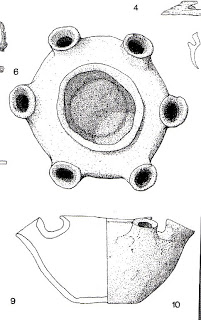
It is a pot with a large  central opening and six smaller spouts all around; together with this go six small bowls. The setup can be used for plying multiple yarns together, but (as we were able to test at the last Textile Forum) it is also a wonderful help when warping for tablet-weaves. I had always lusted after one of these tools, and after testing it at the Forum even more - so at Tannenberg, I ordered one from Anke, specially prepared for fine, delicate threads. It is polished at all the places where a thread will touch the surface - and I am totally looking forward to testing this little darling.

Yeah, my very own Spouty Pot!


Picture from: Bartel, A. (1998). Das Tüllengefäss von Pfakofen, Lkr. Regensburg - ein seltener Fund aus dem frühen Mittelalter. Textiles in European Archaeology. Report from the 6th NESAT Symposium 7-11th May 1996 in Borås. L. Bender Jørgensen and C. Rinaldo. Göteborg, Göteborg University, Dept. of Archaeology. Series A, vol. 1: 139-150. Picture on p. 142.
   
0

By accepting you will be accessing a service provided by a third-party external to https://www.pallia.net/

Kontakt