Latest Comments

Guest - Aislinn Dyestuff Citizen Science.
09. Oktober 2026
This is a great project. I look forward to the results. Thanks for letting us know.
Guest - Aislinn Time for...
09. Oktober 2026
Looks delicious!
Guest - Katrin Sprang Discussion
18. September 2026
Hi Rachel, I have looked for more photos of you, but that was not very successful. I found a link on...
Guest - Beatrix Sprang Discussion
15. September 2026
That lozenge pattern element is not a photograph, but a scan. So it should be to scale. But I pinned...
Guest - Katrin Sprang Discussion
15. September 2026
I was not referring to Rachel's reconstruction (is the reconstruction you refer to the one photograp...
MäRZ
22
0

It's spring, finally.

The snow has been all gone here for a few days now, and the temperatures are high enough to go out without a jacket on the warmer days. Most of all, the garden shows spring growth, and we are totally curious to see what perennials and what flower bulbs our predecessors have left us.

I planted a few tulip bulbs in December, just after we moved in here, and there are some more plants coming out now that were left in from before. Crocuses and snowdrops grow on the side lawn (not many of them, though), but mostly, the stretches of flower beds that surround the path to the house and the front lawn are empty. Which means that we will be doing some planting this year - some plants for the eyes with nice leaves and nice blossoms; some plants for the nose, with good scent; some plants for the palate, to use as herbs or as herbal teas; some for the bees and bumble-bees to feed, and some plants that I just fancy having in the garden, like mandrake and madder. And we hope to get the garden set up with plants hardy enough to prosper year after year, and enough of the growth to keep the weeds down and the beds nice...
0
MäRZ
19
0

Comment Policies

This little blog of mine has gained enough importance to slowly become a target for spammers, it seems. Because spam-type comments have turned up only very seldom in the past, I have never voiced any spam-comment policy, but I feel that it is time now to do so.

If you have tried to comment on an older post, you will have found that comment moderation is enabled. Fresh posts can be commented on without moderation (pun intended), but screening comments makes it easier for me to nip a multi-post comment spam attack in the bud (there were about two of these already, and cleaning them up takes time and gets on my nerves in a major way).

As to the rest... I feel that freedom of speech is an important thing, and I also think that the internet is a very good and very valuable platform to say (write, that is) what you mean, feel, and think. However, I also feel that a blog post and its comments are something like a conversation between blog author and commenters, and if I'm standing around in real life chatting with a bunch of people about, say, ice cream flavours and discussing their impact on the environment and somebody suddenly starts to praise an ice cream factory that is known to mine the last glaciers, grand-style, for ice, or suddenly intrudes on the conversation with a speech about how we should all convert to the Church of the Holy Spaghetti Monster and dress up like pirates AT ONCE... I would feel quite pissed off.

And since these spammers are just delivering their bit and turn away again at once, it isn't even possible to start discussing them into the ground about how mining these last glaciers is the worst thing ever, and so on.

So here's the official comment policy: Comments are more than welcome, whether they agree with me or disagree with me, as long as there is some connection to the blog post they belong to. Unsolicited advice on what, where or how to buy something, product placement including unrelated blog or website placements*, buy-here links and other spam-type comments whether religious or not, will be deleted from my blog. Abusive comments may also be deleted. Comments are moderated for older posts to screen out the bad eggs before they turn up, saving you from disappointment after you click to see the new comment.

That's it. Now... comments, anyone?

* Pointing out a website or blog that is related to the topic of the blog post, or to the general topic of the blog is very welcome, of course!
0
MäRZ
18
0

How d'you like your baths?

I cut the two bits (if you can call 2,9 m of cloth 2 m wide a "bit") of fabric for the side walls of the tent yesterday, and that should have been the last bit of cutting from the bolt for this tent. There's still some bolt left because we have a bit extra just in case and some more extra for making a crawl-in small, additional sleeping tent - what you'd call a "Dackelgarage" in German (translates as dachshund garage, yes, really).

The two side-wall cuts are currently taking their second bath in the tub, which will run the same course as its first bath and the two baths of the main piece: Run the tub with water as hot as it gets from our tap (which is plenty hot), dump in fabric, poke fabric under with a stick-like implement (also called a bath brush). Dunk fingers into water occasionally and swear (plenty hot, right?). Open bathroom window and keep open to let the steam get out.

Return to bathroom periodically to do some more poking and swearing. After a while, grab submerged tent fabric (possibly swearing) and rearrange in hot water.

After a much, much longer while, decide that water is cool enough to give the tent some additional tender loving care by trampling around on it. Take off shoes and socks, roll up trouser legs, get into the tub (possibly swearing again) and take turns around the tub, walking on every bit of the submerged fabric.

Get out of the tub again and realise that the water was still beyond "warm" and even "hot", but all that time hadn't been enough to get it cooler than "boil-a-lobster". Admire bright red colour of feet and legs. Optionally: Walk into the living room with bare feet and trousers still rolled up to drink the rest of your coffee, shocking a visiting friend with the colour in that process. Grin.

Drain water from tub and get the fabric to dry.

I'm currently at the "check back and poke periodically" stage with this bath, so I can still look forward to some bright red colour today!

Full points to you if you can catch the book quote in this text and pinpoint book and author.
0
MäRZ
17
0

The Way my Days are spent.

For a while now, my days are spent like that:
I get up, I make myself a pot of tea, I sit down with it at the computer and spend most of the morning with reading and answering e-mails, blogging, and other computer stuff.

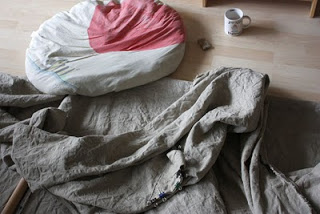
And then, my workspace is shifted to a spot on the livingroom floor that may look approximately like this:

Well, sometimes (for preparation of smaller bits) I even get to sit down on the sofa, but for the most part, tent-making means floor-sitting. Note the large cushion to sit on. The little rectangular thing is my block of beeswax for waxing the sewing thread (a very thick, sturdy linen thread), and beside it there's my cup of tea. The text on the cup, by the way, says "Alles unter Kontrolle" (which means "everything under control"), and that's an expression of hope, most of the time. What you can't see from the photo is that I amuse myself with nice music while I'm sewing. That is one of the perks of that job, I think - you sit down quietly, your hands occupied, and can just relax while having favourite musicians entertain you.

But you are probably more interested in the tent right now?
Here is one of the main constructive elements, innocent-looking as it might be:


This is the corner bit for the right-hand back corner. Its job? Holding up the crossbeam and tensioning the fabric across the upper edge of the back wall. There's an additional tunnel to be added that will cover most of the crossbeam and distribute the stress on the fabric more evenly, but the tent would function with these cornerpieces without additional tunnels.

And here's a closeup of the work on one other innocent-looking constructive detail, the pocket for the sidebeam in the top front corner:

It is a little blurry, but you should be able to make out the needle I use (one of the two needles, the other one being below the fabric at the moment). All seams are done in saddler's stitch (more or less saddler's stitch; there is no half-hitch in the stitch where the two threads cross in the fabric). Aside from a measuring stick, needles, a pencil and my resurfacing mathematics skills (right-angle triangle sidelength calculation, anyone?) you can also see another of my all-important tools for the tentmaking: binder clips. They are incredibly useful in marking a spot, holding down a fold or fixing something into place until it is sewn down. No tent-sewing without them for me, thank you!

 (By the way, did you know that the official German name for binder clips is... "Foldback-Klammer"? Very German, eh?)
0
MäRZ
16
2

It's going black and white (and coloured)!

Sorry, but no photos yet - the camera battery pack needs recharging.

However, I have different good news: The book is scheduled for the actual print run this week! Hooray!

I won't attempt to blog much more than that today, because just thinking of the book going real-ink-on-real-paper... well. Let's say I'm not thinking of much else today.
0
MäRZ
15
0

Tent Stuff

Sorry for the belated blogging - the Firefox update somehow slowed me down a lot.

While Sunday was a nice day for relaxing and taking a walk in one of the neighboring towns, I spent most of Saturday very diligently working on the tent fabric. Waterproofing tests are still running, though a favourite seems to be emerging by now (oil cloth, by the way, really stinks).

The main constructive element is sewn, and I am now working on the next bits - the anchor points that will keep the wooden structure for the back of the stall in place on the fabric. And after that, it will be time to provisorially put up the tent and see where the rest of the anchor points will go...

And tomorrow, I will hopefully have some pictures of the tent construction details already finished.
0
MäRZ
12
0

Finally: The Call!

Not only one, but two (almost three) calls that I can call out here today. If you know somebody who might be interested in either of these events, please pass the Call on!

First of all, the Call for Papers for the EXAR conference 2010 is up and running. EXAR's topic is Experimental Archaeology in Universities 2010. You can get to the full invitation and the registration form for the conference in Berlin, which will take place on October 8-10 2010, via EXAR's website.

And then there is the Call for Papers and Call for Workshops for our own dear Textile Forum:

Working in historical textile crafts can be a very lonely affair. To help remedy this, we are again organising the European Textile Forum for people working in historical textile crafts. The event will take place September 6-12 2010 in ArcheoParc Schnals, South Tyrol/Italy.
The programme consists of three parts: Free time to work, try out things and talk about textile techniques in the mornings; the possibility to attend workshops about historical techniques in the afternoon; and a series of short paper sessions in the evening hours. We would like to present current projects, reconstructions, technical problems or research work during those talks. Poster presentations, including a "show-and-tell" of your current project in progress, are also very welcome.

The museum that generously hosts our Forum is very close to the place where Ötzi was found, in a valley in the South Tyrolean Alps. With this quite early background for the Forum week, we do not want to set a focus on single techniques; instead, we would like to think about and discuss the question of what makes a textile. Is it the material? The production technique? The use? The properties of the piece? What is the difference between a mat woven from grass and a mat woven from stiff threads? What concept does every single one of us have in mind when the word "textile" falls?
Papers or posters about this topic, or papers and posters about objects that are not "standard textile", are thus especially welcome.

We want to give up to thirty textile experts and enthusiasts the opportunity to meet at the museum for one whole week, each with his or her project(s), and there is free time to work, chat, demonstrate and talk about textiles and textile crafts during the day. The museum is open to the public and we welcome other weavers, spinners, dyers, to come so they can also sit, work and talk with both guests and participants. With this opportunity for everybody interested in textiles, we want to help establish a better communication between professionals and non-professionals like Living History enthusiasts. Evening paper sessions and workshop participation are for participants only.

We have organised an accommodation and full board for the participants. The lodgings are two- to six-bed rooms in a guesthouse, all rooms with shower and toilet en suite. If you prefer a more luxurious room, you can book your own accommodation in Unser Frau in Schnals. Full board consists of breakfast, lunch and dinner; water to drink will be available at all times, and coffee or tea can be bought at the museum café during the afternoon and the evening. Meals will be served in the museum café, providing even more opportunity to talk textiles. The conference fee, including accommodations and full board during the week, is 350 Euro per person. Workshops can be booked at additional cost.


For the Forum, we are looking for both paper or poster presentations and workshop offers. Workshops will take place in the afternoon and can take up to four hours per afternoon. They will be booked separately by the participants, and teachers will receive a reimbursement.
Due to space restrictions, there will be no market held at the Forum this year. We regret having to take this decision, but we hope to offer you a market opportunity again in the next Forum. However, we will put up a little "exhibition stand" for small goods, info leaflets or books that participants might want to present or sell on Saturday. If you have something for the exhibition stand, please contact us per mail and tell us about it.

To register for the Forum with or without a poster or paper presentation, please submit your current area of research, the title and abstract of your presentation (papers not longer than 20 minutes) until May 2 via the registration form http://www.textileforum.org/register_2010.html. If you would like to offer a workshop, please register and send an e-mail to Diese E-Mail-Adresse ist vor Spambots geschützt! Zur Anzeige muss JavaScript eingeschaltet sein. telling us the title and topic of your proposed workshop, time and space requirements, minimum and maximum number of participants and the cost per person (workshop cost plus approximate cost for materials). Please note that workshop offers have an earlier deadline and need to be made by April 15. The Forum workshops will be announced on the website on April 20.

For any questions left, you can contact us directly via Diese E-Mail-Adresse ist vor Spambots geschützt! Zur Anzeige muss JavaScript eingeschaltet sein..

We are looking forward to a wonderful conference with you!
0

By accepting you will be accessing a service provided by a third-party external to https://www.pallia.net/

Kontakt