Latest Comments

Guest - Aislinn Dyestuff Citizen Science.
09. Oktober 2026
This is a great project. I look forward to the results. Thanks for letting us know.
Guest - Aislinn Time for...
09. Oktober 2026
Looks delicious!
Guest - Katrin Sprang Discussion
18. September 2026
Hi Rachel, I have looked for more photos of you, but that was not very successful. I found a link on...
Guest - Beatrix Sprang Discussion
15. September 2026
That lozenge pattern element is not a photograph, but a scan. So it should be to scale. But I pinned...
Guest - Katrin Sprang Discussion
15. September 2026
I was not referring to Rachel's reconstruction (is the reconstruction you refer to the one photograp...
FEB.
16
0

Dates and Stuff.

With the new year now firmly in the saddle, dates for the summer season are slowly lining up on my calendar. And it already becomes clear that 2010 is The Year of Unfortunate Date Collisions, with lots of things falling together - like almost all official holidays with Saturdays or Sundays, and a few of my private fixed date events with work events (and should you wonder: work will win).

There are already a few work dates I am very, very much looking forward to. I am planning to go to Cave Gladium again in 2010 - that will be August 9 to August 14. Since I later heard from some folks that they would have loved to attend a workshop, but didn't hear about it in time, this year I am planning to have the 'shops during the week (to leave the weekend for shopping and all the other weekend stuff) and get it much more public much earlier.
There will be more workshopping and a talk/lecture in Austria, too - I am going to the Spectaculum in Friesach, end of July/start of August. You can read more about the programme here on the official pages. The workshop will teach participants the basics of medieval sewing - differences between fabrics, materials, stitches and seams. Because seam types, stitches and fabric type were purposefully matched for the desired results, this is something like "medieval sewing 101", giving the groundworks for sewing and tailoring medieval style. I love this workshop topic because the lowly hand-seam is underestimated so much today - and lining all the possible stitches, seams and hems up in two sampler cloths - one wool, one linen - shows so much of the possibilities.

And speaking of dates: The book is being layouted at the publishing house, and I am waiting for new work (second proofing) any day. Once the packet is here, I promise I will do my very best to be totally quick in reading, proofing and sending back/responding. Very much fitting the situation and the question that usually pops up at some point - "why does that all take so freakingly long?", INTERN (who does write herself all-caps) has put up a nice blog post summing it up here.
0
FEB.
15
5

Montag, Mo(h)ntag...

Poppy seeds have a long history - there have been finds of poppy seeds from Germany dating back to about 4600-3800 BC. While opium, also derived from the poppy plant, was used only for medicinal reasons in Europe during the Middle Ages, poppy was listed in about every compendium of plants for food and medicinal use - the Capitulare Karls des Großen, the plans for the garden of St. Gallen, and so on. Poppy seed oil was not only used for food purposes, but also for mixing paints, since it dries up. (All after Körber-Grohne, Nutzpflanzen in Deutschland).

And why do I write all this? Because some years ago, we became acquainted with the family recipe of a good friend of ours - a poppy seed cake. And what a poppy seed cake! It combines all good things - poppy seeds, freshly ground and heated up with milk to release all the flavours; yeast dough; streusel topping and finally an icing of lemon juice and sugar. This cake is heavenly, and the recipe I have is just too good not to share. So here you go - a typical German-style family recipe:

Mohnrolle mit Streusel (Poppy seed cake roll with streusel)

For the dough:
Ingredients: 500 g flour, 30 g yeast, 1/5 litre milk, 60 g butter, 60 g sugar, 1 pinch of salt.
Instructions: Make yeast dough from this.

Poppy seed filling:
Ingredients: 500 g ground poppy seeds, about 1/2 l milk, about 3 tblspoons semolina, 2-4 eggs, a little bitter almond aroma, ample sugar.
Instructions: Cook a thin soup from milk and semolina, put in poppy seeds. Stir well and let it cool. When cool: mix in eggs, sugar and aroma until mass is spreadable. Sugar to very sweet taste because poppy is slightly bitter in taste. Amounts needed may vary; add in only 2 eggs at first to keep the filling from getting too liquid. Should it be too stiff, add boiling milk.

Streusel:
Ingredients: 200 g flour, 125 g butter, 125 g sugar
Instructions: Mix flour and sugar; knead in butter (cut into pieces) until streusel result.

Icing:
Ingredients: 250 g icing sugar, lemon juice
Instructions: Mix until spreadable.

How to make the cake: Roll out dough until thin. Spread poppy seed filling on it and roll cake into a roll. Place on baking sheet. Moisten roll with cold water and place streusel on top. Bake 50-60 min. at 190-200° C. When cool, ice the cake.

As you can see, it's quite... non-elaborate, and thus always reminds me of medieval recipes - "hey, anyone knows how to make this or that, so there's no need to describe it". However, here are some add-ins from me to make it a little less non-elaborate. (If you don't know how to make yeast dough, I will not describe it here. Go find out - it's totally worthwhile to acquire "make yeast dough" as a basic cooking skill!)

Ground poppy seeds are best used fresh. You can use a poppy seed grinder, which will process absolutely nothing but poppy seeds, or buy freshly ground poppy seeds - though that can prove a bit difficult.
I use about 360-400 g of sugar for the filling, and usually only 2 eggs. The icing will take the freshly pressed juice of one to two lemons.
Roll out the dough really thin; to transfer the roll to a baking sheet, roll out on a clean tea towel, spread filling on it, roll by lifting one side of the tea towel and carry the roll to the sheet on the towel, there to let it roll off. Handle very carefully, or it will burst. When spreading the filling, don't spread it all the way, but concentrate on the side where you will start rolling and leave the opposite end free - the filling will spread more while rolling.
Baking in our oven takes about 50 min at 170° C in our fan oven.

This cake is a fair bit of work - grinding the poppy, preparing all the different bits - but is totally worth it. And I will now go and have a piece of the little that is still left from the weekend...
0
FEB.
12
6

A Blogger's Dilemma.

I'm in a Blogger's Dilemma today.

Let us assume that this blog has non-knitting readers as well as knitting readers (I think that's still the case, if I haven't chased off the non-knitters by now). Let me state for the non-knitters that there is a well-known online knitting magazine, that also happens to be free of charge (which is named, ever so fittingly, Knitty). In said online knitting magazine there are regular issues and, in between these dates, "surprises" - extra patterns coming up.

Now, Knitty is a good, professional magazine that pays their pattern-makers money (not too much, but they do pay a honorarium) and generates traffic for their sites (quite a lot). They also have a newsletter that will inform subscribers about the new issues and the surprises. They are, in addition, so well known and liked that forums like Ravelry will, of course, have threads mentioning their patterns - both regular issue and surprise patterns. So you can probably assume that most knitters who are active online have at least heard of Knitty.

Now for the dilemma. If, say, there is an absolutely delightfully weird and skewed sock pattern in a surprise issue of Knitty, should a blogger with an audience of both knitters and non-knitters mention the totally delightful weirdness of that sock pattern? The breathtaking hotness of the heels? The wonderfully biased stripings of the variegated yarn? The fun fact of a sock toe starting at the big toe instead of somewhere in the middle of the foot where there's actually no toe sticking forth to fill the very tip of the sock? Even devote a whole blog post to that single sock?

Will the knitters be bored because they, of course, have already looked at the pattern and admired the shrewd cleverness of the pattern designer? Will they turn away and say "uh, another lame blog entry about things long known"? There are at this moment already 40 projects of this sock on Ravelry, after all (rav links only accessible to members, sorry).
Meanwhile, will the non-knitters cringe with boredom, or will they rather scratch their heads and say "uh, she's gone completely over the brink now, let's go look for another blog to read regularly instead - one with no weird and/or boring knitting content", because they might not understand how a sock construction can be totally exciting?

Please tell me. I'm all curious.
0
FEB.
11
0

Cold-battling techniques

First of all, thanks for your kind wishes to yesterday's post!

I am already much better - if I get a cold or a flu-like thing, it usually hits me hard, totally flattens me into bed for a day or two, but gets rapidly better from there. However, every time I had a cold and am able to think again, I am fascinated by all of the different cold-battling techniques that different people adopt. I had never heard of oranges with honey, for example - but it is certainly a good idea, plus it leaves the honey unheated.

So here are two tried-and-true cold medicines from my family.
My Dad absolutely swears by something he calls "beekeeper's tea" - it's just honey dissolved in warm to hot water. As always with honey conconctions, it is best if you get the water to a temperature that will feel like a hot drink when you consume it, but is not too hot - honey loses some of its beneficial ingredients if it is heated to more than 40° C.
It's only recently that I really tried beekeeper's tea against a cold, and it did ease things a lot. I don't know why I never tried it before - maybe the urge of youth to seek one's own solutions? One very big plus of beekeeper's tea is that if you have a mug, a spoon, a glass of honey and some warm or hot water, it is very quick and easy to make - no need to wait for tea to steep or similar things. I like to spice mine up with ground or fresh ginger - I feel that this improves it once more.

When I was younger, I found out by chance that a winter juice concoction would also work very well to ease cold or 'flu  symptoms - hot apple juice with spices and honey.
Take a litre of apple juice (pure juice, of course) and put it into a pot; add about one and a half to two teaspoons of cinnamon, a good teaspoon of cloves, and fresh or ground ginger, and heat; do not let the juice come to a boil, just heat it until it is hot enough to pass as a hot drink when put into cups or mugs. Stir occasionally. Once it's hot, take out the cloves and sweeten to taste with honey. This tastes nice (I think), is suitable for children and, after drinking more than one mug of it, has the side-effect of making you quite tired (I don't really know why, but it does) and ready for some health-promoting sleep. When I was properly stricken, I would drink almost the full litre all by myself and then keel over and sleep.
It also makes for a nice depth-of-winter drink, a kind of alcohol-free substitute for mulled wine.

And for food... nothing cries "comfort food" more to me than noodle soup when I'm unwell.
0
FEB.
10
3

Where are those emergency pre-written posts?

Somehow, the last of the pre-written posts got used up a while ago, and I never made some more. You know, those posts that can be slapped onto the blog when things happen and the last thing you want to do is blog?

Today would have been a prime example for such a day - the cold I've caught somewhere back last week really hit me yesterday, and I spent the day mostly in bed. It is much, much better now, but I'll still be taking today off for recuperation. (Also, the ol' brain is not yet fit for proper thinking again.)
0
FEB.
09
2

It's live.

The spirally hat pattern is now live and can actually be bought - for example by clicking this little button:


which will bring you to a Ravelry shopping cart with Paypal paying option.

I have thought about pattern pricing quite some time, and have finally priced the hat at 5.00 Euros - I believe that with the quite uncommon hem construction of the hat, that is still a fair price. The pattern is done in a "chatty" style, because I myself like to be told what will be going on in a pattern section - that helps me to understand what I am knitting and why, and also helps me to avoid or at least correct mistakes more easily.

Apart from that, I seem to have caught a bit of a cold, so it's honeyed tea and reduced thinking abilities for today...
0
FEB.
08
0

Whee!

I'm blogging late because I have been busy proofreading and correcting the knitting pattern for the spirally slouchy hat! There are totally amazing people on Ravelry who have test-knit the hat for me, provided wonderful feedback and been very, very patient with my maths glitches (oops!).

So if nobody reports a last-second problem, the pattern will go live tonight or tomorrow morning - and it will be available for purchase from here, from my website and from the Ravelry store. And I am totally excited about this!

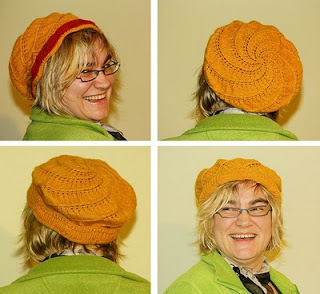
Here is a preview of the hat, graciously modeled by Christiane from www.aecht-fraenkisch.de:

0

By accepting you will be accessing a service provided by a third-party external to https://www.pallia.net/

Kontakt