







Latest Comments

Guest - Aislinn Dyestuff Citizen Science.
09. Oktober 2026
This is a great project. I look forward to the results. Thanks for letting us know.
Guest - Aislinn Time for...
09. Oktober 2026
Looks delicious!
Guest - Katrin Sprang Discussion
18. September 2026
Hi Rachel, I have looked for more photos of you, but that was not very successful. I found a link on...
Guest - Beatrix Sprang Discussion
15. September 2026
That lozenge pattern element is not a photograph, but a scan. So it should be to scale. But I pinned...
Guest - Katrin Sprang Discussion
15. September 2026
I was not referring to Rachel's reconstruction (is the reconstruction you refer to the one photograp...
NOV.
04
0

Tool Talk - Schacht Company: Goko Swift

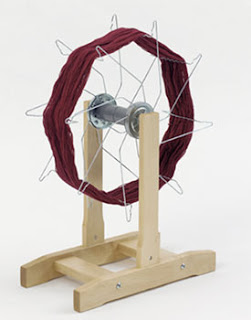
Not a book review, but a tool review this time - the Goko swift, made by Schacht in a traditional japanese design (and sold more or less only in the US).

I first found mention of this swift when looking for some better way to wind the very thin silk that Sabine dyed onto spools for storage and for sale. I have a normal, four-armed "umbrella" swift, but that just didn't work properly, even not when tuning it with an additional cardboard support strip for the silk to lie on. Unskeining these fine threads was not possible in a humane (and sensible) amount of time, and I was looking for alternatives. There was only one swift to be found on the Internet that was supposedly very well suited for fine, delicate threads - the Goko.


Now this swift is not the cheapest one to buy (around 130 USD), and shipping fees to Germany range between steep and outrageously expensive for such an item. But I was in luck - a travelling colleague brought one back to me, saving me the shipping costs. I unpacked and tested it yesterday, and here's what I think.

The swift consists of a wooden stand and a metal wheel with eight supports for the yarns, making it roundish instead of square as most swifts are. The wood part is quite solid, with a glossy varnish as finish, and marked with the Schacht company emblem. The two vertical support beams are slitted on top to take up the axle of the wheel.
The wheel, in contrast to the wood parts, does not have a good finish or solid feel. On my Goko, the "flanged core" was only half assembled, with one of the flanges off and quite bent. I do not know when or why this happened, due to the mode of shipping via "colleague-mail" meaning this went through several pairs of hands, but I had expected a more solid and better finished piece - the holes for the arms and the edges of the flange were not deburred, and I was not thrilled. Some gentle taps with a hammer soon took care of the bend in the second flange, and both the flange and the arms of the swift then were easy to install. However, the arms were not really perpendicular to the core, but instead seemed to be bent a little out of shape - making the whole wheel look slightly lopsided. I now had some doubts if buying the swift really had been a good move - so I proceeded to test it.

I took out a slightly mangled skein of very thin silk threads (why test with something easy, after all?) and put it on the swift. There was the next surprise in stock for me: The skein was too large, probably due to working with it on the previous swift, which might have lead to some stretching. I put it on anyway - since nothing can get caught in moving parts on that swift - and decided to give it a try.

And what shall I say? It worked beautifully. I unskeined the remaining silk with a few stops to untangle a bit, but compared to before, this was incredibly quick and easy. After all, I had stopped working with that skein before because it was almost impossible to unwind in a humane amount of time. The huge difference that the additional four arms of the swift and the wide support for the skein make is hard to describe and still make believable. The too-large skein, by the way, had quickly shrunk to Goko size without additional tangling. I tested it on a second silk skein, and it worked just as well again - so now I am convinced that for my uses, this swift was worth every penny. I had no yarn breakage due to sudden stops in spooling (with a spinning wheel set up for spooling with very light tension on the drive, so it slips with very little resistance), because both the wheel and the swift stopped at once whereas before, my wheel would stop but the swift would break the yarn.

That also is the upside of the very light quality of the metal parts: They are very light - so the actual working part of the swift seems to weigh almost nothing and turns very, very easily and with little resistance to abrupt stops (for example because there's a tangle in the skein). This swift really is very well suited for fine, fiddly yarns that are difficult to unskein. I haven't tested it with wool or other material yet, but I am quite sure it will work nicely as well.

So if you frequently wind yarns or threads that are on the thin and delicate side and give you trouble turning the corners of a normal umbrella swift, you might want to consider the Goko. It is not cheap, and it is not finished to craftspersons' delight in every last bit, but that does not take away from its functionality - and that, for fine threads, really is awesome. Proving again the old fact that good tools are important, and special tasks may need special tools to make success possible.
0
NOV.
03
0

Connecting Grad Students

Through a mail from my old Uni, I have just stumbled upon "Gradnet", an association that wants to make life a little easier for grad students by hosting an interdisciplinary and international conference, an opportunity for productive and critical exchange.

I haven't heard about them before (that's a small wonder and has much to do with both my topic and my work style, and little to do with them), but the programme of the next conference is online, and it looks quite large and quite nice.

The next conference takes place in Erlangen, from 20 to 22 November - so pretty soon - and you can check out their programme on the Gradnet website www.gradnet.de.

I probably won't be able to hop over there due to the move coming up on the next weekend, but I'd love to hear about it, so should you go there, please drop me a comment!
0
NOV.
02
0

Box heaven - or is it hell?

I am slowly but surely surrounding myself with boxes filled with stuff - books, textile implements, more books, resources and materials, more books, tools, cloth, and even more books*. It is a weird-looking mix of order and chaos: a jumble of things on heaps to be sorted out, books still in shelves (almost none left in the study, though), things that are pre-packed in boxes anyways, and the big newly-filled boxes stacked on top of each other, slowly filling up freshly cleared space where shelves were.**

Yes, that sounds like an upcoming move - we will move into a bigger flat, since my stuff seems to have exploded (or maybe "popcorned") during the last months. This is largely connected to my acquiring some exhibition stuff (which includes two dress mannequins) and to the growth of the market stall and its assortment of goods, but also to such slightly mad ventures as the spinning experiment (which resulted in my having about 105 spindles now instead of five, and two more rather large boxes to stash). All this has led to the apartment being too small, and offering too little storage space.

So we will move, but stay in this very nice and quiet part of Erlangen. I will have a nice, large study/work room with no roof slope taking away space for shelf storage or moving around in the room, and enough space to actually do tailoring work in there without feeling cramped. And it is a ground floor flat - hooray for not having to lug so much stuff down from second storey when going to a medieval event!


* Yes, I'm a book junkie. And that is especially true for books on archaeological stuff, textiles foremost, of course. Book buying binges when in museum or exhibition bookstores is a very common quirk of archaeologists, and I'm no exception to that rule. Which means that not only do I have lots of books, I have lots of really seriously heavy books, because most catalogues are printed on thick, glossy, heavy high-quality paper...
** Compared to stacking books on the floor until stack height is still just stable, shelves are a much more compact way of storing (we found this out when emptying a shelf to re-build it with an additional bit a while ago), but even shelf storage cannot beat boxes filled with books and stacked up high. Much less convenient for actual reading, though!
0
OKT.
30
0

Link Drop

Quite a little stack of links to interesting places and things has accumulated in my "slow blogging day" stash, but they are much too good to languish away. So here's a link drop - I hope there's something for you in there, too!

- Two blogs that recently came to my attention: Fait Attention and Publishing Archaeology.

- For those of you working with MS Word, there's a webpage with tons of good advice, instructions, makros and stuff at the Editorium. This site has helped me a lot when finishing off and layouting my thesis. I still wouldn't recommend to use pictures in large Word files, though. (My pics were layouted half-automatically, using the Word-generated picture list, a homemade makro and LaTex. Not the best layout ever, but very little work.)

- A new project is researching medieval soldiers "to challenge assumptions about the emergence of professional soldiery between 1369 and 1453", and they have put a database online where you can search almost 90 000 muster records for soldiers from 1369 to 1453. So don't forget The Soldier in Later Medieval Times when you are looking for muster information!

- I'm very happy that I usually don't have to cope with Latin (and I would look for help if I had to), but for those who are, there's Du Cange's medieval latin glossary available online: beware the rather large .pdf.

- And for those who read French, there's a bimonthly magazine called "Histoire et images Medievales", with some articles available for download. And of course with nice pictures!
0
OKT.
29
2

Horrible Histories!

Once in a while, you stumble over something smashing on the Internet. That happened to me yesterday (leading to some work time reduction and late bed-going due to having to watch funny videos on Youtube). Did you know that CBBC has a series of utterly funny sketches and songs titled "Horrible Histories", making history lessons the most amusing thing ever?

Now I will finally remember what happened to Henry VIII's wives, because of watching this:


And the perfect follow-up for that video is the Terrible Tudors song:


For those lucky enough to be in the right area (unfortunately I'm not), there's also the official webpage of the show, where you can watch snippets, videos and the episodes shown during the last seven days (now I'm jealous!) and even play a game called "Terrible Treasures".
0
OKT.
28
0

A new exhibition coming soon!

Making medieval garments is something nice and fun - but seeing them worn or seeing them in an exhibition is something else again. And two sets of garments are going on display very soon now:
In November (on November 13/14, to be exact), a new exhibition will be opened in Burg Hartenstein (Wikipedia in German, with picture of the castle) in Franconia - featuring two knights fully dressed, with garments that I made. One of them is the 14th century knight and lord of Hartenstein, the second man is a Teutonic Knight from around 1200.

Since the exhibition is not opened yet, I will post no pictures today - but it won't be long now... Meanwhile, if you read German, you can also pay a visit to the official website of castle and of the group organising and running the exhibition, the Freundeskreis Burg Hartenstein.
0
OKT.
27
2

Medieval theme board games

With the hype for all things medieval, there have also been quite a few boardgames with medievally themed topics or artwork. And with the huge games fair in Essen just past, there is a new one in the range - the game "after" Ken Follett's sequel to Pillars of the Earth (which usually means loosely connected to the book topic). That book is, in German, called "Tore der Welt" (doors of the world), quite a different title from "World without End", and the game title matches the book title.

Well, I don't read medieval-themed historical novels anymore (the last I read actually was Pillars, when I had just started studying medieval archaeology), but I'm game to play medieval-themed games. Maybe that is because it is harder to put huge, garish mistakes into game descriptions, and maybe it's just because I like good board games. Especially those that are typical German-style board games (and isn't it amazing they name a whole genre for us Germans, and such a nice one as well?). I didn't manage to play the Pillars game when it came out (I think last year), but this year's Follett I did play, and all four of us playing had a good time. It is a nice game, with good artwork and good, functioning game mechanism, including some fun details: You have to pay taxes, feed your family and show that you are a good christian after each of the four "chapters". The chapters contain different events and give each player six chances on action. Those are selected using your twelve action cards - but you have to discard one of the remaining cards when playing the one you selected. This, for us, sometimes led to more thinking about "what shall I discard" than "what am I going to do now" - quite unusual, and quite dastardly in a very nice and amusing way. For once, you can't blame luck if you don't have the action you would need anymore! Every player also has an "event card" to play each turn, giving him or her some much-needed income and sometimes a second income, but every other player gets something as well. What everyone gets is depending on how the card is placed on the board - another simple, but nice and well-fitting mechanism.

Altogether, I did like the game quite a lot. It is already available, but only in the German version for now, so tough luck for all of you who would like to play it but don't read German. (One competent translator, though, should be enough - you only need to read the rules and the event cards, there is no need to read for choices.) But since the Pillars game (which has also gotten good critiques from those around me who played it) has been translated and is offered in the US, there should be good chances that it will cross the great salty puddle, too.
0

By accepting you will be accessing a service provided by a third-party external to https://www.pallia.net/

Kontakt