Latest Comments

Guest - Aislinn Dyestuff Citizen Science.
09. Oktober 2026
This is a great project. I look forward to the results. Thanks for letting us know.
Guest - Aislinn Time for...
09. Oktober 2026
Looks delicious!
Guest - Katrin Sprang Discussion
18. September 2026
Hi Rachel, I have looked for more photos of you, but that was not very successful. I found a link on...
Guest - Beatrix Sprang Discussion
15. September 2026
That lozenge pattern element is not a photograph, but a scan. So it should be to scale. But I pinned...
Guest - Katrin Sprang Discussion
15. September 2026
I was not referring to Rachel's reconstruction (is the reconstruction you refer to the one photograp...
OKT.
15
2

All the Gory Details, parchment tablets.


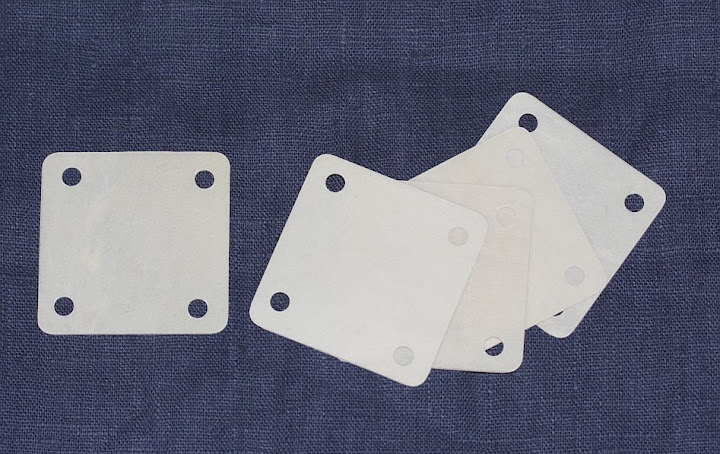
These tablets measure 6 x 6 cm, a convenient size when weaving and large enough that you can handle them well and even weave with the tablets standing on the corners, for tubular or other special weaving actions. The parchment is prepared by hand, in one of the last traditional parchment manufacturies in Germany. In this case, it is calf parchment. Rounded corners for smooth turning, large holes for ease of setting up the warp.

Parchment tablets have not been found in archaeological excavations yet (at least to my knowledge), but they are a logical material to turn to for complex bands with thin threads and lots of tablets. In some rare cases, "leather" tablets were recovered in excavations, although leather either needs to be much thicker or stiffened in some way to make it useable. A detailed analysis of these tablets would be interesting, in case they were originally parchment which underwent a kind of tanning process during burial in the soil.

In comparison to wood, horn or bone, parchment can be worked much thinner and will still be remarkably stiff and resilient. On the other hand, parchment stays flexible, so while thin wood, bone or horn might break easily, these tablets will survive bending without problem. The surface of well-prepared parchment is naturally quite smooth and will polish some more with use. With these properties, the parchment tablets are wonderful for weaving with historical material, presentations in a museum environment (please be aware that inkle looms and "tablet weave looms" are not medieval at all!), and well-suited for wide, many-tablet bands. If you are used to or happy weaving with cardboard tablets, these are a perfect historical alternative.

The parchment tablets are made completely by hand in my own workshop. The material is traditionally prepared parchment from calf hide. Being parchment, they can be marked, coloured, scribbled on - whatever is needed or desired. With a thickness of about 0,6 mm for most of them, they are slim enough so that handling a larger stack is easily possible - but stiff and wide enough to grasp them easily and that marking the edge of one tablet will clearly show.
0
OKT.
14
0

Gory Needle Details

Pins and even more so needles are an archaeological problem because they are so small. This means that unless there is a nest of pins or needles or unless there is a huge stroke of luck, these tiny metal rods will never be found. If they ever survived the corrosive surroundings in damp soil, that is - something that iron or steel might not take these surroundings as kindly as copper alloy. And then these rare items are so much overlooked - because duh, of course they had needles, that's an everyday item, isn't it? - that there is no collation of needle articles or archaeological needle knowledge yet.

There are two possible ways to find out what needles were in use. One way is to find surviving specimens, analyse them, and if possible make some replicas and try them out. That, of course, is quite difficult because of the scarcity of finds and well-published needles.

The other way is by deduction. It is against all logic that medieval people bought extremely costly materials like gold thread and fine silk to weave enormously fine fabrics and embroider them all over with beautiful, awe-inspiring motifs using a huge, bulky (needle) bodkin only, dragging this huge metal abnormity through their costly fine fabric! Fine fabrics require fine tools, and not only density, but fabric type makes a difference too in which tools are needed.

Both ways - deduction as well as the rare archaeological finds - will lead to the conclusion that fine needles were manufactured and used, and that medieval needles were at least partly also made of steel.

The needles offered here are made from non-stainless steel; stainless steel is a more modern invention. Non-stainless means that the needles might discolour with use due to skin oils. Any discolouring can be removed by polishing the needle with extremely fine sandpaper. Better, though, is the prevention by storing the needles dry, not using them with wet or dirty fingers, and best is storing them in a scrap of wool with lanolin content to conserve them.

They have relatively large eyes in a flattened head, designed to take the thread through the fabric without rubbing it and are thus perfect for embroidery with delicate silk or gold threads. This means they are not only wonderful for stitching cloth together, but very well suited for embroidery too.

The needles are completely hand-made by one of the few remaining traditional needle-makers - in Japan, because traditional needle-making has about died out in Germany.
0
OKT.
13
1

Beeswax, reloaded.


I have already posted a snippet about beeswax some time ago, when I had freshly made my blocks of wax. So here is the version for "All the gory details":

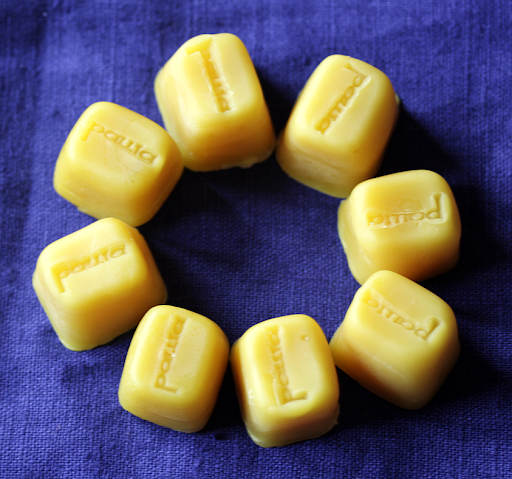
Beeswax is still used for sewing today, sold especially in quilting shops as a little helper for waxing threads for easier use. Drawing the thread over the surface of a beeswax block will lightly coat the thread surface with wax, protecting it from abrasion by the needle eye. Simultaneously, any surplus twist from the plying and winding process is removed from the thread, much reducing its tendency to develop kinks and tangles. Especially linen threads profit a lot from waxing.

Use of beeswax in textile work is documented for medieval times through different written accounts like inventory or acquisition lists. Rests of organic matter identified as wax were also found on pinked edges of cloth, sealing the cuts in their crisp, neat appearance. There are no finds of wax pieces in context with sewing - but like most organic matter, beeswax will quickly decay in the ground.
Beeswax was also used to protect the edges of a cutout embroidery on linen before sewing it into place, or to waterproof linen. That, of course, will use more beeswax than just waxing the threads.

The wax offered here is produced from modern bees (of course), of very high quality and very clean - wax of similar quality is often used in cosmetic production. The wax comes in blocks that were made using modern equipment.
0
OKT.
12
2

Back from wonderful adventures...

I'm back home again, up and running - and blogging (even if it's slightly later than usual due to a much-needed battle against sleep deficiencies). So what have I been up to in these last two weeks?

First, there was Tannenberg. The traditional season's end market and, like Freienfels, usually resembling something like a fair to see different craftspeople and sellers of medieval tools and paraphernalia. This year, however, Tannenberg was rather subdued in atmosphere and with much less participants than the years before. We all wondered why - maybe all the fear-mongering about bad times and recession, combined with real-life struggling of craftspeople and participants, have finally had their impact on the modern middle ages as well. Still, we had a very nice time in Tannenberg, with quite good weather - only one day of rain and drizzle, and not much muddyness at all - and met and chatted with many of our friends and colleagues.

After return on Monday, it was unpacking, drying, sorting out of things and then, for me, preparing for Hungary straight away. Since I had to finish the presentation too, Tuesday was quite short for that - but everything got packed up in time, clothes stuffed into a bag, the trusty laptop bundled up, and off I went to a wonderful and truly memorable conference in Százhalombatta, a town some thirty km from Budapest. The conference was both the EXARC meeting and the last meeting of liveARCH, a project connecting eight archaeological open air museums from eight different countries. It was wonderfully organised by the Matrica Museum and archaeological park of Százhalombatta, including lodgings and transfer from and to the airport (what luxury not to book anything beyond the flight). It was everything I wish for in a conference: lots of people with different experiences and points of view meeting for good, interesting and sometimes thought-provoking presentations, many academic discussions, common meals, excursions to both stretch the legs and see something else for a while (including something typical for the country and/or region), enough coffee breaks with sweets (yes, the local sweets are actually something I enjoy maybe too much on a conference) and more long, varied discussions. Because everything except, of course, the excursions, took place at the hotel and meals were also organised by the conference team, everyone was kept closely together, and there was no scattering to different watering holes for meals and during free time. And that is another thing that makes a successful conference, to me: Keeping everyone together so that networking, chatting, joking and discussing is made easy, because all the others are quite within reach.

And because during liveARCH it became very clear to everybody that there is one single key to good cooperation and to success with networking, perfectly summarised during one of the lectures as "communication, communication, communication", every evening the "liveARCH Social Club" was opened for having a drink and a chat or five between friends. And every evening I got to bed later and later... explaining the sleep deficiencies and, thus, the lateness of today's blog post.
0
SEP.
30
3

Here. Have some Goldwork.

Because of both Tannenberg and the liveARCH conference in Hungary coming up, I am away for the next two weeks - so no blogging during this time. Regular blogging will continue on Monday, October 12.

Today, instead of another instance of the "Gory Details" series, you get a sneak preview of things to come in the market stall. Ages ago, I have already blogged about gold thread once, still pondering whether to carry some or not. Some while later, I made the decision to give it a try. After all, the worst that can happen is that I have to do goldwork for the rest of my life to use all the thread!

Meanwhile, things have progressed, and I have received the sample in final thickness and quality. And just as I had expected, the quality is outstanding, the thread is extremely beautiful, and I am very much looking forward to the day that I can offer it in the market stall.

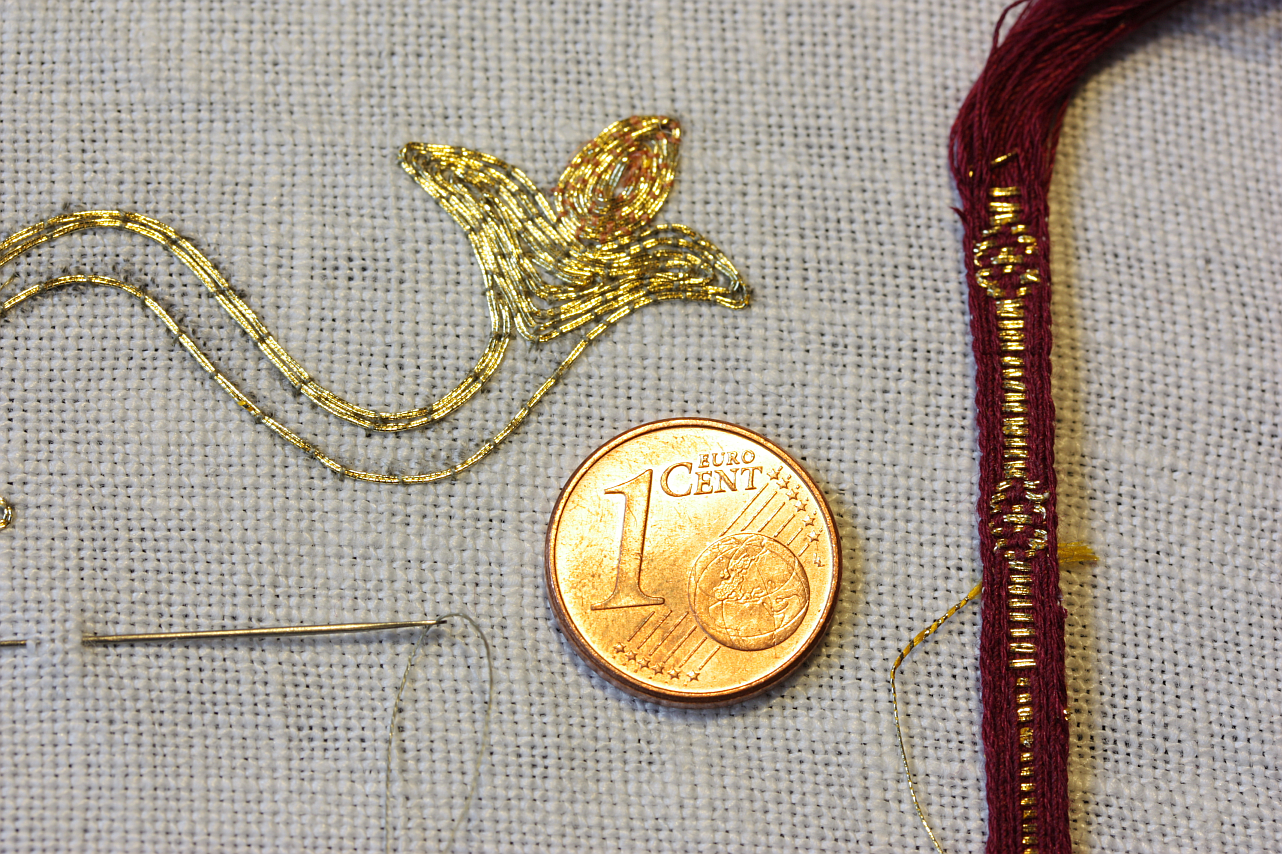
Of course, before placing the final order, I had to play with the gold thread, having fun brocading and embroidering dutifully test the thread for its suitability for both brocade and embroidery. And here you see the results:


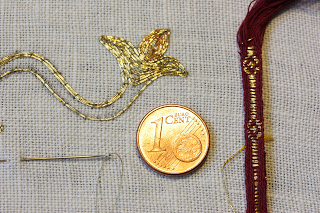
The cent coin is included for scale. On top left, you see part of an unfinished embroidered (couched) motif from 12th century Villach-Judendorf, with the gold thread couched on in pairs. The different shades are made by using green and red silk thread - plant dyed by Sabine and also for sale (coming soon in the "Gory Details" series). It's amazing how much coloured shading this will give - and giving colours to the gold by stitching with the fine silk and giving textures by strategical placing of the stitches really is a delighting and delicious work.

Left of the coin, you can still see most of the steel needle I worked with (and still threaded in with green). And right of the coin is a tablet-woven band, eleven tablets threaded with Gütermann silk in a dark red shade and brocaded with the gold thread, again taken double. While the picture does more or less catch the look of the embroidery, the brocade on the band gave me a hard time photographing it, and the picture doesn't do it justice. It shines and glitters in real life and looks really, really expensive. (Well, it is.)

You can click on the picture to see it much larger, but please don't look too closely at the quality of the weaving and stitching - these are the first bits I made, it was just playing around with it to get a first impression, and I have not really worked with gold thread before. But the thread is wonderful to work with, smooth and flexible and very, very golden. And I just could not keep all this shininess to myself any longer!
0
SEP.
29
2

Linen sewing thread


Good-quality linen thread makes sewing a much more pleasant experience, but linen often features slubs in the single threads. These slubs are not only a nuisance when working, they also mean a weak spot in the thread.

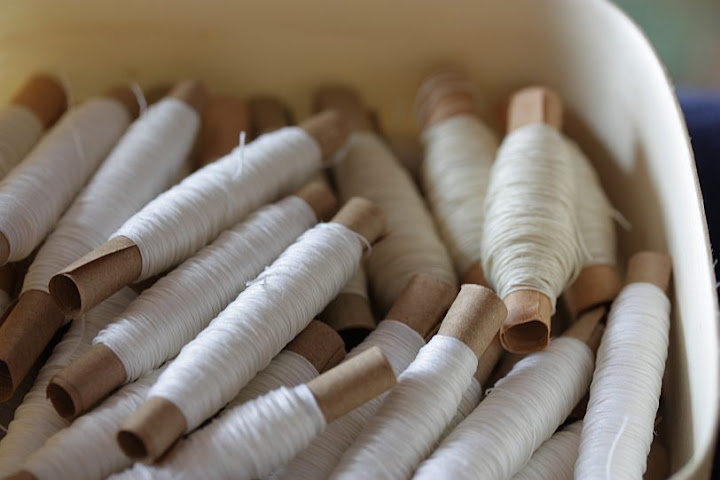
I have searched for nice, smooth, sturdy linen thread for quite some time, and I am happy to have found one finally with no or next to no slubs and imperfections in the thread. Each little spool holds 20 m of thread. If you sew much more with linen thread, larger quantities are possible - just contact me.The thread is a little thinner than the "Sternzwirn" often used by Germans and is plied from three singles in Z-direction. Three singles plied make a smoother thread than two singles, and almost all linen yarns nowadays are plied from three or even more singles. Unfortunately, finds from linen are very, very rare, so we don't know if two- or three-ply linen (or another configuration still) was most common.

The thread is either fully bleached or not fully bleached. White linen is often mentioned in medieval texts, stressing the whiteness, so fully bleached linen does fit into that picture. However, bleaching the fibre to this very light shade would mean a long time in preparing and bleaching, so if you like your sewing thread a little more low-key, you can take the not-quite-white shade.

While brown paper is not an authentic medieval packaging, I have chosen it because it is easy to handle, quite eco-friendly and cheap. The brown paper will at least not be blatantly modern-looking in a historical sewing kit; and if necessary, rewinding 20 m of thread onto a wooden spool will not take very long.

Linen thread is very strong (unless buried in soil, where the slightly acidic milieu dissolves vegetable fibres), but can be harmed by too much rubbing from the needle eye in one spot. So when using linen thread, make sure the eye of your needle has no sharp ridges, and move the needle further along the thread at regular intervals while sewing. Lightly waxing the linen thread with beeswax will significantly protect the linen yarn and also inhibit tangling of longer threads, so while I recommend waxing most sewing threads, it really is a "must do" with linen.
0
SEP.
28
4

Pincushion-in-the-box

Pins and needles are precious - especially if you are buying hand-made pins and needles. So you should have a place for safe keeping of these fine, pricey helpers, and best if that is also convenient to use.


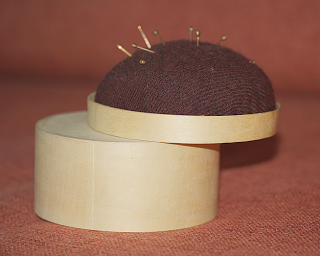
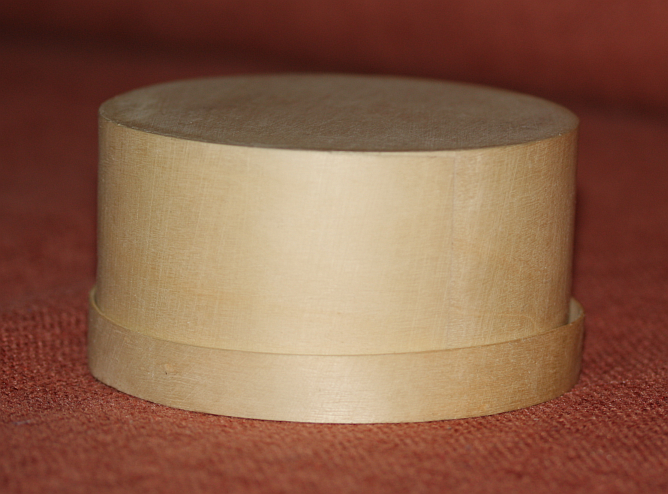
This pincushion-in-the-box was designed for safe keeping and carrying around of pins, combining a box for protection with the convenience and ease-of-use of a pincushion. The cushion itself is sewn from linen, tightly filled with wood shavings to give a pleasant, firm and long-lived cushion, and covered with wool cloth. It sits in the lid of a round wooden box, pleasantly weighted by a hefty sheet of copper between cushion and lid that will not only keep it from sliding around on your table too easily but also prevent the pins from accidentally piercing through the thin layer of wood. The rest of the box goes on as a lid, keeping the pins from dust, dirt, childrens' fingers or other harmful things. For use, simply take off the cover and place the cushion on your table or on the cover turned upside down.


This pincushion is a joy to have for everybody who likes to use pincushions and does textile work in more places than the home sewing spot. Packing a pincushion can't be easier - put on the cover and throw in with the rest of tools and supplies.

Cushion is hand-made and hand-sewn. Woolen cover cloth in several colours, your own material can be used on request. Materials used were available in the middle ages, except the glue fixing the cushion into the box lid; authentic glue can be used on request. The box is a modern machine-made one, glued from rather thin wood slivers, so it is not strictly authentic (for a better authentic look, hide the cover once it's taken off and only display the cushion). Each one is a little different, so if you want something especially high (filling all the box) or low (allowing to keep an occasional needle in the closed box), just contact me.

How medieval is a pin-cushion itself? That is a hard question. On the few illustrations that I have found showing sewing people or tailors, I could not find any pin-cushions. This can be because there were none in the Middle Ages or they were seen as so commonplace or so unimportant that they were not shown. Personally, I would suspect that making something pin-cushion-like for keeping pins handy yet safe should be a quite old concept. And I have never been asked that question while using the pin-cushion, it's just such an ordinary tool for the sewing table.
0

By accepting you will be accessing a service provided by a third-party external to https://www.pallia.net/

Kontakt